


Your regular Saturday afternoon is humming along perfectly. The line's moving, scoops are flying, then someone walks in asking about 200 pre-packed pints for their company picnic next weekend. Your mind immediately starts calculating: Can we handle that volume? Will we have enough vanilla? Should I quote them now or call them back? Meanwhile, three families just walked in and your register person is looking at you desperately.
This exact scenario plays out in ice cream shops everywhere, and most handle it terribly. Not because owners don't care about catering revenue—those bulk orders can represent serious money—but because there's no operational framework separating catering workflows from retail service.
The inventory collision nobody talks about
What typically goes wrong is predictable. You take that 200-pint order, write it on a sticky note, maybe enter it in your calendar. Come Thursday, your morning shift starts pulling inventory for the order. They grab from the same freezers your retail operation depends on. By Friday afternoon, you're telling walk-in customers you're out of chocolate chip cookie dough because nobody realized the catering order would wipe out your weekend supply.
The problem runs deeper than just running out. When catering orders pull from retail inventory without proper reserves, you create a cascade of operational failures. Your weekend staff can't serve what they don't have. Customers leave disappointed. Online reviews mention "always out of popular flavors." Revenue drops on what should be your busiest days.
Most shops try fixing this with informal rules—"always keep 10 gallons in reserve" or "check with the manager before taking bulk inventory." These solutions fail because they don't address the core issue: catering and retail are two different operational streams that need separate inventory allocation.
Building the reserve system that actually works
A functional reserve system starts with understanding your baseline retail needs. Track your average weekend gallonage for each flavor over 4–6 weeks. Not the peaks, not the valleys—the actual average. For a typical 16-flavor shop doing decent weekend business, this usually looks like:
Keep your ice cream shop running smoothly.
Cremyly helps you manage every order, stock level, and staff shift with precision and ease.
- Real-time inventory tracking
- Order management dashboard
- Staff scheduling & shift coordination
No credit card required
-
Top 3 flavors
5–7 gallons each per weekend
-
Middle 8 flavors
3–4 gallons each
-
Bottom 5 flavors
1–2 gallons each
Once you know your retail baseline, establish catering reserves.
Physical separation beats mental math
Mark specific freezer sections as "Catering Only" with actual tape or dividers. When Thursday's prep team sees physical barriers, they respect them. Mental notes and verbal rules get forgotten during rushes.
Use bright tape and a clear label like "Catering Only" so prep staff and overnight crews instantly recognize reserved space.
The 72-hour rule
Any catering order picking up within 72 hours pulls from catering reserves only. This prevents Thursday's bulk order from destroying Saturday's retail availability. Orders beyond 72 hours can factor into production planning.
Rotating reserve stock
Your catering reserves aren't dead inventory. Every Monday, rotate older catering stock into retail and refresh reserves with fresh production. This prevents waste while maintaining separation.
Quoting templates that prevent profit erosion
Most ice cream shops quote catering orders wrong. They take retail prices, maybe add 10%, and call it done. Then they wonder why a $400 catering order feels less profitable than a typical Saturday afternoon.
The hidden costs kill you. That 200-pint order needs someone to pre-pack everything. Someone to coordinate pickup. Someone to handle the invoice. Someone to deal with the inevitable "can you add 20 more pints?" call the day before. These labor costs rarely get captured in quotes.
A quoting structure that captures real costs:
Base product pricing
-
Bulk pints
Retail price minus 15–20%
-
Bulk gallons
Retail equivalent minus 25%
-
Pre-scooped cups
Retail plus 10%
Labor additions
-
Setup fee
$25–50 flat (covers coordination time)
-
Packing fee
$0.50 per unit for special packaging
-
Rush fee
25% surcharge for under 72-hour notice
Minimum thresholds
-
$150 minimum for delivery
-
$75 minimum for pickup
-
No catering orders under 24 units
A real quote might look like:
-
200 pints at $5.50 each (retail $6.50)
$1,100
-
Setup and coordination fee
$35
-
Packing into branded boxes
$100
-
Total
$1,235
Compare that to just multiplying 200 × $6.50 and giving a 10% bulk discount. You'd quote $1,170 and lose money on labor.
Pickup windows that preserve floor operations
The absolute worst thing you can do is tell catering customers to "come anytime Saturday." They'll show up at 2 PM when you've got a line out the door, need someone to help load their car, want to add last-minute items, and create chaos on your busiest day.
Weekday priority windows
-
Tuesday–Thursday
10 AM–12 PM or 3 PM–5 PM
-
Never during lunch rush (12 PM–2 PM)
-
Never during after-school rush (3 PM–4
30 PM on school days)
Weekend restricted windows
-
Saturday
10 AM–11 AM only (before rush)
-
Sunday
10 AM–11 AM or 5 PM–6 PM
-
Never between 12 PM–4 PM on weekends
The handoff zone
Designate a specific area for catering pickups—not your regular counter. Even if it's just a folding table by the back door, separation prevents catering customers from joining retail lines or confusing staff about where to go.
Staffing overlays without destroying labor costs
Shops either ignore catering staffing completely (chaos) or overstaff dramatically (blown labor costs). The solution isn't adding full shifts—it's strategic overlays.
An overlay means bringing someone in for 2–3 hours specifically to handle catering prep or pickup, not full shifts. This focused labor allocation prevents catering from disrupting retail while controlling costs.
Prep overlays
If you've got three catering orders picking up Friday, bring someone in Thursday 6 PM–9 PM just for packing. They're not making ice cream or serving customers—they're exclusively pulling, packing, and labeling catering orders.
| Example | Cost | Value |
|---|---|---|
| Prep overlays | 3 hours at $15/hour = $45 | Your Friday morning team isn't scrambling to pack orders while opening |
| Pickup overlays | 1 hour at $15/hour = $15 | Zero disruption to retail operations |
| The float position | scheduled 11 AM–3 PM | coverage without pure overhead |
Pickup overlays
For large or complex pickups, schedule someone for a 1-hour overlay during the pickup window. Their only job: manage the catering handoff, verify orders, process payment, help load.
The float position
On heavy catering weekends, create a "float" position—someone scheduled 11 AM–3 PM whose primary role is handling catering pickups but helps retail between pickups. This gives you coverage without pure overhead.
Communication scripts that set boundaries
Customers need education about why catering works differently than walking in for a cone. Without clear communication, they'll expect retail flexibility with wholesale pricing.
Initial inquiry response:
"We'd love to help with your catering needs. Our minimum order is 24 units with 72-hour advance notice. For orders under 72 hours, we add a 25% rush fee to ensure we can fulfill without impacting our regular customers. Would you like me to check availability for your date?"
Inventory limitations:
"For orders over 50 units, we can guarantee up to 5 flavor selections. This ensures consistent availability and quality. Our most popular catering selections are vanilla, chocolate, strawberry, cookies & cream, and mint chip. Would you like to choose from these or check availability for specific flavors?"
Pickup coordination:
"We've reserved the 10 AM–11 AM pickup window for your order. This is before our Saturday rush, ensuring our team can give you full attention. If you need to adjust the pickup time, please let us know by Thursday at 5 PM. Day-of changes may not be possible during peak hours."
When catering makes sense (and when it doesn't)
Not every ice cream shop should chase catering business. If your operation barely handles weekend rushes, adding catering complexity might break things entirely.
But for shops with stable retail operations, catering can add 15–25% to monthly revenue without proportional overhead increases.
Catering works when:
-
You have excess production capacity (making 100 gallons but only selling 70)
-
Your location has office parks or event venues nearby
-
You can dedicate freezer space to reserves
-
Your team has bandwidth for order coordination
Catering fails when:
-
You're already struggling with inventory management
-
Your freezer space is maxed out
-
You can't maintain product consistency at volume
-
Your location has no commercial customer base
But for shops with stable retail operations, catering can add 15–25% to monthly revenue without proportional overhead increases.
The coordination gap that software fills
The biggest challenge in ice cream catering operations isn't making the product—it's coordinating all the moving parts. Orders come through different channels. Payment happens at different times. Pickup windows need tracking. Inventory reserves need monitoring. Staff needs notification.
Operational software becomes critical here. Not fancy technology for its own sake, but practical tools that centralize catering workflows. A proper platform tracks orders from quote to pickup, monitors reserve inventory levels, schedules staff overlays, and prevents double-booking pickup windows.
Here’s a quick visualization of that workflow:
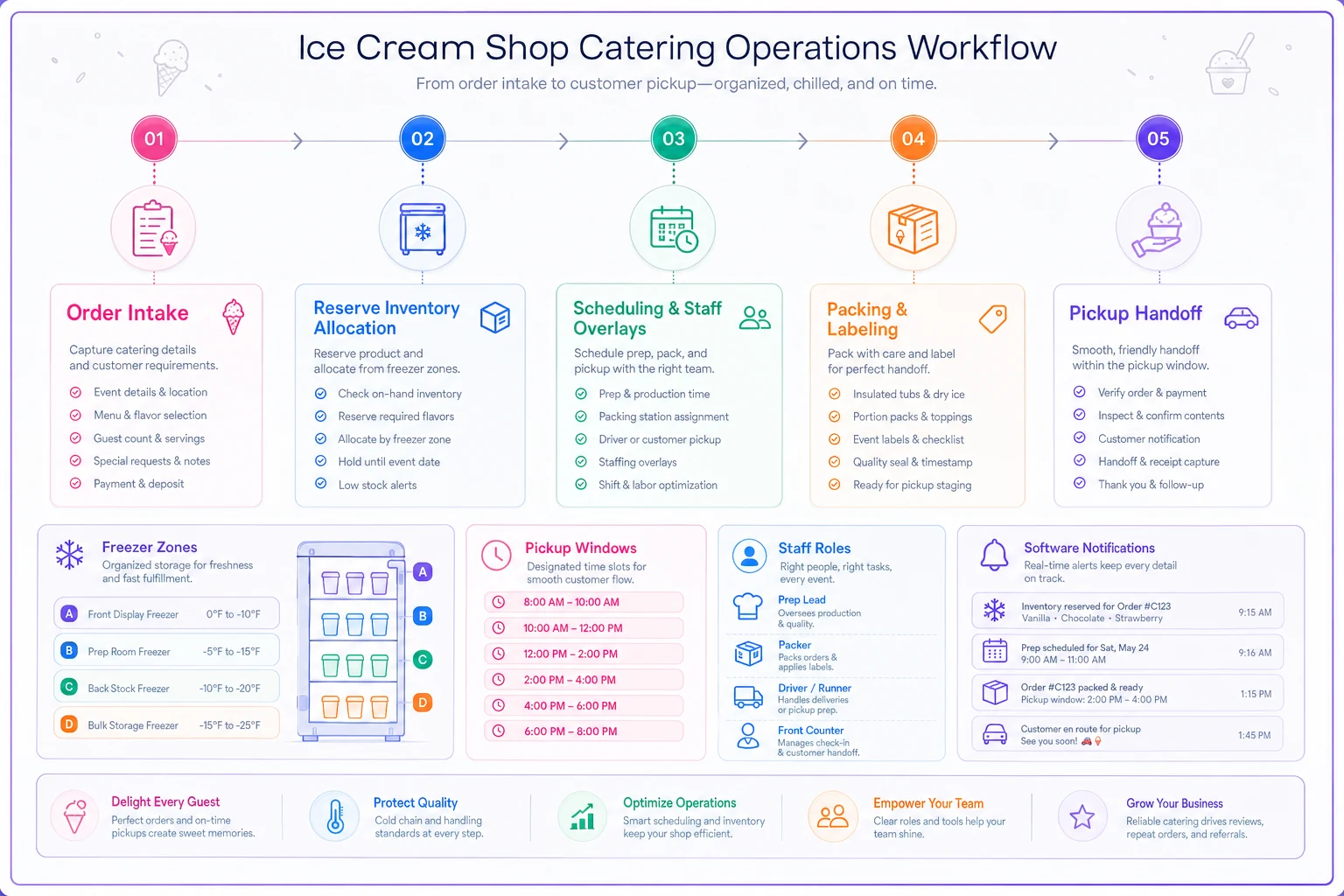
This illustrates the core flow from quote to pickup and how software ties the steps together.
The automation handles what humans forget—remembering that Thursday's 200-pint order needs packing Wednesday night, or that you promised the Johnson wedding vanilla and chocolate but your retail team just sold the last of the catering reserve.
These systems can predict catering demand patterns, suggesting production increases based on historical order data. During graduation season, the platform might recommend producing extra sheet cake ice cream based on previous years' patterns.
Real operational impact
Consider Marina's Gelato in a college town. Before implementing structured catering operations, they'd lose entire Saturday afternoons to chaos when catering customers showed up during peak hours. Orders weren't ready. Retail customers waited. Staff scrambled between two different service models.
After building proper operational separation—reserve inventory, structured pickup windows, dedicated prep overlays—their catering revenue jumped from around $2,800 monthly to nearly $7,200. More importantly, their retail operation stopped suffering. Weekend customer counts actually increased because service improved without catering disruptions.
The framework eliminated daily friction. Staff knew exactly where catering inventory lived. Customers understood pickup windows were non-negotiable. The owner stopped fielding panicked Saturday texts about running out of chocolate because someone used retail inventory for catering.
Making the system sustainable
The hardest part isn't setting up the system—it's maintaining it when things get busy. The first time you're slammed on Thursday and that 300-pint order needs packing, every instinct says "just pull from retail inventory, we'll figure it out."
Documentation and automation matter here. Written protocols posted in prep areas. Digital systems that flag when someone tries to pull from retail reserves. Automated alerts when catering orders approach pickup without completion. These guardrails maintain operational discipline when judgment gets overwhelmed.
The goal isn't perfection. Sometimes you'll need to flex the rules. But having structure means those become conscious exceptions, not daily chaos. Your team knows the standard process. Customers understand boundaries. The operation runs predictably even when volume spikes.
For ice cream shops serious about growth, catering represents one of the best margin opportunities available. But only if you build operational infrastructure to support it without sacrificing your core retail business. The templates, reserves, windows, and overlays aren't bureaucracy—they're the foundation that lets you serve both customer segments profitably.
Shops that get this right don't just add catering revenue. They build reputation as the reliable option for events and bulk orders. That reputation drives more catering business, which justifies better systems, which improves reliability further. Meanwhile, their retail customers never notice the catering operation exists because it never impacts their experience.
That's the mark of excellent operations—when two distinct service models run simultaneously without collision, each profitable in its own right, neither compromising the other.
Ready to scoop up efficiency and grow your shop?
Join hundreds of ice cream shops using Cremyly to boost productivity, reduce waste, and delight customers with faster service.