


Three weeks ago, I watched a frustrated ice cream shop owner throw away $400 worth of spoiled mix-ins because their new employee didn't understand the thaw rotation schedule. The kicker? They'd already run out of cookie dough twice that week, turning away disappointed customers while bags of frozen strawberries turned to mush in the back freezer.
This wasn't about bad training or poor communication. It was a systems failure that happens when frozen dessert shops try to manage perishable inventory using methods designed for dry goods or standard restaurants.
Why ice cream inventory breaks differently than other food service
Most restaurant inventory systems assume ingredients follow predictable paths: receive, store, prep, serve. But frozen desserts operate in this weird middle ground where products constantly shift between frozen, thawing, and serving states. Each transition has its own timing windows and spoilage risks.
A gallon of vanilla base might have a 14-day shelf life once thawed, but you can't just thaw one gallon at a time. You need enough ready for tomorrow's rush, plus buffer for unexpected demand, minus what expires tonight. Cookie dough needs 4 hours to thaw but stays good for 3 days. Fresh fruit needs overnight thawing but spoils within 36 hours. Sauces can sit at room temp but separate if left too long.
When you layer in portion yields, things get messier. That gallon of base theoretically makes 32 four-ounce scoops. In practice, new staff might get 28 scoops while experienced servers stretch it to 35. Mix-in portions vary even more wildly - one person's "generous" chocolate chips is another's "light sprinkle."
Then weather hits. A surprise heatwave doubles your daily sales. You're scrambling to thaw extra inventory while calculating whether you have enough frozen backup to last through the weekend rush. By Monday, you're either sitting on expired product or explaining to customers why you're out of half your flavors.
The cascade effect when one component runs out
You run out of caramel sauce on Friday afternoon. Seems minor - just 86 it from the menu, right? Except caramel swirl is your third best-selling flavor. Customers pivot to hot fudge sundaes instead, depleting that sauce faster than expected. By Saturday night, you're out of both.
Keep your ice cream shop running smoothly.
Cremyly helps you manage every order, stock level, and staff shift with precision and ease.
- Real-time inventory tracking
- Order management dashboard
- Staff scheduling & shift coordination
No credit card required
Now customers are settling for plain scoops or leaving for the shop down the street. Your Saturday night revenue drops 20% - not from the missing sauces directly, but from the lost upsell opportunities and customers who wanted specific combinations. Sunday's order arrives with plenty of caramel, but now you're overstocked because customers have learned not to expect it.
One shop I analyzed had this pattern repeat weekly. They'd over-order after stockouts, creating storage problems. Excess inventory would expire before use. To compensate, they'd under-order, triggering more stockouts. The owner estimated they were losing $1,800 monthly just from this inventory wobble, not counting lost sales from disappointed customers.
Storage Tetris and the freezer space nobody talks about
Freezer space shapes everything in frozen dessert operations, yet most shops plan it as an afterthought. A typical small shop might have one walk-in freezer, a chest freezer for backup, and the display case. Sounds like plenty until you map the actual workflow.
The walk-in holds your frozen inventory - gallons of base, bags of mix-ins, backup tubs. But you can't thaw products in the same freezer where you store frozen goods. So you need refrigerator space for thawing inventory. The display case holds ready-to-serve ice cream, but only about 12-16 flavors typically.
Now add the complications. That new seasonal flavor everyone loves? It's outselling vanilla 3-to-1, so you need double the normal backup tubs. But your freezer is already full from yesterday's delivery. You could store some tubs in the chest freezer, but that's in the back room. Every time someone needs to refill the display case during a rush, they're gone for five minutes playing freezer Jenga.
The math gets worse with mix-ins. A busy Saturday might need 15 pounds of cookie dough ready to go. That's 5 bags thawing in rotation - Monday's bag expires as Friday's bag becomes ready. Your prep fridge only holds 3 bags comfortably alongside the thawing ice cream base. So you're either constantly shuffling inventory or accepting waste.
Building a reorder system that actually works with freeze-thaw cycles
Successful shops don't manage inventory - they manage inventory states. Map your thaw windows first. Create a simple chart:
| Product | Thaw Time | Service Window | Storage State |
|---|---|---|---|
| Ice cream base | 24 hours | 14 days | Walk-in → Fridge → Display |
| Cookie dough | 4 hours | 72 hours | Freezer → Counter → Fridge |
| Fresh berries | 12 hours | 36 hours | Freezer → Fridge only |
| Hot fudge | 2 hours | 7 days | Dry storage → Warmer |
| Waffle cones | N/A | Until stale | Dry storage only |
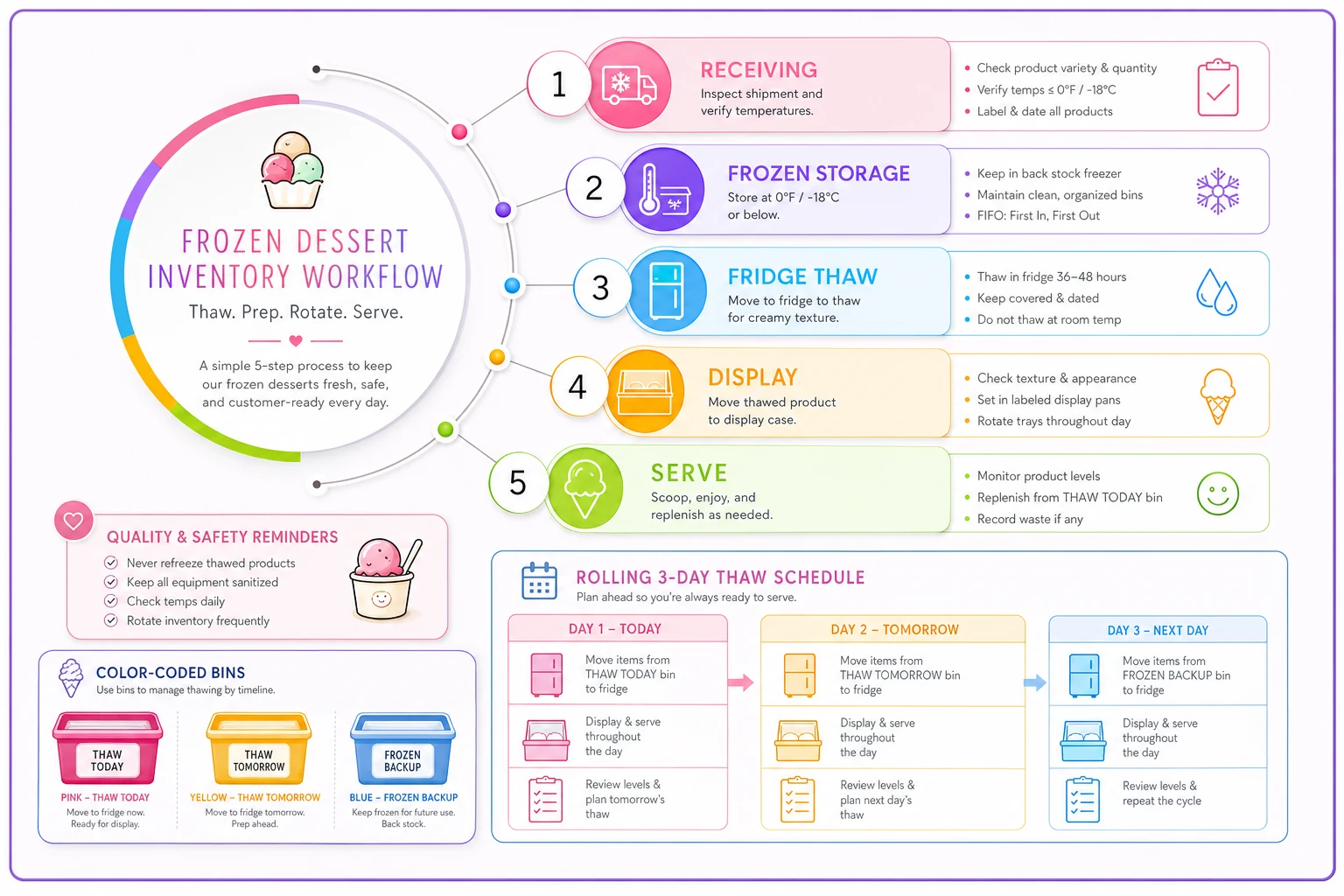
Here's a simple visual of the thaw-prep-serve workflow.
Next, calculate true portion yields. Don't use manufacturer specs. Track actual portions over a week. Have each employee serve 10 portions of each mix-in into cups. Weigh them. You'll probably find 30-40% variation between staff members. Use the average, not the ideal.
Weigh samples from each staff member over several shifts to get a reliable average portion yield before setting pars.
Most shops order weekly because that's convenient. But your thaw windows don't care about convenience. If cookie dough takes 4 hours to thaw and lasts 72 hours, you need fresh dough every 3 days. If you only order weekly, you're either over-ordering (waste) or under-ordering (stockouts).
The solution isn't daily ordering - that's a nightmare. Instead, split your inventory into three categories:
Weekly orders: Stable base products, dry goods, anything with 7+ day service windows
Twice-weekly orders: Medium-stability items like most mix-ins, anything with 3-6 day windows
Daily prep: Fresh items, anything with under 48-hour windows
Set par levels based on sales velocity plus thaw time. If you sell 5 gallons of vanilla daily and it takes 24 hours to thaw, you need minimum 10 gallons in rotation at any time - 5 for today, 5 thawing for tomorrow. Add 20% buffer for demand spikes.
Safety stock rules that prevent both waste and stockouts
Generic safety stock formulas fail for frozen desserts because they assume consistent lead times. But your "lead time" varies by temperature. That cookie dough that takes 4 hours to thaw in summer might need 6 hours in winter when your kitchen runs cooler.
Track your weekly velocity by item, then add buffers based on variability, not just volume:
High-velocity, stable items (vanilla base, chocolate sauce): 1.5 days of safety stock
High-velocity, variable items (seasonal flavors, trendy mix-ins): 2 days of safety stock
Low-velocity, stable items (sugar-free options, specialty toppings): 3 days of safety stock
Low-velocity, variable items (premium mix-ins, dietary alternatives): Order to demand
That last category surprises people. Why would you order to demand for slow-moving items? Because the carrying cost exceeds the sale value. That $40 bag of premium Belgian chocolate chunks that sells twice a week costs you more in freezer space and potential waste than the profit from those two sales.
Real scenario: fixing a failing rotation system
A 1,400-square-foot shop in a college town struggled with constant inventory problems. They'd run out of popular flavors during weekend rushes while throwing away expired specialty flavors. Their mix-in waste ran about $600 monthly. Customer complaints about out-of-stock items were increasing.
The owner had tried everything - detailed prep lists, inventory tracking sheets, dedicated prep staff. Nothing stuck. The problem wasn't effort; it was system design.
We mapped their actual freeze-thaw patterns over two weeks. Their Friday night sales were 3x their Tuesday afternoon sales, but they prepped the same amount daily. Their thaw schedule assumed steady demand. By Friday night, they'd burned through inventory prepped for the weekend. By Tuesday, they were tossing expired products from quiet Monday.
The fix was surprisingly simple. Instead of daily prep schedules, we created a rolling three-day thaw system:
-
Monday
Prep for Tuesday through Thursday (light days)
-
Wednesday
Prep for Friday rush
-
Friday
Prep for weekend
-
Sunday
Prep for Monday-Tuesday
We also reorganized their freezer with colored bins - red for "thaw today," yellow for "thaw tomorrow," green for "frozen backup." Staff could see at a glance what needed pulling.
Within three weeks, waste dropped to under $200 monthly. Stockouts during rushes essentially disappeared. The owner estimated the improved availability increased revenue by about $2,400 monthly - customers stopped leaving when their preferred flavors were available.
When automated tracking makes sense (and when it doesn't)
Many shops resist inventory software because it feels like overkill for their operation. If you're a single-location shop with stable sales and an experienced manager, spreadsheets work fine.
But there's a tipping point around $40k monthly revenue where manual tracking starts breaking down. Not because the volume is unmanageable, but because the variety becomes complex. You're carrying 20+ flavors, 30+ toppings, seasonal rotations, catering orders. One person can't hold all those thaw windows and par levels in their head.
This is where a perishable inventory system for an ice cream shop shifts from nice-to-have to necessity. Modern AI-powered operational software can track those freeze-thaw windows automatically, alerting staff when items need pulling from the freezer. Instead of checking three different sheets and doing mental math, your team gets a simple daily prep list adjusted for expected sales, current inventory, and expiration dates.
The real value isn't just accuracy - it's freeing up mental bandwidth. Your managers stop spending 45 minutes each morning figuring out the day's prep. They stop panicking about whether they ordered enough cookie dough for the weekend. That mental energy goes back into customer service and quality control.
Don't over-automate though. Some shops install complex systems that track every sprinkle. The overhead of maintaining that precision exceeds the benefit. Focus automation on high-value, high-complexity items: ice cream bases, expensive mix-ins, and anything with tight expiration windows.
Scaling considerations for multi-location or growth scenarios
Inventory complexity doesn't scale linearly with growth. Opening a second location doesn't just double your inventory needs - it exponentially increases coordination challenges.
Single location problems are mostly about timing and storage. Multi-location problems add transfer logistics, demand balancing, and communication gaps. That cookie dough shortage at Location A while Location B throws away expired product? Classic coordination failure.
The shops that scale successfully build centralized prep systems early. Instead of each location managing its own thaw schedule, one person coordinates inventory across all sites. They might prep all specialty items at one location and transfer them. Or they'll coordinate orders so locations can share backup inventory during unexpected rushes.
Centralization creates new problems though. Transfer windows become critical - that ice cream base needs to stay frozen during the 20-minute drive between shops. Health codes vary by jurisdiction; some allow transfers, others require separate prep at each location. Insurance often needs updating to cover product in transit.
The sweet spot for most growing chains is partial centralization. Core products (base ice cream, standard toppings) get managed locally with coordinated ordering. Specialty items (seasonal flavors, premium mix-ins) get prepped centrally and distributed. This balances efficiency with flexibility.
Beyond the basics: handling seasonal shifts and special events
Summer operations and winter operations might as well be different businesses. A shop doing $8k weekly in July might drop to $2k in January. Your freezer doesn't shrink in winter though. Neither does your rent.
Smart shops use winter to experiment with lower-risk inventory strategies. Test new flavors in small batches. Reduce variety but increase quality. That 20-flavor summer menu might shrink to 12 premium options in winter. Fewer SKUs means simpler inventory management and less waste from slow-movers.
Special events require different thinking entirely. A catering order for 200 servings doesn't just mean ordering extra inventory. You need to start thaw cycles days in advance without disrupting regular service. This usually means designating specific freezer sections for event inventory and creating separate prep schedules.
The shops that handle this well build buffer systems. They maintain "event freezers" separate from daily operations. They establish minimum lead times for large orders - not just for procurement, but for the full thaw-prep-serve cycle. They charge deposits that cover inventory costs, protecting against last-minute cancellations that leave them with excess perishable product.
Conclusion: the system is the solution
The difference between shops that struggle with inventory and those that don't isn't effort or intelligence. It's system design. A well-built perishable inventory system for an ice cream shop prevents problems rather than solving them repeatedly.
Stop treating inventory as items to count. Start treating it as states to manage. Your vanilla ice cream isn't one product - it's frozen concentrate in the back freezer, thawing base in the walk-in, ready product in the display case, and expired waste in the trash. Each state has different rules, timelines, and risks.
Build your system around these state transitions. Map the flow from receiving to serving. Identify the bottlenecks - usually freezer space or thaw time. Create buffers at these bottleneck points. Track what actually happens, not what should happen.
Accept that perfection isn't the goal. A good inventory system prevents major stockouts and reduces waste to acceptable levels. It doesn't eliminate all problems. You'll still occasionally run out of chocolate chips on a busy Saturday. You'll still sometimes toss expired specialty flavors. But these become minor inconveniences instead of daily crises.
The shops thriving today have stopped fighting their inventory and started flowing with it. They understand that ice cream inventory isn't just about having enough product. It's about having the right product in the right state at the right time. Build your system around that reality, and the rest falls into place.
Ready to scoop up efficiency and grow your shop?
Join hundreds of ice cream shops using Cremyly to boost productivity, reduce waste, and delight customers with faster service.