


Running low on mint chocolate chip during a Saturday rush feels like watching money walk out the door. But sitting on twelve tubs of lavender honey that expire next month? That's just burning cash in slow motion.
Most ice cream shops nail the popular flavors but struggle with the specialty ones. You know vanilla needs constant restocking, but what about that seasonal pumpkin spice? Or the vegan coconut matcha that sells three tubs weekly?
The real headache comes from supplier minimums. Your distributor wants you to order six tubs minimum of each flavor. Your artisan supplier needs 48 hours lead time. The local dairy delivers twice weekly but requires orders by noon the day before. Meanwhile, you're working with a walk-in freezer that fits maybe 180 tubs total, and half those flavors expire within three weeks of delivery.
When lead times collide with limited freezer space
Picture your typical ordering week. Monday morning you check inventory and realize the salted caramel is down to one tub. Your main distributor delivers Thursday, but you need to place the order by Tuesday 2pm for that delivery window. That gives you three full days of selling with just one backup tub.
Salted caramel moves about four tubs weekly in summer, but only two in January. Order too many in winter and you're stuck. Order too few in July and you're explaining to customers why their favorite is out of stock.
The challenge gets worse with specialty suppliers. That small-batch producer making your premium Madagascar vanilla? They deliver once weekly with a five-day lead time. Miss the Wednesday cutoff and you're waiting twelve days for the next batch. Their minimum order is eight tubs, each with a 21-day shelf life once delivered.
This is what usually happens: you order eight tubs to hit the minimum, sell five before they expire, and toss three. At $28 per tub wholesale, you just threw away $84. Do that with four specialty flavors monthly and you're bleeding over $300 in waste.
Safety stock calculations that actually work for perishables
Traditional safety stock math assumes products last indefinitely. Ice cream tubs don't work that way. You need a modified approach that factors expiration dates into the equation.
Keep your ice cream shop running smoothly.
Cremyly helps you manage every order, stock level, and staff shift with precision and ease.
- Real-time inventory tracking
- Order management dashboard
- Staff scheduling & shift coordination
No credit card required
Start with this baseline formula:
Safety Stock = (Maximum daily usage × Maximum lead time) - (Average daily usage × Average lead time)
But for perishables, add an expiration modifier:
Adjusted Safety Stock = Traditional Safety Stock × (Days until expiration ÷ 30)
Here's how this plays out with actual numbers.
Take cookies and cream in July. You sell roughly 1.2 tubs daily, with spikes up to 2.5 tubs on busy Saturdays. Your supplier has a three-day lead time that sometimes stretches to five days during peak season.
Traditional formula: (2.5 × 5) - (1.2 × 3) = 12.5 - 3.6 = 8.9 tubs
But those tubs expire in 20 days. Your expiration modifier: 20 ÷ 30 = 0.67
Adjusted safety stock: 8.9 × 0.67 = 6 tubs
That's a significant difference. Following traditional calculations would leave you with three extra tubs likely to expire.
Breaking down minimum orders without breaking the bank
Minimum order quantities become manageable when you understand the math behind sharing orders across flavors or timing them strategically.
Consider a supplier with these terms:
-
$300 minimum per order
-
$8 delivery fee under minimum
-
Individual flavor minimums of 4 tubs
-
15% discount at 24 tubs total
Most shops order each flavor individually and pay multiple delivery fees. Or they hit the minimum by over-ordering slow movers. Neither approach works well.
Instead, calculate your "minimum order interval" for each supplier:
Minimum Order Interval = Supplier minimum ÷ Average weekly supplier spend
If you typically move $180 worth of product from this supplier weekly, your interval is $300 ÷ $180 = 1.67 weeks, or roughly every 12 days.
Now align flavors by velocity to hit that interval. Fast movers (>3 tubs/week) get ordered every cycle. Medium movers (1-3 tubs/week) every other cycle. Slow movers (<1 tub/week) every third cycle.
This natural grouping helps you hit minimums without overstocking the slow sellers.
Mini-MOQ workarounds for boutique suppliers
Small-batch suppliers often have rigid minimums that don't match your sales velocity. A gelato maker requires 12 liters minimum per flavor. An artisan producer needs orders in cases of six. These constraints force inefficient buying patterns.
The solution involves creative bundling and negotiation tactics most shops overlook.
Flavor rotation agreements work well. Propose ordering different flavors each cycle while maintaining total volume. Instead of 12 liters of pistachio monthly, order pistachio one month, hazelnut the next, then amaretto. You maintain the supplier's revenue while reducing waste.
Shared deliveries make sense too. Find another shop buying from the same supplier. Split orders and delivery fees. Three shops saved $180 monthly each by coordinating orders from their shared chocolate supplier. One needed dark chocolate, another wanted milk chocolate, the third took white chocolate. Together they easily hit the case minimums.
For ultra-premium flavors, negotiate consignment arrangements. You pay only for sold product, returning unsold tubs before expiration. Suppliers prefer this over losing the sale entirely. Expect to pay 5-10% more per tub, but you eliminate waste risk.
The Tuesday-Thursday ordering rhythm
There's a weekly rhythm that minimizes waste while maintaining availability. Tuesday morning works best for placing main distributor orders. Check weekend sales data, current inventory, and weather forecast. Most distributors need 48-72 hour lead time for Thursday/Friday delivery. Tuesday gives you fresh weekend data while meeting cutoff times.
Wednesday afternoon handles specialty supplier orders. These typically have longer lead times. Wednesday ordering gets you Monday/Tuesday delivery the following week, right when weekend stock runs low.
Thursday means receiving your main delivery, arriving before the weekend rush. You have Thursday afternoon and Friday morning to organize storage and update inventory systems.
Sunday evening calls for a quick inventory count. Ten-minute check of fast movers only. Just vanilla, chocolate, strawberry, and your top two specialty flavors. This catches any surprise shortages before Monday.
This pattern cuts waste significantly. Stores following this rhythm averaged 18% less waste than those ordering randomly throughout the week.
Negotiation checklist for small buyers
Small shops assume they have no leverage with suppliers. That's rarely true. Suppliers value consistent buyers, even small ones, especially if you're reliable with payments and flexible on delivery timing.
Payment terms give you leverage. Offer to pay NET 15 instead of NET 30 for 2% discount. Propose automatic ACH payments for 1% reduction. Pay quarterly in advance for 5-8% discount on stable items.
Delivery flexibility helps too. Accept delivery any day for reduced minimum. Take delivery during supplier's slow hours (usually 10am-2pm). Allow 2-day delivery window instead of specific day.
Volume commitments work when structured right. Guarantee annual minimum spend for better per-unit pricing. Commit to exclusive sourcing for specific flavors. Agree to feature supplier flavors prominently for reduced minimums.
Product flexibility opens doors. Accept short-date product (7-10 days) at 20-30% discount. Take overstock flavors at reduced prices. Serve as test market for new flavors.
Build relationships strategically. Provide sales data to help supplier planning. Offer testimonials and photos for supplier marketing. Refer other shops to supplier.
Offer to be a supplier reference account and share monthly sales reports to earn better minimums and discounts.
A gelato shop used these tactics to reduce their minimum from $500 to $300, secured 10% discount on orders over $400, and got flexible twice-weekly delivery instead of fixed Thursday-only. They simply offered to be the supplier's reference account and provided monthly sales reports.
Real scenario: fixing the premium flavor problem
Marina Creamery carried eighteen flavors total. Six core flavors drove 70% of revenue. Twelve specialty flavors created constant ordering headaches.
Their specialty supplier required six-tub minimums with five-day lead time. Several flavors sold only two tubs weekly. The owner, David, was tossing $400 monthly in expired specialty product.
David calculated true demand for each specialty flavor first, including day-of-week patterns. Matcha sold primarily on weekends. Lavender peaked during Sunday brunch. Rum raisin was steady but slow.
Then he grouped flavors by velocity and expiration tolerance:
| Group | Flavors | Order Frequency |
|---|---|---|
| A | Earl grey, salted caramel | Weekly |
| B | Matcha, lavender, honey fig | Bi-weekly |
| C | Rum raisin, rose, cardamom | Monthly |
David approached his supplier with data. He showed them his waste numbers and proposed a modified ordering structure: four-tub minimums for Group A flavors, maintained six-tub minimums for Groups B and C, but guaranteed $1,200 monthly minimum spend.
The supplier agreed, knowing David's total volume wouldn't change. David also negotiated to receive two-week-old tubs at 25% discount for flavors with predictable demand.
Results after three months: Waste dropped from $400 to roughly $120 monthly. Specialty flavor availability increased from 85% to 95%. Freed up freezer space for two new seasonal flavors. Improved cash flow by $280 monthly.
Technology that handles the complexity
Tracking all these variables in spreadsheets gets overwhelming fast. You're juggling lead times, expiration dates, velocity patterns, and supplier minimums across dozens of SKUs.
Modern operational software designed for food service can track these patterns automatically. The right platform monitors your sales velocity, factors in lead times, and suggests order quantities that respect both supplier minimums and expiration dates. It sends ordering reminders based on your supplier cadence, not generic weekly alerts.
The systems that work best integrate directly with your POS to track real-time inventory movement. They learn your seasonal patterns and adjust safety stock recommendations accordingly. During summer, they'll suggest higher vanilla and chocolate levels. Come winter, they scale back automatically.
Some platforms now use predictive modeling to forecast demand based on weather patterns, local events, and historical sales data. They'll flag when you're about to run low on strawberry right before the forecast heatwave, or when you should scale back orders before the rainy week ahead.
This automation transforms ordering from a stressful guessing game into a systematic process. You spend less time counting tubs and calculating reorder points, more time perfecting recipes and serving customers.
Common reorder mistakes that cost real money
Even experienced managers repeat these ordering errors. Each seems minor but compounds into serious waste or stockouts.
Ordering everything on the same cycle ignores that vanilla might need restocking every three days while lavender lasts two weeks. You end up over-ordering slow movers to sync with fast movers.
Not factoring partial tub usage creates problems. That opened tub of mango in your dipping cabinet contains about 60% product. Your count shows "1 tub" so you don't reorder. Friday night arrives, you blow through that partial tub in two hours, and now mango's off the menu all weekend.
Ignoring production delays hurts during peak seasons. Your artisan supplier usually delivers in three days. But during strawberry season, their production gets backed up. That three days becomes six. Build seasonal buffer into your planning.
Treating all expirations equally doesn't work either. Dairy-based flavors deteriorate faster than sorbet. That coconut milk ice cream might technically last three weeks, but quality drops noticeably after ten days. Customers notice the ice crystals and off-texture.
Reacting to single-day spikes causes overstock. Saturday was busy and you sold eight tubs of chocolate. Panicking, you double next week's chocolate order. But Saturday was a youth soccer tournament. Next Saturday is normal, and now you're overstocked.
Building supplier relationships that flex with your needs
Your supplier relationships determine how much flexibility you actually have with minimums and lead times. Build these relationships strategically and those rigid requirements become negotiable.
Understand your value to each supplier first. You might be small by volume, but if you're one of only three shops in town carrying their product, you have leverage. If you pay on time when their other accounts drag payment to 45 days, you have leverage.
Share your sales data openly. Suppliers appreciate buyers who help them forecast. Send them your monthly velocity reports. Tell them about upcoming catering events that'll spike demand. Warn them when you're trying a new flavor that might reduce orders of their products.
When issues arise, communicate fast and honestly. Equipment breakdown means you can't take delivery Thursday? Call Tuesday, not Thursday morning. Unexpected slow period means you need to push next week's order? Give them advance notice.
One shop owner sends her supplier a simple weekly email every Monday: last week's sales by flavor, this week's expected needs, and any upcoming events or concerns. Takes five minutes. In return, that supplier waives delivery fees, extends payment terms during slow season, and once drove out emergency vanilla on a Saturday night.
The real math on freezer space allocation
Limited freezer space forces constant trade-offs. Stock more variety or deeper inventory of best sellers? Reserve space for seasonal flavors or maximize year-round options?
Here's the allocation framework that actually works:
-
Core flavors (40% of freezer) Vanilla, chocolate, strawberry, and your two signature flavors. These should never stock out. Keep 8-10 day supply minimum.
-
Rotating premium (30% of freezer) Six to eight specialty flavors that change monthly. Only 4-5 day supply needed since customers expect occasional unavailability.
-
Seasonal (15% of freezer) Two to three flavors that match the season. Deeper stock during their peak period, minimal or zero during off-season.
-
Buffer space (15% of freezer) Empty space for delivery staging, special orders, and overflow during busy periods.
This allocation assumes a typical 180-tub freezer capacity: 72 tubs core flavors, 54 tubs rotating premium, 27 tubs seasonal, 27 tubs worth of empty space.
The buffer space feels wasteful but prevents bigger problems. When you're completely full, you can't take advantage of supplier deals, can't accommodate special orders, and spend excessive time reorganizing every delivery.
Weekly ordering workflows that prevent surprises
A consistent weekly workflow eliminates most ordering crises.
-
Monday morning (30 minutes)
Review weekend sales and update flavor velocity tracker. Note any unusual patterns or customer requests.
-
Tuesday morning (45 minutes)
Full inventory count. Calculate days of supply for each flavor. Place orders with main distributor and any suppliers with Tuesday cutoffs.
-
Wednesday afternoon (20 minutes)
Quick check of fast movers. Place specialty supplier orders. Review next week's event calendar for unusual demand.
-
Friday morning (15 minutes)
Verify Thursday deliveries arrived complete. Reorganize freezer after restocking. Update inventory system with received quantities.
-
Sunday evening (10 minutes)
Spot-check top five flavors. Note any weekend surprises for Monday review.
Total time: Two hours weekly for complete inventory control. This rhythm prevents both stockouts and excess inventory. The multiple touchpoints catch issues early.
Here's a simple visual workflow to follow each week.
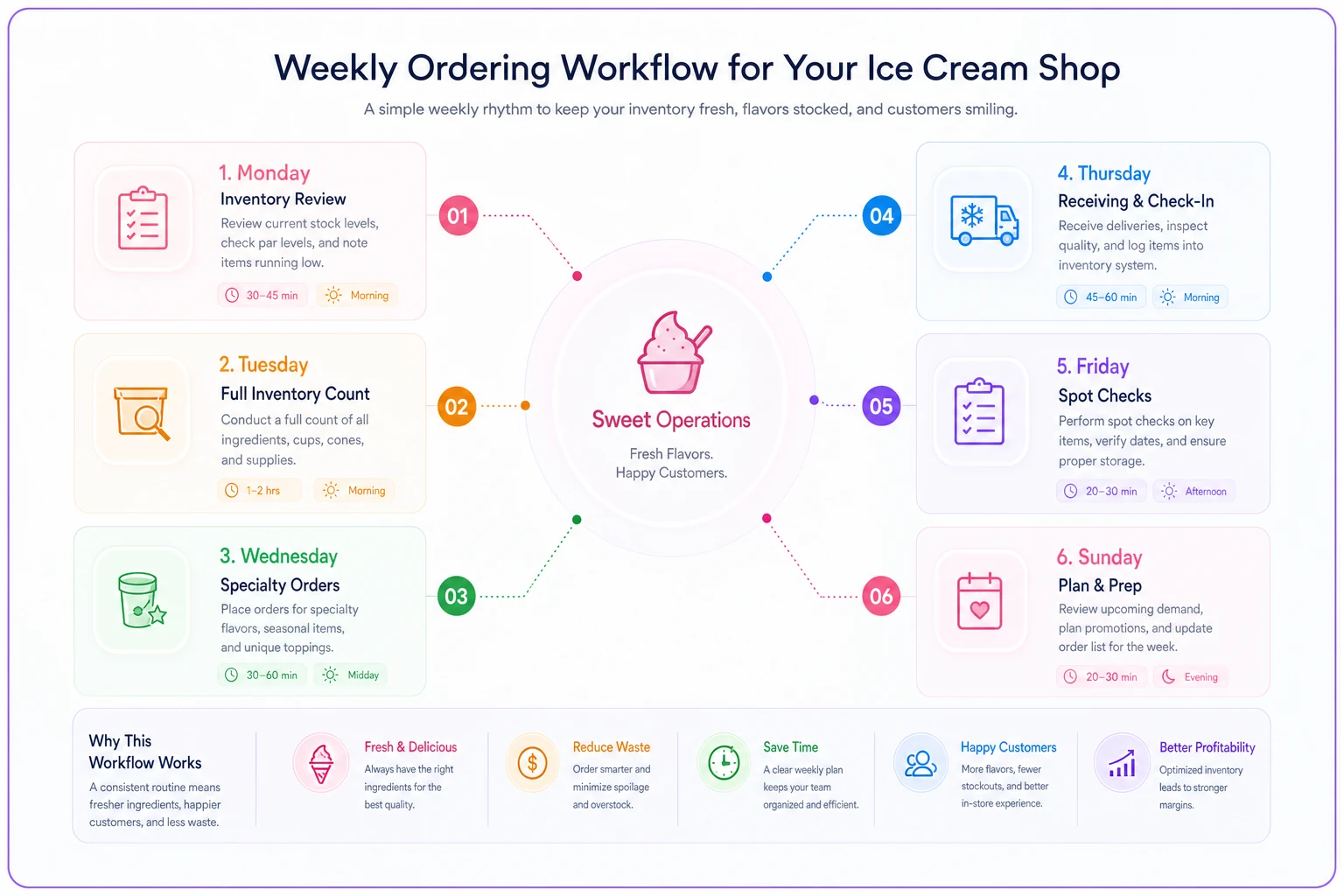
This rhythm prevents both stockouts and excess inventory. The multiple touchpoints catch issues early.
Making peace with imperfect MOQs
Perfect order quantities don't exist in the ice cream business. Between supplier minimums, expiration dates, and unpredictable demand, you'll always carry slightly too much or too little of something.
The goal isn't perfection. It's finding the sweet spot where waste stays under 5% of inventory value and stockouts affect less than 2% of customer interactions.
Track these metrics monthly:
-
Waste as percentage of purchases
-
Number of stockout incidents
-
Customer complaints about unavailable flavors
-
Freezer utilization percentage
-
Days cash tied up in inventory
When waste creeps above 5%, your safety stocks are too high or your slow-mover ordering frequency needs adjustment. When stockouts exceed 2% of interactions, your reorder points need tweaking or your lead time buffers are too tight.
Most shops find their balance point after three to four months of deliberate tracking and adjustment. Once you hit that balance, maintaining it becomes routine rather than constant crisis management.
The shops that struggle indefinitely are those without systematic approaches. They order based on what looks low, not calculated reorder points. They negotiate with suppliers once then never revisit terms. They treat all flavors identically instead of segmenting by velocity and margin.
Your supplier cadence should feel boring and predictable, not stressful and reactive. When ordering becomes routine, you've built a system that actually works.
Ready to scoop up efficiency and grow your shop?
Join hundreds of ice cream shops using Cremyly to boost productivity, reduce waste, and delight customers with faster service.