

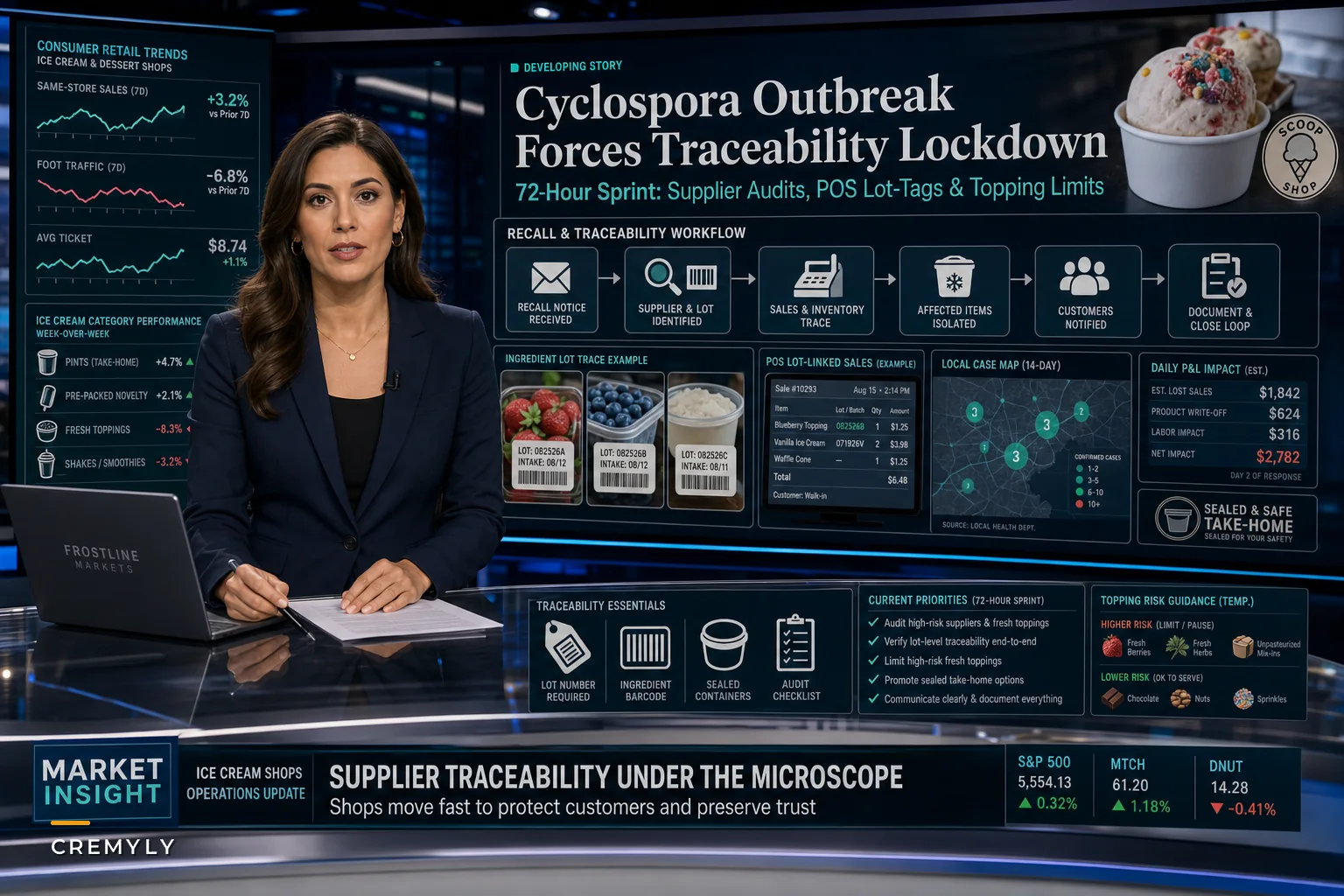

Most scoop shop owners assume food safety outbreaks are somebody else's problem. Leafy greens, cilantro, imported berries — that's a grocery chain issue, not a corner ice cream shop. But if you're topping sundaes with fresh strawberries, garnishing with mint, folding in fresh fruit purees, or running a build-your-own bar with cut produce, you're sitting closer to the risk line than you'd probably like to admit.
Right now that's worth paying attention to. The CDC has been tracking a large multistate Cyclospora outbreak that expanded again in early August 2026, with the investigation update from the CDC pointing toward contaminated fresh-produce supply links and tens of thousands of domestically acquired cases. The Washington Post reported that it's now considered the largest known outbreak of its kind, spanning 15 states. Cyclospora isn't killed by freezing — which is exactly why frozen dessert shops shouldn't wave this off.
This post isn't a news recap. It's about what the outbreak exposes — specifically, that most independent shops can't answer a simple question fast: "Which supplier and which lot did this ingredient come from, and what did we sell it in?" If you can't answer that in under ten minutes, you have a traceability gap, and that gap costs you during an outbreak, an inspection, or a customer complaint.
The real problem: your fresh toppings are a supply chain you never mapped
There's a pattern that comes up over and over. A shop has tight control over its base mix and tubs — they know their dairy supplier, their reorder points, their FIFO rotation. But the fresh add-ons? Bought loosely. Someone grabs flats of strawberries from a produce wholesaler, or makes a cash-and-carry run when they're short, and nobody records the lot code or even the supplier consistently.
So when public-health attention spikes — like it is now — the shop has no clean way to check whether the produce they served came from an implicated source. They're guessing. And guessing during an outbreak is how you either serve something you shouldn't, or panic and dump inventory you didn't need to.
Ingredient traceability for ice cream shops isn't about becoming a food-safety lab. It's about being able to draw a straight line from a supplier invoice → a received lot → the menu items that used it → the shifts and days it was sold. Most shops have every piece of that data scattered across a stack of paper invoices, a POS that only knows "Strawberry Sundae," and a manager's memory. That's the underlying weakness this outbreak is putting a spotlight on.
A concise operational checklist to close the gap fast
If you want to tighten things up this week without overhauling your whole operation, work through these in order. Most of it can be done in a couple of shifts.
Keep your ice cream shop running smoothly.
Cremyly helps you manage every order, stock level, and staff shift with precision and ease.
- Real-time inventory tracking
- Order management dashboard
- Staff scheduling & shift coordination
No credit card required
Supplier verification
-
Pull your last 60 days of produce and fresh-ingredient invoices and confirm you have a supplier name, delivery date, and lot/batch code for each
-
Ask each fresh-produce supplier for their recall notification process — how will they tell you if a lot is implicated?
-
Flag any supplier where you can't get a lot code; those are your highest-risk vendors
-
Cross-check your current fresh produce against active outbreak sourcing info before you assume you're clear
POS and inventory tagging
-
Add ingredient-level tags to menu items that contain fresh at-risk produce (not just the product name)
-
Tag received lots at intake, even a simple handwritten lot number on the intake sheet tied to the invoice
-
Make sure a "fresh strawberry" tag rolls up across every item that uses it — sundaes, milkshakes, waffle bowls, take-home pints
Documentation and staff
-
Print or export inspection-ready records
intake logs, temp logs, supplier list with lot codes
-
Retrain staff on the two-minute question
"If a customer asks whether our toppings are affected, what do you say?"
-
Assign one person per shift who owns intake logging so it doesn't fall through the cracks
Menu and customer
-
Decide in advance which fresh toppings you'd pull temporarily if sourcing gets murky
-
Prepare a short, calm customer-facing message (more on that below)
Assign one person per shift who owns intake logging so it doesn't fall through the cracks.
Most of it can be done in a couple of shifts.
Why POS tagging is the piece most shops skip — and why it matters here
The supplier side of this is fairly intuitive. The part that trips people up is connecting sales data to ingredients. Your POS almost certainly tracks products, not ingredients. It knows you sold 42 "Berry Blast Sundaes" last Saturday. It has no idea those sundaes contained fresh strawberries from a specific delivery.
That disconnect is exactly what turns a five-minute check into a two-day scramble. If a supplier notifies you that a lot delivered on a certain date is implicated, you want to instantly know: which menu items used that lot, how many were sold, on which days, and whether any went into sealed take-home pints that customers still have in their freezers.
This is where ingredient-level tagging earns its keep. If you've already built out a clean data taxonomy — where products map to ingredients, and ingredients map to lots — this becomes a lookup instead of an investigation. We walked through how to structure that kind of tagging in our guide on building an operational data taxonomy for scoop shops, and it's worth revisiting now because an outbreak is exactly the scenario that taxonomy is built to survive.
Here's a simple way to think about what "traced" versus "untraced" looks like operationally:
| Question during an outbreak | Untraced shop | Ingredient-tagged shop |
|---|---|---|
| Which supplier did this topping come from? | Dig through paper invoices | Pull up supplier tag |
| Which lot / delivery date? | Usually unknown | Recorded at intake |
| Which menu items used it? | Guess from memory | Instant rollup by ingredient tag |
| How many did we sell, and when? | Manual POS report + guessing | Filtered sales report by tag |
| Did any go into take-home pints? | Nearly impossible to know | Traceable if pints were tagged |
The right column takes upfront effort. But the difference between those two columns is the difference between a controlled response and a chaotic one.
A workflow for handling a supplier recall notice
Say a produce supplier emails you: "Lot #4471, delivered July 22, is part of the current investigation. Do not serve." Here's the sequence to run.
-
Locate the lot at intake. Confirm from your intake log that Lot #4471 was received July 22 and how much came in.
-
Pull all ingredient tags linked to it. Identify every menu item that used that strawberry lot during its usable window.
-
Run a sales report filtered by those items. Determine the date range it was actually served — say July 22 through July 26.
-
Segment by sale type. Separate in-store scoops (already consumed) from sealed take-home pints (still in customer freezers).
-
Pull remaining inventory. Physically remove anything tied to that lot from prep stations and freezers, and log the disposal.
-
Prepare targeted communication. If pints are involved and you have contact info from online orders, notify those specific customers directly.
-
Document everything. Timestamp each step so you have a clean record if an inspector asks how you responded.
The whole thing should take under an hour if your tagging is in place. Without it, step 2 alone can eat half a day, and you'll probably over-dump inventory out of caution.
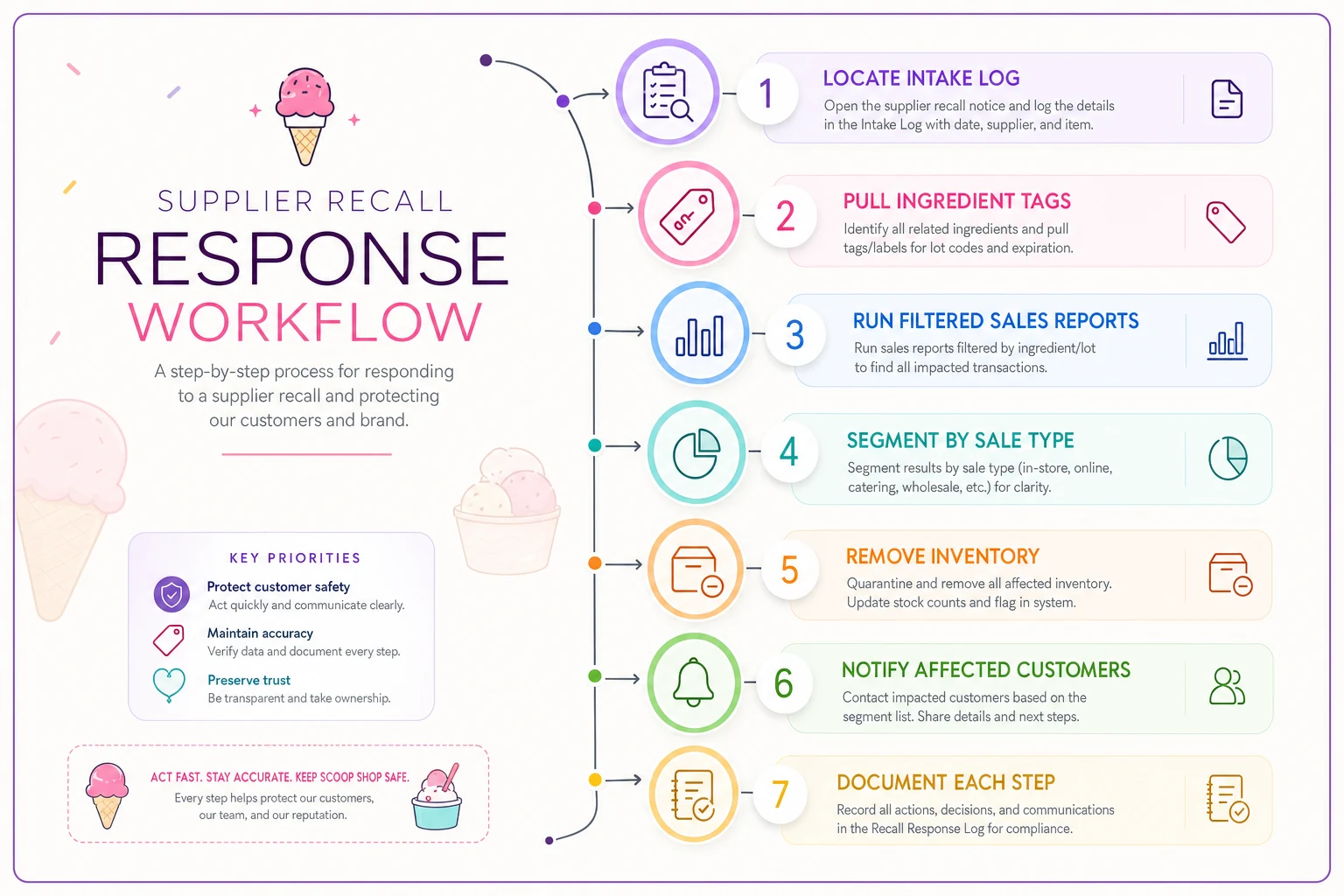
A quick visual of this sequence helps staff run it calmly under pressure.
Reassuring customers without amplifying panic
When food-safety news is in the headlines, foot traffic gets weird. Some customers avoid anything with fresh produce. Some ask pointed questions at the counter. And demand quietly shifts toward sealed, single-flavor take-home pints because they feel safer than an open topping bar.
The mistake shops make is either saying nothing — which reads as ignoring it — or overexplaining, which reads as nervous. The tone that works is calm, factual, and brief.
A good counter-level script: "We're aware of the current produce advisory. We've confirmed our fresh toppings with our suppliers, and we've temporarily simplified our topping options while things are being investigated. Our sealed pints and core flavors aren't affected."
That's it. It signals you're paying attention, you've done the work, and you're not hiding anything.
A small sign near the register saying the same thing does more for trust than a defensive back-and-forth at the counter.
A few practical moves that help during a produce scare:
-
Lean into your sealed take-home pints in signage and online listings, since demand naturally drifts there
-
Offer a simplified "clean menu" of items with no fresh at-risk produce
-
Make sure your online ordering flow captures customer contact info in case you ever need to notify a pint buyer
-
Brief every staff member so answers are consistent across shifts
Brief every staff member so answers are consistent across shifts
When temporarily pulling fresh toppings makes sense — and when it doesn't
Not every shop needs to strip its menu. This is a judgment call.
Pulling fresh at-risk toppings makes sense when:
-
you can't get lot codes from your produce supplier
-
the outbreak sourcing is still unclear
-
a meaningful share of your sales rely on fresh produce bought from inconsistent sources
Pulling toppings is probably overkill when:
-
you buy from a single verified supplier with clean lot tracking
-
the implicated produce categories don't match anything you serve
-
you can trace every fresh ingredient you're currently using
Who should absolutely not skip this exercise: any shop running a self-serve topping bar, high fresh-fruit volume, or catering and bulk orders that go out to events where you lose visibility once the product leaves. Those setups have the widest blast radius if something goes wrong.
A real scenario: the strawberry sundae trace
A small two-location scoop shop ran a popular fresh strawberry sundae through peak summer, moving somewhere around 60–80 of them a day between both stores. Their strawberries came from two different produce wholesalers depending on availability, and nobody was logging which supplier or delivery a given batch came from.
When outbreak coverage picked up, the owner wanted to know if any of their recent strawberries were at risk. It took a manager most of an afternoon — digging through invoices, calling both wholesalers, and estimating from memory which deliveries went to which store. They ended up dumping roughly $400–$500 of produce and prepped toppings across both locations, mostly because they couldn't confirm what was actually safe, so they tossed all of it to be cautious.
Afterward they set up a dead-simple intake sheet: every fresh delivery gets logged with supplier, date, and lot, and their sundae menu item now carries a "fresh strawberry" tag in the POS. The next time a supplier flagged a batch, the same trace took about fifteen minutes and they pulled only the specific affected lot — a fraction of the waste, no guessing. The whole setup cost them maybe an hour of work and a printed logbook.
The takeaway
An outbreak like the current Cyclospora situation isn't really a topping problem — it's a visibility problem. The shops that handle these moments well aren't the ones with the fanciest food-safety programs. They're the ones who can trace an ingredient from invoice to sale quickly, communicate calmly, and pull exactly what needs pulling instead of dumping everything in a panic.
You don't need to overhaul your operation. Start by logging fresh-produce lots at intake, tag your at-risk menu items down to the ingredient, keep your supplier list current with recall contacts, and have a short customer message ready. Do that, and the next time food-safety news rattles your customers, you'll be answering questions with facts instead of scrambling for them.
Ready to scoop up efficiency and grow your shop?
Join hundreds of ice cream shops using Cremyly to boost productivity, reduce waste, and delight customers with faster service.