


Most shops onboard managers by accident. You promote your best scooper, hand them the keys, show them how to close the till, and hope the rest gets picked up by osmosis. Three weeks later you're still getting texts at 9pm asking where the backup waffle cone mix lives, and the labor percentage crept up two points because nobody's cutting people early when the line dies.
The gap isn't intelligence or work ethic. It's that scooper onboarding and manager onboarding are two completely different jobs, and almost nobody separates them. A scooper needs to learn portioning, register flow, and how to keep the case looking full. A manager needs to know how to read a shift, protect margin, and coach the people doing the scooping. Run the same onboarding for both and you get someone who scoops beautifully and manages nothing.
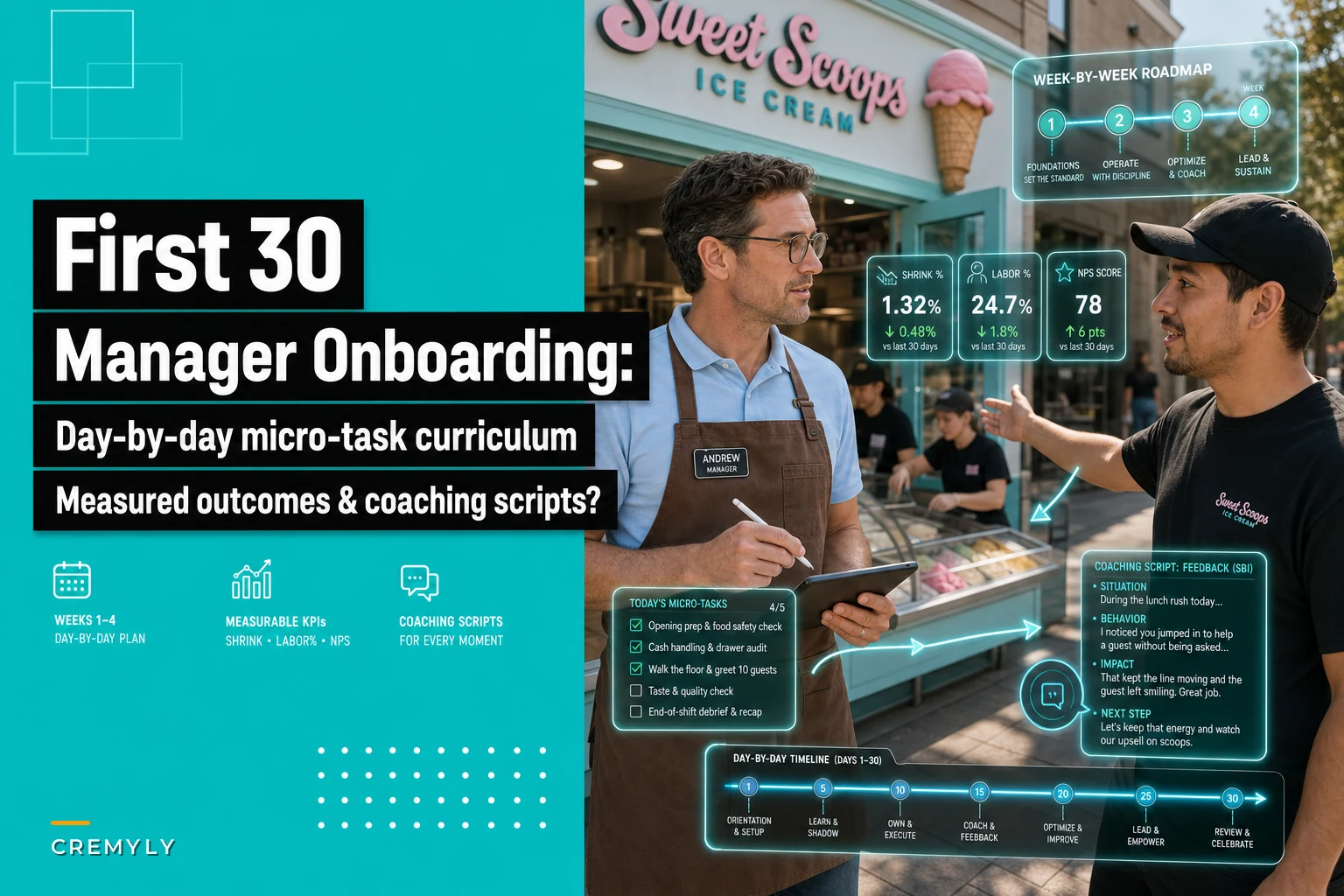
What follows is a 30-day curriculum broken into daily micro-tasks, tied to three numbers you can actually measure — shrink, labor %, and NPS — plus the coaching scripts that make the people part stick. This is specifically for manager onboarding at an ice cream shop, not front-line training.
Why the "promote and pray" method quietly costs you
Here's the pattern: a shop promotes a strong hourly employee to shift lead. Nobody writes down what "manager" actually means, so the new lead defaults to what they already know — being an excellent scooper who happens to have keys.
The problem is that the manager-specific tasks are the ones that don't feel urgent in the moment. Cutting labor when the line thins out. Doing a mid-shift freezer temp check. Catching that the sprinkle containers are being overfilled and quietly bleeding product. None of these scream at you the way a 12-deep line does. So they get skipped, and the cost shows up on the P&L a month later where it's hard to trace back to anything specific.
A rough example: a shop doing around $18k–$22k a week lets labor drift from a target of about 26% to 30% because the new lead never learned to send people home during dead zones. That's roughly $700–$900 a week in labor that produced nothing. Over a season that's real money, and it's invisible until you go looking for it.
The whole point of a structured first-30 is to make the non-urgent manager tasks routine before the new lead has to think about them under pressure.
The three numbers this curriculum is built around
Before the day-by-day, get clear on what you're actually measuring. Every week ties back to one of these.
Keep your ice cream shop running smoothly.
Cremyly helps you manage every order, stock level, and staff shift with precision and ease.
- Real-time inventory tracking
- Order management dashboard
- Staff scheduling & shift coordination
No credit card required
| Metric | What it tells you | Baseline to capture before Day 1 | Where a new manager moves it |
|---|---|---|---|
| Shrink (waste + over-portion + theft) | How well product is being controlled | Last month's waste log + food cost % | Portion discipline, FIFO enforcement, close-out counts |
| Labor % | Whether staffing matches demand | Trailing 4-week labor % by daypart | Cutting/adding staff live, break timing |
| NPS / review sentiment | Whether the guest experience holds up | Last 30 days of reviews + any survey data | Coaching, recovery moves, pace management |
Capture baselines before the manager starts. If you don't, you'll never know whether they improved anything. Most shops skip this step and then argue in month two about whether the new lead is "working out" based on vibes. Numbers end that argument.
If your labor targets aren't tied to forecasted demand yet, that's worth fixing before you run this curriculum — the day-by-day below assumes you already have shift templates that reflect real demand patterns. If you don't, start with a labor-planning system that ties forecasted demand to shift templates and margin targets, then come back.
Week 1 — Systems, not scooping
The goal of week one is orientation to the manager's view of the shop. The new lead already knows the front of house. This week is about showing them the machinery behind it.
Day 1 — The tour they never got as a scooper. Walk the back of house together. Where's the backup inventory, the spare parts bin, the freezer temp log, the breaker panel, the shutoff valves. Micro-task: have them label or photograph five things they didn't know the location of. Sounds trivial. It's the difference between a manager who solves a problem and one who texts you.
Day 2 — Open and close, but as an auditor. They've done both before. Today they do it while asking "what would tell me something is wrong?" Micro-task: they write down three things they'd check on open that a scooper wouldn't — case temp, overnight waste, cash drawer count.
Day 3 — Read the schedule against demand. Sit with the current week's schedule. Which dayparts are overstaffed? Which are thin? Micro-task: they mark one shift they'd staff differently and explain why. You're teaching them that the schedule is a lever, not a fixed thing.
Day 4 — Waste log immersion. Show them the last month of waste. Where's it coming from — melt, over-portion, expired tubs, dropped cones? Micro-task: identify the single biggest waste category and one guess at the root cause.
Day 5 — Shadow you on a live shift. You run the shift, they watch what you do that scoopers don't: the mid-shift temp check, the labor call, the quiet coaching moment. Micro-task: they log every "manager move" they saw you make.
Coaching script for Day 5 debrief: > "You noticed I sent Maya home at 3:15. Here's how I made that call: line was gone, next rush isn't until 5, and we were sitting at three people for zero customers. That decision saved us about an hour of labor. I want you making that call by week three without asking me."
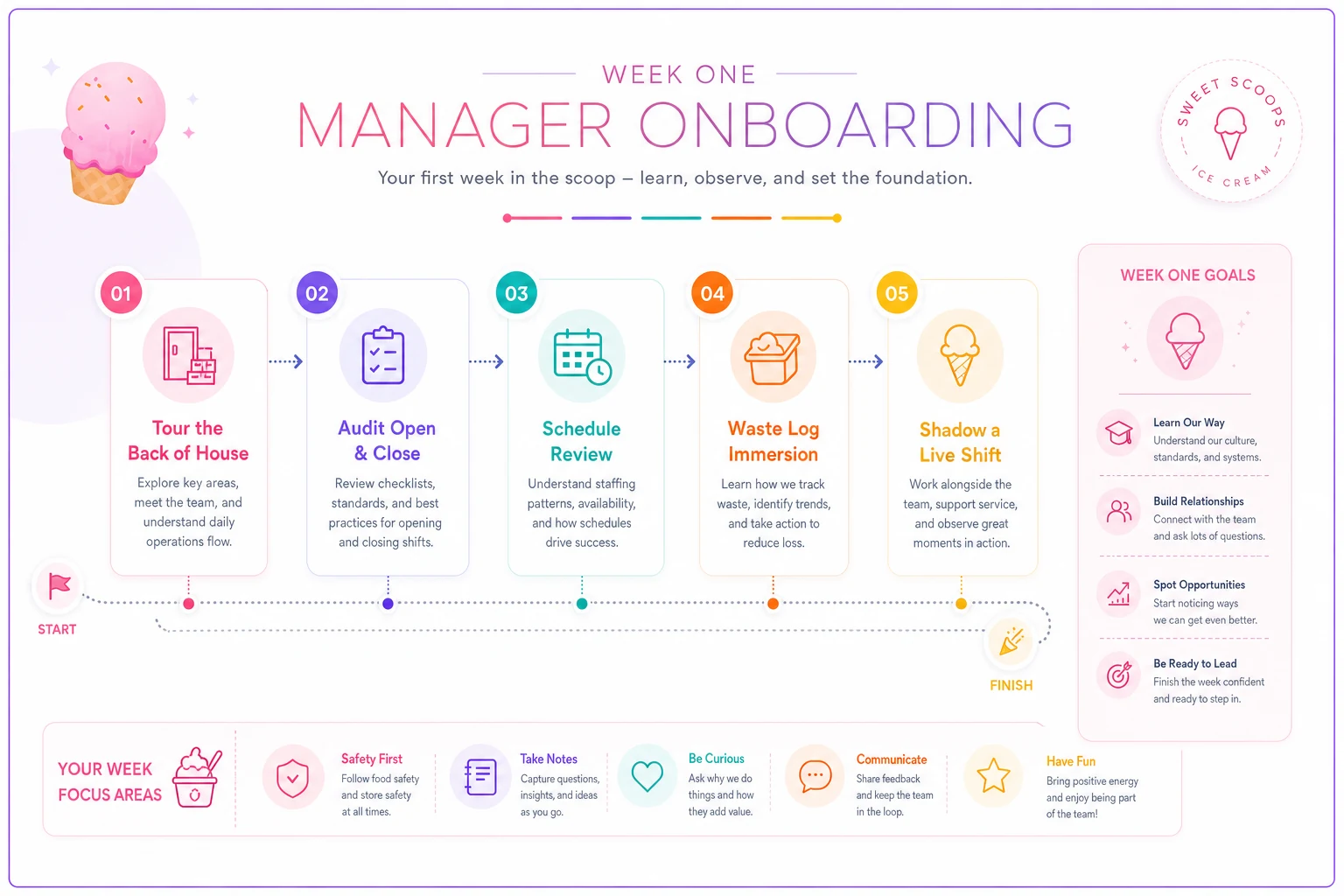
Use this to visualize the week-one orientation flow and where each micro-task slots in.
Week 1 measurable outcome: They can locate every critical system, run open/close as an auditor, and articulate the shop's biggest waste source. No P&L movement expected yet — this is foundation.
Week 2 — Owning shrink
Now they start controlling product. Shrink is the easiest metric for a new manager to move quickly, which makes it a good confidence builder early on.
Day 6 — Portion calibration. Have them weigh scoops from three different staff members. The spread will surprise them. Micro-task: document the variance and set the target weight.
Day 7 — FIFO walk. Enforce first-in-first-out on the case and back stock. If your rotation system is loose, tighten it now. Micro-task: they run a rotation check and flag anything out of order.
Day 8 — Run their first shrink-focused shift. Their job today: keep waste low, watch portions, enforce rotation. You're present but hands-off. Micro-task: end-of-shift waste count compared to a normal day.
Day 9 — Root-cause one waste category. Take the biggest waste source from Day 4 and dig. Is it a training issue, a case-loading issue, a demand-forecasting issue? Micro-task: one written hypothesis and one small experiment to test it.
Day 10 — Cash and inventory reconciliation. Teach them to tie the register to the product. If 40 sundaes rang up but the topping usage looks like 55, something's off. Micro-task: they reconcile one shift's sales against usage.
Coaching script for a portion problem: > "I'm not worried about you personally — your scoops are solid. But two of the crew are running heavy, and at our volume that's real product walking out the door. Your job now isn't to scoop perfectly, it's to make sure everyone does. Here's how I'd bring it up with them without making it weird…"
That last line matters. New managers freeze on correcting former peers. Giving them the exact words removes the excuse.
Week 2 measurable outcome: Shrink on their shifts trending down versus baseline. Even a modest move — waste dropping from around 4% of sales toward 3% — shows the training is landing.
Week 3 — Owning labor
This is the hardest week because labor decisions require judgment under pressure, and getting them wrong is immediately visible — either the line gets ugly or the P&L bleeds.
Day 11 — Read the daypart curve. Walk through the demand pattern for each day. When does the rush actually start and end? Micro-task: they predict tomorrow's busiest and deadest 90-minute windows.
Day 12 — Live labor calls with a safety net. They make the send-home and break decisions; you approve or veto before they act. Micro-task: three labor decisions with their reasoning written down.
Day 13 — The overlap problem. Teach them to stagger shifts so you're not paying four people to stand around at 2pm. Micro-task: rebuild one day's shift start/end times for tighter coverage.
Day 14 — Handle a curveball. A no-show, a surprise bus tour, a broken machine. Throw one at them (or use a real one if it comes up). Micro-task: they adjust staffing live and document what they did.
Day 15 — Full solo shift, labor-focused. They run it and own the labor number. You review after. Micro-task: shift labor % versus target.
Coaching script for a manager who won't cut labor: > "I get it — sending someone home feels bad, and you don't want to be the one who cuts hours. But when we're overstaffed in a dead zone, that money doesn't come from nowhere. It comes out of everyone's raise pool and out of how many hours I can offer during the busy weeks. Protecting labor % is protecting your team. Let's practice how you'd phrase the send-home so it feels fair."
Reframing labor discipline as protecting the team rather than squeezing it is what makes it stick. Managers who see it as cost-cutting resist it. Managers who see it as fairness enforce it.
If you want the deeper mechanics on how labor and margin connect day to day, the operations playbook to align inventory, scheduling and daily P&L covers the leak points a new manager should learn to watch.
Week 3 measurable outcome: Labor % on their shifts within about a point of target, without the guest experience falling apart.
Week 4 — Owning the guest experience and coaching
By now they can control product and staffing. Week four is about the softer, harder skill: keeping the experience consistent and actually developing the people under them.
Day 16 — Read the reviews. Go through the last 30 days of feedback together. What are guests actually complaining about — wait times, portion consistency, cleanliness, attitude? Micro-task: identify the top two themes.
Day 17 — Pace management. Teach them to keep the line moving without making it feel rushed. Micro-task: time the line during a rush and find the bottleneck station.
Day 18 — Service recovery. When something goes wrong — melted takeout order, wrong flavor, long wait — what do they do? Micro-task: they handle one recovery live and you debrief the guest's reaction.
Day 19 — First real coaching conversation. They give feedback to one crew member on something concrete. You observe. Micro-task: written summary of how it went and what they'd change.
Day 20 — Run a full shift owning all three metrics. Shrink, labor, and guest experience, all on them. This is the dress rehearsal for going solo. Micro-task: post-shift self-assessment against all three numbers.
Coaching script for teaching them to coach: > "Good feedback is specific and future-focused. Don't say 'you're being slow.' Say 'during the rush I need you to pre-scoop the top three flavors into the dipping wells — here's why it speeds the whole line up.' You're giving them a tool, not a criticism. Try it with one person today and tell me how they took it."
Week 4 measurable outcome: Review sentiment holding or improving on their shifts, and at least one documented coaching conversation that produced a behavior change.
Days 21–30 — Solo with a shrinking net
The final stretch is deliberate weaning. Each shift, you're less present.
-
Days 21–23 They run solo, you review the numbers same-day and debrief.
-
Days 24–26 They run solo, you review the numbers next-day only. No live check-ins unless something breaks.
-
Days 27–29 They run solo and self-report against all three metrics. You spot-check.
-
Day 30 Full review. Compare their shift averages across shrink, labor %, and NPS against the baselines you captured before Day 1.
If the numbers moved the right direction and the coaching conversations are happening without you prompting them, the onboarding worked. If not, you now know exactly which week to revisit, because each week maps to a specific competency.
A quick real scenario
A two-location scoop shop promoted a floor lead who'd been scooping for about two years. First promotion, no structured onboarding — the classic hand-off-the-keys situation. Their shifts ran labor around 30–31% against a 26% target for the first month, and waste sat noticeably higher than the owner's own shifts.
They ran a version of this 30-day curriculum on the next promotion. By day 30, the new manager's shifts were running labor near 27%, waste had come down to roughly in line with the owner's shifts, and — the part the owner didn't expect — the new manager was proactively flagging schedule problems for the following week instead of reacting to them. The difference wasn't a better hire. It was that the manager-specific tasks got trained deliberately instead of absorbed by luck.
Keeping this from living in a binder nobody opens
Most onboarding curriculums fail not because the content is wrong, but because they get printed once, used for one hire, and forgotten by the third. The day-by-day tasks end up living in someone's head, the baseline numbers never get captured, and the coaching scripts get improvised badly under stress.
Keep the checklist, the daily micro-tasks, and the metric baselines in a shared ops location so new managers can self-serve their progress.
The shops that consistently develop capable managers tend to keep the checklist, the daily micro-tasks, and the metric baselines somewhere everyone can actually see and update — a shared operations system rather than a physical binder or a manager's memory. When the shrink log, the labor targets, and the onboarding checklist are all in the same place, a new manager can see how their shift performed and what they're supposed to do about it without you translating every data point for them. That's less about any specific tool and more about not letting the process evaporate between hires.
When to run the full 30 — and when not to
Run the full curriculum when: you're promoting a first-time manager, opening a second location, or you've had two managers in a row not work out. In all three cases the cost of a bad onboarding dwarfs the time this takes.
Compress it when: you're onboarding someone who's already managed a food business elsewhere. Skip the systems immersion in week one, keep the shrink/labor/coaching progression, and let them prove out faster. Forcing an experienced hire through basic tasks insults them and wastes your time.
Skip it entirely — and reconsider the promotion — when: the person is a great scooper who visibly dreads correcting peers, avoids anything schedule-related, and lights up only at the register. Being good on the floor and being a manager are different jobs. It's kinder to keep a happy senior scooper than to push a reluctant one into a role that'll burn them out in a season.
The whole curriculum comes down to one idea: a manager is not a scooper with keys. The scooping was the easy part. Shrink discipline, live labor calls, and the coaching conversations that nobody wants to have — those are the actual job. And those are exactly the things that never get trained when you promote and pray. Thirty structured days, three real numbers, and a handful of scripts for the conversations people avoid. That's what separates a shift lead you're babysitting from one you can actually hand the shop to.
Ready to scoop up efficiency and grow your shop?
Join hundreds of ice cream shops using Cremyly to boost productivity, reduce waste, and delight customers with faster service.