

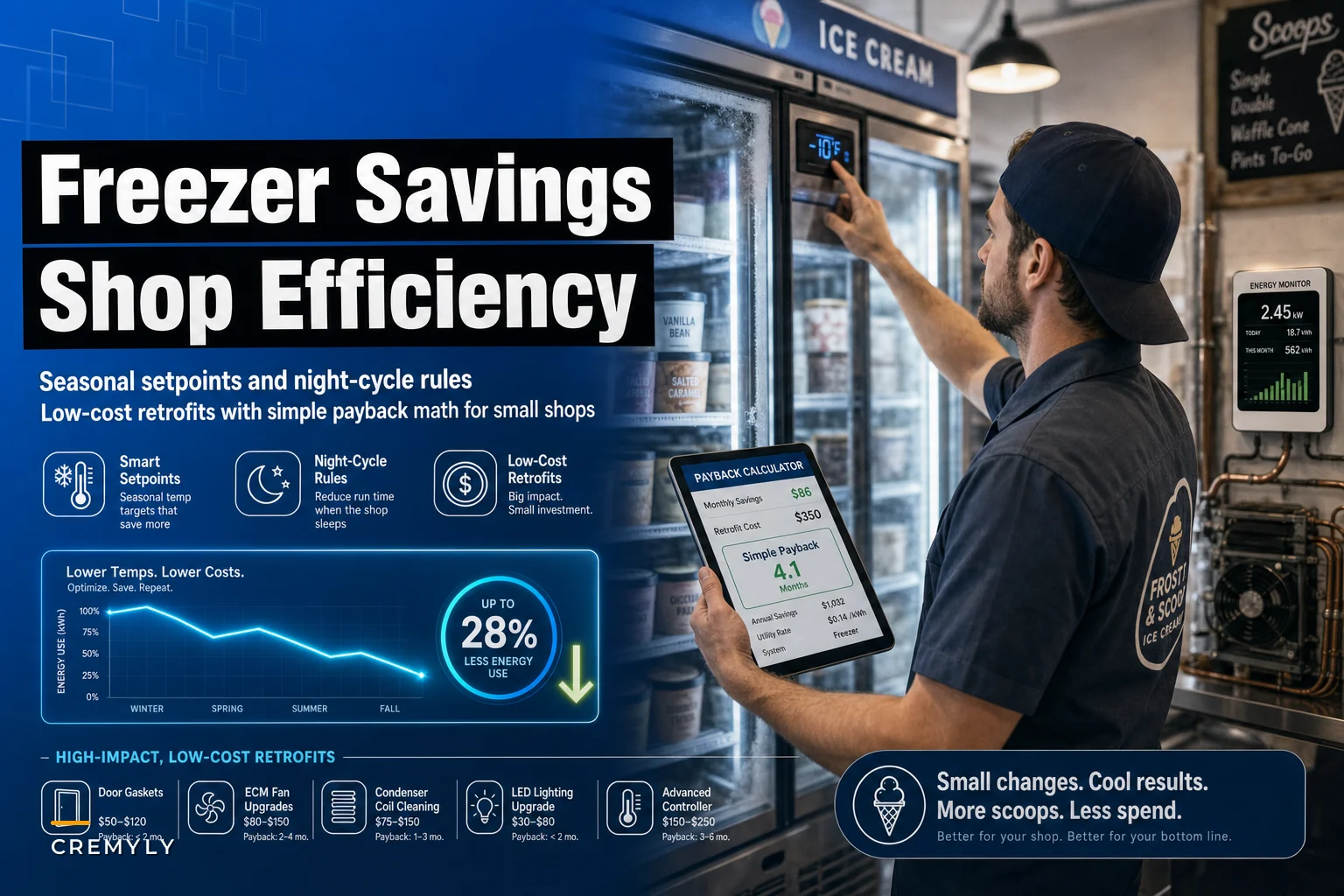

Most scoop shop owners can quote their dairy cost per gallon to the penny but have no real idea what a single reach-in freezer costs to run in a month. That gap is where money quietly leaks. A small fleet of four to eight units — a couple of dipping cabinets, a hardening freezer, a walk-in, maybe a display case — can easily run $900 to $1,600 a month in electricity during summer, and a surprising chunk of that is waste you can cut without buying a single new compressor.
This isn't about replacing equipment. It's about setpoints, timing, and a short list of cheap retrofits that pay for themselves in one season. If you want the broader maintenance and reliability picture, that lives in our writeup on freezer-fleet operations and energy cadence. This post stays narrow: cutting the kilowatt-hours, and proving the payback before you spend anything.
Start by finding your worst-behaving unit
Before touching a thermostat, you need to know which freezer is the pig. Energy waste is almost never spread evenly across a fleet. One aging dipping cabinet with a torn gasket and a compressor short-cycling every four minutes can eat more power than two newer units combined.
You don't need an engineer for this. A $25 plug-in energy monitor (for anything on a standard outlet) or a clamp meter reading on hardwired units gives you a rough kWh-per-day per freezer. Log each unit for three days during a normal busy week.
A typical pattern looks like this:
| Unit | Age | kWh/day (summer) | Est. monthly cost @ $0.16/kWh | Notes |
|---|---|---|---|---|
| Dipping cabinet A | 9 yrs | 14.2 | ~$68 | Gasket cracked, runs constantly |
| Dipping cabinet B | 3 yrs | 8.6 | ~$41 | Fine |
| Hardening freezer | 6 yrs | 11.0 | ~$53 | Overcooled, set to -20°F |
| Walk-in | 5 yrs | 22.5 | ~$108 | Door left open during restock |
| Display case | 4 yrs | 9.1 | ~$44 | Anti-sweat heaters always on |
Cabinet A and the walk-in are your targets. The insight most owners miss: the oldest unit isn't automatically the worst. Behavior and settings matter more than age. That hardening freezer set to -20°F is burning money for zero product benefit, and it's only six years old.
Seasonal setpoints: stop running winter settings in July and vice versa
This mistake is almost universal. A shop dials in freezer temperatures once — during install or the first heat wave — and never touches them again. So the same setpoints running in August are still running in February.
Keep your ice cream shop running smoothly.
Cremyly helps you manage every order, stock level, and staff shift with precision and ease.
- Real-time inventory tracking
- Order management dashboard
- Staff scheduling & shift coordination
No credit card required
Product doesn't need the same treatment year-round, and neither does your compressor. Ambient shop temperature, door-open frequency, and product turnover all shift by season. Running aggressive cold settings during a slow winter is pure waste — you're chilling half-empty cabinets against a cool room.
A practical seasonal setpoint approach:
-
Serving temperature for dipping cabinets should sit around 0°F to 5°F for scoopability. That doesn't change much seasonally — customers want soft, workable ice cream in January too. But you can tighten the differential in winter because door traffic is lower.
-
Hardening freezers need to be cold — around -15°F — but only when you're actively hardening fresh batches. During slow months when production drops, bumping to -8°F still holds product safely and cuts runtime noticeably.
-
Walk-in storage for sealed tubs and backstock is fine at -10°F to -5°F. Many shops run these at -20°F "to be safe," which does nothing for sealed product and adds 15–20% to the walk-in's energy draw.
Worth internalizing: colder isn't safer past a certain point — it's just more expensive. Frozen product held at -8°F versus -18°F has essentially identical shelf stability if it's already frozen solid and sealed. That extra ten degrees is buying nothing but a higher bill.
One caution: seasonal doesn't mean "set it and walk away for six months." Reset when your shop's real conditions change — usually a spring adjustment when foot traffic climbs, and a fall one when it drops. Two changes a year. Put it on the calendar next to your filter changes.
Night‑cycle rules: your freezers don't need to work as hard at 2 a.m.
This is the single most overlooked lever in a scoop shop, and it costs nothing to implement.
At night, the shop is dark, empty, and cooler. Nobody is opening the dipping cabinet every ninety seconds. The ambient load drops hard. Yet most freezers keep running at daytime setpoints against a much lighter workload — the compressor cycles more than it needs to relative to actual demand.
Night-cycle rules mean adjusting behavior for closed hours:
-
Raise dipping cabinet setpoints 3–5°F overnight. Product firms up slightly (which is fine — nobody's scooping at 2 a.m.) and morning pull-down happens fast once the shop warms up. You save the compressor from fighting a cold room all night.
-
Cover open display cases after close. An insulated cover or fitted night curtains on an open-front case can cut overnight draw by roughly a third. Highest return per dollar in the building.
-
Turn off anti-sweat door heaters overnight if your case has them. Humidity drops when the shop is closed and the HVAC settles — the heaters are fighting a problem that isn't there.
-
Batch your hardening work. If you're producing, do it in a concentrated evening window rather than trickling batches across the day. The freezer recovers once, hard, instead of cycling all afternoon.
A rough example: a shop with one open display case running anti-sweat heaters 24/7 and no night cover was drawing about 9 kWh/day on that unit alone. Adding a night cover and putting the heaters on a timer dropped it to roughly 6 kWh/day — about $14/month, or around $170 a year, for maybe $40 in materials.
If your units have programmable controllers, this is a five-minute setup.
If your units have programmable controllers, this is a five-minute setup. If they're old dial thermostats, you're doing it manually at open and close — which is exactly why a plug-in timer or smart thermostat earns its keep fast.
The low‑cost retrofit checklist
None of these require an electrician for most units, and none should cost more than a couple hundred dollars each. Work down the list by payback speed.
-
[ ] Replace cracked or compressed door gaskets. A failing gasket on a dipping cabinet is the number-one silent energy drain. Test with a dollar bill — close the door on it, and if it pulls out with no resistance, the seal's gone. Gaskets run $40–$120 and often pay back in under two months.
-
[ ] Add night covers or curtains to open display cases. Highest return per dollar in the whole shop.
-
[ ] Clean condenser coils and set a monthly schedule. Dust-choked coils force the compressor to run longer. Free to do, and can cut a unit's draw 10–15% if coils were badly clogged.
-
[ ] Install door-open alarms on the walk-in. A propped or slow-closing walk-in door during restock is a massive hidden cost. A $20 alarm that beeps after 60 seconds changes staff behavior fast.
-
[ ] Add strip curtains to the walk-in doorway. Cuts cold-air spill during the frequent open-close of a busy service shift.
-
[ ] Put anti-sweat heaters and display cases on timers or smart plugs. Enables night-cycle rules without relying on staff memory.
-
[ ] Check and adjust setpoints against the seasonal targets above. Free. Often the biggest single win.
-
[ ] Swap case lighting to LED if it's still fluorescent or halogen. Old case lighting adds heat inside the cabinet, which the compressor then has to remove — you pay twice.
The pattern to notice: the cheapest fixes (setpoints, coil cleaning, gaskets) almost always deliver the fastest payback, while the tempting big purchases deliver the slowest. Owners want to buy a shiny new efficient freezer. The math almost always says fix what you have first.
The payback calculator you can run on a napkin
You don't need software to decide whether a retrofit is worth it. The formula is:
Payback (months) = Retrofit cost ÷ Monthly savings
Monthly savings = (kWh/day saved) × 30 × (your $/kWh rate)
Your $/kWh rate is on your utility bill — divide total charges by total kWh used. Most shops land somewhere between $0.12 and $0.22 depending on region and demand charges.
Worked example — the tired dipping cabinet:
-
kWh/day saved
14.2 − 10.5 = 3.7
-
Monthly savings
3.7 × 30 × $0.16 = ~$17.80/month
-
Payback
$90 ÷ $17.80 = ~5 months
After that, it's roughly $210 a year back in your pocket from one cabinet, ongoing. Run this for each unit you flagged. Rank the retrofits by payback months, shortest first, and work top-down as cash allows. Anything with a payback under six months you should do immediately — it's cheaper than leaving money in the wall socket.
When aggressive energy cutting is a bad idea
Not every lever is worth pulling, and a few will bite you.
Don't raise setpoints on anything holding soft-serve mix or product mid-freeze. Seasonal and night-cycle adjustments apply to fully frozen, sealed, or scoopable product — not to product in a temperature-sensitive state.
Don't skip the measurement step to save time. The owners who "just adjust everything colder to be safe" and the ones who "just crank it all up to save money" both lose. Without per-unit readings you're guessing, and guessing on frozen inventory is expensive in a different way.
Don't put your walk-in on aggressive night-cycling if you're storing anything marginal. Sealed backstock, fine. But if your walk-in doubles as short-term holding for open product, keep it steady.
A brand-new shop with a single modern, well-sealed freezer and a small bill should probably skip most of this. The savings won't justify the fiddling. This work starts paying off when you're running four or more units and your summer power bill has real weight to it.
A real scenario
A two-location scoop shop in a warm climate was running seven freezer units per store and seeing summer electric bills around $1,400–$1,500 a month per location. The owner figured it was just the cost of doing business in the heat.
Three days of plug-monitor logging found two cracked gaskets, a walk-in habitually set to -20°F, two display cases running anti-sweat heaters around the clock, and condenser coils that hadn't been cleaned in over a year.
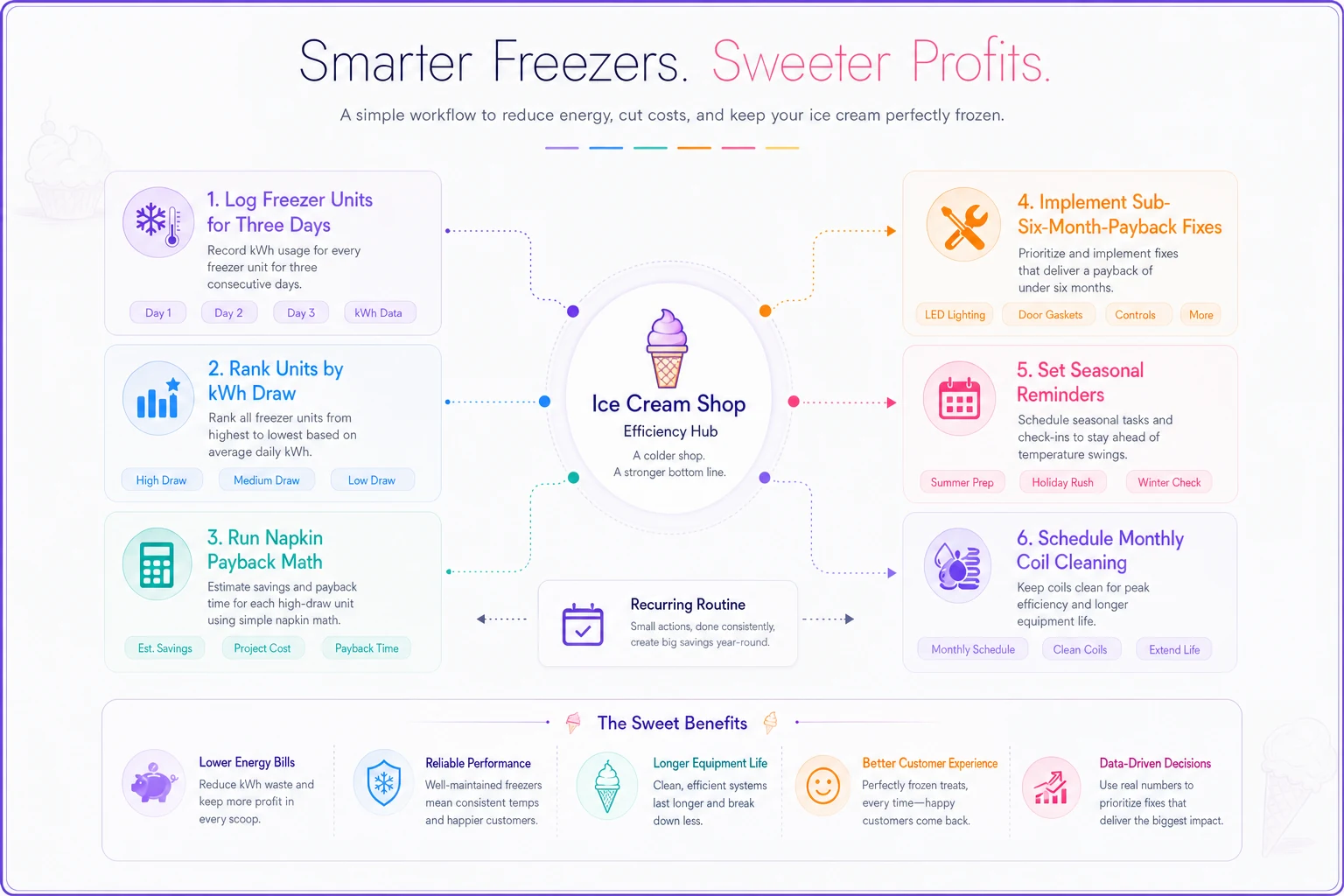
The fixes cost about $260 in parts across both stores — gaskets, two night covers, a couple of smart plugs — plus a Saturday of the owner's time. They corrected setpoints to seasonal targets, added night-cycle rules on the timer-controlled units, and set a monthly coil-cleaning reminder. The sequence they followed looked like this:
-
Log every unit for three days with a plug monitor or clamp meter.
-
Rank units by daily kWh draw and flag the obvious outliers.
-
Run the napkin payback math on each identified fix.
-
Do every fix with a sub-six-month payback immediately.
-
Set seasonal setpoint reminders twice a year on the calendar.
-
Schedule monthly coil cleaning alongside filter changes.
The following summer, bills dropped to roughly $1,150–$1,250 per location. About $250 a month saved per store, somewhere around $500 monthly across both — for a couple hundred dollars and a weekend of work. Product quality didn't suffer; if anything, the freshly-gasketed cabinets held temperature more steadily than before.
The takeaway that actually matters
Freezer energy savings in an ice cream shop isn't a gear problem — it's a measurement-and-habit problem. The shops bleeding the most money are usually running one-size-fits-all settings across seasons and hours that change constantly, with a gasket or two quietly failing in the background.
Log your units for three days. Fix the worst one first. Set two seasonal adjustments a year and a handful of night-cycle rules on timers. Run the napkin payback math before you spend anything, and do everything with a sub-six-month return right away. That sequence — measure, rank, fix cheap-and-fast first — will pull more out of your power bill than any new freezer you could buy this year.
Ready to scoop up efficiency and grow your shop?
Join hundreds of ice cream shops using Cremyly to boost productivity, reduce waste, and delight customers with faster service.