

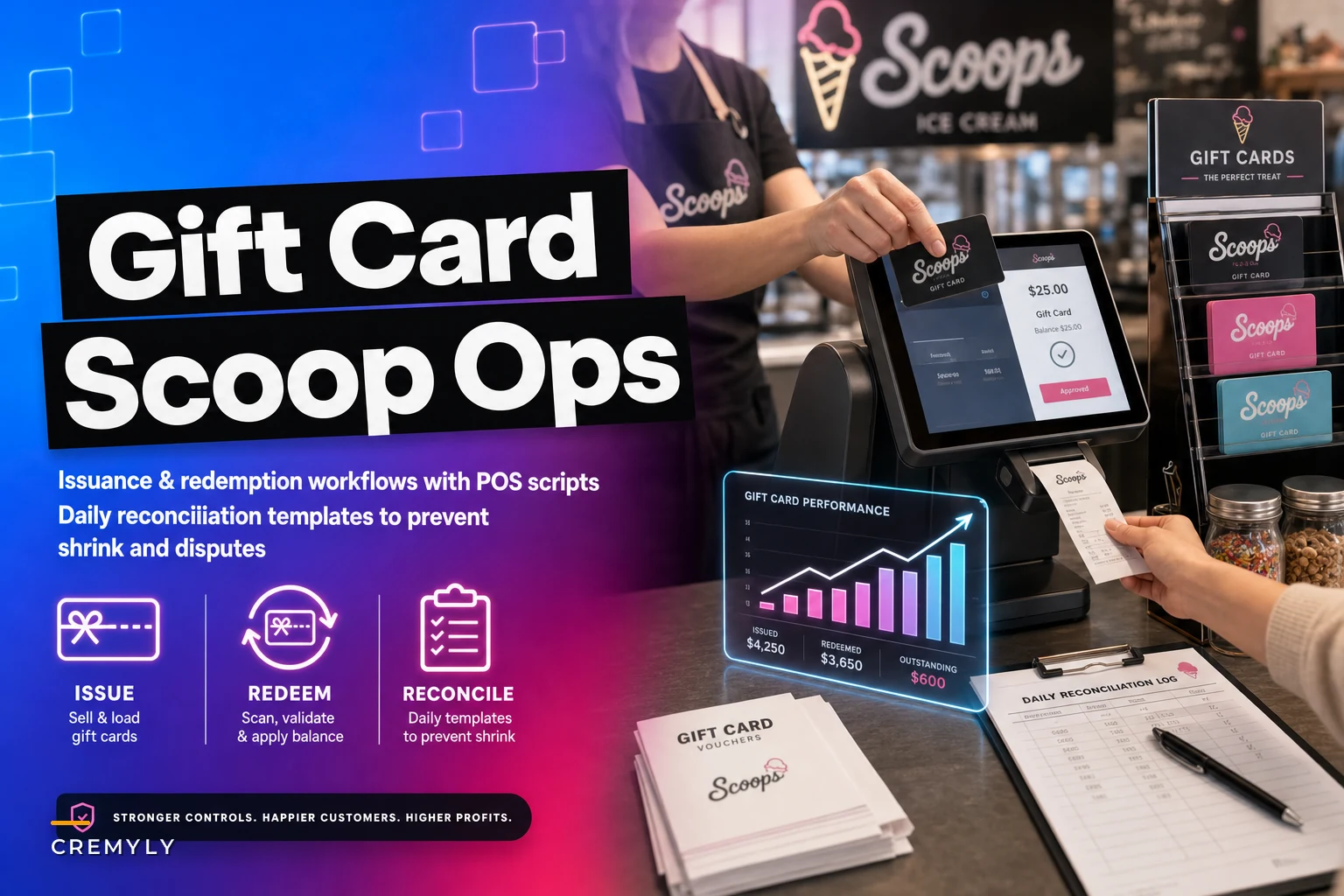

Most scoop shop owners treat gift cards as free money. Someone hands you $50 today, you deliver ice cream later, and in between you get to hold their cash. That part is true. What gets missed is that a gift card program is essentially a small bank you're running out of a freezer, and if you run it without records, it leaks in ways that don't show up until a customer is standing at your counter arguing about a balance you can't verify.
The failures aren't dramatic. Nobody steals a thousand dollars in one move. It's a $25 voucher that got redeemed twice because the first redemption never got logged. It's the plastic card a staff member "reloaded" for a friend without ringing anything. It's the December stack of cards you sold that you never separated from regular revenue, so your accountant booked $4k of liability as income and now your tax picture is wrong.
This post covers exactly that: how gift cards and vouchers create shrink and disputes in a scoop shop, and the specific POS steps, staff scripts, accounting treatment, and daily reconciliation habits that stop it. Nothing about marketing them — just the operations underneath.
Where the money actually leaks
Before getting into templates, it helps to see the actual failure points. In real operations, gift-card shrink almost always traces back to one of these — usually more than one at the same time:
-
Untracked issuance. A card gets sold or reloaded but the load isn't recorded in the POS as a distinct transaction. Cash goes in the drawer, no liability gets created, and the balance lives only on the physical card.
-
Double redemption. A paper voucher or non-integrated card gets accepted twice because there's no system marking it "used." Happens constantly with printed promo vouchers.
-
Manual balance overrides. Staff type in a balance manually instead of the POS pulling it, and the number they type is wrong — sometimes by accident, sometimes not.
-
The gray-market reload. A staff member loads a card using a comp or void, effectively converting store credit into a personal balance. This one quietly costs the most.
-
Accounting misclassification. Card sales booked as revenue instead of liability. Not shrink exactly, but it distorts your margins and creates a tax and dispute mess later.
The pattern worth internalizing: gift-card shrink is rarely a theft problem first. It's a recording problem first, and the theft slips in through the gap the missing record leaves open. Fix the recording and most of the theft has nowhere to hide.
Two systems, very different risk
The single biggest factor in how much a scoop shop bleeds on gift cards is whether the card is tracked by the POS or by a piece of plastic and someone's memory.
Keep your ice cream shop running smoothly.
Cremyly helps you manage every order, stock level, and staff shift with precision and ease.
- Real-time inventory tracking
- Order management dashboard
- Staff scheduling & shift coordination
No credit card required
| Feature | POS-integrated cards | Manual / paper vouchers |
|---|---|---|
| Balance lives in | The system, pulled live | On the card or in staff's head |
| Double-redemption risk | Very low (auto-marked used) | High |
| Reload fraud risk | Low if voids are logged | High |
| Reconciliation effort | Minutes, mostly automatic | Manual, error-prone |
| Dispute resolution | Instant lookup | "Let me check the back room" |
| Best for | Reloadable plastic, e-gift | One-off promos, fundraisers |
Paper vouchers are fine for a fundraiser night or a "$5 off next visit" card with a printed serial number and an expiry date. They are not fine as your everyday stored-value system. If your shop is still running reloadable value on non-integrated cards, that's the first thing to change — before any template below matters.
The issuance workflow (where the liability gets created correctly)
Selling a gift card is not selling ice cream. The money you take in isn't yours yet — it's a promise. Your issuance workflow needs to reflect that, both in the POS and in the drawer.
-
Ring the sale as a gift-card product, not a generic sale. Your POS should have a dedicated "Gift Card" or "Gift Card Reload" item. This is what keeps the money off your revenue line.
-
Load the exact amount onto the card in the same transaction. For integrated cards, the load and the sale happen together. Never accept payment for a card without the load completing on screen.
-
Confirm the balance shows on the terminal. Read it back to the customer: "That's a $50 balance loaded, receipt shows the card number ending in the last four."
-
Hand over the receipt. The receipt is the customer's proof and your paper trail. For paper vouchers, log the serial number and value in your voucher sheet before the customer leaves.
-
Never load a card off a void, comp, or manual adjustment. If a card is being reloaded, it's paid for with real tender — cash, card, whatever — and that tender hits the drawer.
Quick visual of the issuance workflow.
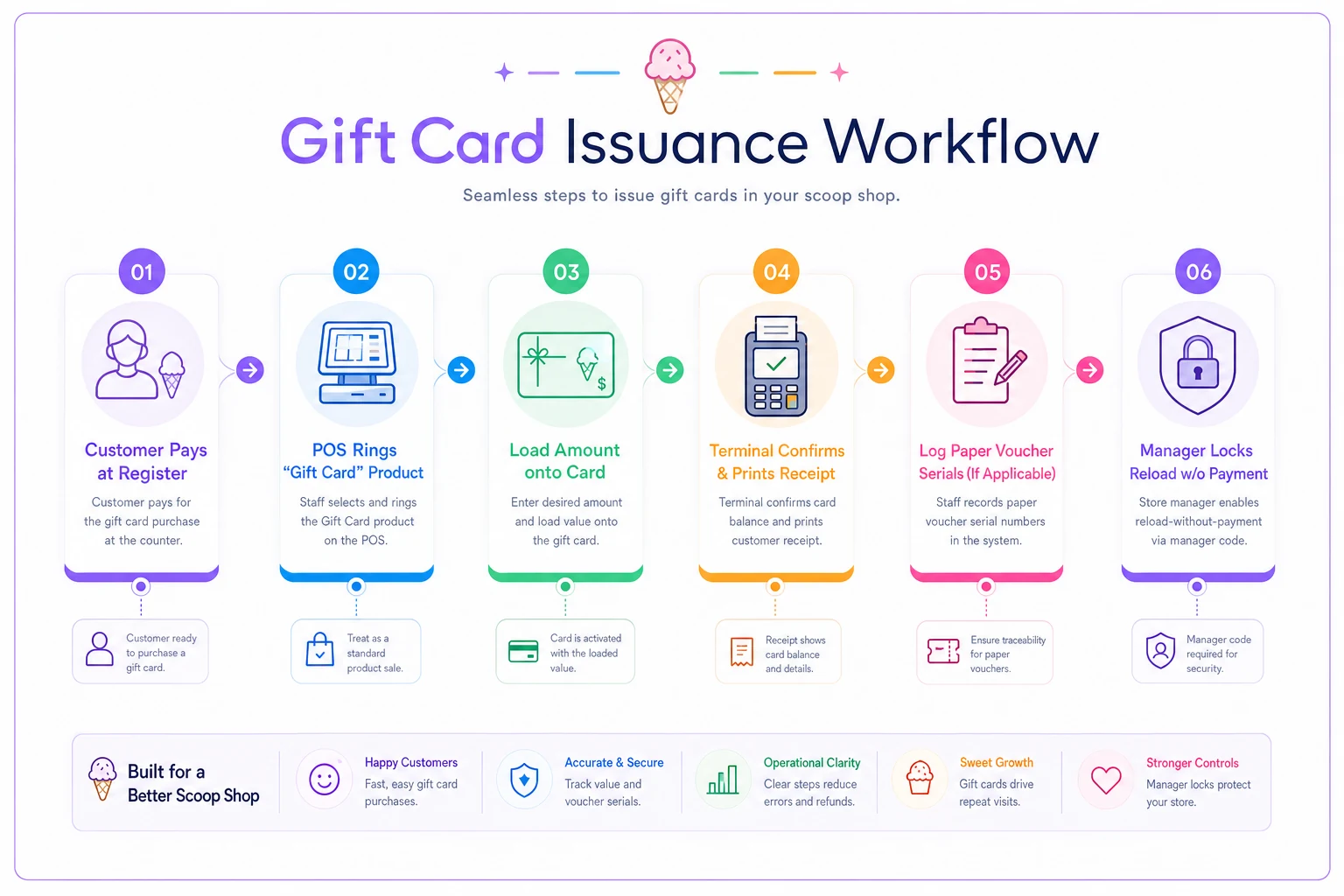
That last step is the guardrail against the gray-market reload. If your POS lets any staff member add value to a card without a corresponding payment, you have an open vault. Lock reload-without-payment behind a manager code, or turn it off entirely.
The redemption workflow (where double-spend and disputes happen)
Redemption is where customers get angry, because this is where a balance either matches what they expect or it doesn't. Two rules prevent almost every dispute.
Rule one: the system reads the balance, staff never type it. The moment a staff member is manually keying in "this card has $30 on it," you've lost the audit trail. For integrated cards, scan or swipe and let the POS pull the live number. For paper vouchers, the serial number gets matched against your log and marked redeemed on the spot.
Rule two: partial redemptions leave the remainder on the card, not in the customer's head. A common scoop-shop mess — someone with a $50 card buys $12 worth of sundaes, and the staff member says "you've got about $38 left" without the system tracking it. Next visit, a different staff member sees a different number, and now you're in an argument. The POS must carry the remaining balance forward on the card itself.
For paper vouchers specifically, add a physical step: staff writes "REDEEMED" and the date across the voucher and drops it in a dedicated slot at the register, separate from cash. At end of day these get matched against the day's voucher redemptions. A voucher with no matching log entry — or a redeemed count higher than what you issued — is your shrink signal.
Staff scripts that prevent the argument before it starts
The disputes that eat your time aren't really about money. They're about tone and clarity. A few short scripts, drilled during onboarding, cut most of them off. If you're building a broader onboarding flow, these fit naturally alongside the operational habits covered in the operations playbook for aligning inventory, scheduling and daily P&L.
Selling a card: > "This loads $50 that never expires. Keep the receipt — if the card's ever lost, the receipt is how we look it up."
Redeeming with a remaining balance: > "That used $12, so you've got $38 left on the same card. The receipt shows the new balance."
A disputed balance: > "Let me pull it up by the card number — give me one second." (Then read the system number, not a guess.)
A lost card with no receipt: > "Without the card or a receipt I can't verify the balance from here, but if you bought it with a card I can check the sale date. Let me see what I can find." That last one doesn't promise a replacement. Decide your lost-card policy in advance and write it on a card taped near the register so no staff member has to improvise a promise you'll later have to honor.
Accounting treatment: liability, not revenue
This is where owners who nail the operational side still get burned. When you sell a $50 gift card, that $50 is a liability — deferred revenue. You owe someone ice cream. It becomes revenue only when the card is redeemed.
-
On sale Cash increases, gift-card liability increases by the same amount. No revenue yet.
-
On redemption Liability decreases, revenue recognized for the amount redeemed, COGS booked against the product actually served.
-
On breakage (unredeemed balances) After a reasonable period — and depending on your state's escheatment rules — a portion of long-dead balances can be recognized as breakage income. Real money, but only if you've been tracking outstanding balances the whole time.
If your POS books gift-card sales straight into sales revenue, two bad things happen. Your revenue looks inflated in the months you sell cards — December, mostly — and deflated in the months people redeem them, which wrecks any month-over-month margin read. And your outstanding liability becomes invisible, so you have no idea how much ice cream you actually owe.
A clean setup keeps a running outstanding gift-card liability number you can check any day. That number is also your theft detector: if liability drops without matching redemptions, something's off.
The daily reconciliation template
This is the habit that ties everything together. Five minutes at close, done the same way every day. The point isn't to catch a big theft — it's to catch a small discrepancy on the day it happens, while the transactions are still fresh and traceable.
-
[ ] Pull the day's gift-card loads total from the POS (cards sold + reloads)
-
[ ] Pull the day's gift-card redemptions total from the POS
-
[ ] Count physical redeemed paper vouchers in the register slot; match count and value to the POS/voucher log
-
[ ] Confirm loads collected matching tender (cash/card in drawer for every card sold)
-
[ ] Check the outstanding liability balance moved the expected direction (up by loads, down by redemptions)
-
[ ] Flag any manual balance override logged that day and confirm it had a manager code
-
[ ] Note any discrepancy over ~$5 and who was on shift, before locking the drawer
Keep the voucher redemption slot labeled and in the same place so counting and matching at close takes seconds.
Loads in minus redemptions out should equal the change in your outstanding liability. If it doesn't, you have exactly one day of transactions to dig through instead of a month. A mismatch found the same night is a five-minute conversation. The same mismatch found in a monthly review is an unsolvable mystery.
A real scenario
A two-location scoop shop was selling a solid volume of gift cards — somewhere around $3k–$4k a month in summer, more around the holidays. They ran a mix of integrated plastic and printed "$10 off a quart" vouchers for a local school fundraiser.
The problem showed up as a slow drift they couldn't explain: their outstanding liability, once they finally started tracking it, didn't match what they thought they'd sold. Digging in, two things were happening. Paper vouchers were getting redeemed more often than they'd been issued — staff at the second location were accepting photocopies without checking serials. And a couple of reloadable cards had been topped up off voided transactions, quietly converting a few hundred dollars of store value into personal balances over several months.
The fixes were unglamorous. Serial numbers logged on every voucher and matched at redemption. Reload-without-payment locked behind a manager code. And the five-minute daily reconciliation above, run at both locations. The photocopy trick died immediately — a duplicate serial got caught the same night. Over the following couple of months the unexplained liability drift flattened out to nearly nothing, and disputes at the counter dropped to the occasional lost-card question instead of weekly arguments over balances.
Nothing required new software or a big project. It required treating stored value like the small bank it is.
When to keep it simple, and when to tighten up
When a light touch is fine: If you sell only a handful of cards a month and run everything through integrated plastic, the daily reconciliation can be weekly, and you can skip the voucher log entirely because you're not issuing paper. Don't build controls for volume you don't have.
When you need the full workflow: The moment you have more than one location, more than a couple of staff running the register unsupervised, or you're issuing paper vouchers, every step above earns its keep. Multiple hands on the drawer is the single biggest predictor of gift-card shrink.
Who should not run paper vouchers at all: If you can't commit to logging serials and matching them at redemption, don't issue paper stored value. A voucher you can't verify is a voucher that will get spent twice. Use integrated cards or nothing.
Gift-card operations for a scoop shop come down to a simple discipline: money you take in for cards isn't yours until the card is redeemed, and every dollar of that promise should be traceable to a record you can pull up in seconds. The shrink and the disputes don't come from bad customers or dishonest staff as often as owners assume — they come from gaps where no record got created, and those gaps are genuinely easy to close. Set up issuance and redemption so the system carries the balance instead of a person's memory. Book the sales as liability, not revenue. Run the five-minute reconciliation at close. Do that consistently, and the plastic in your drawer stops being a slow leak and goes back to being what it should be: someone else's money, held for a little while, on terms you can actually account for.
Ready to scoop up efficiency and grow your shop?
Join hundreds of ice cream shops using Cremyly to boost productivity, reduce waste, and delight customers with faster service.