

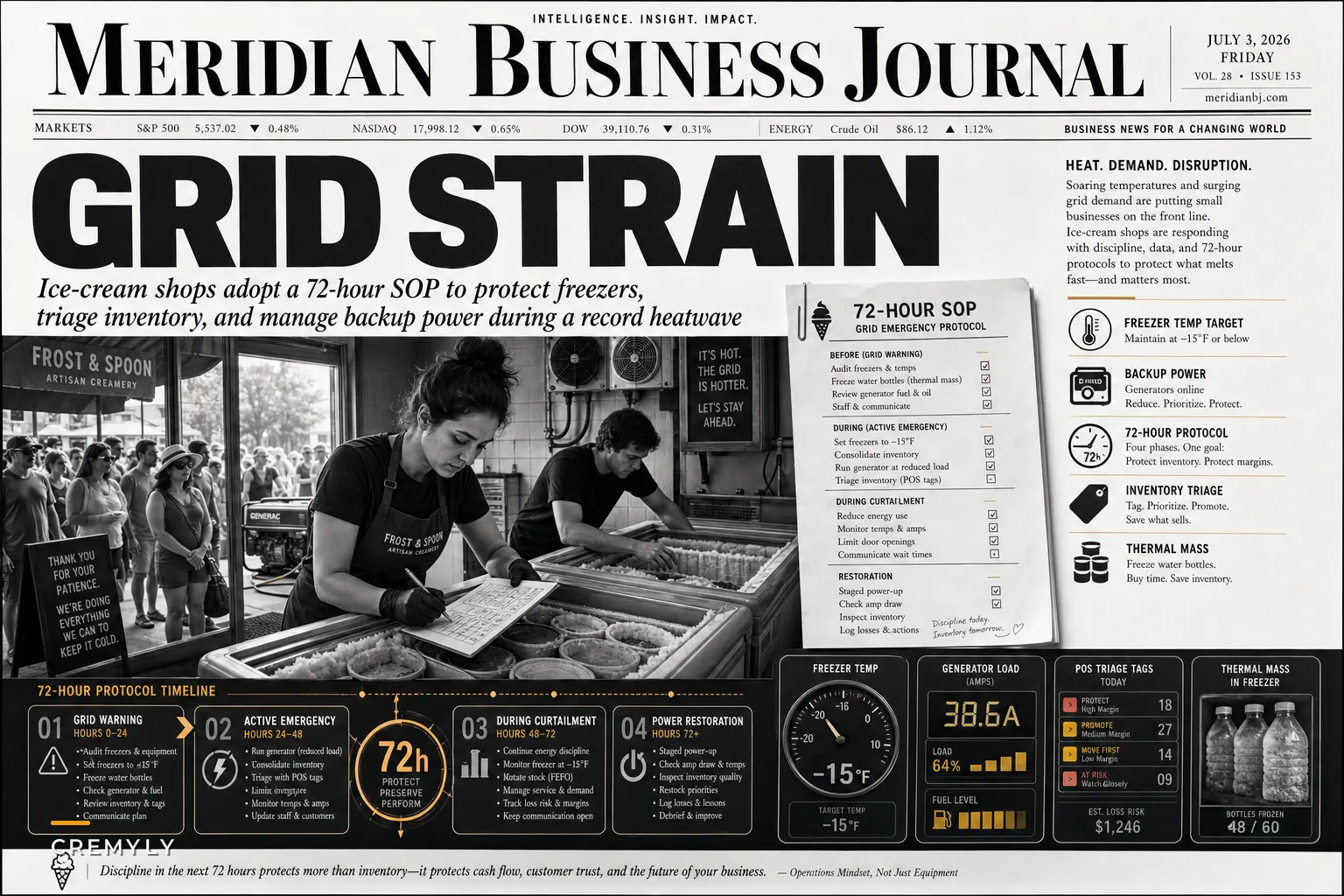

The Department of Energy just issued emergency orders for the PJM grid through July 3rd. If you run an ice cream shop anywhere from Chicago to Philadelphia, your freezers are at risk right now. Not theoretical risk — actual rotating blackouts and voltage drops that can kill compressors worth $8,000 each.
I watched three shops lose their entire inventory during the 2019 Manhattan blackout. One owner in Hell's Kitchen lost $14,000 in premium gelato because her backup power system failed after four hours. Insurance covered maybe half.
What makes this week particularly brutal: it's hitting during July 4th weekend when foot traffic peaks, freezers are packed for holiday sales, and every HVAC contractor in a 50-mile radius is already booked solid.
The triple threat most shops don't prepare for
Most ice cream shops prepare for complete outages. They buy generators, stock dry ice, maybe have a backup freezer truck on speed dial. But grid emergencies create three distinct problems that standard outage prep doesn't really address.
First, brownouts come before blackouts. Your freezers might run at 85% voltage for hours, slowly burning out compressor motors. The ice cream stays frozen while the equipment quietly dies. You won't know until the compressor seizes — usually right when power stabilizes and demand spikes back up.
Second, rotating outages hit without real warning. Unlike scheduled maintenance where you get 48-hour notice, emergency load shedding gives you maybe 15 minutes. Sometimes less. The automated systems managing these cutoffs don't care that you're mid-batch or just received a $3,000 dairy delivery.
Third — and this one catches people off guard — power restoration creates surge conditions that fry control boards. Modern freezer systems have electronic controllers managing defrost cycles, temperature logging, and compressor staging. A voltage spike during restoration can destroy those boards entirely. You'll have a freezer that powers on but doesn't actually cool.
Your 72-hour emergency protocol
The steps below assume you're working through a grid emergency in real time. Adapt them to your setup, but don't skip the sequencing — the order matters more than people expect.
Keep your ice cream shop running smoothly.
Cremyly helps you manage every order, stock level, and staff shift with precision and ease.
- Real-time inventory tracking
- Order management dashboard
- Staff scheduling & shift coordination
No credit card required
Phase 1: Grid Warning (Now through Thursday morning)
Start by auditing your actual freezer loads. Pull everything out of your display freezers and consolidate into your most efficient units. A typical 12-pan display case pulls around 3.2 kW continuously in 95°F ambient conditions. Your walk-in pulls closer to 1.8 kW for the same storage capacity.
Move all gelato and super-premium products — anything above 14% butterfat — to your coldest freezer. These show quality degradation at -5°F, while standard ice cream tolerates up to 0°F for short periods. Stack them in the back corner where cold air pools.
Check your compressor oil sight glasses. Low oil during high-temperature operation causes immediate failure. If any unit shows oil below minimum, shut it down now. Better to lose one freezer's contents than destroy a compressor that won't be available for two weeks.
Document every batch number, flavor, and container location with photos. You won't trust memory at 2 AM during an outage.
Phase 2: Active Emergency (When curtailment notice arrives)
Utility emergency alerts usually come 30–60 minutes before curtailment. Sometimes you get two hours. Sometimes ten minutes.
Switch to triage mode immediately. Your walk-in becomes a bunker. Pack it using what I call the submarine method: heavy tubs on bottom, thermal mass walls, six inches between product and walls for air circulation. Fill every gap with sealed water bottles you've been freezing since yesterday — they act as thermal batteries.
Set all freezers to -15°F right now. You're pre-chilling thermal mass while you still have power. The extra energy cost for three hours is nothing compared to inventory loss.
Stop all production. Disconnect batch freezers and blast chillers from power completely. These have the highest startup surge and will trip breakers when power returns.
Phase 3: During Curtailment
Monitor temperatures every 20 minutes, but don't open doors to check. Use external thermometers or your freezer monitoring system's remote sensors. Once any freezer climbs above -5°F, you've got roughly four hours before quality degradation starts.
If temperature rises above 0°F, go to dry ice protocol. You need about 7 pounds of dry ice per cubic foot of freezer space for 24-hour coverage. Place it on cardboard above product — never directly on containers. CO2 sinks, so top placement gives you the best coverage.
Run generators at 75% capacity max. Full-load operation in extreme heat causes premature failure. Cycle between freezers if needed, running each unit for 45 minutes per hour.
Here's a quick visual of the protocol workflow to share with staff.
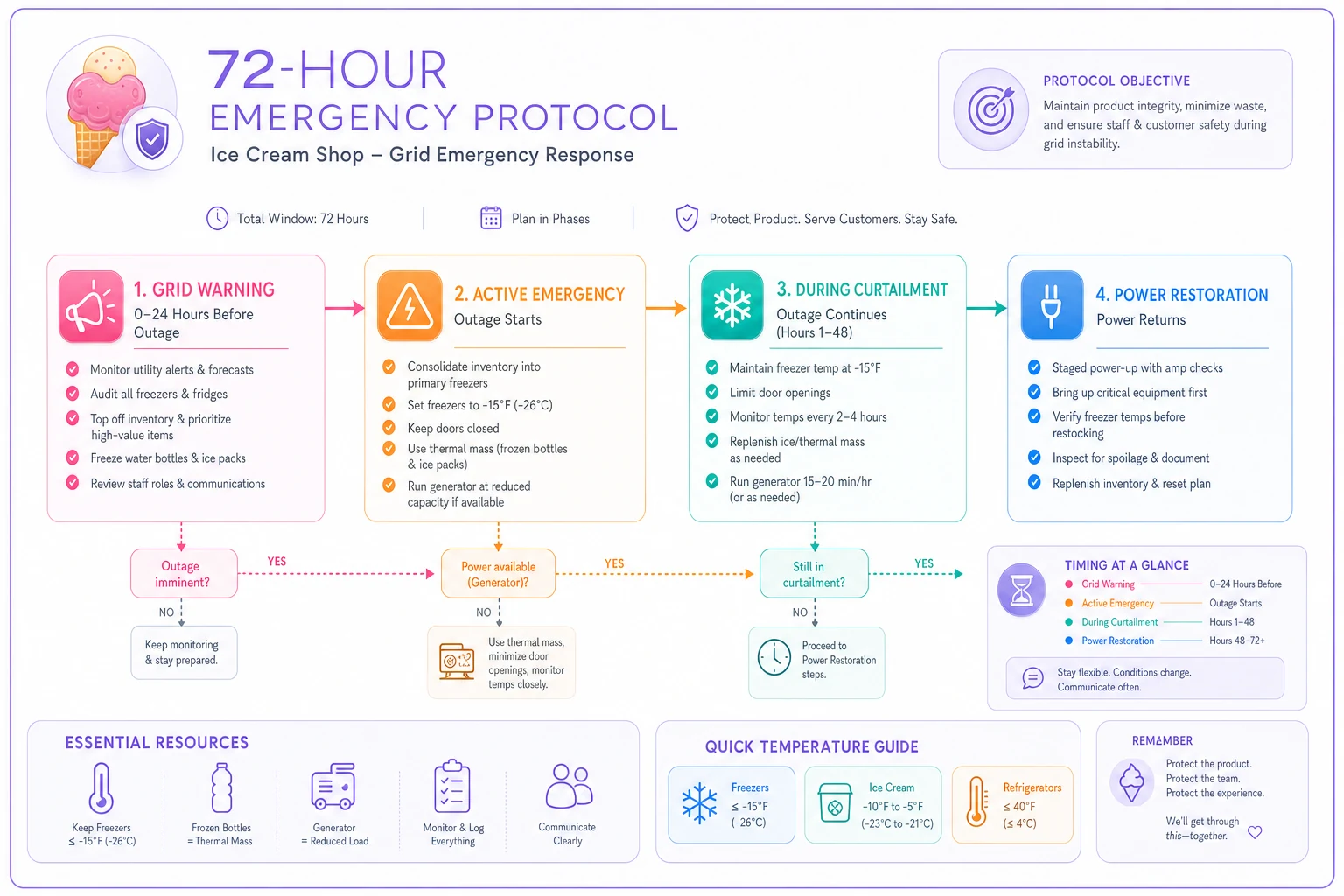
This diagram helps staff visualize sequencing so they don't turn everything on at once.
Phase 4: Power Restoration
This is actually when most damage happens. Don't flip everything back on at once.
Start with one freezer at a time, five minutes apart. Listen for unusual sounds — grinding or squealing from compressors. Check amp draws against nameplate ratings. Anything pulling 20% over rating is close to failure.
The whole restoration sequence looks like this:
-
Wait at least 10 minutes after power returns before switching anything on
-
Start with your walk-in first — highest inventory value, lowest startup surge
-
Bring display cases online one at a time, five minutes between each unit
-
Check amp draw on each compressor within the first two minutes of operation
-
Reconnect batch freezers and blast chillers last, only after core units are stable
-
Log the time, amperage, and any abnormal sounds for every unit you restart
Skipping steps 3 through 5 is how shops end up with a fried control board on their best freezer the morning of a holiday weekend.
The inventory triage decision matrix
When power isn't coming back quickly, you face hard decisions about what to save. This is the framework that holds up under pressure:
| Product Category | Threshold Temp | Hold Time | Action if Exceeded |
|---|---|---|---|
| Gelato/Super Premium | -5°F | 2 hours | Move to dry ice immediately |
| Standard Ice Cream | 0°F | 4 hours | Blast freeze when power returns |
| Novelties/Bars | 5°F | 6 hours | Sell at 50% within 24 hours |
| Toppings/Sauces | 10°F | 8 hours | Move to refrigerator |
| Soft-Serve Mix | 35°F | 2 hours | Discard per health code |
You'll probably lose something. Focus on protecting highest-margin inventory and products you can't quickly reorder.
Communication scripts that prevent meltdowns
Your customers need information before they need ice cream. Post updates every two hours on social, even if nothing has changed. Silence creates anxiety, anxiety creates complaints, complaints create bad reviews.
Text catering clients immediately: "Due to emergency grid conditions, we're confirming all orders 24 hours before delivery. Your July 5th order is currently secure. We'll update you by 6 PM tomorrow."
Tell staff exactly what to say: "We're operating under utility emergency protocols. All our frozen inventory is protected, but we're limiting door opens to maintain temperature. Can I suggest our pre-packed pints?"
Build a supplier notification list too. Your dairy vendor needs to know if you can't accept deliveries. Your dry ice supplier needs advance warning on emergency orders. Your refrigeration contractor needs to know you'll pay emergency rates — because you will be.
The Monday morning recovery audit
After the emergency passes, most shops just reopen and hope everything's fine. The ones who actually come out ahead run a complete system check first.
Check every compressor's amp draw at startup and again after 20 minutes of runtime. Document any variance from normal. A 15% increase in amp draw suggests refrigerant loss or mechanical wear — that compressor will fail within weeks if you ignore it.
Inspect all door gaskets. High-temperature operation causes rubber to expand and deform. Gaskets that look fine can leak enough to drive energy consumption up noticeably. Run the dollar bill test on every seal.
Review temperature logs for the entire emergency period. Look for patterns — one freezer warming faster than others often indicates a refrigerant leak. Temperature spikes during specific hours point to cycling problems.
Sample three random products from each freezer. Check for ice crystal formation, texture changes, or separation. Temperature abuse sometimes doesn't show up until weeks later.
Building resilience beyond emergency prep
Grid emergencies will keep happening. The infrastructure investment needed to prevent them will take years, and demand keeps growing faster than generation capacity.
Map your actual power dependencies. Most shops don't know their real electrical loads until the bill arrives. Install monitoring on each freezer circuit, track usage patterns, understand which equipment can handle voltage variation and which can't.
Build financial reserves specifically for equipment replacement — somewhere around 8% of revenue is a reasonable target. When a compressor fails during peak season, you need $8,000 available immediately, not after an insurance claim processes.
Keep a dedicated emergency fund equal to roughly 8% of revenue earmarked for immediate equipment replacement.
Develop relationships before you need them. The refrigeration contractor who already knows your system saves hours during emergency repairs. The dry ice supplier with your card on file delivers without confirmation calls. The neighboring restaurant with excess generator capacity could become temporary freezer space.
AI-assisted operational platforms can automate a lot of this response — temperature alerts before thresholds breach, inventory tracking that calculates loss values in real time, customer communication that doesn't require manual posts at 2 AM. That upfront investment pays for itself the first time you avoid a major loss.
The uncomfortable reality about grid reliability
ABC News reported that these emergency orders reflect systemic problems that aren't going away soon. Demand keeps growing. Transmission infrastructure ages. Weather extremes stress systems designed for moderate conditions.
Your freezers represent roughly 65% of your total energy consumption under normal conditions. During heat waves, that climbs as compressors work harder against higher ambient temps — every degree above 95°F adds approximately 2.5% to your refrigeration load.
Insurance might cover spoiled inventory, but it won't cover lost sales, a damaged reputation, or the three weeks you spend waiting for replacement equipment. It definitely won't cover the customer who planned their kid's birthday party around your catering order.
The shops that come through these emergencies don't do it through luck or last-minute scrambles. They know which products to sacrifice, which equipment to protect, and which customers to contact first — because they worked it out before the crisis hit.
Document what breaks this week. Note what takes too long. Identify decisions that required agonizing deliberation that really should be automatic. Your freezers will face this again — maybe next month, almost certainly next summer. The goal is building systems that make the heroic effort unnecessary.
Document what breaks this week. Note what takes too long. Identify decisions that required agonizing deliberation that really should be automatic. Your freezers will face this again — maybe next month, almost certainly next summer. The goal is building systems that make the heroic effort unnecessary.
Ready to scoop up efficiency and grow your shop?
Join hundreds of ice cream shops using Cremyly to boost productivity, reduce waste, and delight customers with faster service.