

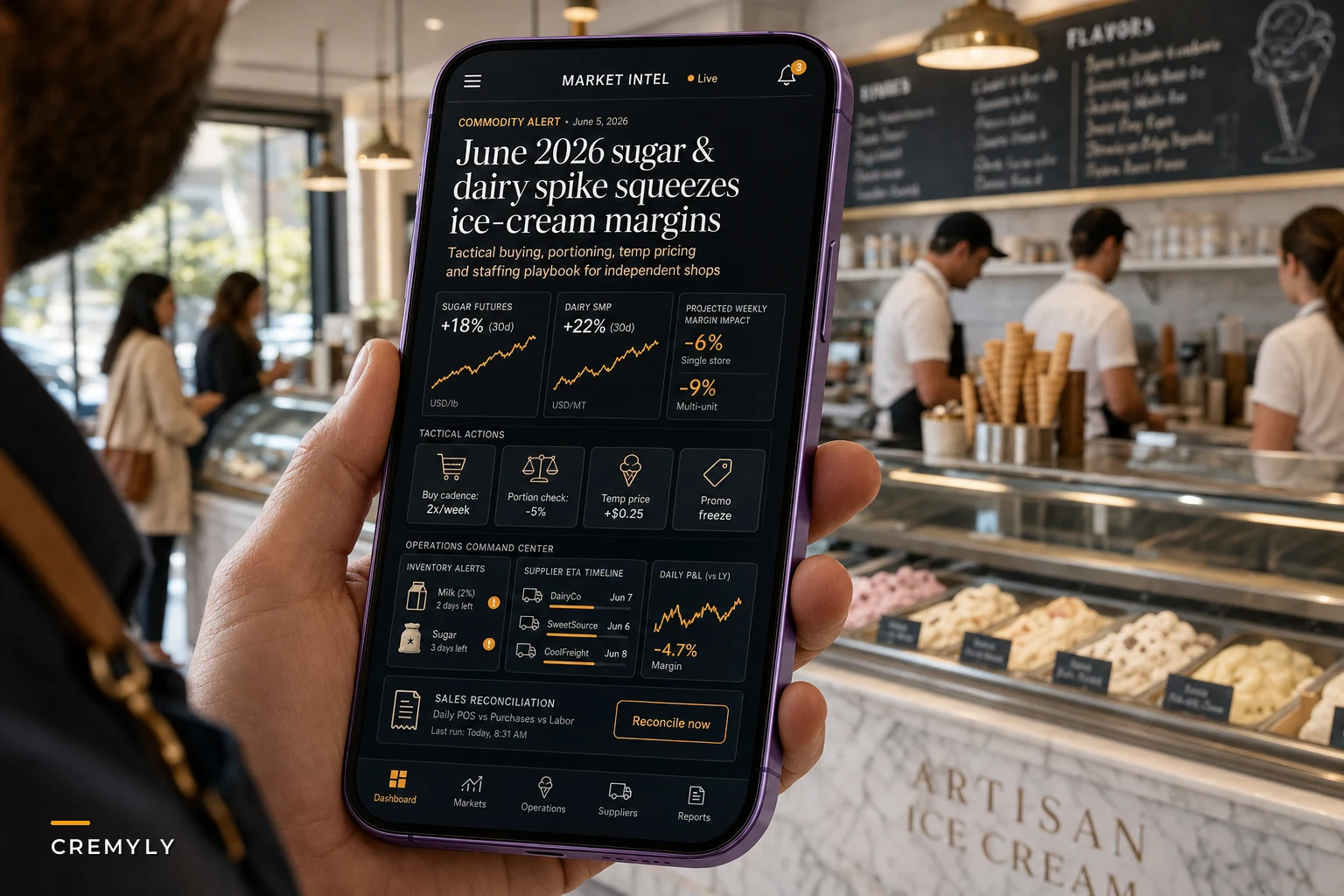

Last week's sugar price spike caught most independent ice cream shops mid-season prep. Reuters reported that sugar prices jumped 7.5% in May alone, while dairy commodities remain volatile near three-year highs. For a typical 1,200-square-foot shop pushing through 80-100 gallons weekly during peak season, that translates to an immediate $400-600 monthly hit on base ingredients alone.
The timing couldn't be worse. June marks the transition into peak selling season when most shops lock in their summer pricing, staff up for longer hours, and commit to promotional calendars. Now you're staring at invoices that jumped 8-12% overall while your menu boards still show last month's prices.
But this is particularly brutal for independents because you don't have the buying power to absorb these spikes like chains do. Baskin-Robbins can hedge commodity prices six months out. Your shop orders ingredients every 10-14 days from regional distributors who pass price increases through immediately. No buffer, no negotiation window, just higher costs landing right as customer traffic picks up.
Why traditional responses fail when ingredient costs spike mid-season
The knee-jerk reaction is usually predictable. Raise prices across the board, cut portion sizes slightly, or eat the margin hit and hope prices stabilize. None of these work particularly well when you're dealing with a sharp commodity spike during peak season.
Price increases during summer feel like betrayal to regular customers. That family that comes in every Friday night suddenly sees their usual order jump from $28 to $32. They don't know about sugar markets or FAO commodity indices. They just know your shop got more expensive right when they planned to visit more often.
Portion control creates its own mess. Training teenage scoopers to suddenly serve 15% less per scoop while maintaining consistency? Good luck. You'll either get wildly inconsistent servings that anger customers or staff reverting to old habits within days. Plus customers notice immediately when that double scoop looks suspiciously like last week's single-and-a-half.
Most shops discover too late: margin protection during commodity spikes requires coordinated operational changes across purchasing, production, pricing, and staffing. Single-point fixes just shift the problem somewhere else.
Breaking down the actual cost impact: where sugar prices really hurt
A standard vanilla base runs about 12% sugar by weight. For every 5-gallon batch (roughly 40 pounds), you're using close to 5 pounds of sugar. At pre-spike prices around $0.85 per pound, that's $4.25 in sugar per batch. Post-spike, you're looking at $4.57.
Keep your ice cream shop running smoothly.
Cremyly helps you manage every order, stock level, and staff shift with precision and ease.
- Real-time inventory tracking
- Order management dashboard
- Staff scheduling & shift coordination
No credit card required
Doesn't sound catastrophic until you multiply it out. A shop producing 20 batches weekly across all flavors sees sugar costs jump $26 per week. Add the ripple effects through chocolate, caramel, fruit preparations, waffle cones, and toppings—all sugar-heavy items—and you're easily looking at $150-200 weekly in additional costs just from this one commodity.
But sugar never spikes alone. Dairy markets move in tandem, freight costs adjust, and suddenly that $200 weekly hit becomes $350-400. For a shop running 18-20% net margins, that's enough to flip a profitable month into a loss if you don't adjust operations quickly.
The hidden multiplier comes through your specialty items. That salted caramel swirl you charge premium for? It's 65% sugar by weight. The brownie chunks in your bestselling sundae? Sugar and chocolate, both spiking. These high-margin add-ons that typically subsidize your basic scoops suddenly become margin drains.
Tactical buying adjustments that actually work
Forget trying to time the commodity markets or lock in annual contracts you can't afford. Small shops need buying tactics that match their cash flow reality and storage capacity.
Start with order splitting. Instead of your usual weekly 50-pound sugar bags, shift to twice-weekly 25-pound orders. Yes, you lose some volume discount, but you gain price flexibility. When costs spike, you're not sitting on expensive inventory. When they dip even slightly, you capture the savings immediately. Most distributors will accommodate split deliveries if you maintain total volume.
The substitution game becomes critical but requires careful testing. Corn syrup can replace 20-30% of sugar in many bases without noticeable flavor change, and it's typically more price-stable. Dextrose works for certain applications at 70% the cost of sucrose. But you need controlled testing—make single test batches, document exact ratios, and do blind taste tests with staff before rolling out changes.
Coordinate split orders with your storage rotation so you don't increase spoilage risk when you reduce order sizes.
Consider supplier diversity even at small scale. Your main distributor might be convenient, but during price spikes, shopping specific ingredients saves real money. Restaurant supply stores often beat specialty distributors on commodity items by 15-20%. Cash-and-carry wholesale clubs work for shelf-stable basics. The coordination overhead pays for itself when margins get this tight.
One move most shops miss: collaborative buying with neighboring food businesses. That bakery two blocks over faces the same sugar spike. Pool orders to hit volume thresholds neither of you reaches alone. Split delivery fees. Share storage space for bulk purchases. Three shops ordering together often access pricing tiers typically reserved for regional chains.
Menu engineering when every ingredient costs more
The standard advice says to analyze item profitability and push high-margin products. But during ingredient spikes, the math gets weird. Your previous high-margin items might now be dogs, while simple offerings become profit centers.
Start with temporary menu simplification. Not permanently cutting flavors, but strategically limiting daily offerings to reduce waste and concentrate purchasing power. Running 8 flavors daily instead of 12 cuts batch variety by 33%, which improves ingredient negotiation and reduces partial-batch waste. Rotate flavors more frequently to maintain variety perception without the inventory burden.
Bundle pricing becomes your friend when done strategically. Create "Sugar Rush Specials" that package lower-cost items with premium products. A single scoop plus sugar-free topping for $5.50 moves customers away from double scoops while maintaining transaction value. Position bundles as limited-time value offers, not permanent menu changes.
The real opportunity sits in engineering entirely new products around available ingredients. When sugar spikes but milk powder remains stable, suddenly those Italian-style gelatos with lower sugar content and higher milk solids make economic sense. Market them as "artisan summer selections" at premium prices while your actual cost basis improves.
Don't overlook portion presentation tricks that maintain perceived value. Serve singles in smaller diameter cups that make scoops look larger. Add free garnishes like mint leaves or cookie straws that cost pennies but enhance presentation. Switch to waffle cone bowls instead of regular cones—same ingredient cost but perceived as premium.
Staffing overlays that protect margins without cutting hours
Labor remains your second-largest cost after ingredients, but cutting hours during busy season destroys service quality. The solution involves strategic scheduling overlays that maximize productivity without increasing total hours.
Implement position specialization during peak periods. Instead of everyone doing everything, assign specific roles: dedicated scoopers, register operators, and prep staff. Specialized positions move 30-40% faster than generalists. A dedicated scooper serves 12-15 customers per hour versus 8-10 for someone juggling multiple duties.
The prep schedule needs complete reorganization during price spikes. Batch production must align with ingredient delivery to minimize working capital tied up in inventory. If you receive dairy Tuesday and Friday, schedule all base production for those afternoons. Fresh ingredients get transformed immediately, reducing spoilage risk when every pound costs more.
Cross-training becomes essential but focus on specific skill pairs. Your morning prep person learns afternoon front-counter operations. Evening closers train on next-day opening procedures. This creates natural coverage without overstaffing while ensuring each shift can handle 20% more volume with the same headcount.
Consider the "floater" position during transition hours. One experienced employee scheduled 2-7pm bridges lunch and dinner rushes, handles prep between customer waves, and provides break coverage without requiring two full shifts. This role typically pays $1-2 more hourly but eliminates the need for additional part-time positions.
Daily P&L reconciliation: your early warning system
When margins compress, waiting until month-end to discover problems means eating 30 days of losses. Daily P&L tracking catches issues while they're still fixable.
But traditional daily P&L takes too long for realistic execution. Instead, track three critical daily metrics that predict margin health: ingredient cost per transaction, labor cost per transaction, and average transaction value. These three numbers, tracked on a simple spreadsheet, reveal margin problems within 24 hours.
Set up automatic flags for variance. If ingredient cost per transaction jumps 10% day-over-day, something's wrong—overportioning, waste, or theft. If labor cost per transaction spikes without corresponding sales increase, you're overstaffed or operations are inefficient. These flags trigger immediate investigation, not month-end surprises.
Daily tracking and weekly adjustments keep you agile. Notice Wednesday's ingredient costs running high? Thursday morning, you're retraining portion control. Labor costs creeping up during slow periods? Friday's schedule gets adjusted. This rapid response cycle prevents small problems from becoming margin killers.
Most shops already track daily sales. Adding ingredient pulls and hours worked takes five extra minutes at close. The payoff: catching a portion control problem three days earlier saves $200-300 in overserved product. Identifying an overstaffing pattern after one week instead of one month saves a full percentage point of labor cost.
For deeper integration of daily tracking with inventory and scheduling systems, operational software can automate these connections. Our previous deep-dive on margin leak prevention walks through building these systems, but even basic spreadsheet tracking beats flying blind during commodity spikes.
Here's a quick visual workflow for daily tracking and flagging that most shops can follow.
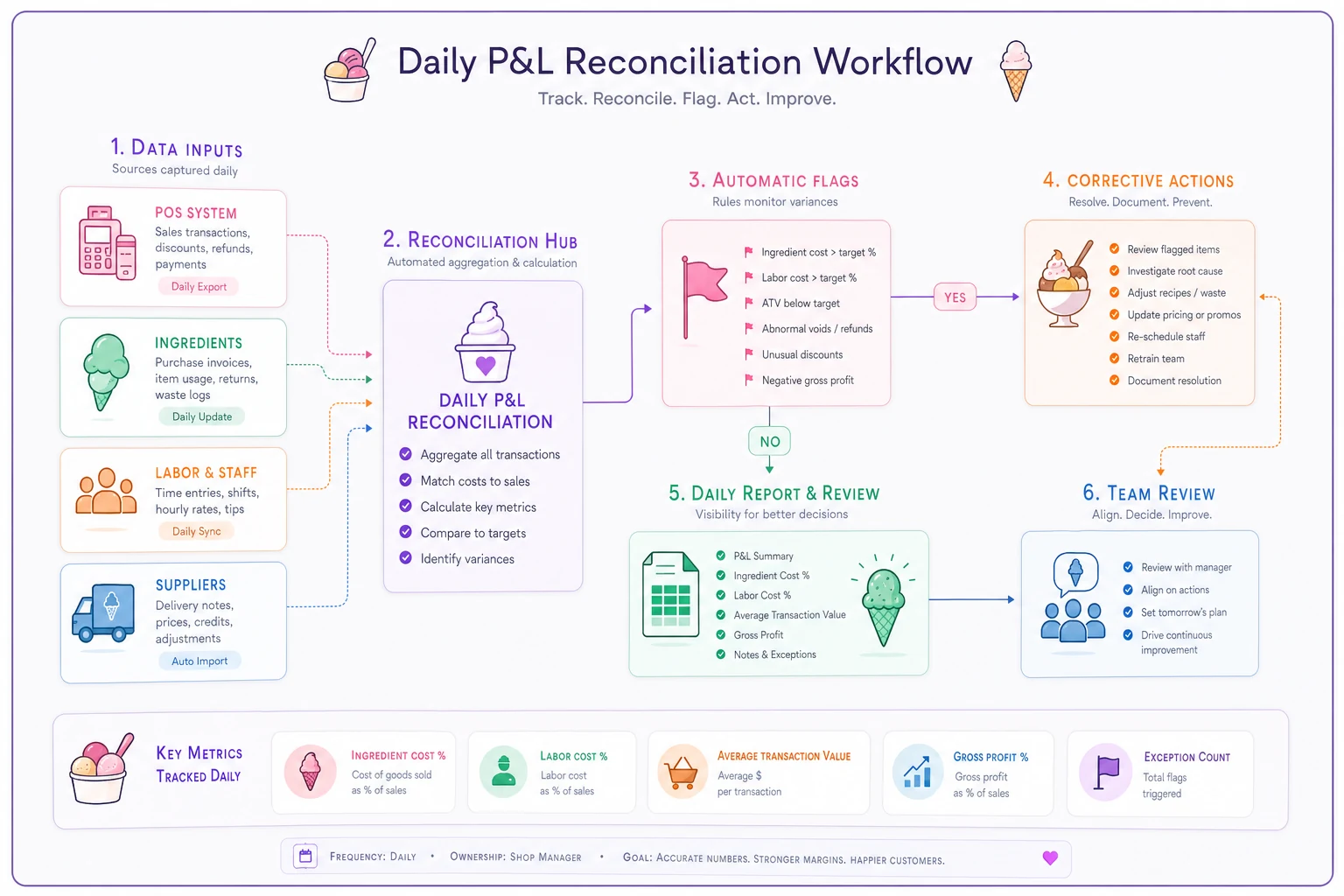
Use the flow as a checklist: collect metrics, run variance checks, trigger investigation, and implement corrective action within 24 hours.
Pricing communication that maintains customer trust
The worst response to ingredient spikes is surprise price increases without explanation. Customers feel ambushed and assume you're profiteering. The second worst is apologetic messaging that makes your business look weak.
Instead, frame price adjustments as temporary and specific. "Summer Market Pricing" on your menu board signals adjustment without permanence. Add a small sign: "Due to global sugar market conditions, prices reflect temporary adjustments. We're working hard to maintain quality while managing costs." Honest, specific, not apologetic.
Create offsetting value to soften the impact. Introduce a "Locals Hour" with previous pricing for regular customers. Offer a "Buy 9, Get 10th Free" card specifically during the spike period. These moves show you're sharing the burden, not just passing it through.
The psychology matters more than the math. A 50-cent increase on a $5 item feels less severe than a 35-cent increase on a $3.50 item, even though the percentage is identical. Price in round increments that feel deliberate, not desperate. $5.50 becoming $6.00 reads as strategic. $5.50 becoming $5.85 screams panic.
For regular customers, personal communication beats signage. When the Thursday night family comes in, briefly mention: "Hey folks, just so you know, our costs have gone up temporarily due to sugar prices, so you'll see slightly different pricing. We're doing everything we can to keep the impact minimal." That 30-second conversation prevents shock and often generates sympathy.
Building resilience against future spikes
This sugar spike won't be the last commodity shock your shop faces. Climate volatility, supply chain disruption, and global market dynamics guarantee future surprises. The shops that survive build operational resilience before the next crisis hits.
Start with supplier relationship depth. Knowing one distributor isn't enough anymore. Maintain active accounts with three suppliers even if you primarily use one. When prices spike, you have immediate alternatives without scrambling for new vendor approval. The $50 monthly minimum order from secondary suppliers is insurance premium, not waste.
Create an ingredient substitution matrix now, while you have time to test. Document which ingredients can substitute for others, at what ratios, with what flavor impact. When the next spike hits—whether cocoa, vanilla, or dairy—you have proven alternatives ready to deploy. Testing during calm periods beats desperate experimentation during crisis.
Financial buffers require discipline but save businesses. That 2% of gross revenue you should be setting aside monthly? Actually do it. Call it the "Commodity Volatility Fund" and treat it as untouchable except for ingredient spikes. Six months of disciplined saving creates enough buffer to absorb a 10% ingredient cost increase for 60 days while you adjust operations.
Build operational flexibility into your standard procedures. If your recipes only work with exact ingredients, your staffing only functions with specific schedules, and your pricing only makes sense at certain costs, you're brittle. Build 15-20% flexibility into every system—recipes that accommodate substitution, staff trained across multiple positions, and pricing tiers that can adjust without reprinting everything.
Making the tough calls: what to stop doing immediately
During margin compression, some standard practices become luxuries you can't afford. The hardest decisions involve stopping things that seem essential but actually drain profits.
Free samples need to stop or shrink dramatically. That sample spoon costs you 15-20 cents in product when ingredients spike. Multiply by 50 daily samples and you're losing $70-90 weekly. Switch to paid "mini scoops" at $1.50—customers wanting to try flavors still can, but you're not bleeding margin.
Wholesale accounts get reevaluated immediately. That local coffee shop buying 5 gallons weekly at wholesale pricing? When your margins compress to 10%, you're basically subsidizing their business. Either prices increase to maintain 20% margin or wholesale pauses until commodity prices stabilize. Harsh but necessary.
Promotional partnerships need renegotiation. The youth soccer league expecting donated sundaes for their fundraiser? Offer to sell at cost instead. The summer camp wanting bulk discount pricing? Show them your current ingredient costs and explain why last year's pricing impossible. Most partners understand when you're transparent about the situation.
Staff meals and tastings require new limits. Unlimited free ice cream for employees sounds generous but costs $500-800 monthly in lost product. Switch to one free single per shift or offer non-ice-cream alternatives. The team understands when you explain the alternative might be hour reductions.
Technical solutions for margin protection
Modern operational software transforms how shops respond to commodity volatility. Real-time cost tracking, automated reorder points, and integrated P&L analysis catch margin compression before it becomes critical.
AI-powered demand forecasting helps optimize production schedules around volatile ingredient costs. Instead of making standard batches regardless of demand, systems predict exact needs based on weather, events, and historical patterns. Reducing overproduction by 20% during high-cost periods directly protects margins.
Automated portion monitoring through POS integration reveals serving inconsistencies immediately. When transaction data shows single-scoop sales but inventory depletion suggests larger portions, you know training needs reinforcement. These systems catch problems in hours, not weeks.
Dynamic pricing engines adjust digital menu boards based on real-time costs. As ingredient prices fluctuate, pricing automatically maintains target margins without manual intervention. Customers see consistent margin-protected pricing while you avoid constant manual updates.
Integration between inventory, sales, and scheduling systems creates closed-loop margin protection. When ingredient costs spike, the system automatically adjusts production schedules, suggests menu modifications, and flags staffing inefficiencies. This coordinated response happens faster than manual management allows.
The next 90 days: your survival checklist
Surviving this sugar price spike requires immediate action across multiple operational areas. Here's your prioritized action plan:
| Phase | Actions |
|---|---|
| Week 1: Immediate triage | Audit current inventory and calculate true per-unit costs at new prices Contact secondary suppliers for price quotes Implement daily P&L tracking if not already active Brief staff on portion control importance Create customer communication about temporary pricing |
| Week 2-3: Operational adjustments | Test ingredient substitutions in small batches Redesign menu to emphasize lower-sugar items Establish supplier diversity with minimum orders Launch bundled pricing options Refine staff scheduling for maximum efficiency |
| Week 4-6: Stabilization | Roll out successful substitutions across full menu Negotiate forward pricing with suppliers where possible Implement automated tracking systems Develop contingency plans for further spikes Build commodity volatility fund |
| Week 7-12: Building resilience | Document all successful adaptations for future use Create standard operating procedures for price spikes Establish permanent supplier relationships Train backup staff on all positions Review and adjust pricing strategy based on results |
The shops that emerge stronger from this spike will be those that treated it as an operational wake-up call rather than a temporary inconvenience.
-
Audit current inventory and calculate true per-unit costs at new prices
-
Contact secondary suppliers for price quotes
-
Implement daily P&L tracking if not already active
-
Brief staff on portion control importance
-
Create customer communication about temporary pricing
-
Test ingredient substitutions in small batches
-
Redesign menu to emphasize lower-sugar items
-
Establish supplier diversity with minimum orders
-
Launch bundled pricing options
-
Refine staff scheduling for maximum efficiency
-
Roll out successful substitutions across full menu
-
Negotiate forward pricing with suppliers where possible
-
Implement automated tracking systems
-
Develop contingency plans for further spikes
-
Build commodity volatility fund
-
Document all successful adaptations for future use
-
Create standard operating procedures for price spikes
-
Establish permanent supplier relationships
-
Train backup staff on all positions
-
Review and adjust pricing strategy based on results
Every adjustment you make now—from supplier diversity to portion control to pricing strategy—builds resilience for the next disruption.
Because whether it's sugar, dairy, chocolate, or some commodity you haven't even considered, another spike is coming. The question isn't whether you'll face future margin pressure, but whether you'll have systems in place to respond without panic.
The work you do today determines whether the next spike is a crisis or just another operational adjustment.
Ready to scoop up efficiency and grow your shop?
Join hundreds of ice cream shops using Cremyly to boost productivity, reduce waste, and delight customers with faster service.