



The Conference Board's August number came in at 89.4, the lowest reading in seven months, and Reuters flagged it as a sign that households are getting more cautious about spending. If you run a scoop shop, that headline probably didn't move you much on the day it dropped. It shouldn't have. One month of softer sentiment doesn't decide your season.
What it does do is change the odds. And in a business where your cost of goods walks out the door melted if you guess wrong, playing those odds badly for three or four weeks is enough to erase a good July.
So skip the macro commentary. The useful question isn't "is confidence down?" It's "what does a cautious customer actually do differently at the counter, and how do I adjust before the freezer tells me I overbought?"
What a nervous customer actually changes (and what they don't)
Ice cream sits in a strange spot. It's discretionary, but it's cheap discretionary. When people pull back, they don't usually cut a $6 cone the way they cut a $60 dinner. What they cut is frequency and size.
-
Party size shrinks before visit count does. A family of four that used to buy four scoops starts buying two and sharing. Your transaction count holds, but average check slides.
-
Add-ons die first. Waffle cone upgrade, extra topping, the pint to take home "since we're here" — that's the discretionary layer on top of the discretionary purchase. It evaporates fast.
-
Trade-down inside the menu. Kids' size instead of regular. Cup instead of the specialty sundae.
-
Impulse dayparts flatten. The random 8
45pm walk-in on a weeknight is more sensitive than the planned Saturday afternoon trip.
Notice what's not on that list: people abandoning ice cream entirely. That's the good news, and it's also the trap. Your foot traffic can look basically fine while your margins quietly compress from the add-on side. Owners who only watch the door count miss it completely.
The mistake worth warning against most: cutting your base price. If people are still coming but spending less per head, a headline price cut just hands margin to the customers who were going to buy anyway. You've solved a demand problem you don't have and made your real problem — average check — worse.
The underlying issue this exposes: most shops forecast off last year, not off this week
A soft-confidence stretch punishes shops that plan on autopilot. If your ordering, your prep, and your schedule are all built on "what we did last August," a sentiment shift becomes an inventory shift you didn't budget for.
Keep your ice cream shop running smoothly.
Cremyly helps you manage every order, stock level, and staff shift with precision and ease.
- Real-time inventory tracking
- Order management dashboard
- Staff scheduling & shift coordination
No credit card required
The shops that ride it out cleanly have one thing in common: they run a short feedback loop between what actually sold yesterday and what they prep and staff for tomorrow. This is exactly why a lightweight demand-forecasting framework for seasonal, weather-driven dessert sales matters more in an uncertain month than in a normal one — you're not trying to predict the whole quarter, you're trying to catch a bend in the curve two weeks earlier than you otherwise would.
-
Average items per transaction start dropping (add-ons going first).
-
Your specialty and premium mix shrinks relative to core scoops.
-
Waste on slower-moving flavors creeps up because you kept prepping to old volume.
If you're tracking those three, you get a warning. If you're only tracking total sales, you find out at month-end.
Pricing moves that protect the check instead of collapsing it
The goal in a cautious stretch isn't to be cheaper. It's to give the customer a reason to not trade down, and to make trading up feel like the smart choice rather than an indulgence.
A few plays that work better than a flat discount:
Bundle the add-ons back in. Instead of charging $1.25 for a topping that people are now skipping, build a "scoop + topping + cone upgrade" combo priced so the perceived deal is obvious but your margin on the bundle still beats a lonely single scoop. You're not discounting — you're re-anchoring what a "normal" purchase looks like.
Protect your entry point, defend your top. Keep a genuinely cheap option visible (kids' cup, single scoop) so nobody feels priced out and walks. But keep your premium tier fully intact. The customers who trade down need a floor; the customers who don't care about the economy shouldn't be trained to expect discounts.
Sell the shareable. A caution response is often "let's split something." Lean into it. A two-person sundae or a flight of small scoops turns a party-shrink behavior into a slightly higher check than two individual small orders.
Here's a rough comparison of how three responses tend to play out over a soft four-week window:
| Response | Effect on traffic | Effect on avg check | Margin risk |
|---|---|---|---|
| Flat 15% off everything | Small bump, mostly existing customers | Drops hard | High — you paid to discount loyal buyers |
| Add-on bundles | Neutral to slightly up | Holds or rises | Low — protects mix |
| Shareable/flight items | Neutral | Modest rise | Low–medium — watch portioning |
| Do nothing | Flat | Slides quietly | Medium — spoilage from over-prep |
The bundle-and-shareable approach rarely produces a dramatic sales spike. What it does is keep the check from bleeding while your traffic is stable — which is the actual fight in a low-confidence month.
Staffing: match labor to a demand curve you're re-checking weekly
This is where soft months quietly kill margin, because labor is your one big lever that adjusts daily.
When impulse dayparts flatten first, the fix isn't cutting a whole shift — it's trimming the edges of shifts. That weeknight 8–10pm stretch that used to justify two people on the floor might now run fine with one plus an on-call. The Saturday rush stays fully staffed because planned trips hold up.
-
Monday pull last week's sales by daypart, compare to the two weeks prior, flag any daypart that dropped more than roughly 10%.
-
Tuesday rebuild the coming week's schedule against that signal, not the template.
-
Thursday confirm weekend staffing against the weather forecast — a cautious customer plus a gray Saturday is a double hit, and you don't want two extra people standing around.
The Conference Board's own consumer confidence release is a slow-moving macro signal; your daypart sales are the fast one. Use the macro read to raise your alertness, then let your own numbers drive the actual schedule.
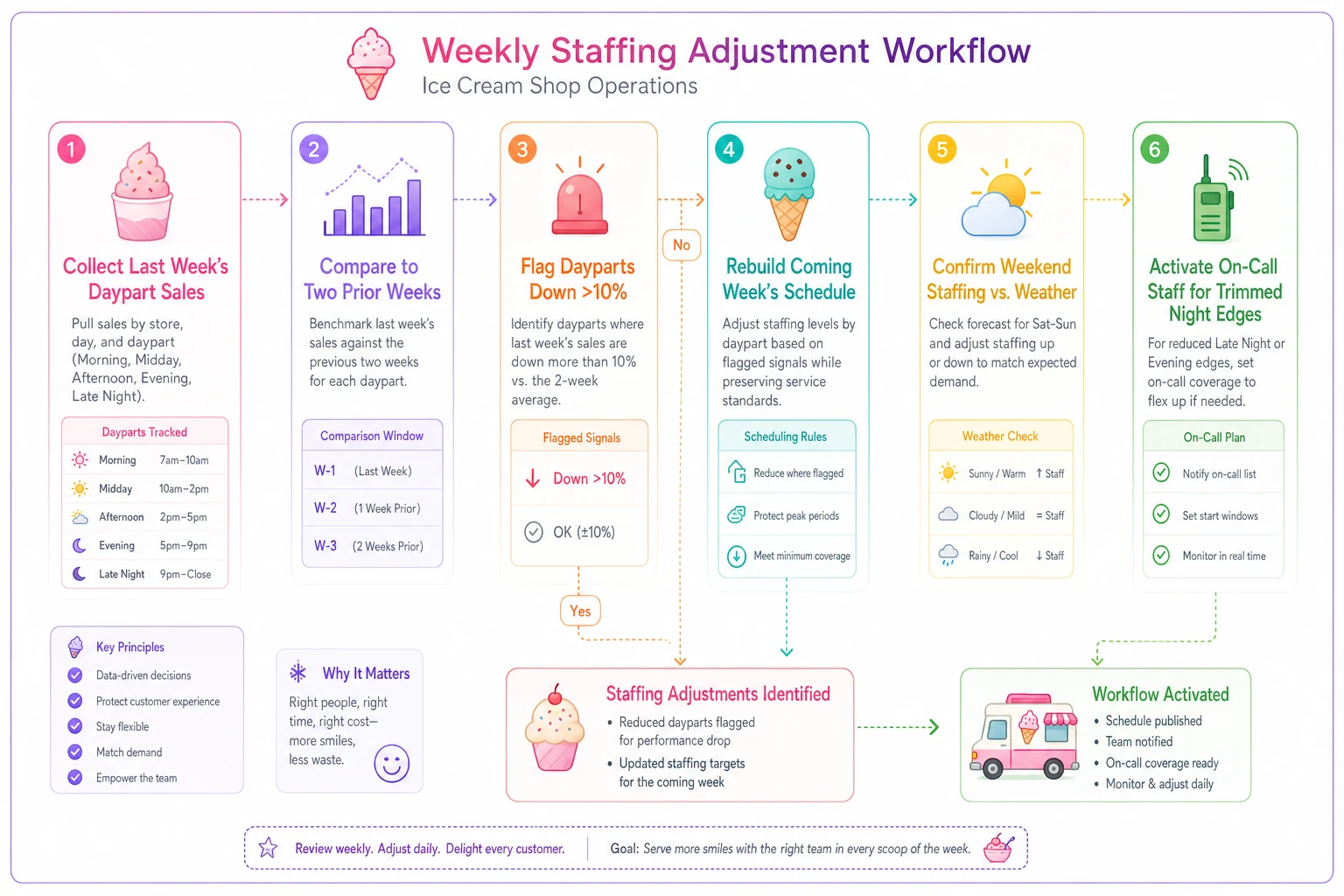
This illustrates the simple weekly rhythm to adjust staffing based on fast signals.
A short real scenario
A single-location shop in a mid-size downtown noticed foot traffic holding steady into late August — around 260–290 transactions a day, roughly in line with the prior year. On paper, fine. But their average check had slipped from about $9.40 to just under $8.30 over three weeks. Nobody flagged it because the door count looked normal.
The leak was entirely add-ons and premium mix: topping attach rate had fallen, and pint-to-go sales at the counter had nearly halved. Meanwhile they were still prepping specialty flavors to July volume, and weekly waste on two slower flavors had roughly doubled.
The corrections were unglamorous. They killed the standalone topping charge and rolled it into a $7.50 "loaded scoop" combo, put a two-spoon shareable sundae on the front of the menu board, cut about six hours a week off late weeknight coverage, and dropped specialty prep batch sizes by a third with tighter reorder triggers.
Traffic didn't change much over the next month — that wasn't the point. Average check recovered to just over $9, waste came back toward normal, and the labor trim quietly added back a few margin points. No price war, no dramatic swing. Just closing the leaks a soft month tends to open.
Where the ordering discipline actually comes from
None of the above works if your inventory keeps chasing last year's numbers. The single biggest avoidable loss in a cautious stretch is prep-and-order volume that never got adjusted down. You can nail pricing and staffing and still throw margin in the trash because you batched to a demand level that quietly left.
This is the boring backbone: reorder points and prep batches that respond to recent sell-through, not the calendar. Tie your batch sizes to a rolling read of the last 10–14 days and you stop over-committing perishable stock the moment the curve bends. It's the same forecasting habit that helps in a heat wave or a slow week — you're just applying it to a demand signal that's coming from sentiment instead of weather.
Tie your reorder triggers to the last 10–14 days of sell-through, not last year's calendar dates.
Plenty of shops run this on a whiteboard and a POS export, and that's genuinely fine for one location. The value isn't the tool — it's the discipline of looking at the right three numbers (items per transaction, premium mix, slow-flavor waste) often enough to act while it still matters.
A quick checklist for the next four weeks
Pull average check and items-per-transaction weekly, not just total sales
-
Track topping/add-on attach rate as an early-warning number
-
Convert standalone add-ons into value-anchored bundles
-
Keep a visible cheap entry option; do not discount your premium tier
-
Add or promote at least one shareable item
-
Trim shift edges on soft dayparts before cutting whole shifts
-
Re-check weekend staffing against weather every Thursday
-
Cut specialty prep batch sizes and tighten reorder triggers on slow movers
-
Review flavor-level waste weekly and drop the two worst offenders' volume first
Track topping/add-on attach rate as an early-warning number
Bottom line — but not the tidy kind
A single soft confidence reading isn't a crisis. What it should do is shorten your reaction time. The shops that get hurt in months like this aren't the ones with lower traffic — traffic usually holds. They're the ones who kept prepping, ordering, and staffing to a demand level that quietly walked out the door, and only noticed at month-end when the P&L was already set.
Watch the check, not just the count. Protect your mix instead of your headline price. Adjust your prep to what sold last week, not last year. That's the whole game in a cautious stretch — and it's a habit worth keeping long after confidence ticks back up.
A single soft confidence reading isn't a crisis. What it should do is shorten your reaction time. The shops that get hurt in months like this aren't the ones with lower traffic — traffic usually holds. They're the ones who kept prepping, ordering, and staffing to a demand level that quietly walked out the door, and only noticed at month-end when the P&L was already set.
Watch the check, not just the count. Protect your mix instead of your headline price. Adjust your prep to what sold last week, not last year. That's the whole game in a cautious stretch — and it's a habit worth keeping long after confidence ticks back up.
Ready to scoop up efficiency and grow your shop?
Join hundreds of ice cream shops using Cremyly to boost productivity, reduce waste, and delight customers with faster service.