



Diesel just hit a record. On-highway prices climbed to around $6.30 a gallon in mid-September 2026, and that number isn't staying on the trucking balance sheets — it walks straight into your invoices through surcharges, raised minimums, and quietly reduced delivery frequency. CNBC's reporting on how record diesel prices ripple through the economy laid it out plainly: freight-heavy food supply chains feel this within weeks, not months.
For a scoop shop, the timing is rough. You're closing out summer volume, cash is softer heading into fall, and your dairy and tub orders are among the most freight-sensitive things you buy. This also isn't quite the same as a commodity price story — sugar moving, cocoa spiking. The product costs roughly the same at the plant. Getting it to your door costs more. That distinction matters for how you respond.
Why diesel hits ice cream shops differently than other food businesses
A dry-goods restaurant can shrug off a delivery surcharge by consolidating orders and holding more inventory. You mostly can't. Your core inventory is perishable and frozen, so you can't just buy ahead to dodge freight increases the way a pizza place stockpiles flour.
That's the core tension of a diesel fuel spike supply chain ice cream shop problem: the obvious defense — order less often, order bigger — runs straight into freezer capacity and freeze/thaw risk. Order too much and you're paying in spoilage and energy what you saved in freight. Order too little and you eat surcharges and minimum-order penalties every single week.
What usually gets missed is this: most shops only look at the unit price of a tub when evaluating a supplier. Freight pressure forces you to think about landed cost per usable scoop — product plus freight plus the storage and waste that your ordering pattern creates. When freight was cheap, those last two pieces were rounding errors. They're not anymore.
The hidden cost most owners don't track until it's too late
The sneaky part of a freight spike isn't the surcharge line — you can see that. It's the second-order changes suppliers make to protect their own margins:
Keep your ice cream shop running smoothly.
Cremyly helps you manage every order, stock level, and staff shift with precision and ease.
- Real-time inventory tracking
- Order management dashboard
- Staff scheduling & shift coordination
No credit card required
-
Reduced delivery days. Your supplier quietly moves your route from twice-weekly to weekly.
-
Higher order minimums. The $300 minimum becomes $500 to justify the stop.
-
Soft fuel surcharges. A percentage tacked on that fluctuates and rarely gets questioned.
-
Slower substitution responses. When they're short on your flavor base, they're less willing to make a special run.
Any one of these quietly reshapes your inventory math. A shop that was comfortable running lean on a Tuesday/Friday delivery cadence suddenly has to hold six or seven days of stock on a single weekly drop. That's a different freezer plan, different reorder points, different spoilage exposure — all triggered by a fuel price most owners think is someone else's problem.
A typical example: a single-store shop doing somewhere around $18k–$22k a month in summer gets moved from two deliveries to one. To cover the gap, they start holding roughly 30% more frozen inventory. Their freight cost per delivery drops, which feels like a win — until end-of-month waste creeps up by a few hundred dollars and the freezer energy bill climbs during the same heat they're already fighting. Net savings: close to zero, sometimes negative.
A fast triage: what to check this week
Before renegotiating anything, get your actual exposure on paper. This takes an afternoon.
-
Pull your last 8 weeks of supplier invoices. Highlight every freight line, surcharge, and minimum-order fee separately from product cost.
-
Calculate freight as a percentage of each order. Anything above 6–8% is worth a conversation. Above 12% is a red flag.
-
List which items are single-sourced. Those are your leverage-free zones and your biggest risk if a surcharge sticks.
-
Map delivery frequency to freezer capacity. If a cadence change would push you past safe storage limits, flag it now.
-
Identify your top 5 items by total spend. Freight savings on these move the needle; everything else is noise.
The point isn't to panic. It's to figure out where a 3–4% freight bump actually threatens margin versus where it's annoying but manageable. Most shops find two or three items carrying almost all the pain, and the rest barely matters.
Renegotiating without blowing up your supplier relationship
Suppliers are getting squeezed too, so going in aggressive rarely works. What tends to work is giving them a way to keep your business profitable for them while protecting you.
-
Offer order consolidation in exchange for a frozen surcharge cap. "I'll move to one weekly drop and hit your higher minimum if you cap the fuel surcharge at X%." You're trading route efficiency for cost predictability.
-
Ask for a fixed freight rate over a 60–90 day window. Even if it's slightly higher than today's rate, predictability lets you price with confidence.
-
Group orders with a neighboring shop on the same route. Two scoop shops splitting a delivery is a real argument for keeping both minimums reasonable.
The table below shows how the same freight increase plays out depending on how you respond:
| Response approach | Freight cost impact | Inventory/waste risk | Margin outcome |
|---|---|---|---|
| Do nothing, absorb surcharges | +3–5% on landed cost | Low | Slow margin erosion |
| Order less often, bigger loads | Freight per order drops | High (spoilage, energy) | Often net neutral |
| Consolidate + negotiate cap | Moderate, predictable | Low–moderate | Best protected |
| Switch to cheaper distant supplier | Variable, freight-heavy | Moderate | Usually a trap |
That last row is where shops get burned. A cheaper per-unit price from a supplier farther away can look great on the quote and terrible on the invoice once freight is loaded in. Distance is the enemy during a diesel spike. Closer is almost always cheaper right now, even if the sticker price is higher.
A simple workflow to negotiate and consolidate deliveries:
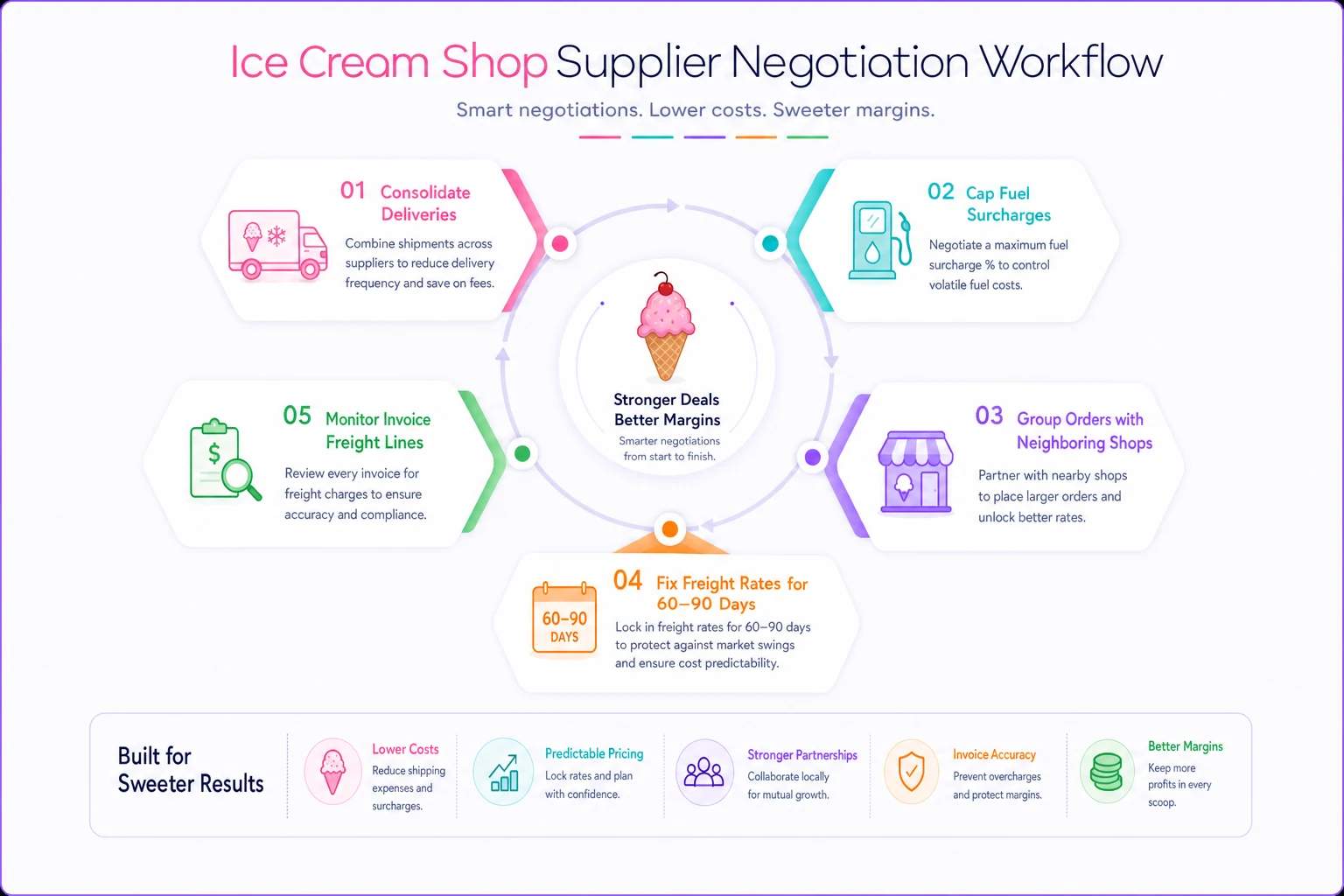
Use this flow as a checklist when you call your supplier.
The pricing question nobody wants to deal with
Freight pressure eventually forces a menu conversation, and the instinct is to raise the price of a scoop across the board. That's usually the wrong move. A broad price increase is the most visible, most resented thing you can do, and it rarely matches where the cost actually landed.
The tactical buying and pricing logic in our guide on responding to a sudden sugar and dairy price spike maps directly onto freight — the trigger is different, but the approach is identical: isolate the affected items, protect your anchor prices, and move quietly on the rest.
When a price increase actually makes sense
-
Your freight-loaded landed cost on a core item has climbed and shows no sign of easing.
-
You've already exhausted consolidation and negotiation options.
-
Your anchor items can stay untouched while you adjust premiums.
When it's a bad idea
-
The surcharge looks temporary and you can probably ride it out a few weeks.
-
You haven't checked whether reordering cadence could offset the hit first.
-
You'd be raising the exact price customers use to size up your shop.
Protect the price customers use to decide whether you're "expensive," and recover margin on the items where a small bump goes unnoticed.
A real scenario
A two-location shop in a mid-size metro was running both stores off one regional dairy supplier, with twice-weekly deliveries to each. When the diesel spike hit, the supplier added a fuel surcharge of about 6% and bumped the minimum order.
Instead of absorbing it, the owner did two things. First, they synced both stores' orders to a single consolidated weekly delivery per location, hitting the higher minimum cleanly rather than paying small-order penalties. Second, they negotiated a surcharge cap in exchange for that committed volume — the supplier preferred one predictable large stop over two scattered small ones.
Freight as a share of spend dropped back toward where it had been before the spike, saving a few hundred dollars monthly across both locations. The tradeoff was holding more inventory, so they tightened their rotation checks and nudged a couple of premium menu prices to cover the residual. Nothing dramatic — just a return to roughly their pre-spike margin instead of watching it bleed week after week.
The lesson wasn't clever negotiation. It was treating freight as something to actively manage instead of a fixed cost of doing business.
Keeping the whole thing from falling apart in practice
The operational trap here is tracking. A freight spike creates a bunch of small moving pieces — new cadences, surcharge caps, shifted minimums, item-level price changes — and if those live in someone's head or on a sticky note, they drift. Three weeks later nobody remembers what the agreed surcharge cap was, the invoice has crept up, and you're back where you started.
This is where having supplier terms, reorder points, and landed-cost math centralized actually pays off. Whether that's a well-built spreadsheet or an operational platform that flags when an invoice's freight line exceeds your negotiated cap, the goal is the same: make the drift visible. The shops that hold margin through a spike aren't the ones with the best negotiation skills — they're the ones who notice fast when a supplier quietly walks a rate back up. AI-assisted operational tools help here mostly by catching the numbers you'd otherwise only see at month-end, but even a disciplined manual review beats flying blind.
Track surcharge caps and delivery cadences in a single spreadsheet tab so you can spot slips before month-end.
The EIA's weekly diesel price data is worth bookmarking for exactly this reason — you can see whether the spike is easing before you lock in a long surcharge agreement or make permanent menu changes.
Bottom line
A diesel spike isn't a commodity problem you wait out — it's a logistics problem you manage. The product didn't get more expensive; moving it did. That opens specific levers most owners never pull: consolidating cadence, capping surcharges, sourcing closer, and pricing surgically instead of across the board.
Do the afternoon triage. Find the two or three items carrying the real pain. Negotiate predictability over the lowest sticker price. And keep the terms somewhere you'll actually notice when they slip. Freight pressure will ease eventually, but the shops that come through with margins intact are the ones who treated it as something to operate against — not just absorb.
Ready to scoop up efficiency and grow your shop?
Join hundreds of ice cream shops using Cremyly to boost productivity, reduce waste, and delight customers with faster service.