

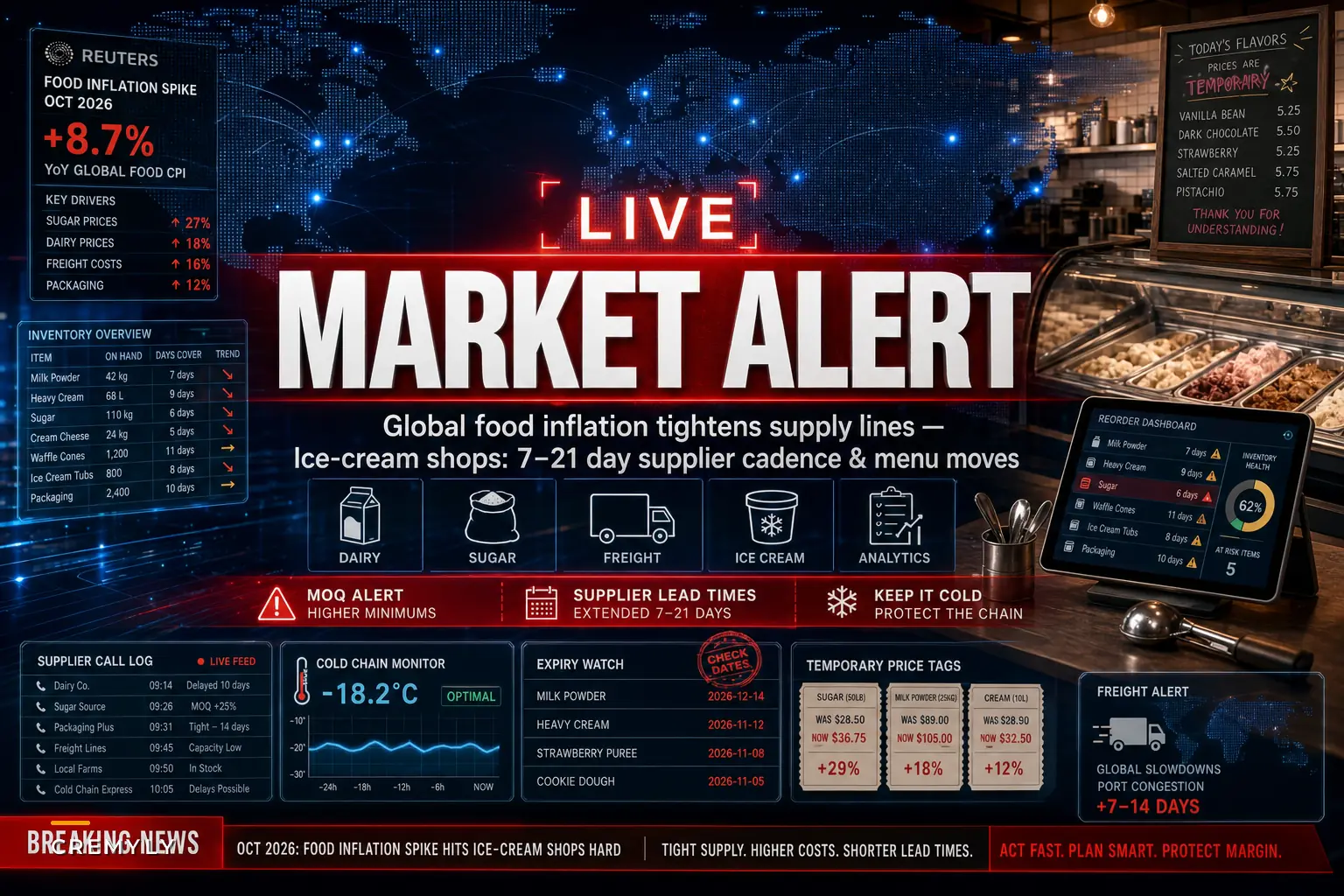

Wheat is up more than 30% year-to-date. Shipping risk is back on the table. Weather patterns and scattered supply shocks are stacking on top of each other, and the forecasts aren't optimistic. Reuters reported on October 19 that global food inflation is expected to intensify as supply shocks pile up, and a follow-up Reuters poll a week later suggested elevated inflation will likely stick around into next year.
For a scoop shop, this isn't abstract macroeconomics. It shows up as a dairy invoice that's 8% higher than last month, a packaging rep who suddenly wants you to order two cases of pint lids instead of one, and a cone supplier whose "next available delivery" quietly slid from Tuesday to Friday. The mistake most owners make in a moment like this is treating it as a pricing problem. It's not — it's a cadence problem first. How often you order, how much you're forced to buy each time, and how long it takes to arrive — those three levers move before your menu prices ever need to. This playbook is about getting those right in the next 7 to 21 days.
Why cadence breaks before price does
When input costs climb, suppliers don't just raise prices. They quietly change how they do business with you, and those changes hit your margin in ways that don't show up on the per-unit price sheet.
A distributor facing their own freight surcharges wants fewer, bigger deliveries. So they nudge up your minimum order quantity, stretch your delivery window, or add a small-order fee. On paper, the price per gallon of base mix looks almost the same. But now you're holding 40% more inventory than your freezer was designed for, your cash is tied up in product that might melt-risk before you sell it, and your reorder rhythm is thrown off.
The food inflation supplier cadence problem for an ice cream shop is really this: your ordering system was tuned for a stable world, and that world just got bumpier. A reorder point that made sense when lead time was two days is dangerous when lead time is now five and unpredictable.
A typical example: a single-location shop was reordering waffle cones every Monday — roughly 6 cases — with a Wednesday delivery. Their supplier shifted to a $75 minimum and a once-weekly truck. Suddenly the shop either overbuys (tying up dry storage and risking stale cones) or underbuys and runs out mid-weekend. Neither is a pricing issue. Both are cadence failures that quietly cost money.
The first 72 hours: find out what actually changed
Before you touch a single menu price, you need to know what your suppliers are doing right now, not what their last contract said. Most of the damage in a cost spike comes from owners reacting to last month's terms.
Keep your ice cream shop running smoothly.
Cremyly helps you manage every order, stock level, and staff shift with precision and ease.
- Real-time inventory tracking
- Order management dashboard
- Staff scheduling & shift coordination
No credit card required
-
Has my MOQ changed, or is it about to?
-
What's your current realistic lead time — not the best case, the honest one?
-
Are there new surcharges (fuel, small-order, handling) that weren't on my last invoice?
-
Which of my regular items are you having trouble sourcing consistently?
Write the answers down somewhere everyone can see them. You're building a snapshot of your real supply picture, and it will probably look different from what you assumed.
The mistake here is assuming your relationship protects you. It helps, but a distributor's own supplier shocks flow downhill regardless of how friendly your rep is. The owners who get hurt are the ones who find out about a lead-time change when the truck doesn't show up on a Saturday.
Recalculating reorder points when lead times get shaky
Your reorder point is just: how much you use during the lead time, plus a safety buffer. When lead time stretches and gets less reliable, both halves of that equation move.
Here's the math worth running for your core perishables. Take your average daily usage, multiply it by your new realistic lead time, then add a safety buffer sized to how unreliable that supplier has become.
| Item | Daily usage | Old lead time | New lead time | Old reorder point | New reorder point |
|---|---|---|---|---|---|
| Dairy base (gal) | ~12 | 2 days | 4 days | ~30 gal | ~60 gal |
| Pint containers | ~45 | 3 days | 6 days | ~160 | ~320 |
| Waffle cones (case) | ~1 | 2 days | 5 days | ~3 cases | ~6 cases |
| Chocolate topping | ~2 lb | 4 days | 7 days | ~10 lb | ~18 lb |
Two things jump out when you actually run this. First, your reorder points roughly double on several items — which means more cash tied up and more freezer and storage pressure. Second, perishables and shelf-stable items behave completely differently. You can carry a bigger buffer of pint lids without much risk. You cannot do that with dairy base, because a bigger buffer just moves you closer to quality limits and freeze/thaw issues.
So the correct move isn't "order more of everything." Carry deeper buffers on shelf-stable items that won't spoil, and protect yourself on perishables through a second source or a more frequent (even if smaller) delivery — not through volume.
That distinction — matching buffer strategy to spoilage risk — is where most inventory plans fall apart under pressure. It's also why your supplier portfolio strategy for perishables matters more during a cost spike than during calm periods. A single dairy source is fine when deliveries are reliable. It becomes a liability the moment that supplier's own lead times start wobbling.
MOQs: the trap that looks like savings
New or raised minimum order quantities are where a lot of owners accidentally donate their margin back.
The pitch always sounds reasonable. "Order three cases instead of one and I'll hold the price." If it's a shelf-stable item you'll definitely use, great — take it. But run the holding-cost gut check first: how long will that larger quantity sit, and what's the spoilage or staleness risk over that window?
-
Shelf-stable, high-turnover (cups, spoons, napkins) Accepting a higher MOQ is usually smart. You'll burn through it, and you're locking a price.
-
Shelf-stable, slow-turnover (specialty toppings, seasonal mix-ins) Be careful. A three-month supply of a topping you use twice a week is dead cash.
-
Perishable (dairy, fresh fruit purées, some sauces) A higher MOQ is often a trap. The "savings" evaporate the first time you discard product.
A real scenario: a small two-unit operation was offered a 6% discount on dairy base for doubling their order. The owner almost took it. When they actually mapped usage against freeze windows across both locations, they realized the larger order would push roughly a fifth of each delivery past its ideal-use window on slower midweek days. The 6% "savings" would have been eaten by around 12–15% waste on the excess. They declined, kept the smaller cadence, and split a portion of the order between both sites instead — which smoothed usage without carrying dead inventory.
Menu and pricing moves that don't scare off regulars
Only after cadence and reorder points are stable should you touch the menu. And when you do, think surgical moves — not an across-the-board price hike that your regulars will notice and resent.
A broad 10% increase feels efficient to the owner and feels like a betrayal to the customer who comes in every Friday. Smaller, targeted changes protect margin with far less backlash.
-
Reprice your most cost-exposed items, not everything. If dairy and chocolate are spiking, the triple-scoop sundae took the biggest hit. Adjust that, leave the single scoop alone.
-
Shrink the gap between sizes. Raising the price of a small slightly less than the large nudges people toward the size with better margin for you.
-
Rotate expensive mix-ins to "limited." Moving a costly topping from standard to a featured limited-time add-on lets you charge for it explicitly instead of eating the cost silently.
-
Lean into flavors built on cheaper, stable inputs. If wheat-based cones and certain imported ingredients are the pressure points, feature cup-based or house-made options that route around them.
-
Protect one or two "anchor" prices. Keep your single scoop and your kids' cup at the same price if you possibly can. These are the prices people remember. Everything else has more room.
Customers anchor on a few signature prices and barely track the rest. Defend the anchors, adjust around them.
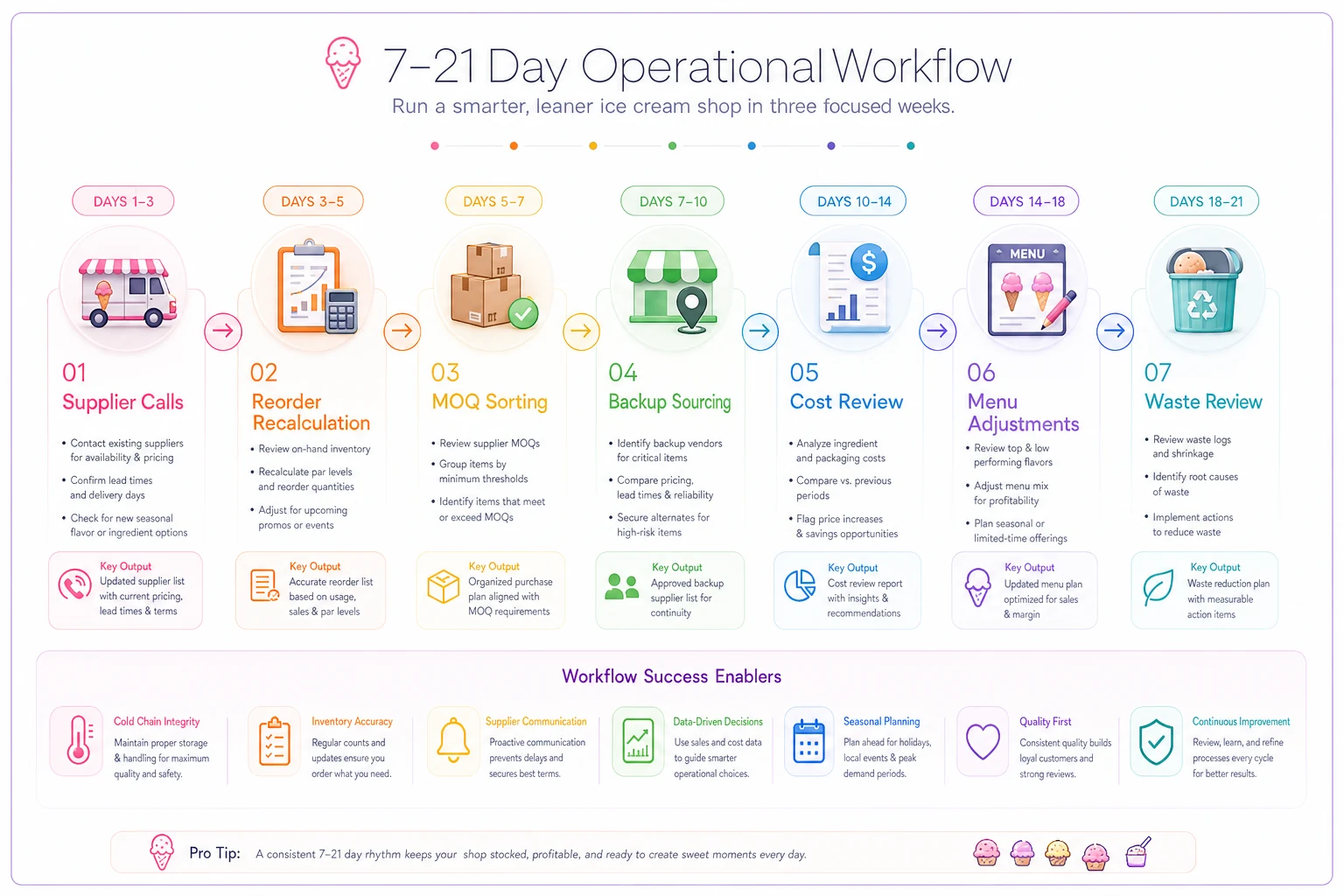
A 7–21 day sequence you can actually run
Here's the order of operations that keeps you from skipping steps and panicking into a bad menu change.
-
Days 1–3 Call top suppliers, capture real MOQs, lead times, surcharges, and at-risk items. Build your supply snapshot.
-
Days 3–5 Recalculate reorder points for core items using the new lead times. Flag anything where your freezer or storage can't physically hold the new buffer.
-
Days 5–7 Sort every raised-MOQ offer into shelf-stable vs. perishable. Accept the smart ones, decline the traps.
-
Days 7–10 Line up or confirm a backup source for your two most cost-exposed perishables. Even a verbal "yes, we can supply you" is worth having.
-
Days 10–14 Identify your 3–5 most cost-exposed menu items. Run updated per-item cost math on just those.
-
Days 14–18 Make surgical menu and pricing adjustments. Protect your anchor prices. Update any specials to route around the hardest-hit inputs.
-
Days 18–21 Review waste and melt-reject numbers against the new, larger buffers. If anything's spiking, your reorder point is too high — pull it back.
Here's a simple visual if the list helps — the run of calls, calculations, and confirmations in order.
The step people skip is the last one. They build bigger buffers to feel safe, then never check whether those buffers are quietly increasing waste. Larger inventory and higher waste often travel together, and in a cost spike that's exactly the combination you're trying to avoid.
Where this gets hard to manage by hand
Everything above is doable with a spreadsheet and some discipline. The trouble is that during a cost spike, the variables move weekly, and a spreadsheet is a snapshot of a moment that's already passed.
This is where operational software earns its keep — not because it's clever, but because it keeps the moving parts in sync. When your system already tracks daily usage, lead times, and supplier terms, recalculating reorder points after a lead-time change becomes a quick adjustment rather than an afternoon of manual math. Platforms that connect your POS sales data and inventory movement can flag when a buffer is quietly driving waste up, or when an item's reorder point hasn't kept pace with a supplier's slower truck. The value isn't automation for its own sake — it's that you stop finding out about a problem from an empty freezer on a Saturday.
A lightweight setup that watches usage against reorder points and surfaces the handful of items that need attention each week turns this from a fire drill into routine maintenance. You still make the calls. You're just not rebuilding the whole picture from scratch every time a supplier changes terms.
When to hold the line, and when to just absorb it
Not every cost increase deserves a response. If your dairy goes up 2% and you're carrying healthy margin, absorbing it quietly may protect customer goodwill better than any price move. Chasing every small input bump with a menu change trains your customers to expect instability and trains your staff to re-learn prices constantly.
Act decisively when: a core input jumps meaningfully (high single digits or more), a supplier's cadence change forces you into risky inventory levels, or multiple inputs rise at once and start compounding on your most popular items.
Hold off when: the increase is small, limited to a single low-volume item, or likely temporary — and you have the margin to ride it out for a few weeks while you watch where it's heading.
The owners who come through a period like this in the best shape aren't the ones who reacted fastest. They're the ones who fixed cadence first, protected their perishable sourcing, and made small confident menu moves instead of one loud panicked one. Food costs will keep moving — the Reuters poll suggests that's the environment for a while. The shops that treat their ordering rhythm as the first line of defense, and pricing as the last, are the ones whose margins actually hold.
Ready to scoop up efficiency and grow your shop?
Join hundreds of ice cream shops using Cremyly to boost productivity, reduce waste, and delight customers with faster service.