

Most scoop shops don't lose their main supplier dramatically. There's no email that says "we're dropping you." What happens is quieter and worse: your delivery shows up a day late during a July heat wave, two of your top flavors are backordered, the substitution they sent has a different butterfat spec, and now you're reworking your whole freezer plan on a Saturday morning with a line out the door.
That's the real failure mode. Not catastrophe. Just friction that compounds until it eats your margin and your weekend.
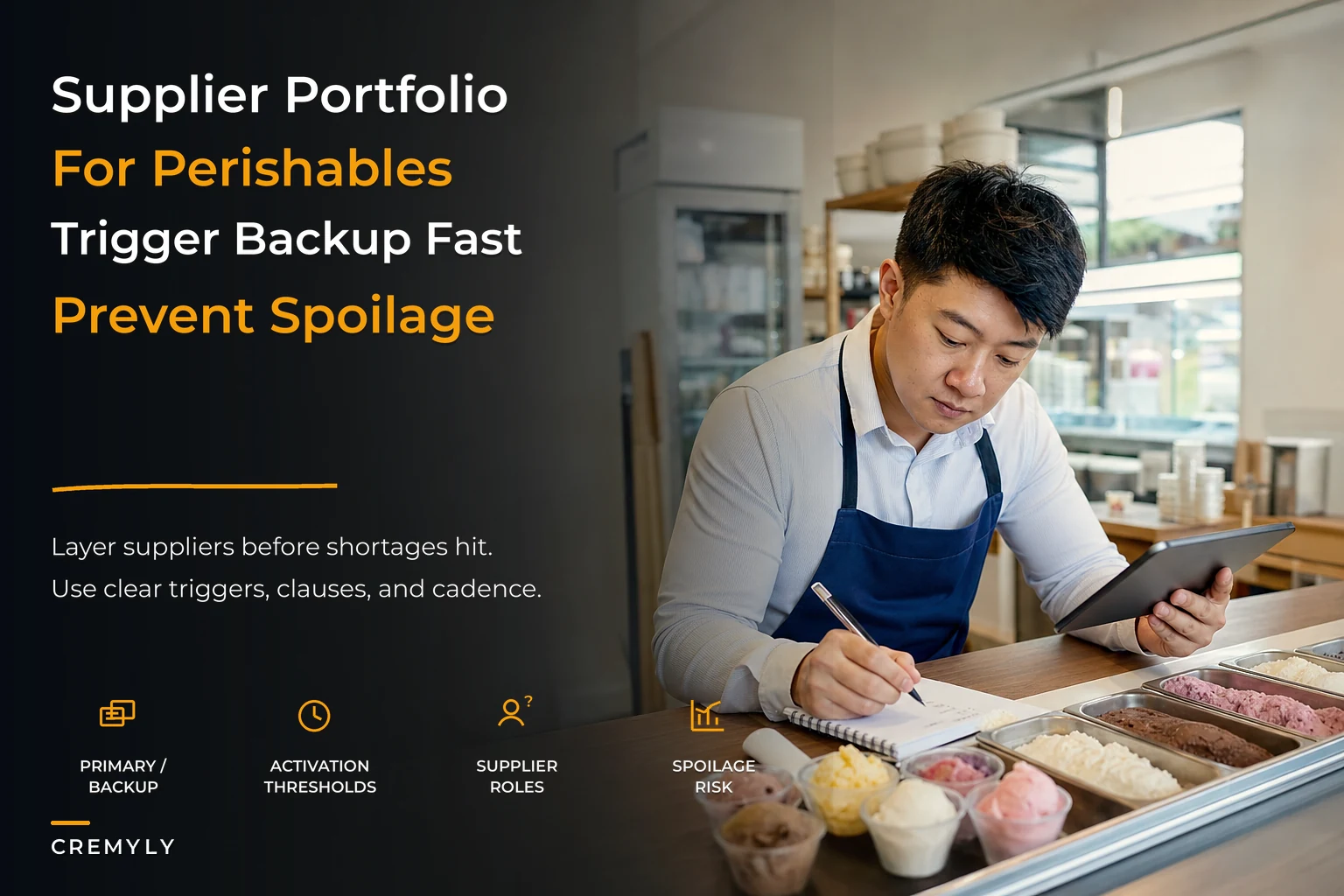
A supplier portfolio for perishables isn't about having a fat binder of backup vendors you've never called. It's a structure — layers of suppliers with defined roles, clear activation rules, and rehearsed muscle memory so that when the primary wobbles, the response is boring and automatic instead of frantic. The whole point is to take a single-supplier risk and spread it thin enough that no one event can knock out your service or spike your food cost.
This is the design template. Not tips. A system you can actually copy.
Why single-supplier dependence quietly runs most shops
The pattern across small frozen-dessert operations is pretty consistent: one distributor handles 80–90% of dairy base, mix, and dry goods because consolidating onto one invoice is simpler and usually gets you a better price tier. Totally rational. Until it isn't.
The dependence builds invisibly because it works most of the year. You only find out how exposed you are when something breaks during your highest-demand window — which, for a scoop shop, is exactly when you have zero slack to absorb it.
-
You can't stockpile your way out. Cream and mix have freeze/thaw windows and finite shelf life. Buying three weeks ahead to hedge a supplier risk often just converts a supply problem into a spoilage problem.
-
Substitutions change your product. A backup mix with different fat content or stabilizers changes overrun, texture, and scoop weight. Your customers notice even if you don't announce it.
-
Lead times are tight and seasonal. The same heat wave that spikes your demand also strains your supplier's cold chain and routing.
So the exposure isn't just "what if they disappear." It's "what if they're 70% reliable during the 10 weeks that make my year." That's the problem a portfolio solves.
The four-layer portfolio structure
Think of your supplier base in layers, each with a defined job. The mistake most owners make is treating every alternate vendor as the same kind of "backup" — when really they serve totally different purposes and activate at different moments.
Keep your ice cream shop running smoothly.
Cremyly helps you manage every order, stock level, and staff shift with precision and ease.
- Real-time inventory tracking
- Order management dashboard
- Staff scheduling & shift coordination
No credit card required
| Layer | Role | % of normal volume | When it runs | Relationship depth |
|---|---|---|---|---|
| Primary | Your workhorse. Best price, best terms, main volume | 70–85% | Always | Deep, contracted |
| Tactical backup | Pre-qualified, order-ready, slightly worse pricing | 10–20% | Primary slips on fill rate or timing | Warm, lightly contracted |
| Emergency | Fast fulfillment, you'll overpay, product may differ | Whatever you need, now | Primary + tactical both fail | Transactional but tested |
| Spot/flex | Opportunistic — seasonal items, specialty, price arb | Variable | When price or availability favors it | Loose |
The layers that matter most and get ignored most are the tactical backup and emergency. The primary takes care of itself. The spot layer is nice-to-have. But the middle two are where survival lives, and they're the ones nobody maintains because they feel like wasted effort when things are calm.
A tactical backup you order from occasionally stays alive. A backup you've never ordered from is a phone number, not a supplier. If your tactical layer sits at exactly 0% all year, it will fail you the first time you need it — their system won't have you set up, their rep won't recognize your shop, and your "pre-negotiated" terms will turn out to be a conversation someone forgot.
That's why the portfolio design includes keeping each layer warm, which we'll get to.
Activation thresholds: the part everyone skips
A portfolio without activation triggers is just a contact list. The whole mechanism depends on knowing — in advance, written down — exactly what makes you pull the next layer off the bench.
The goal is to remove judgment from the moment of stress. When it's 4pm on a Friday and your delivery didn't come, you don't want to be deciding whether to escalate. You want a rule that already decided for you.
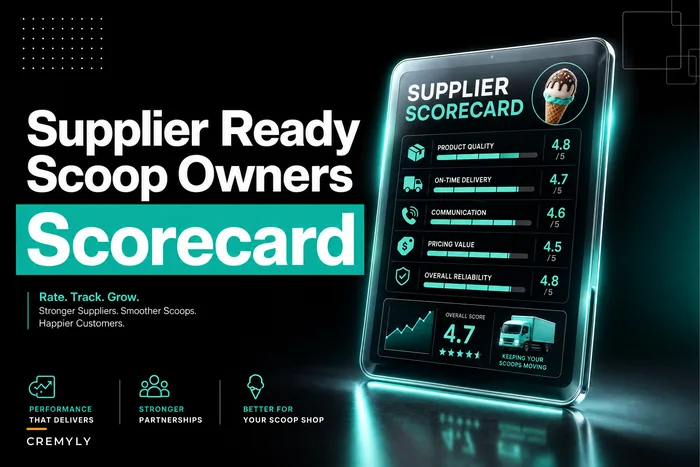
Build your thresholds around measurable signals you already track (or should — this ties directly into your supplier scoring, and if you haven't set that up, the supplier scorecard and fast-backup onboarding guide walks through the on-delivery audit that feeds these numbers).
-
Fill-rate trigger (tactical) Primary delivers under ~90% of ordered line items for two consecutive deliveries → shift ~15% of next order to tactical backup.
-
Timing trigger (tactical) Two late deliveries in a rolling 14-day window during peak season → place a parallel standing order with tactical to cover the gap.
-
Quality trigger (tactical or emergency) Any rejected lot on temp or spec → immediate replacement order to tactical; if tactical can't make the window, escalate to emergency.
-
Hard-out trigger (emergency) Primary confirms they can't fulfill a critical item within your freeze-window buffer → emergency order, same day.
-
Price trigger (spot/flex) A core input jumps beyond a set threshold and tactical or spot can beat it meaningfully → split the order to cap exposure.
The number you choose matters less than the fact that it's fixed and visible. A 90% fill-rate line might be too strict for one shop and too loose for another. Set it once, watch it for a season, adjust. What you can't do is leave it undefined and hope you'll "know it when you see it" — in the moment you'll always rationalize waiting one more day, and one more day is often exactly the day you run out.
The mini-MOQ problem (and activation scripts)
Here's the practical snag nobody warns you about. Your tactical and emergency suppliers have minimum order quantities built for regular customers. When you activate them mid-crisis for a partial fill, you're often forced to either overbuy to hit their MOQ — which risks spoilage — or get told no.
The fix is to negotiate mini-MOQ activation terms before you need them, so your backup layers will take a smaller emergency order without the full minimum. This is a small ask when you're a calm prospect and an impossible ask when you're a desperate 4pm phone call.
Setting up the mini-MOQ in advance (calm conversation):
> "We'd love to add you as a backup supplier. Realistically we'd order from you a few times a season, maybe more if things break. Our normal full order would be [X], but for backup activations I need to be able to place a partial — say 30–40% of that — on short notice. Can we set that up as a standing arrangement so I'm already in your system when I call?"
Activating during a gap (the real moment):
> "This is [name] at [shop] — we're set up as backup account [#]. Primary fell short on [item], I need [small quantity] to cover through [day]. This is the backup-order arrangement we agreed on. Can you get it on the next truck to us?"
The difference between those two calls is everything. The first one makes the second one possible. The second one, made cold, usually ends with "our minimum is a full pallet" and a dead end.
Shops that successfully run backups almost always have a named, accountable relationship at each layer — a rep who knows the shop. Backups that only exist as a company name in a spreadsheet fail at the mini-MOQ step every single time, because there's no human on the other end who remembers agreeing to anything.
Contract-lite clauses that hold up without a lawyer
You don't need a 12-page master service agreement with a backup supplier. You need a handful of clauses that pin down the stuff that actually goes sideways. Call it contract-lite — a one-page email confirmation that both sides sign off on, covering the few things that break trust fastest.
The clauses worth getting in writing:
-
Activation lead time. "On a backup activation, you'll confirm availability within [X hours] and deliver within [Y days]." This is the whole reason they're a backup. If they can't commit to a window, they're not a backup, they're a wish.
-
Mini-MOQ allowance. The partial-order right discussed above, written down with the specific quantity floor.
-
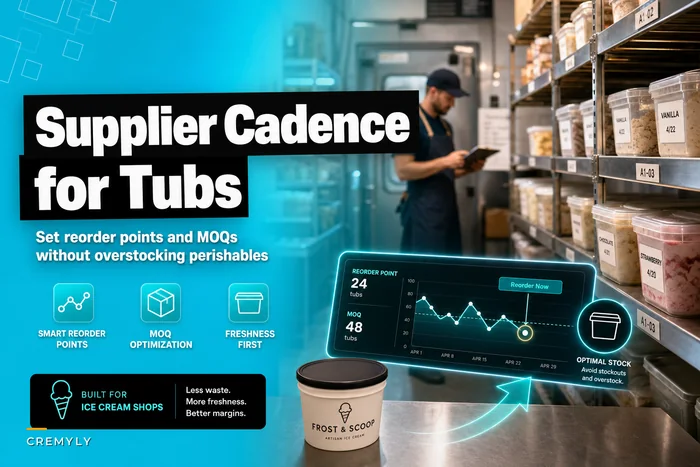
Price ceiling or formula. "Backup pricing won't exceed [primary price + X%] or will follow [index]." Protects you from getting gouged precisely when you're most vulnerable. This connects directly to how you set reorder economics in the first place — the tub supplier cadence guide covers how MOQs and reorder points interact so you're not whipsawing between overstock and stockout.
-
Spec match or disclosure. "Substituted mix will match [fat %, stabilizer profile] or you'll flag the deviation before shipping." So you're never surprised by a texture change mid-service.
-
Cold-chain confirmation. Delivery temp requirements and the right to reject out-of-spec lots without penalty.
-
No-penalty dormancy. "We may order infrequently; account stays active with no minimum-volume penalty." Keeps the relationship alive without committing you to volume you don't need.
That's it. Six lines, one page. The point isn't legal armor — it's shared expectations so that activation is a known process, not a negotiation under pressure. Most suppliers will happily sign something this light because it signals you're organized and serious, which makes you the account they want when capacity gets tight.
Rehearsal cadence: keeping the whole thing alive
This is what separates a portfolio that works from a binder that collects dust. A supplier portfolio is like a fire drill — it only works if you've practiced it when nothing's on fire.
A cadence that keeps each layer warm without creating a bunch of busywork:
-
Monthly Place at least one real (small) order with your tactical backup. Not a test — an actual order you'd make anyway, routed to them instead of primary. This keeps your account active, your rep engaged, and your terms honest.
-
Quarterly Run a "ghost activation" with your emergency supplier — call, confirm they can still hit your lead time, re-verify pricing and mini-MOQ terms. Thirty minutes. Catches the silent failures (rep turnover, changed minimums, dropped product lines) before they catch you.
-
Seasonally (pre-peak) Full tabletop walkthrough. Pick a scenario — "primary can't deliver base for 5 days starting a Thursday in July" — and walk your team through exactly who they call, what they say, what they order. Time it. Find the gaps.
-
Annually Re-score every supplier, re-rank the layers, and decide if anyone needs to be promoted, demoted, or dropped. A tactical backup that's gotten reliable and cheap might deserve more volume; a primary that's slipped might need to share the load.
Supplier reps turn over constantly, minimums drift, product lines get discontinued — and you find out about all of it at the worst possible moment unless you check quarterly. A fifteen-minute call in April saves you a catastrophic Saturday in July.
The ghost activation is the highest-leverage habit here and the one almost nobody does.
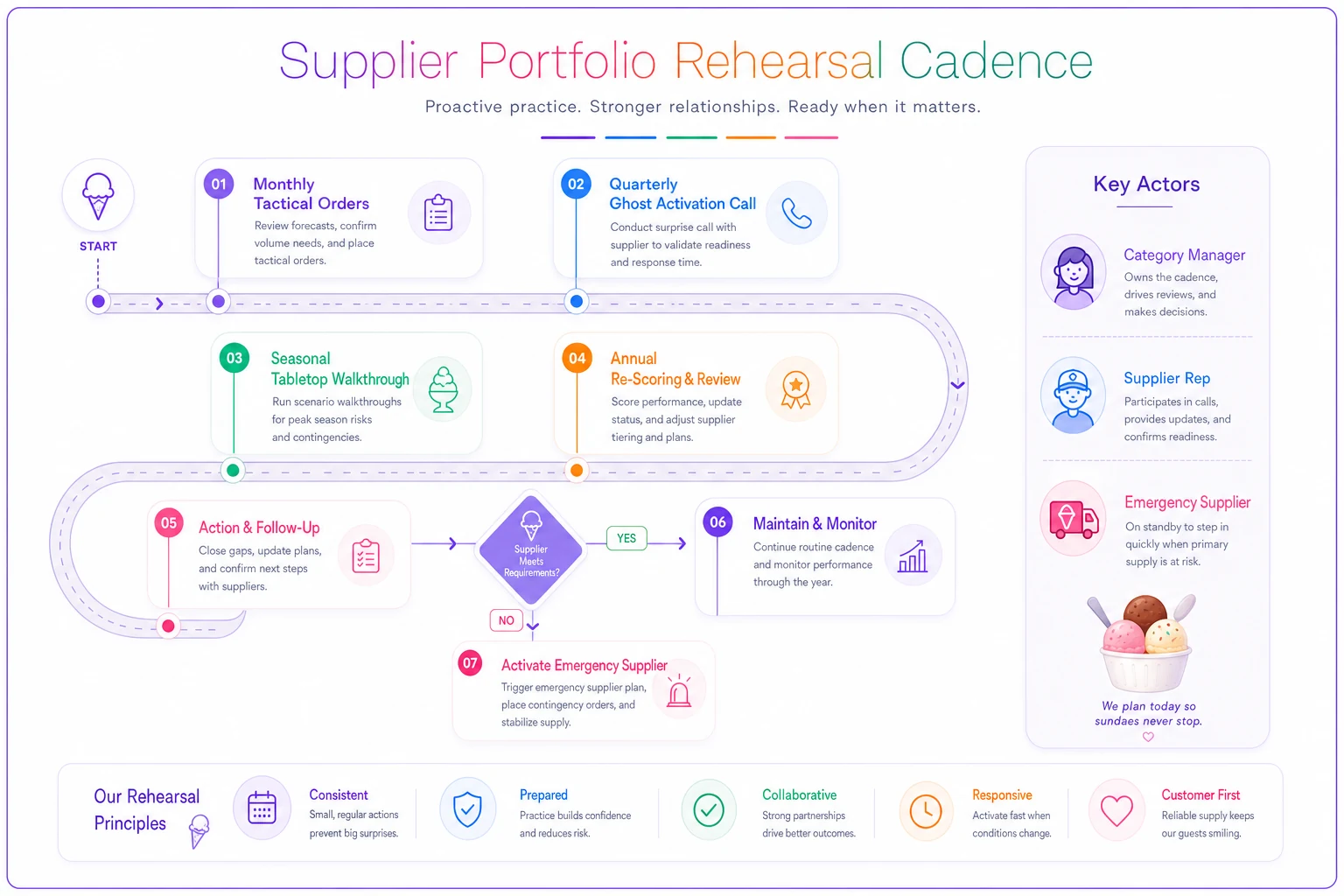
A quick visual of the rehearsal workflow.
The ghost activation is the highest-leverage habit here and the one almost nobody does. Supplier reps turn over constantly, minimums drift, product lines get discontinued — and you find out about all of it at the worst possible moment unless you check quarterly. A fifteen-minute call in April saves you a catastrophic Saturday in July.
A real scenario
A single-location shop doing roughly $380k–$420k a year ran everything through one broadline distributor. Great pricing, clean invoices, no complaints — for about two years.
Then a regional distribution issue hit in late June. Their primary went to partial fills: around 75% fill rate for about three weeks, right into the Fourth of July window. The shop had no tactical layer set up. They scrambled, bought retail-tier mix from a cash-and-carry at roughly 40% above their normal cost to avoid running out, and still 86'd two signature flavors on their busiest weekend. Rough estimate on the damage: somewhere around $2,800–$3,400 in blown margin and lost sales across those three weeks, not counting the goodwill hit from empty flavor wells.
Over the following off-season they built a two-layer structure: one tactical backup they now route about 15% of volume to year-round, plus one emergency supplier with a signed contract-lite page including a mini-MOQ clause and a price ceiling at primary-plus-12%.
The next summer, their primary had a shorter wobble — a few late deliveries in a 10-day stretch. This time the tactical trigger fired automatically. A manager placed a parallel order the same afternoon using the script, hit the pre-agreed partial, and the shop never ran out of anything. No retail-tier panic buy. No 86'd flavors. The whole event barely registered as a problem, which is exactly the point.
When this makes sense — and when it doesn't
Build the full multi-layer portfolio when:
-
One supplier covers more than ~70% of your perishable inputs
-
Your peak season is concentrated and unforgiving (most scoop shops)
-
You've already been burned by a shortage or late delivery at least once
-
You carry signature flavors that depend on specific mix specs
Keep it lighter when:
-
You're genuinely tiny and buy mostly retail/cash-and-carry already — your "portfolio" is just two stores you can drive to
-
You're in a dense metro with many interchangeable distributors and short lead times, where backups are easy to activate cold
-
Your product tolerates substitution without customers noticing
Who should not over-engineer this: a brand-new shop still figuring out its base recipe and volume. You can't build meaningful supplier terms until you know what and how much you actually buy. Nail your core cadence and your scoring first, then layer in backups. Trying to negotiate mini-MOQ clauses before you have a stable order pattern just wastes everyone's time.
How this connects to the rest of your operation
A supplier portfolio doesn't live in isolation. Your activation thresholds pull directly from your delivery audits and supplier scores. Your mini-MOQ math has to respect your freeze/thaw windows so an emergency order doesn't become spoilage. Your price ceilings feed straight into your food-cost tracking — and when a backup activation pushes cost up temporarily, that needs to show up in your daily P&L alignment so you can adjust before a single rough week quietly eats a month of margin.
A backup you activate at primary-plus-12% is a smart move for three days and a slow leak over three weeks. The portfolio tells you who to call. Your P&L discipline tells you how long you can afford to leave them activated before you need to fix the root problem or re-rank your layers. Those two systems have to talk to each other.
Where this gets easier as you grow is coordination. A single owner can hold all of this in their head — who to call, what the terms are, when a trigger fires. The moment you've got shift managers placing orders, that knowledge has to live outside your head: thresholds written on the reorder sheet, scripts taped by the phone, contract-lite terms in a shared folder, the rehearsal cadence on the calendar. A good inventory or operations platform helps here mostly by making those thresholds visible and the activation history trackable — so a trigger that fires on a Tuesday afternoon is something anyone on shift can act on, not just the owner who happens to remember the deal. But the structure comes first. The tooling just keeps it honest.
The takeaway
Single-supplier risk in a perishable business isn't a question of if — it's a question of which July it finally costs you. The shops that ride through shortages without 86'ing flavors or panic-buying retail mix aren't lucky. They've done the unglamorous work of defining layers, writing down triggers, negotiating partial-order terms when they were calm, and running a quick drill every quarter so the muscle memory is there when it counts.
None of this is expensive. Most of it is a few phone calls, a one-page email, and a recurring reminder. The hard part isn't the complexity — it's doing it in March when nothing's wrong and the whole thing feels unnecessary. That's exactly when it's cheapest to build and most valuable to have.
Ready to scoop up efficiency and grow your shop?
Join hundreds of ice cream shops using Cremyly to boost productivity, reduce waste, and delight customers with faster service.