

The most dangerous moment in a scoop shop isn't the peak line at 8pm. It's the 45 seconds when a parent leans over the case and says "does the birthday cake flavor have nuts?" and your newest scooper, three days in, guesses.
That guess is your entire allergen program. Everything else — the labels, the training, the ingredient binder in the back — either supports that 45 seconds or it doesn't. In most shops it doesn't, because the systems were built for health inspectors, not for a 17-year-old under pressure with a line out the door.
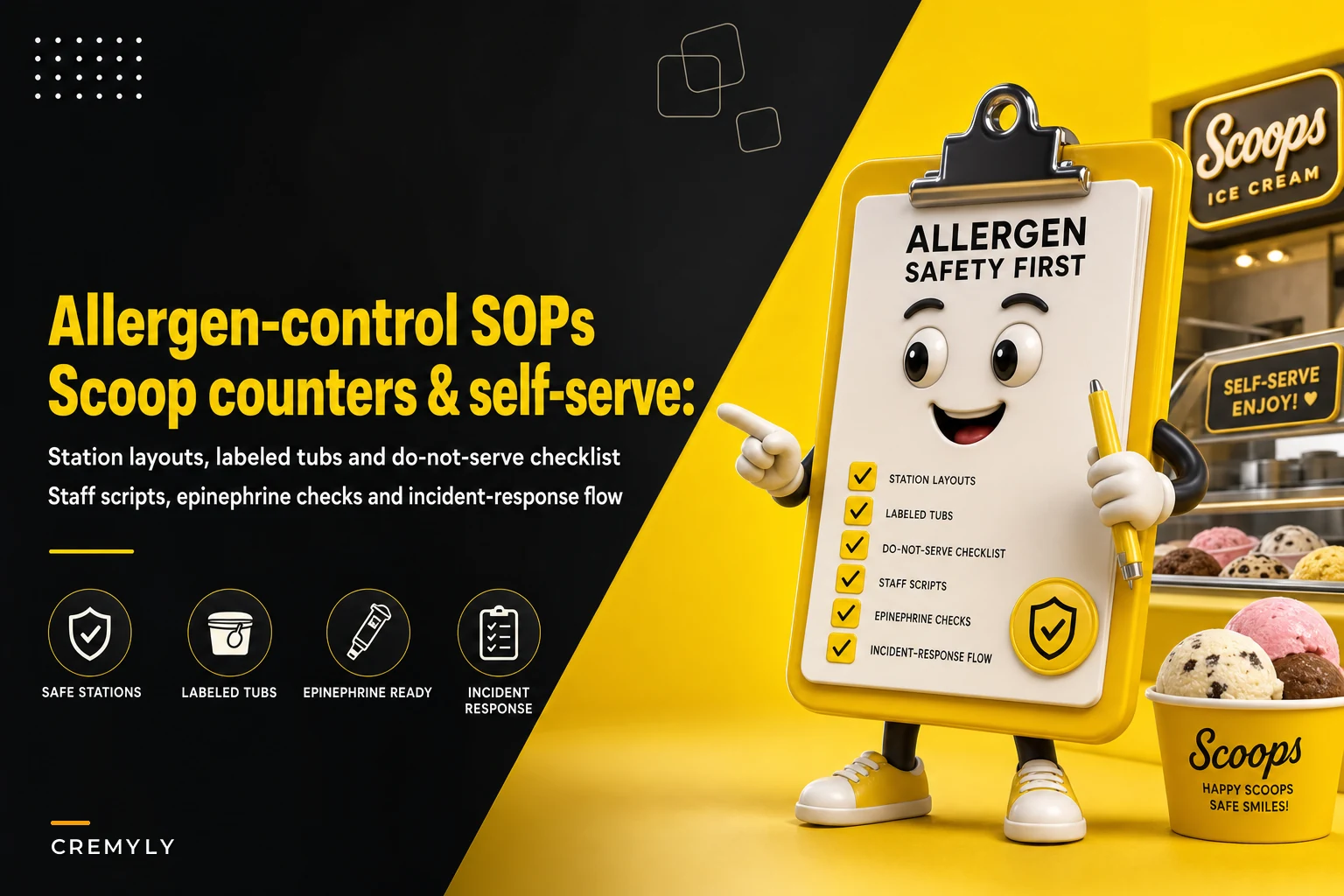
This is a walkthrough of how to build an allergen SOP for an ice cream shop that survives real service conditions: labeled station layouts, a do-not-serve checklist that people actually follow, tight staff scripts, and an incident-response flow for when something goes wrong. Not the compliance-binder version. The one that works at 8:47pm on a July Saturday.
Why scoop counters and self-serve bars are uniquely bad at allergen control
Restaurants have separation baked into the workflow. Different stations, different prep, plated and handed off. A scoop counter has almost none of that. One scoop bucket, a rinse well, and a person moving fast between 30 flavors that all live in the same case.
Cross-contact isn't a rare accident here — it's the default state. Rocky road sits next to vanilla. The scoop that dug into cookie dough (wheat, egg) goes into the rinse water and comes back out to serve a "safe" sorbet. Sprinkles migrate. A cone shelf holds regular cones and gluten-free cones eighteen inches apart with nothing between them.
Self-serve bars make it worse. The customer becomes the last line of handling, and they contaminate your toppings constantly. The peanut spoon ends up in the M&Ms. Someone's kid drags a gummy-covered scoop through the "nut-free" granola. By 2pm on a busy day, half your topping wells have shared utensils whether your policy says so or not.
What you see across a lot of shops is that owners write a solid allergen policy, post it, and never account for the physical reality that everything is packed into eight square feet and moving fast. The policy and the layout end up fighting each other, and the layout wins every time.
Start with the layout, not the paperwork
You can't script your way out of a bad station design. Fix the physical space first, then the SOP has something to stand on.
Keep your ice cream shop running smoothly.
Cremyly helps you manage every order, stock level, and staff shift with precision and ease.
- Real-time inventory tracking
- Order management dashboard
- Staff scheduling & shift coordination
No credit card required
Station labeling that works at a glance. Every flavor tag in the case needs allergen icons, not paragraphs. Nobody reads a sentence mid-scoop. Use a fixed icon set — milk, egg, wheat, soy, tree nut, peanut — printed the same way on every tag so staff pattern-match instead of reading. The icons should be visible from the staff side of the case, not just the customer side. Most shops label for customers and leave scoopers guessing from memory.
Physical separation for the high-risk stuff. Peanut and tree-nut flavors should live at one end of the case with a color-coded scoop that never leaves that zone. A red-handled scoop for nut flavors, a blue rinse well dedicated to it. It costs almost nothing and removes the single most common cross-contact path.
Make the safe choice the easiest by placing dedicated scoops and color cues within the scooper's line of sight.
A true "safe" prep path. If you're advertising nut-free or gluten-free service, you need a genuinely separate route: dedicated scoops stored away from the line, single-serve topping containers pulled from the back, and a clean cone from a closed sleeve. Not "we rinsed it real quick."
Here's a comparison of how the same layout decision plays out:
| Layout choice | Common shortcut version | SOP-safe version |
|---|---|---|
| Nut-flavor scoops | Same scoops, rinsed between | Dedicated red scoop + dedicated rinse well, never rotated out |
| GF cones | Shelved next to regular cones | Sealed sleeve, pulled only for the order, opened at time of serve |
| Self-serve toppings | Shared open bins | High-risk toppings behind counter, served on request |
| Allergen tags | Customer-facing text | Icon set visible on both sides of the case |
| Sample spoons | One cup of spoons for all | Separated safe-flavor sampling on request |
None of this is expensive. It's mostly a matter of deciding where things physically live and refusing to let them drift back to convenient-but-mixed during a rush. The drift is the enemy. Your layout needs to make the safe choice the easy choice, because tired staff always take the easy path.
If your case rotation is already loose, allergen separation will collapse right along with it. Tight physical organization upstream — the kind covered in FIFO for small freezers — is what keeps the "red scoop only touches nut flavors" rule from quietly falling apart by week two.
The do-not-serve checklist
This is the core of the whole thing. When a customer flags an allergy, the scooper needs a hard stop — a short mental checklist that overrides speed. Not a poster. A drilled routine.
The rule that matters most: when in doubt, do not serve. A refused sale costs you $6. A reaction costs you everything. Make sure every person on the floor knows that trading a sale for safety is not just allowed, it's expected. That single cultural point prevents more incidents than any label ever will.
Here's the do-not-serve check, meant to run in about ten seconds:
-
Stop and confirm the allergen out loud. "You said tree nuts — is that all, or anything else?" Never assume you heard the full list.
-
Check the actual tag, don't recall from memory. Even for flavors you're sure about. Recipes change, cross-contact notes get updated.
-
Ask about severity if it's ambiguous. "Is this a severe allergy where I need to use separate tools?" Most customers will tell you exactly how careful to be.
-
If it's a severe/anaphylactic allergy, switch to the safe prep path. New scoop, clean rinse, sealed cone, single-serve toppings. No shortcuts.
-
If you can't verify a flavor is safe, don't serve that flavor. Offer an alternative you can verify. Do not guess to save the sale.
-
Never let the customer talk you out of the protocol. Some will say "oh it's fine, a little is okay." Follow your prep path anyway.
The mistake most shops make is treating this as knowledge instead of a reflex. Knowledge fades under pressure. A drilled ten-second routine doesn't. Run it in onboarding until it's automatic, the same way you'd drill portion weights.
Staff scripts that don't slow the line
Scripts get a bad reputation because they sound robotic, but the point isn't the exact words — it's that staff have a ready answer instead of improvising something dangerous. The three scripts every scooper needs:
When a customer mentions an allergy: > "Thanks for letting me know. Which allergens, so I can check the tags and set up clean tools for you?" This does two things: it signals you take it seriously, and it forces the full list out before anything gets scooped.
When you're not 100% sure a flavor is safe: > "I want to double-check that one before I serve it — give me a sec." (Then actually check the tag or ask the shift lead. If it can't be verified: "I can't confirm that one's safe for your allergy, but here are the ones I can.") The temptation is to soften this into a guess. The script exists to kill the guess.
When you're setting up safe prep: > "For a nut allergy I'm going to grab fresh tools and a sealed cone — takes an extra minute, worth it." Saying it out loud reassures the customer and creates accountability. A scooper who announces the safe path is far more likely to actually follow through on it.
One pattern worth flagging: shops that let staff say "I think it's fine" have basically no allergen program, no matter what's in their binder. "I think" is the exact phrase your scripts are designed to eliminate. Train people to hear themselves say it and stop.
The incident-response flow
Even good programs have incidents. What separates a scary-but-handled moment from a catastrophe is whether the team knows the flow cold before it happens. This is the part almost nobody rehearses, and it's the part that matters most when it counts.
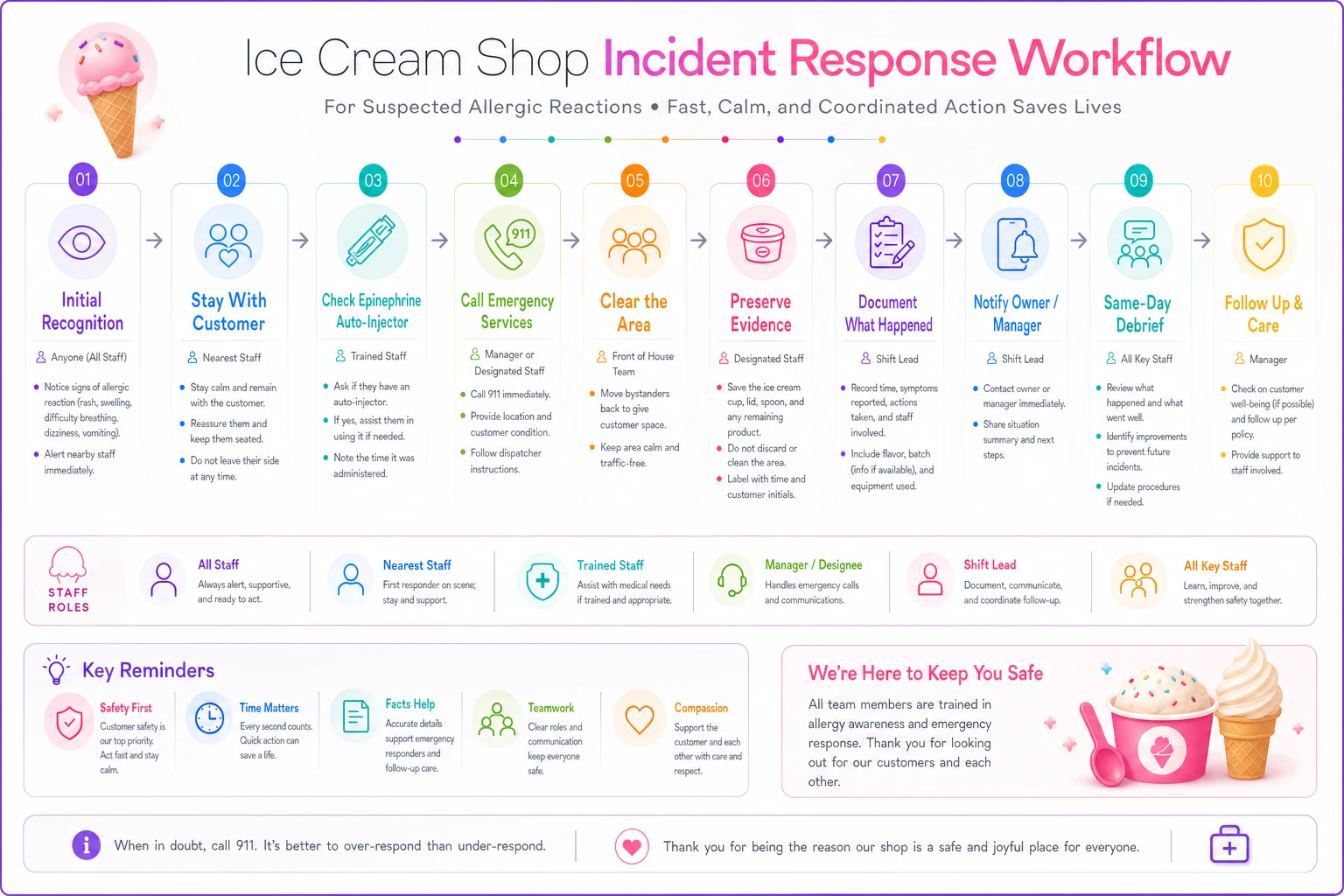
Here's a tight response sequence for a suspected allergic reaction on-site:
-
Take it seriously immediately. If a customer says they're reacting, don't debate it. Someone stays with them the entire time.
-
Ask if they have an epinephrine auto-injector and help them access it. Do not hesitate on this. Time is the whole game with anaphylaxis.
-
Call emergency services for any breathing difficulty, swelling, or severe symptoms. Err toward calling. Nobody has ever regretted calling too early.
-
Clear the immediate area and assign one person to manage the line so the response isn't happening in the middle of chaos.
-
Preserve the evidence. Set aside the exact product, the cup, the scoop used. Note which flavor and which tools. This matters for medical treatment and for understanding what failed.
-
The shift lead documents everything while it's fresh
time, flavor, what the customer ordered, what allergen was disclosed, what tools were used.
-
Notify the owner/manager immediately, not at end of shift.
-
Do a same-day debrief once the situation is stable
where did the protocol break? Was the tag wrong? Was a scoop cross-contacted? Was the safe path skipped under pressure?
A simple flow to follow during a suspected reaction helps keep everyone coordinated.
That last step is where the real learning lives. Almost every incident traces back to a specific, fixable break — a mislabeled tag, a shared scoop during a rush, a script that got skipped. The debrief turns a bad night into a permanent fix instead of a story nobody talks about.
Keep the incident log somewhere it can't get lost. A repeated pattern in your logs — say, three near-misses all tied to the same self-serve topping bin — tells you exactly where your layout is failing. This is the same discipline behind tracking melt-and-reject rates and running shift-level corrective checks: the log isn't paperwork, it's your early-warning system.
A real scenario
A two-location scoop shop with a big self-serve topping bar had a close call: a customer with a peanut allergy reacted after eating a "safe" sorbet. It turned out fine — mild, no ER — but it shook the owner. The root cause in the debrief wasn't the sorbet. It was the topping bar. A shared spoon had moved chopped peanuts into the "nut-free" granola bin, and the customer added it themselves.
Before the fix, their whole allergen program was a laminated policy sheet and a verbal "we're careful." No layout separation, no scripts, no incident flow.
After, they made four changes:
-
high-risk toppings (nuts, anything with cross-contact history) moved behind the counter and served on request only;
-
the self-serve bar dropped to lower-risk items with individual scoops chained to each bin;
-
scoopers got the ten-second do-not-serve drill in onboarding;
-
and they started a simple incident and near-miss log.
Over the following season they logged around a dozen near-misses — almost all caught at the do-not-serve check before anything was served — and zero reactions. The near-misses weren't a bad sign. They were the system working: catches that used to be silent guesses were now visible, verified stops. The refused or delayed sales cost them very little; the owner estimated it came out to well under a couple hundred dollars across the whole summer.
When to go stricter, and when it's overkill
Go fully strict — separate prep path, restricted self-serve, drilled scripts — if you serve nut-heavy flavors, run a self-serve bar, or get regular allergy questions from families. Kids' birthday traffic alone justifies it.
You can run lighter if you're a small, staff-served counter with a short flavor list and clear ingredient sourcing, where every scooper genuinely knows every flavor. Even then, keep the do-not-serve reflex and the incident flow. Those cost nothing and there's no version of the business where they're a bad idea.
The one place not to cut corners: advertising "allergy-friendly" or "nut-free" without a real separate prep path. If you make the claim, you own the standard. A customer who reads "nut-free option" and gets cross-contacted has a much stronger case against you than one who was simply told "we can't guarantee it." Don't advertise a safety level your layout can't actually deliver.
The thing most owners miss
Allergen safety in a scoop shop isn't really about knowledge. Your staff mostly know that peanuts are dangerous.
It fails at the seam between what people know and what they physically do when the line is long and they're tired. The whole point of the layout, the checklist, and the scripts is to remove the moment of judgment — to make the safe action automatic so nobody has to be a hero at 8:47pm.
Get the physical separation right, drill the ten-second stop until it's reflex, and rehearse the incident flow once before you ever need it. That's a real allergen SOP for an ice cream shop — not the one that lives in a binder for the inspector, but the one that actually protects the family standing at your case asking a nervous question about the birthday cake flavor.
Ready to scoop up efficiency and grow your shop?
Join hundreds of ice cream shops using Cremyly to boost productivity, reduce waste, and delight customers with faster service.