


A busy scoop shop lives or dies in the three steps between the freezer case and the register. Most owners obsess over flavors and front-of-house vibe, but the real bottleneck is usually the choreography behind the counter — who reaches for what, how many times a scooper turns their body, and how often two people collide at the dipping well on a Saturday afternoon.
The frustrating part is that ice cream shop back of house layout problems hide in plain sight. Service feels "a little slow," the line feels "a little long," and nobody can point to why. It's rarely one big thing. It's a dozen tiny handoffs stacked on top of each other, each costing four or five seconds, multiplied by 300 transactions.
This post does three things: breaks down five layout patterns that fit real shop footprints, gives you micro-simulation timing tables so you can estimate service time before you move a single freezer, and walks you through a 48-hour experiment you can run this weekend to compare layouts using actual service-time and waste numbers.
Why handoffs quietly eat your service time
A "handoff" is any moment where product, information, or a tool passes between two steps — scooper to topping station, topping station to register, register back to scooper for a remake. Each handoff introduces a pause, a turn, a reach, or a wait.
In practice, the damage usually looks like this: the scooper finishes a double, turns to grab a waffle cone stored behind them, pivots back, then realizes the toppings person is mid-sundae and can't take the handoff yet. That's three wasted motions and one idle beat. Feels like nothing. Across a rush, those idle beats compound into a line out the door.
Something worth noticing — shops with the fastest service rarely have the fastest scoopers. They have layouts where the scooper almost never changes direction. Everything needed for 80% of orders sits within one arm-sweep. The speed isn't athletic, it's spatial.
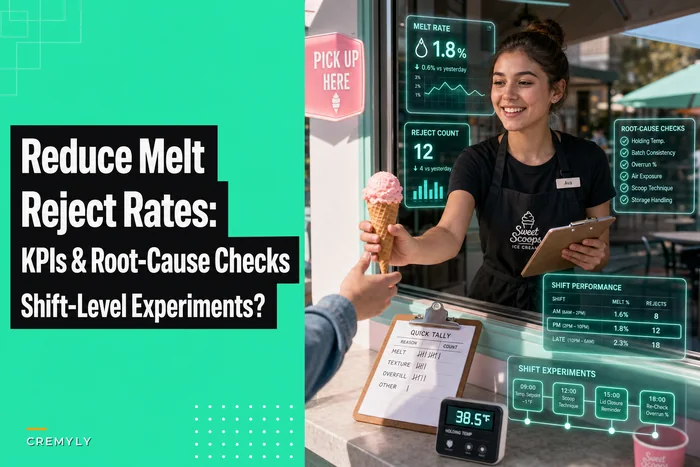
The second hidden cost is waste. When a scooper has to walk away from an open tub to grab something, the tub sits exposed longer, surface melt increases, and the next scoop pulls softer product that over-portions. Layout and waste are more tightly connected than most owners assume — the same awkward reach that slows service is also warming your product. If melt and over-portioning are already on your radar, that angle pairs directly with reducing melt-and-reject rates through shift-level corrective experiments.
The five layout patterns by footprint
There's no universal "best" layout. The right one depends on your footprint shape, your average order complexity, and whether one or two people work the line during peak. Here are five patterns that cover most real shops.
Keep your ice cream shop running smoothly.
Cremyly helps you manage every order, stock level, and staff shift with precision and ease.
- Real-time inventory tracking
- Order management dashboard
- Staff scheduling & shift coordination
No credit card required
1. The Straight Line (narrow, deep shops)
Freezer case → scoop/dip well → toppings → register, all in one row against a single wall. Works in long skinny spaces. The customer walks the length of the counter as their order gets built. Strength: zero crossing paths, natural order flow. Weakness: on two-person shifts, staff get stuck in single file and can't pass each other. One slow step clogs the whole line.
2. The L-Shape (corner footprints)
Scooping runs along one wall, toppings and register turn the corner onto the perpendicular wall. Common in corner storefronts. Strength: separates "cold work" from "finish and pay," so two people rarely collide. Weakness: the corner itself becomes a pinch point if your topping station is deep. Products stored in the corner are the hardest to reach — don't put high-use items there.
3. The Parallel Galley (medium square shops)
Two counters facing each other with a center aisle. Freezer and scooping on one side, toppings/register/prep on the other. Staff work the aisle. Strength: very short reaches, everything within a pivot. Scales well to two or three staff. Weakness: aisle width is everything. Under about 42 inches and two people bump constantly; it becomes slower than a straight line.
4. The U-Shape / Horseshoe (deeper square footprints)
Three connected counters wrapping the staff. The scooper stands in the middle and barely moves — freezer behind, toppings to one side, register to the other. Strength: the single-operator dream. One person can run a surprising volume without taking more than a half-step. If you run solo shifts, this is worth studying alongside the realities covered in running a one-person shift safely. Weakness: terrible for two people — they're constantly in each other's cone of motion. It's a solo-optimized shape.
5. The Island (large open shops)
A central freestanding counter customers can approach from multiple sides, with scooping, toppings, and register as zones around the island. Strength: handles crowds and multiple simultaneous lines, great for high-traffic tourist spots. Weakness: requires more staff to cover the zones, and restocking the island mid-rush is a nightmare if back storage is far away.
Quick comparison
| Pattern | Best footprint | Ideal staff count | Handoff risk | Solo-shift friendly |
|---|---|---|---|---|
| Straight Line | Narrow & deep | 1–2 | Low (1), High (2) | OK |
| L-Shape | Corner unit | 2 | Medium | Weak |
| Parallel Galley | Medium square | 2–3 | Low if aisle ≥42" | OK |
| U-Shape | Deeper square | 1 | Low (1), High (2) | Excellent |
| Island | Large open | 3+ | Low | Poor |
The mistake owners make here is picking a layout based on a photo from a shop they admired — without checking whether that shop's staffing model matches theirs. A beautiful U-shape in a shop running two people on Saturdays is actively fighting its own staff.
Micro-simulation: estimating service time before you move anything
You don't need fancy software to estimate whether a layout change will help. Break one transaction into its physical steps, assign rough seconds to each, and you've got a usable model. This is micro-simulation, and it's shockingly accurate when you time real staff.
| Step | Straight Line | U-Shape (solo) | Parallel Galley (2 staff) |
|---|---|---|---|
| Greet + take order | 6s | 6s | 5s |
| Open case, scoop #1 | 7s | 7s | 7s |
| Scoop #2 | 6s | 6s | 6s |
| Move to toppings | 4s | 1s | 2s (handoff) |
| Apply topping | 5s | 5s | 5s |
| Move to register | 3s | 1s | 2s (handoff) |
| Ring + pay | 14s | 14s | 14s |
| Total | 45s | 40s | 41s |
The interesting part isn't the totals — they're close. It's where the differences live. The U-shape wins on movement (those 1-second pivots) but loses nothing to handoffs because one person owns the whole order. The galley splits the work, so the second person starts ringing while the first preps the next order — the 41-second figure actually hides higher throughput because two orders overlap.
The number that matters is throughput during a rush, not single-order time. A layout that's 3 seconds slower per order but lets two people work without colliding will clear a line faster than a "fast" layout that forces single-file.
-
Pick your three most common orders (pull them from your POS mix).
-
Film one scooper doing each order, twice, during a slow period.
-
Break each into the steps above and record seconds.
-
Note every time the staffer changes direction or waits on a coworker — those are your handoff and motion costs.
-
Re-draw the layout mentally and re-estimate the movement steps only. Scoop and ring times won't change; walking and handoffs will.
That fifth step is where the decision gets made. If your biggest time sink is "move to toppings" and "move to register," a tighter U or galley helps. If the sink is "ring + pay," no layout change fixes that — you need a POS or payment flow adjustment instead.
Film one scooper doing each order, twice, during a slow period.
If your biggest time sink is "move to toppings" and "move to register," a tighter U or galley helps. If the sink is "ring + pay," no layout change fixes that — you need a POS or payment flow adjustment instead.
The 48-hour layout experiment
Simulation gives you a hypothesis. Actually running both layouts back-to-back is what gives you real numbers.
Setup (the Thursday before):
-
Pick two candidate layouts — your current one and one alternative you can reach by moving portable stations (topping caddy, cone rack, register tablet). Don't move the freezer case; work around it.
-
Choose two comparable days. Two Saturdays is ideal. Same-day comparisons get polluted by weather and crowd swings.
-
Decide your metrics up front. You only need three
Metrics to track:
-
Average service time — timer from "order taken" to "payment complete," sampled on every 10th transaction.
-
Waste proxy — grams of scrape-back and melt discarded per shift, weighed at close. (If you already run tight rotation checks, this plugs right into your FIFO and 5-minute rotation routine.)
-
Collision/wait count — a simple tally sheet where staff mark a tick every time they had to wait on a coworker or change direction awkwardly.
Run it:
-
Day 1 — current layout. Staff work normally. One manager samples service times, staff keep the tally sheet by the sink, waste gets weighed at close.
-
Reset overnight. Move the portable stations into the alternative layout. Walk staff through it before open so nobody's fumbling when the first customer walks in.
-
Day 2 — alternative layout. Same sampling, same tally, same closing weigh-in.
-
Compare the three metrics. Don't average feelings — read the sheet.
Here's the experimental workflow at a glance.
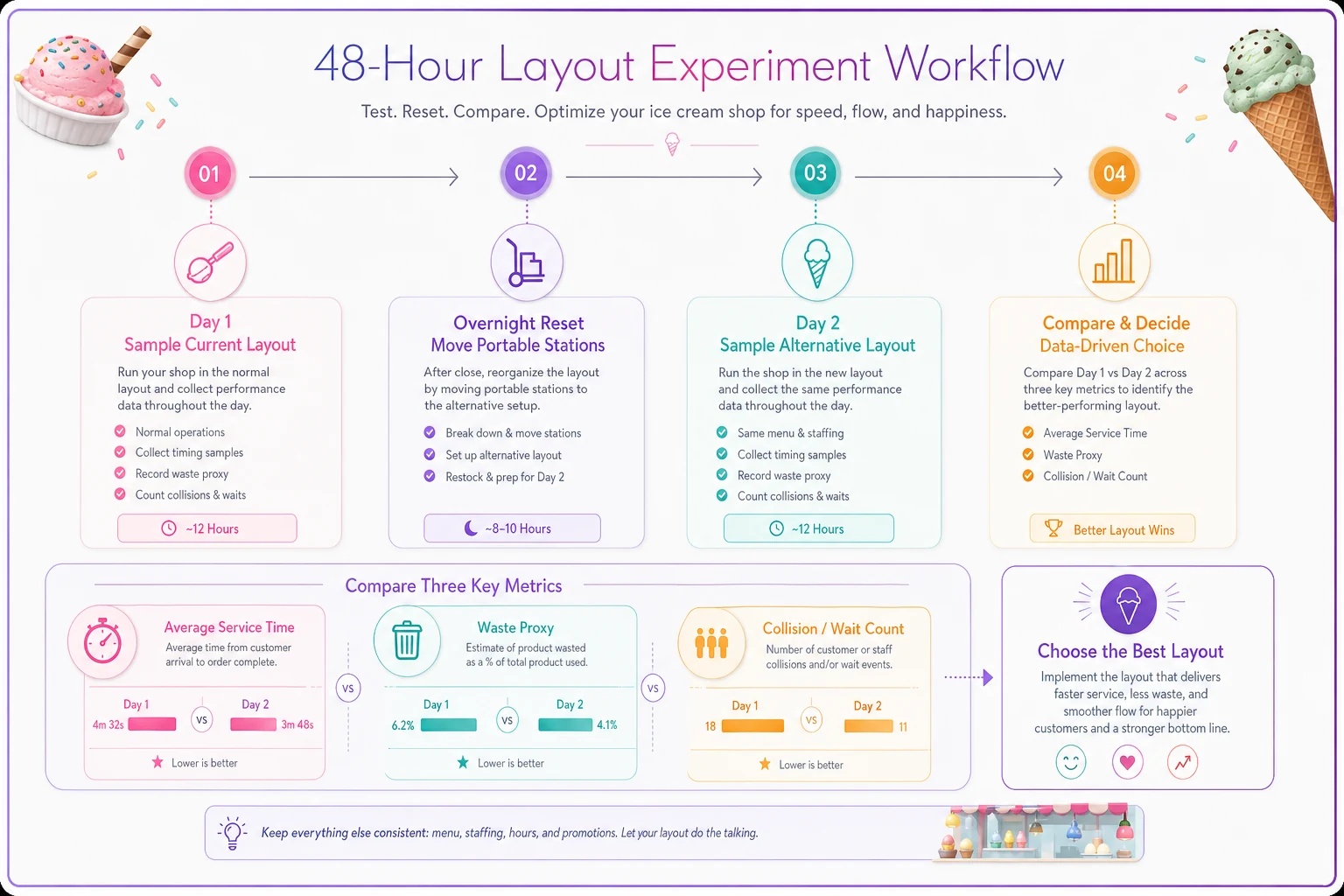
Reading the results: A real example from a medium square shop that tested straight-line against a parallel galley — service-time sampling came out nearly identical (around 44 vs 42 seconds), but the collision tally dropped from roughly 60 ticks to under 20, and the line never backed past the door on galley day. Waste was a wash. The decision was obvious: the galley didn't make individual orders dramatically faster, it made the rush survivable.
That's what most layout advice misses. You're not optimizing a stopwatch — you're optimizing what happens when 14 people walk in at once.
When a layout change actually makes sense
Reorganizing your back-of-house is disruptive, so don't do it on a hunch. It's worth doing when:
-
Your line regularly backs out the door during peak, but your scoopers aren't slow — the time is lost to movement and collisions.
-
You run two people and they're constantly saying "behind you" or stepping around each other.
-
Your waste at close is creeping up and you've traced part of it to tubs sitting open while staff walk away.
Your line regularly backs out the door during peak, but your scoopers aren't slow — the time is lost to movement and collisions.
When it's a bad idea
If your bottleneck is payment, not movement — a slow card reader or a chatty register flow won't be fixed by moving the topping caddy.
-
If your bottleneck is payment, not movement — a slow card reader or a chatty register flow won't be fixed by moving the topping caddy.
-
If you're a single-operator shop already running a tight U-shape, you're probably near optimal; chasing seconds isn't worth the disruption.
-
If the "problem" only shows up two weekends a year, staff smarter for those peaks instead of rebuilding your whole counter.
If you're a single-operator shop already running a tight U-shape, you're probably near optimal; chasing seconds isn't worth the disruption.
Who should not bother
Owners whose service-time data and collision tallies come back nearly flat across both experiment days.
If the numbers don't move, the layout isn't your constraint — and you'll have saved yourself a pointless remodel by running the 48-hour test first instead of guessing.
Back-of-house layout is one of the few operational levers that improves both speed and waste simultaneously, because the awkward reach that slows a scooper is the same reach that leaves a tub melting.
Start by timing three real orders, map where the motion and handoffs actually live, then prove your fix with a two-day experiment and real numbers instead of a gut feeling.
The shops that get this right aren't the ones with the biggest kitchens or the fastest staff. They're the ones who noticed that the scooper almost never has to turn around — and built the whole counter around that one quiet idea.
Ready to scoop up efficiency and grow your shop?
Join hundreds of ice cream shops using Cremyly to boost productivity, reduce waste, and delight customers with faster service.