

Most ice cream shops that start composting do it quietly. The bins show up behind the shop, staff learn to sort waffle-cone scraps from plastic sample spoons, and a few months later nobody outside the building knows it happened. Then the owner reads about a competitor landing a feature in the local paper for their "zero-waste" dessert program and thinks, wait, we're doing more than they are.
The problem is the gap between doing the work and saying something about it responsibly. Shops that get this wrong either stay silent and get no credit, or they oversell and get caught. Composting PR for a small business lives in a narrow lane — you want to earn visibility for genuine effort without drifting into claims you can't back up. That line is easier to hold than most people think, as long as you build the reporting first and the messaging second.
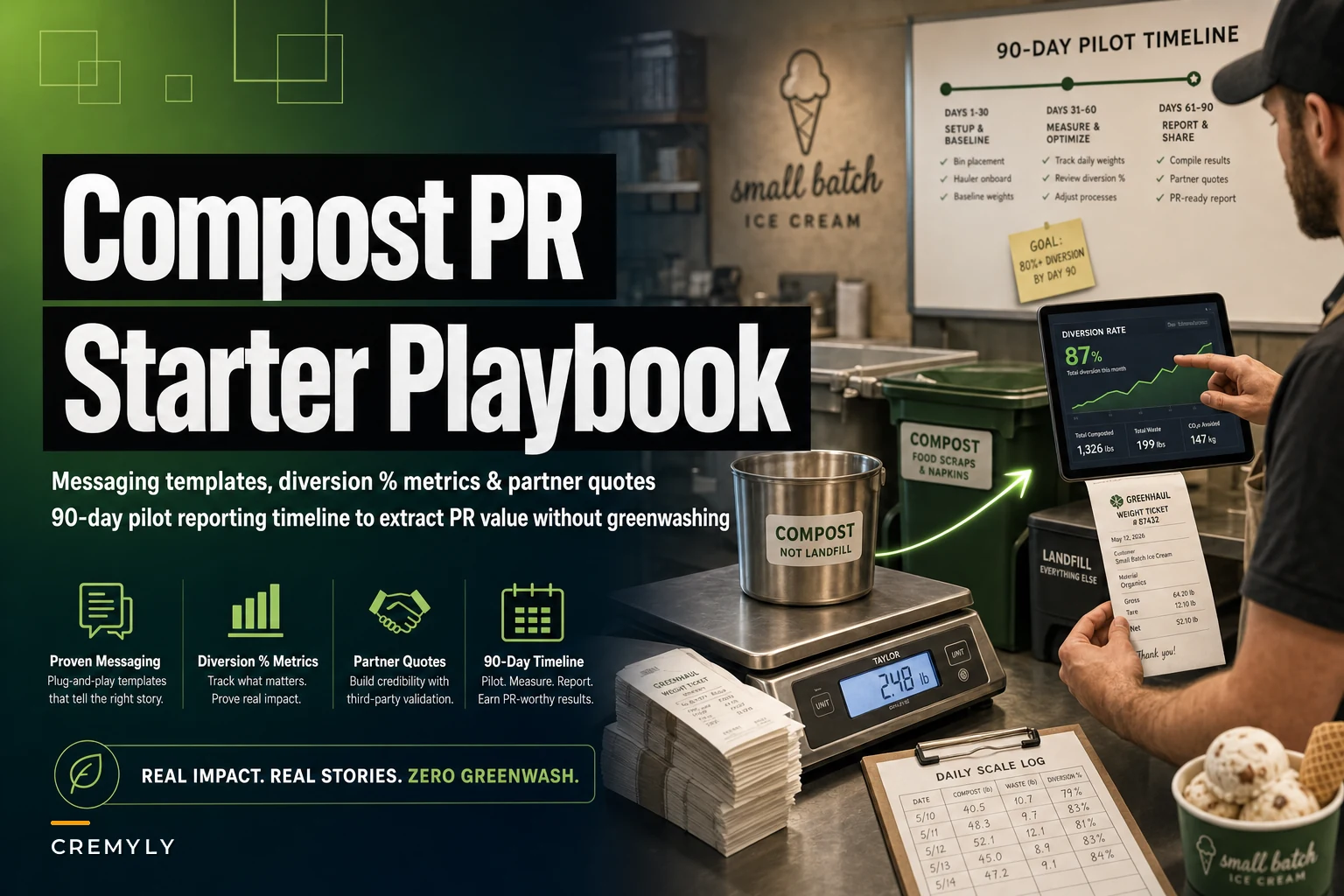
This is a playbook for extracting real PR value from your composting program using measured language, metrics you can actually prove, partner quotes, and a 90-day reporting cadence. No vague "eco-friendly" badges. Just numbers you can defend.
Why most composting announcements backfire
Greenwashing rarely comes from bad intent. It usually comes from a shop announcing an outcome before it has data to describe that outcome accurately.
A typical example: a shop composts for three weeks, posts "We're now a zero-waste shop!" on Instagram, and then a regular walks in, sees a trash can full of plastic cups, and screenshots it. Now you've got a credibility problem instead of a PR win. The claim was aspirational; the operation wasn't there yet.
The other common failure is the unquantified superlative. Phrases like "dramatically reducing our waste" or "committed to sustainability" mean nothing because they describe nothing measurable. Journalists have learned to ignore them. Local sustainability reporters in particular get dozens of these pitches and can smell a hollow one in two sentences.
What actually travels is specificity. "We diverted 62% of our back-of-house waste from landfill over the last quarter, verified by our hauler's weight tickets" is a sentence a reporter can print without risking their own credibility. The difference between that and "we're going green" is the difference between a story and a press release nobody runs.
Build the measurement before the message
You cannot responsibly talk about diversion without tracking diversion. This is the part everyone wants to skip, and it's the only part that protects you.
Keep your ice cream shop running smoothly.
Cremyly helps you manage every order, stock level, and staff shift with precision and ease.
- Real-time inventory tracking
- Order management dashboard
- Staff scheduling & shift coordination
No credit card required
The core metric is diversion rate: the share of your total waste, by weight, that goes to compost or recycling instead of landfill.
``
Diversion % = (compost weight + recycling weight) ÷ total waste weight × 100
``
Weight matters more than volume because volume lies. A bag of compostable cups looks enormous but weighs almost nothing. Dairy-soaked cardboard and food scraps are heavy. If you report by bag count or by how full a bin looks, your numbers will be soft and anyone who checks will find holes.
Where do the weights come from? A few practical sources:
-
Hauler weight tickets. Most commercial compost and recycling haulers log weight per pickup. This is your gold-standard source because it's third-party.
-
A cheap floor scale. For shops whose hauler doesn't itemize, a $40 platform scale and a 30-second log per bin at close gives you defensible internal numbers.
-
Landfill estimate. You need total waste, so weigh or estimate the trash too. Even a consistent estimate — same bin, same scale — keeps the ratio honest.
Here's the honesty rule most shops miss: report the denominator. "We composted 400 lbs this quarter" sounds great and means nothing without knowing you also sent 900 lbs to landfill. The diversion percentage forces the full picture, which is exactly why it's the safe number to lead with.
Pro-tip: weigh the trash at close for a week to lock a consistent baseline denominator.
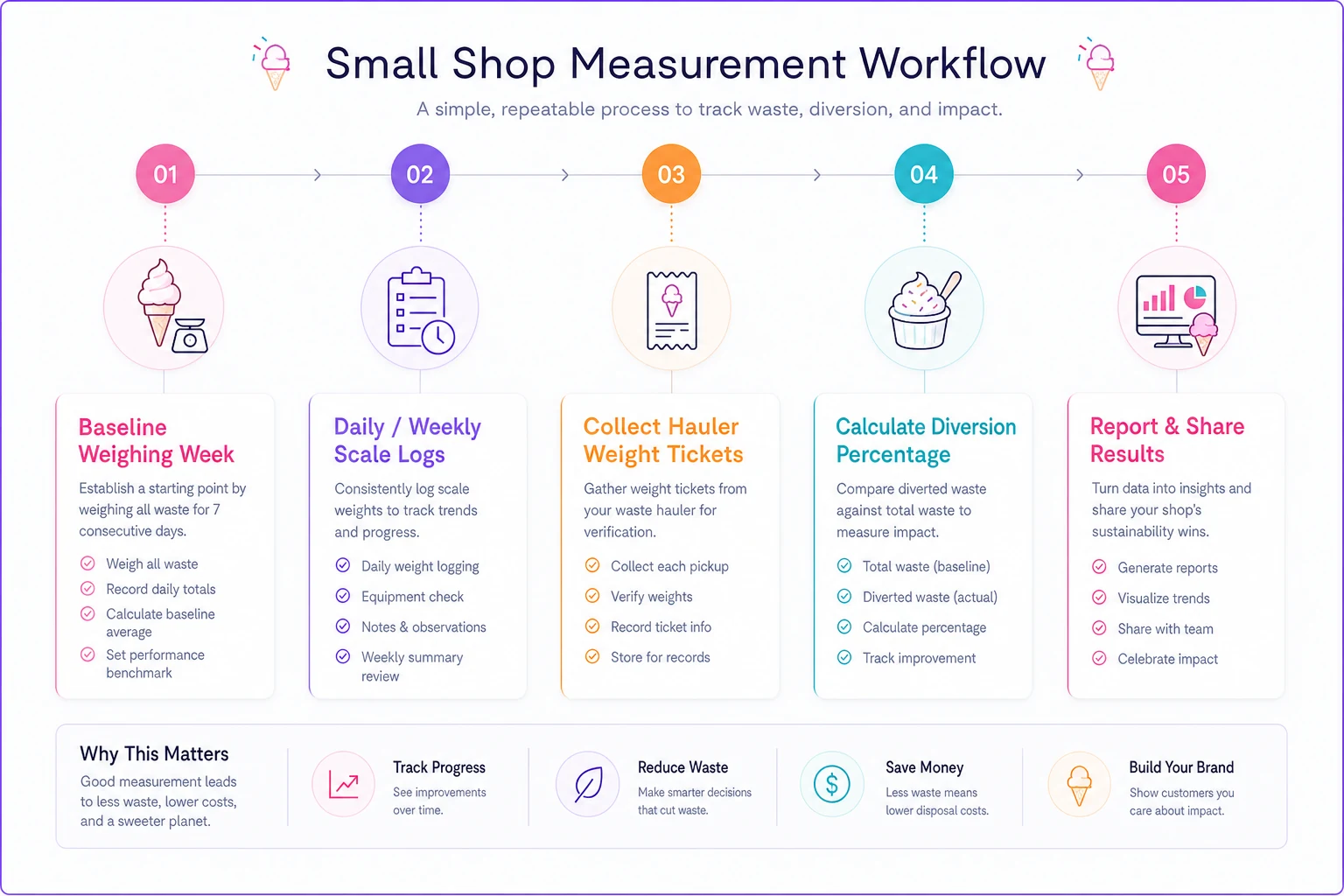
Visualizing the measurement workflow can make it easier for staff and partners to follow the steps and keep records consistent.
The metrics worth reporting (and the ones to avoid)
Not every number helps you, and some actively create risk. A quick breakdown of what to track versus what to leave out of public messaging:
| Metric | Report publicly? | Why |
|---|---|---|
| Diversion % (by weight) | Yes | Verifiable, hard to fake, full picture |
| Total lbs composted / quarter | Yes, with context | Fine alongside diversion %, misleading alone |
| CO₂ equivalent "saved" | Carefully | Only if using a hauler-provided or published conversion factor you can cite |
| "Zero waste" claim | Almost never | Nearly impossible to prove; invites scrutiny |
| Contamination rate | Internally, mostly | Useful for ops; shows honesty if shared |
| % of packaging compostable | Yes | Concrete, checkable against your supplier specs |
The CO₂ line deserves a warning. Converting compost weight into "cars off the road" or "trees planted" requires conversion math that's easy to get wrong and easy to inflate. If you use it, source the factor from your hauler or a published municipal figure, and say where it came from. An unsourced CO₂ claim is one of the fastest ways to get flagged.
Contamination rate is interesting because it's actually the metric that builds trust when you're honest about it. Admitting "we're at about 8% contamination and working to get under 5%" signals that you measure rigorously. It makes everything else you say more believable.
Measured messaging templates
For a social post: > "Q2 diversion update: we kept about 61% of our shop's waste out of the landfill this quarter — roughly 540 lbs of food scraps, cones, and compostable packaging. Still working on cutting contamination. Weight tickets from [hauler name]."
For a press pitch (email subject + opening): > Subject: Local scoop shop hits 60%+ landfill diversion — data attached > > "Over the past 90 days, [Shop] diverted 61% of its total waste from landfill, verified by weekly weight tickets from our hauler, [name]. That's up from roughly 40% when we started tracking in [month]. Happy to share the full log and walk you through how a small shop runs this."
For in-store signage: > "This quarter we composted about 540 lbs. Our diversion rate is 61%. We'd rather show you the number than call ourselves 'green.'"
Notice what these avoid: no "zero waste," no "fully sustainable," no unqualified superlatives. Every claim carries a number and a source. That's what separates measured messaging from greenwashing, and it's also what reporters quote.
One more language habit worth adopting: use up from framing. "61%, up from 40%" tells a progress story, which is more honest and more interesting than a single static number. It also quietly admits you weren't perfect at the start, which reads as credible rather than defensive.
Partner quotes that carry weight
Your own claims about your own program always sound like marketing. A quote from your compost hauler, a local sustainability nonprofit, or a municipal waste program turns your story into something a journalist treats as corroborated.
The useful part: these partners usually want to be quoted, because your success is their case study too. A composting hauler trying to sign more restaurants loves pointing at a scoop shop hitting 60% diversion.
-
Ask after you have real numbers. A partner can only speak to performance they've seen. Wait until you've got a quarter of weight tickets.
-
Give them the data first. Send them your diversion figures so their quote references something specific, not just a generic endorsement.
-
Request one concrete sentence. Ask for a quote that mentions a number or a behavior. "They sort better than most of our clients" beats "we love working with them."
-
Let them approve the final usage. This keeps the relationship clean and means they'll vouch for the quote if a reporter follows up.
A quote that works looks like: "Among the small food businesses we service, [Shop] runs one of the cleaner compost streams — their contamination is low enough that we rarely have to reject loads." Specific, third-party, survives scrutiny.
A 90-day pilot reporting timeline
Treating your first quarter as a documented pilot does two things. It gives you clean data to report, and it gives you a story arc — before, during, after — that makes the eventual PR worth running.
Days 1–7: Baseline. Before you change anything, weigh your current waste for a week. This is your "before" number. Skipping this is the single most common mistake, because without a baseline you can never say "up from." Log total landfill weight daily.
Days 8–30: Set up and sort. Install bins, train staff on sorting, and start logging compost and recycling weights alongside landfill. Expect messy data and high contamination early — that's normal and it's part of the honest story. Don't announce anything yet.
Days 31–60: Stabilize. Sorting habits settle. Contamination should start dropping. Begin weekly diversion % calculations so you can see the trend forming. This is also when you tell your hauler you're tracking and ask whether their weight tickets can itemize your streams.
Days 61–85: Verify and gather. Pull together hauler weight tickets, reconcile them against your internal logs, and resolve any gaps. Request your partner quote now, with real numbers in hand. Draft your messaging using the actual figures, not placeholders.
Days 86–90: Report. Publish the quarter. Lead with the diversion %, include the before-and-after, cite the source, and attach or reference the partner quote. Pitch local press with the data attached rather than promised.
This timeline keeps you from the two failure modes: announcing too early with no proof, or doing the work for months and never telling anyone.
A quick checklist before you publish anything
Run every composting claim through this filter first:
-
Is the number based on weight, not volume or bag count?
-
Do I have a source (weight ticket, logged scale reading) I could show a reporter?
-
Did I include the denominator so the diversion % is honest?
-
Have I avoided the words "zero waste" and "fully sustainable"?
-
Is any CO₂ or equivalency claim tied to a cited conversion factor?
-
Does my partner quote reference something specific, with their approval?
-
Am I using "up from" framing to show a real baseline?
-
Would this claim survive a customer walking in and checking the bins?
That last question is the one that matters most. If a skeptical regular could photograph your trash and make your claim look false, the claim is too strong.
A real scenario
A single-location scoop shop in a mid-size college town started composting mostly to cut their landfill hauling cost, not for publicity. First month they tracked nothing and sorted inconsistently — contamination was high enough that the hauler rejected a couple of early loads.
Once they ran a proper pilot, the picture got clear. Baseline week showed roughly 230 lbs of weekly landfill waste. By the end of the quarter they were diverting about 58% by weight, with contamination down from around 15% to under 7%. The hauler, glad to have a clean account, gave them a quote referencing exactly that.
They pitched the local paper with weight tickets attached and the before-and-after framed as "40% to 58% in one quarter." It ran as a short feature. The owner's takeaway wasn't the press itself — it was that the pitch worked because they'd led with verifiable numbers and admitted the rough start. Nothing in the story could be poked at, so it got printed as written.
When this is worth it — and when it isn't
Running a documented composting PR pilot makes sense when you already have a working program or are committed to one for at least a quarter, and when your local market actually has press or community channels that care about this. College towns, farmers-market-heavy areas, and neighborhoods with active sustainability groups reward it most.
It's a bad idea if you're composting inconsistently, if contamination is still high enough that loads get rejected, or if you're tempted to round the numbers up to sound better. A soft claim is worse than no claim — it converts a genuine effort into a liability.
And if your real motivation is a quick marketing hit rather than an actual operational change, skip it. The whole system works because the numbers are real. Reporters, partners, and regulars can all tell when they're not.
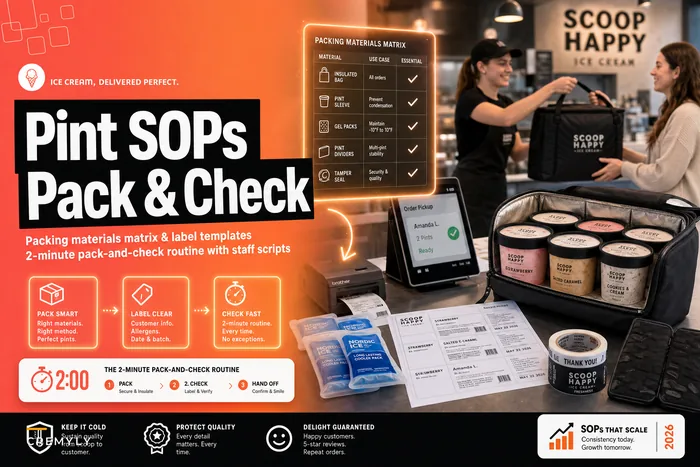
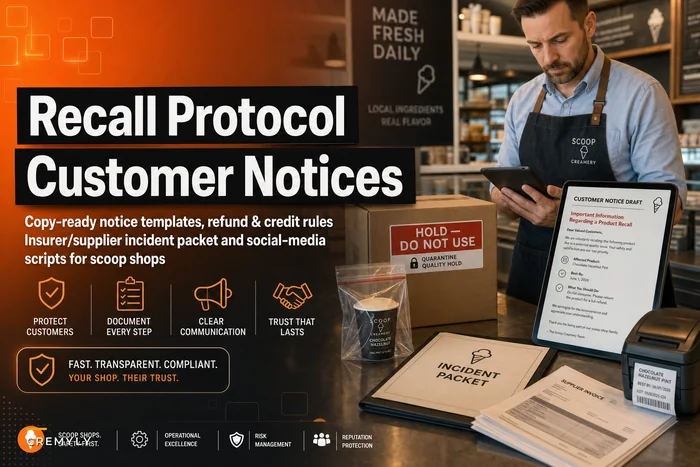
The same discipline you'd apply to tracing a product problem or documenting a quality incident applies here — honest records protect you. The habits that make your take-home pint packing routine reliable and your recall and customer-notice protocol defensible are the same habits that make a composting claim survive scrutiny: measure it, source it, and never say more than your data supports.
Composting is genuinely good operations and genuinely good PR — but only in that order. Build the measurement, let the numbers do the talking, and the story writes itself without a single word you'd have to walk back.
Ready to scoop up efficiency and grow your shop?
Join hundreds of ice cream shops using Cremyly to boost productivity, reduce waste, and delight customers with faster service.