

Your staff hands a customer their online order: four pints packed in a paper bag with one small ice pack. Twenty minutes later, that customer's posting photos of melted ice cream leaking through soggy cardboard on your shop's Instagram. The refund costs you $32, but the damage to your reputation spreads wider.
Most ice cream shops treat take-home packaging like an afterthought. They grab whatever materials are handy, slap on a handwritten label, and hope for the best. But packaging SOP for ice cream pints determines whether customers get a perfect product at home or a disappointing mess that ends up in the trash.
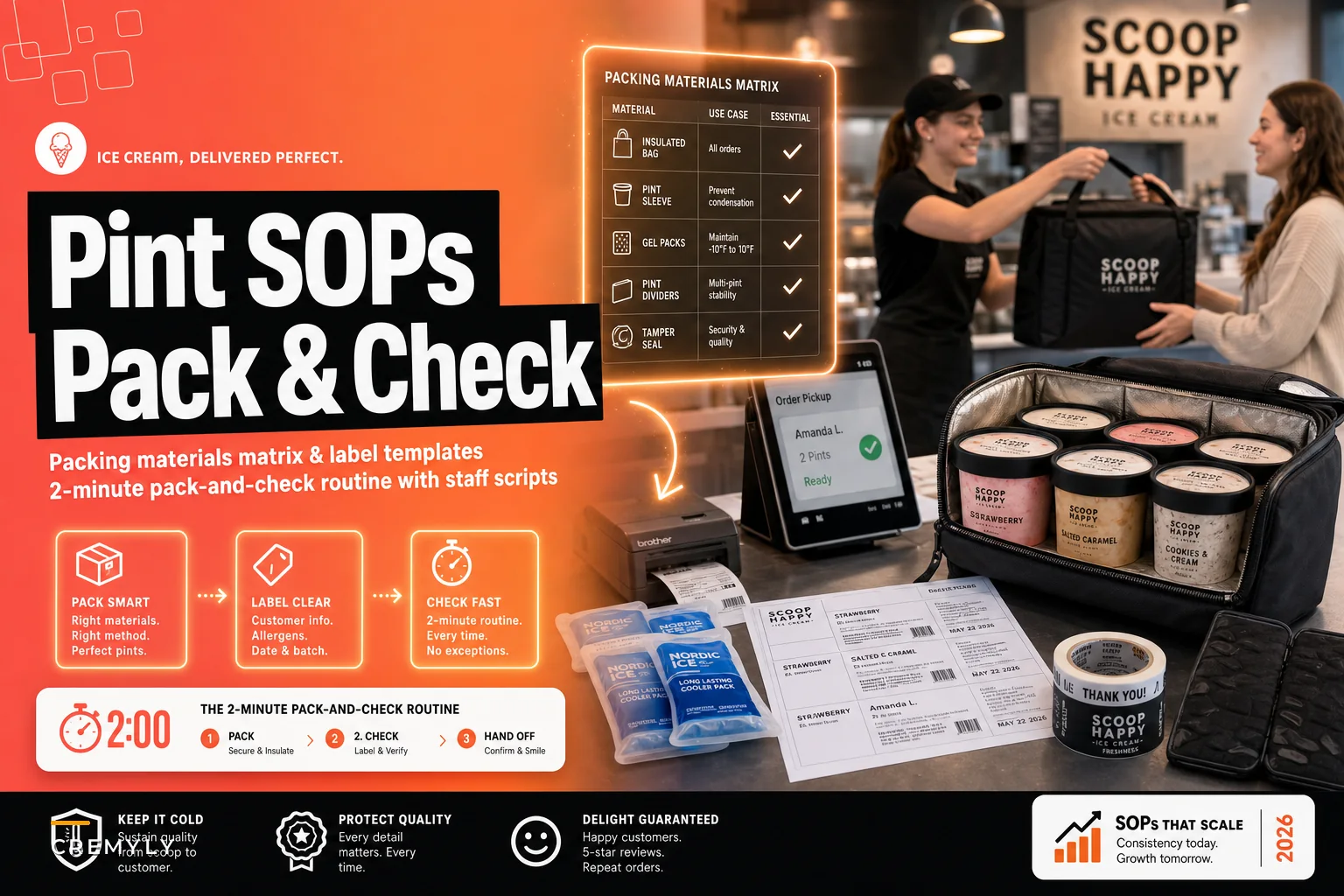
The difference between shops that nail take-home orders and those constantly dealing with complaints comes down to three operational elements: a distance-based packing matrix, consistent labeling that prevents confusion, and a rapid pack-and-check routine that catches problems before they leave your shop.
Why your current packing approach creates expensive problems
Walk into most ice cream shops during the afternoon rush and watch how they handle take-home orders. Someone grabs pints from the freezer, tosses them in whatever bag is closest, maybe adds an ice pack if they remember, and sends the customer out the door. No system, no consistency, just hoping it works out.
This casual approach creates cascading operational failures. Staff waste time debating how much insulation each order needs. Customers get home to find their premium gelato turned to soup. Your freezer inventory gets disrupted because no one tracks which flavors left for take-home versus in-store consumption.
When someone pays $14 for a pint of your signature brown butter pecan, they expect it to arrive home in the same condition they'd get eating in your shop. When that expectation breaks, they don't just skip their next order—they tell friends to avoid your take-home options entirely.
Temperature abuse during transport affects more than just texture. Ice crystals form when pints partially melt and refreeze, creating that grainy, unpleasant mouthfeel that screams "low quality" even if you started with premium ingredients. Your carefully balanced flavors get masked by freezer burn taste. The $8 worth of ingredients in that pint becomes worthless.
Building your distance-based insulation matrix
Stop guessing about insulation needs. Different travel distances require completely different packing approaches, and your staff needs clear guidelines that remove decision-making from the equation.
Keep your ice cream shop running smoothly.
Cremyly helps you manage every order, stock level, and staff shift with precision and ease.
- Real-time inventory tracking
- Order management dashboard
- Staff scheduling & shift coordination
No credit card required
0-10 minute trips (walking distance):
-
Single paper bag
-
No ice pack needed if outdoor temp below 70°F
-
One small gel pack if above 70°F
-
Pints stacked vertically, not horizontally
10-30 minute trips (short drive):
-
Insulated bag or double paper bag
-
Two medium ice packs, one bottom, one top
-
Newspaper or bubble wrap between pints
-
Sealed plastic bag inside to prevent condensation damage
30-60 minute trips (suburban drive):
-
Styrofoam cooler or thick insulated bag
-
Dry ice pellets (1/4 pound per 4 pints)
-
Individual pint wrapping in paper
-
Temperature indicator strip on outside
60+ minute trips (refuse or special arrangement):
-
Hard-sided cooler required
-
Minimum 1/2 pound dry ice
-
Customer brings own cooler, or
-
Charge additional $15 cooler deposit
The matrix eliminates arguments and confusion. Your Tuesday night closer doesn't need to guess whether twenty minutes to the suburbs needs extra insulation. They check the matrix, pack accordingly, done.
Distance alone doesn't determine packing needs though. Ambient temperature changes everything. During July heat waves, even five-minute walks need serious insulation. During January, you might skip ice packs entirely for short trips.
During July heat waves, even five-minute walks need serious insulation.
Create a simple temperature modifier:
| Temperature | Adjustment |
|---|---|
| Below 50°F | Reduce insulation by one level |
| 50-70°F | Use standard matrix |
| 70-85°F | Increase insulation by one level |
| Above 85°F | Add 50% more cooling material |
During July heat waves, even five-minute walks need serious insulation. During January, you might skip ice packs entirely for short trips.
Label templates that prevent confusion and returns
A customer pulls a pint from their freezer three weeks later. No label. Is it the dairy-free chocolate or the regular? When did they buy it? They take a guess, serve it to their lactose-intolerant friend, and now you're dealing with an angry phone call about allergic reactions.
Your labeling system needs three critical elements: flavor identification, pack date, and handling instructions.
Flavor and allergen template:
[FLAVOR NAME - Large Font] Contains: [Dairy/Eggs/Nuts/Soy - Bold] Dietary: [Vegan/GF if applicable] Batch: [Date code]
Print these on waterproof labels. Regular paper labels peel off when condensation forms. One shop switched to vinyl labels and cut their "unknown flavor" complaints by 90%.
Date and freshness template:
Packed: [DATE] Best by: [DATE + 30 days] For best quality, consume within 2 weeks Keep frozen below -5°F
The "best by" date isn't just about food safety—it's about setting quality expectations. Ice cream doesn't spoil like milk, but quality degrades. Customers eating freezer-burned pints three months later blame your product quality, not their storage habits.
Thaw and serve instructions:
-
Remove from freezer 5-10 min before serving
-
Softer texture
10-15 min at room temp
-
Firmer scoops
serve immediately
-
Once softened, do not refreeze
These instructions seem obvious to you, but customers regularly complain about "too hard" ice cream because they try scooping straight from a -10°F freezer. Clear instructions prevent these pointless complaints.
The 2-minute pack-and-check routine
Speed matters during rush periods, but rushing through packing causes more problems than it solves. A tight 2-minute routine ensures consistency without killing efficiency.
Minute 1: Pull and prep
Staff member announces the order out loud: "Four pints going out, cookies and cream, vanilla, chocolate, strawberry." This verbal confirmation catches errors before packing starts. They pull pints using the FIFO system from your freezer setup, checking each lid seal.
-
Lid gaps (air exposure causes freezer burn)
-
Container cracks (will leak when softening)
-
Frost buildup (indicates temperature abuse)
Any damaged pints get pulled for staff meals or sampling, not customer orders.
Minute 2: Pack and seal
-
Cooling material on bottom
-
Pints in vertical position
-
Insulation material between pints
-
Cooling material on top
-
Seal bag completely
The final check happens at handoff. Staff member confirms with customer: "Four pints, staying cold for about 30 minutes, keep them upright during transport." This verbal handoff prevents customers from leaving pints in hot cars for hours then blaming your packaging.
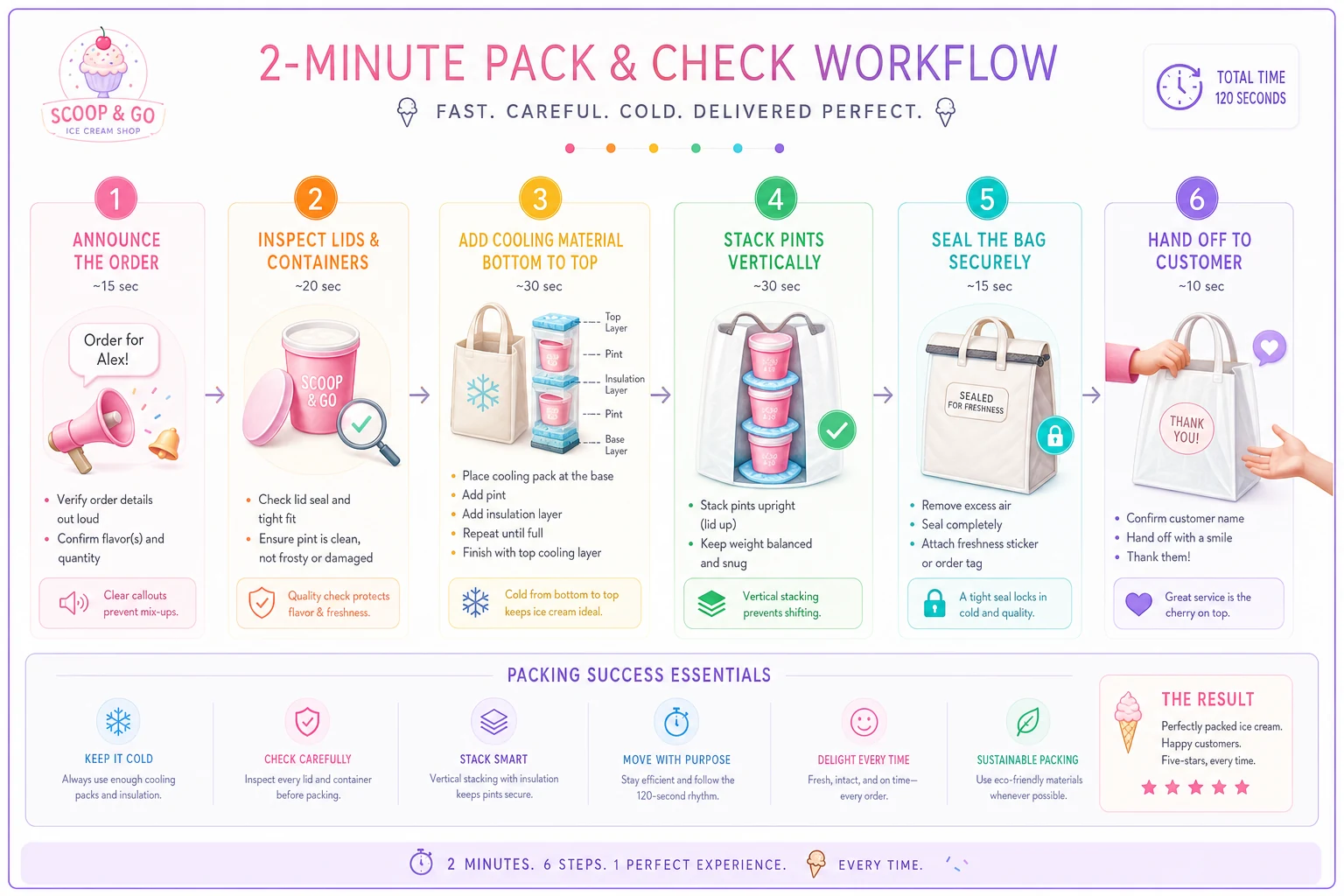
A concise visual guide teams can glance at during rushes.
Staff scripts that maintain consistency
Your team needs exact language for common situations. Vague instructions lead to inconsistent execution.
For checking travel distance: "How far are you traveling with these today? Just want to make sure we pack them with the right amount of insulation."
Not: "Do you need ice packs?" (Customer always says yes, even for two-minute walks)
For explaining packing charges: "For trips over 30 minutes, we add $2 for dry ice to guarantee they stay frozen. Should I add that?"
Not: "There's an extra charge for insulation." (Sounds like nickel-and-diming)
For refusing problematic requests: "For a two-hour drive, you'll need to bring your own cooler. Our standard packaging won't keep them frozen that long."
Not: "That's too far, sorry." (Sounds unhelpful)
For handling complaints: "I see the problem. Let me replace those pints right now, and let's go over the best way to transport them to avoid this happening again."
Not: "They must have melted in your car." (Sounds blame-shifting)
Damage reduction tactics from high-volume shops
Shops processing 200+ take-home orders weekly have discovered specific tricks that dramatically reduce damage rates.
The pre-freeze technique: Keep empty insulated bags in your freezer. Starting with a pre-chilled bag buys you an extra 10-15 minutes of holding time. One shop in Phoenix started pre-freezing bags during summer and cut their melt complaints by 40%.
The barrier method: Place a sheet of freezer paper between the ice pack and pint tops. Direct contact between ice packs and lids causes condensation that loosens labels and creates slip hazards. The paper barrier prevents this while maintaining cooling.
The orientation rule: Pints must stay vertical during transport. Horizontal pints leak through lid seams when they start softening. Train staff to show customers the correct carrying position. Mark bags with "THIS SIDE UP" arrows.
The batch separation: Never pack pints from different temperature zones together. A pint from the front display freezer (-5°F) packed with one from deep storage (-15°F) creates condensation between them. Temperature matching prevents moisture problems.
Measuring success through simple metrics
Track three numbers to know if your packaging SOP actually works.
Melt-related refunds per 100 take-home orders. Anything above 2% indicates systematic problems. Below 1% means your system works.
Packaging cost per order should stay between $0.50-$2.00 depending on distance. Higher means overpackaging, lower means risking quality.
Pack time during rush needs to hit 2 minutes or less. Longer disrupts service flow and creates bottlenecks.
A gelato shop tracking these metrics discovered their Thursday night crew had 3x higher melt complaints than other shifts. Turns out that crew was skipping the distance check to save time, using minimal packaging for everything. Twenty minutes of retraining solved a problem costing $200 weekly in refunds.
When to upgrade your packaging system
Some shops need more sophisticated solutions. If you're processing 50+ take-home orders daily or managing catering and bulk orders, basic packaging won't cut it.
Signs you need system upgrades include staff spending 5+ minutes debating packaging for each order, melt complaints exceeding 5% of take-home orders, buying packaging materials weekly with no tracking, or different shifts using completely different packing methods.
Operations handling this volume benefit from automated decision-making and tracking. AI-powered operational software can automatically determine optimal packaging based on order details, travel distance, weather conditions, and historical success rates. Instead of staff guessing or checking matrices, the system assigns specific packing instructions to each order. This removes human error while capturing data about what packaging combinations actually prevent problems.
The same platform tracks packaging inventory, automatically reorders materials before you run out, and identifies patterns in damage complaints. When Thursday's dinner rush consistently generates more melt complaints, the system flags this for investigation rather than letting the pattern continue invisibly for months.
Creating sustainable packaging habits
Your packaging SOP only works if every shift follows it consistently. Build habits, not just rules.
Make the matrix visible. Post it at the packing station where staff can't miss it. Include pictures showing correct vs incorrect packing. Visual guides work better than written instructions during busy periods.
Run monthly packing audits. Have a manager randomly check 10 take-home orders for proper packaging. Share results with the team. Celebrate improvements, address problems without blame.
Stock materials predictably. Running out of medium ice packs during Saturday rush forces staff to improvise, breaking your carefully designed system. Keep two weeks of materials on hand minimum.
Train every new hire on the complete routine before they touch their first take-home order. Don't assume they'll figure it out by watching others. Bad habits spread faster than good ones.
Shops that excel at take-home orders treat packaging as seriously as they treat flavor development. They recognize that the customer's experience doesn't end when they leave your shop—it ends when they open that pint at home. A two-minute packing routine might seem trivial compared to perfecting your salted caramel recipe, but it determines whether customers actually get to enjoy that recipe or end up with expensive soup.
Your packaging SOP for ice cream pints isn't about perfection. It's about consistency. When every order gets packed the same careful way, whether it's Tuesday morning or Saturday night rush, you build the kind of reliability that turns occasional take-home buyers into weekly customers who stock their freezers with your products. The difference between shops struggling with constant refunds and those building thriving take-home businesses comes down to systems. Not expensive equipment or complex training programs—just clear, simple systems that remove guesswork and ensure every pint arrives exactly as intended.
Ready to scoop up efficiency and grow your shop?
Join hundreds of ice cream shops using Cremyly to boost productivity, reduce waste, and delight customers with faster service.