

Most quality incidents at a scoop shop aren't dramatic. No ambulance, no health department cruiser out front. It's usually quiet and slow: a customer DMs you that the pistachio "tasted off," then a second person mentions stomach cramps the next morning, and suddenly you're staring at your phone at 9pm trying to remember which tub of pistachio you opened and whether you still have the lid.
That gap — between "something might be wrong" and "we have a plan" — is where small shops lose the most. Not to the actual contamination, but to the scramble. Nobody decided who makes the call, what the customer gets told, what you post publicly, or what evidence you need to keep. This is a working protocol for that exact window. Built for a single shop or a tiny chain, not a food manufacturer with a legal department.
Quick note before we start: this is an operational playbook, not legal advice. Food law varies by state and municipality, and anything involving suspected illness should loop in your local health authority early. Treat the templates below as starting points your attorney or inspector can bless.
## The three-bucket triage that should happen in the first 20 minutes
The core mistake isn't acting too slow. It's reacting at the wrong intensity. Shops either panic over a single "it tasted weird" comment and torch their reputation with an overcautious public post, or they shrug off a legitimate cluster because it came in piecemeal over two days.
A clean recall protocol for a small food business starts with one decision: which bucket is this?
| Bucket | What triggers it | First action | Public posture |
|---|---|---|---|
| A – Single quality complaint | One customer, taste/texture, no illness reported | Log it, pull the suspect tub for inspection, offer refund/credit | None. Handle privately. |
| B – Potential safety issue | Two+ unrelated complaints on the same flavor/batch, OR any reported illness, OR a foreign object | Quarantine the batch, trace supplier lot, notify owner immediately, start the incident packet | Prepare notice; hold until facts confirmed |
| C – Confirmed contamination / regulatory | Supplier recall notice, positive test, health dept contact, confirmed allergen cross-contact causing reaction | Full pull of affected product, notify health authority, issue customer notice, contact insurer | Public notice required |
The value here is that it stops two expensive overreactions. A Bucket A complaint doesn't need a Facebook post. A Bucket B situation doesn't need you to wait until person number five shows up.
One pattern worth naming: a lot of shops never escalate from A to B because complaints come through different channels — one on Instagram, one via a Yelp review, one a staff member heard in person. No single person sees all three, so nobody connects them.
The fix is dead simple and comes up later: every complaint, no matter how it arrives, goes into one log.
## Why the "connect the dots" problem is the real failure point
The actual contamination risk in a well-run scoop shop is low if your local compliance and temp logging is solid. What fails is detection and coordination.
Keep your ice cream shop running smoothly.
Cremyly helps you manage every order, stock level, and staff shift with precision and ease.
- Real-time inventory tracking
- Order management dashboard
- Staff scheduling & shift coordination
No credit card required
In practice, it usually plays out like this: a complaint comes in on a Saturday closing shift. The closer is 19, slammed, and tells the customer "so sorry, here's a free scoop next time" — a fine human response — but never logs it. Sunday a different complaint hits the Instagram DMs and the morning person who reads it has no idea Saturday happened. Monday the owner gets a cramping email. Three signals, three people, zero connection. By the time anyone realizes there's a pattern, the suspect tub has been scooped down to nothing and tossed, and your traceability is gone with it.
That's the whole game. Contamination you can insure against. A missing lot number and an empty tub you cannot.
So before any templates matter, you need two non-negotiables running at all times:
-
One complaint log. Every taste/quality/illness report, from every channel, in one place, with the flavor, approximate purchase time, and batch/lot if known.
-
A "don't toss the evidence" rule. When a complaint comes in on a specific flavor, the current open tub of that flavor gets lidded, labeled "HOLD – do not serve," dated, and moved — not discarded. Same for the packaging of any supplier ingredient tied to it.
The fix is dead simple and comes up later: every complaint, no matter how it arrives, goes into one log.
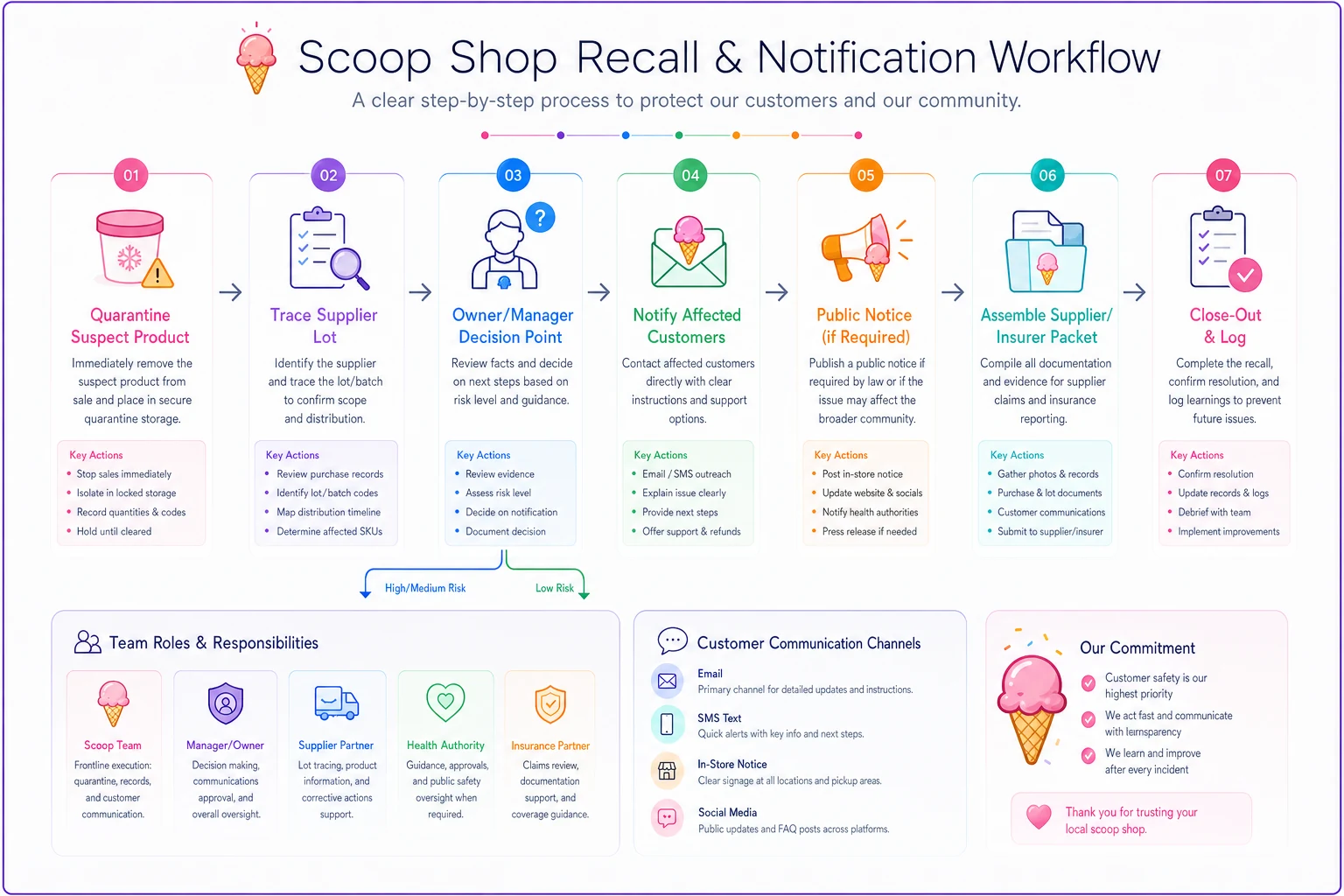
## The notification sequence, in order
Once you're in Bucket B or C, the sequence matters more than speed. Doing the right steps out of order — posting publicly before you've confirmed the batch, or refunding customers before you've traced the lot — creates problems you can't walk back.
-
Quarantine first (minutes 0–15). Pull and label every unit of the suspect product. Open tubs, backstock, pints in the take-home case, anything made from the same base or ingredient lot. Nothing moves until you've photographed it.
-
Trace the lot (minutes 15–45). Pull supplier invoices and lot codes for the implicated ingredient. Note delivery date, supplier, and which batches you produced from it. This is where a clean supplier paper trail earns its keep — your supplier scorecard and on-delivery audit records are exactly what you'll be flipping through here.
-
Owner/manager decision (by minute 45). One named person decides the bucket and whether a customer notice goes out. Not a committee. Write the decision and the time down.
-
Notify affected customers (same day). Direct notice to anyone you can identify — loyalty members who bought the flavor, catering clients, anyone who complained. Direct beats public when you can reach people directly.
-
Public notice only if required (Bucket C, or Bucket B that's already spreading online). A short, factual post. Template below.
-
Supplier + insurer packet (within 24–48 hours). Assemble the incident packet while memory and evidence are fresh.
-
Close-out and log. Once resolved, write the after-action
what happened, what you changed, batch disposition.
The step shops get backwards most often is 4 and 5. They post publicly first because it feels proactive, then spend the next week doing reputation cleanup over what might've been a two-customer issue. Reach the people you can reach directly — quietly and quickly — before you broadcast.
A quick visual of the steps can help staff remember the order during a scramble.
The step shops get backwards most often is 4 and 5. They post publicly first because it feels proactive, then spend the next week doing reputation cleanup over what might've been a two-customer issue. Reach the people you can reach directly — quietly and quickly — before you broadcast.
## Customer notice templates
Keep these short. Over-explaining reads as panic. Under-explaining reads as a cover-up. Factual and brief wins.
Direct notice — Bucket B (potential issue, being investigated):
> Hi [Name] — thank you for letting us know about the [flavor] you purchased on [date]. We take this seriously and are reviewing that batch now. Out of caution, we've pulled it from sale. If you still have any, please don't eat it — we'll refund or replace it, your choice. If you've felt unwell, please see a doctor and let us know. We'll follow up once we know more. — [Owner name], [Shop]
Direct notice — Bucket C (confirmed, with action):
> Hi [Name] — we're reaching out because you purchased [product, flavor] on or around [date], which is part of a batch we've removed due to [brief reason: a supplier ingredient recall / a confirmed quality issue]. Please do not consume it. Return it for a full refund or [credit amount], no receipt needed. If you have any health concerns, please contact your doctor. We're sorry for the trouble and are taking steps to make sure it doesn't recur. — [Owner name], [Shop]
Public notice — Bucket C (keep it this short):
> Product notice: We've voluntarily removed [product/flavor, with batch or date range] from sale due to [brief reason]. If you purchased it between [dates], please don't consume it and bring it in for a full refund or credit. Questions: [email/phone]. Customer safety is our priority and we're addressing this directly with our supplier.
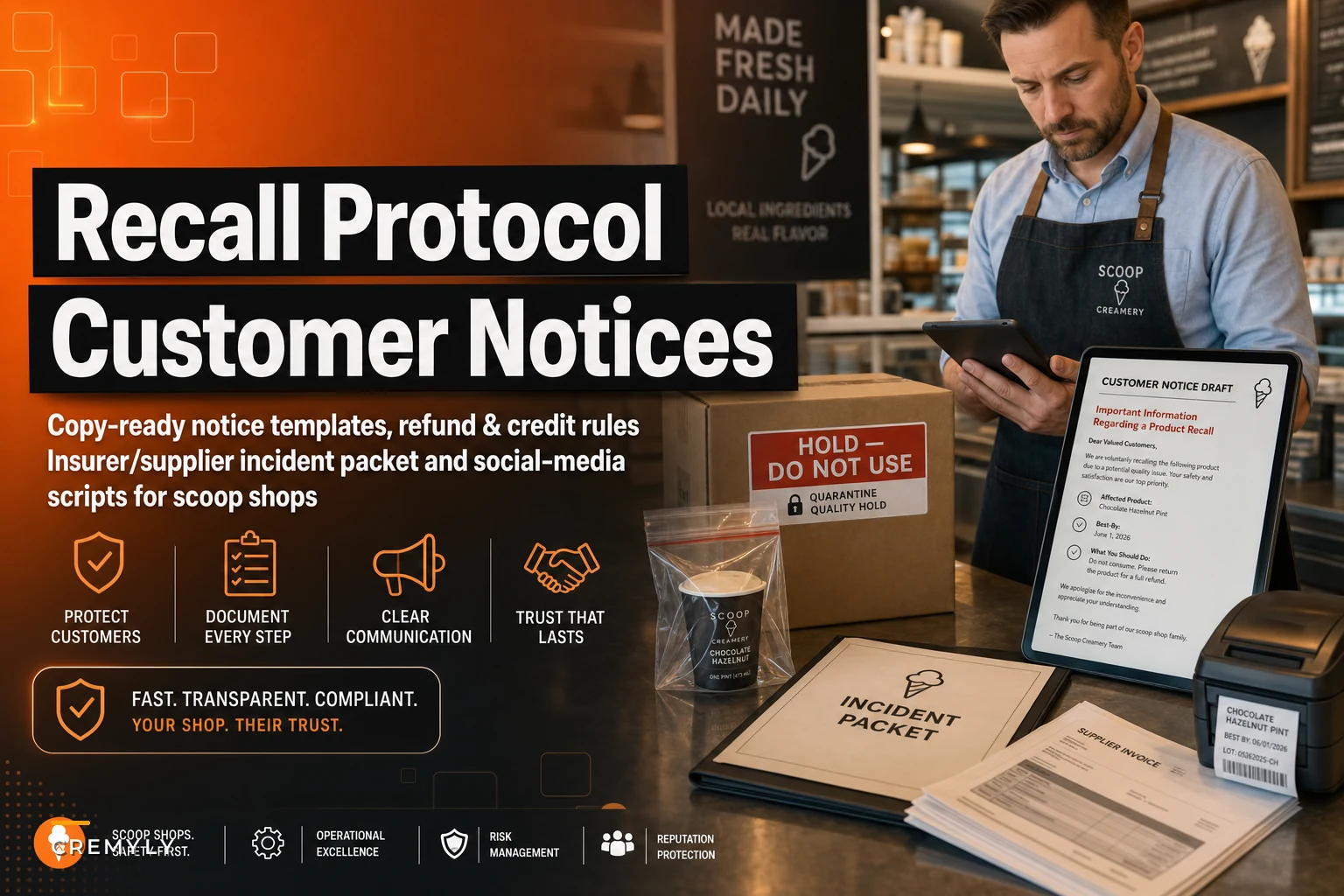
Notice what these don't do: they don't speculate on cause, don't assign blame to the supplier by name, and don't promise things ("completely safe now," "isolated incident") you can't yet back up. Speculation in writing is what your insurer and attorney will wince at later.
## Refund and credit rules that don't bleed you dry
Decide these in advance, because setting refund policy in the middle of an incident — while stressed and guilty — is how shops give away far more than necessary or, worse, apply it inconsistently and look unfair.
-
Bucket A (quality) Refund or replacement of the affected item. Receipt not required for in-store; one item per complaint.
-
Bucket B (potential safety, unconfirmed) Full refund of the product plus a modest goodwill credit (a free pint or two scoops). No receipt required.
-
Bucket C (confirmed) Full refund regardless of receipt, plus credit. If illness is reported, do not offer "settlement"-style cash or ask anyone to sign anything — that's a conversation for your insurer, not your counter staff. Document the contact and route it.
The hard rule to write down and train: counter staff never discuss fault, cause, or compensation beyond a standard refund/credit for any illness report. The script is one sentence: "I'm so sorry to hear that — let me take your details and the owner will follow up today." That single boundary prevents a well-meaning teenager from saying something that becomes evidence.
## Social messaging: what actually matters
Social is where small food incidents either stay small or detonate. The difference is usually tone and timing, not the facts.
Do:
-
Respond to public complaints fast, even if it's just "We're on it — can you DM us your details?" Silence reads as guilt.
-
Move the real conversation to DM or email. Never resolve specifics in a public comment thread.
-
Keep every public statement to facts you've confirmed.
-
Have one person approved to post. Multiple voices create contradictions.
Don't:
-
Don't delete negative comments or reviews mid-incident. It looks like a cover-up and screenshots live forever.
-
Don't argue, even when the customer is wrong or exaggerating. You will not win and you will be the clip that circulates.
-
Don't name or blame your supplier publicly, even if it's genuinely their lot. That's a contractual and relationship conversation, not a public one.
-
Don't post an all-clear until you've genuinely got one.
One thing that quietly saves shops: the owner who, the moment a complaint goes public, replies within the hour with a calm "Thanks for flagging — DMing you now." Most people deescalate instantly when they feel heard. The ones who blow up on social usually do so because they got ignored, not because they got poisoned.
## The incident packet your insurer and supplier actually want
This is the piece most shops skip, and it's the one that determines whether a claim goes smoothly or turns into a months-long back-and-forth. Assemble it while everything's fresh — within 48 hours. Memory degrades fast and nobody accurately reconstructs timestamps a week later.
-
Timeline every signal and action with times and dates — first complaint, quarantine, trace, notices sent.
-
Product details flavor, batch/production date, quantity made, quantity sold, quantity recovered.
-
Supplier lot info ingredient, supplier, lot code, delivery date, invoice copy.
-
Photos the quarantined product, labels, lot codes, any foreign object, storage area.
-
Temp logs for the relevant window, from your existing temperature logging records. If a freezer event is involved, your freezer-failure incident records and insurer triggers plug straight in here.
-
Customer contacts list of affected/notified customers and reported symptoms (dates only, keep it factual, respect privacy).
-
Communications log copies of every notice sent and every public post.
-
Disposition what happened to the recalled product and how it was disposed.
Photograph lot codes and labels immediately when you quarantine products.
One underrated move: send the relevant slice of this packet to your supplier with the refund/replacement request, not after. "Here's lot #X, delivered [date], here's the issue, here are photos" gets a credit processed far faster than a vague complaint about sick customers. Specificity is leverage.
## A real scenario
A two-location shop in a beach town got two complaints over a weekend on the same salted-caramel pint line — one "tasted fermented," one mild stomach upset. Separate channels, nearly got missed. The weekend lead happened to check the shared complaint log before tossing the open tub and connected them.
They quarantined every salted-caramel pint across both shops (about 40 units, roughly $160 retail value held), traced it to a single caramel base lot delivered that Tuesday, and found the base had been left in a warm prep area longer than their window allowed during a busy catering push. Not a supplier problem — their own process gap.
Because they caught it as Bucket B and not Bucket C, there was no public post, no health department involvement. They DM'd the two complainers, refunded plus a free-pint credit, pulled and discarded the 40 units, and documented the whole thing in a packet. Total hard cost: the product loss plus credits, a few hundred dollars. They tightened the base-handling rule the next day.
The alternative version — where nobody connects the two complaints, the tub gets scooped empty, and a third customer posts publicly on Tuesday — is the same incident costing ten times as much in refunds, reviews, and a week of the owner's attention. Same contamination, wildly different outcome, entirely because of detection and sequence.
## When a full protocol is overkill — and when it isn't
Single tiny shop, a few hundred scoops a week, simple flavors, tight temp control? You don't need a binder. You need the complaint log, the hold-the-evidence rule, and these templates saved somewhere you can find them at 9pm.
Where the full sequence earns its keep: multi-location shops where complaints scatter and someone has to aggregate them, shops doing wholesale or catering where you're liable for product in other people's venues, and anyone using lots of outside components — mix-ins, sauces, inclusions — where a supplier recall can land on you with no warning.
Who should not improvise any of this in the moment: anyone facing a reported illness. The second someone says they got sick, you're out of "handle it at the counter" territory. Log it, hold evidence, notify the owner, and get your insurer and health authority involved early. Being cautious and well-documented there is never the expensive choice.
## Where this quietly ties into your systems
None of this needs fancy tooling. The one place software genuinely earns its spot is the complaint log — because the whole failure mode is signals scattered across people and channels.
If your operations platform lets you tag a sale by batch, log a complaint against a flavor, and see everything in one view, the "connect the dots" problem mostly solves itself. When AI-assisted tools flag that three separate complaints hit the same flavor within 48 hours, a human makes the Bucket B call days earlier than they would have otherwise. The decision stays human; surfacing the pattern is what you're automating.
That's really the whole point of this protocol. Quality incidents rarely go bad because a shop did something careless. They go bad because the right people didn't see the right signals in time, and because nobody decided — in advance, calmly — what the first twenty minutes should look like. Decide it now, write the templates now, and the worst version of this never happens.
That's really the whole point of this protocol. Quality incidents rarely go bad because a shop did something careless. They go bad because the right people didn't see the right signals in time, and because nobody decided — in advance, calmly — what the first twenty minutes should look like. Decide it now, write the templates now, and the worst version of this never happens.
Ready to scoop up efficiency and grow your shop?
Join hundreds of ice cream shops using Cremyly to boost productivity, reduce waste, and delight customers with faster service.