

Most scoop shops treat sampling, checkout, and repeat visits as three separate things. Sampling belongs to the counter staff. Conversion belongs to the POS. Retention belongs to whatever loyalty punch card is gathering syrup near the register. Nobody owns the loop, so nobody notices when it leaks.
And it leaks in ugly, invisible ways. A shop can push samples all day, convert like crazy on a hot Saturday, and still have a customer base that basically resets to zero every season. You feel busy. Your margins say otherwise. The problem isn't any single stage — it's that the stages don't talk to each other. The data that ties a sample to a first sale to a fourth visit either doesn't exist or lives in five places that never get compared.
This is the part of running a customer lifecycle scoop shop that almost nobody sets up on purpose. Here's how the loop actually works, where it breaks as you grow, and what a connected version looks like.
The loop, and why it's a loop and not a funnel
People love the word "funnel." A funnel implies customers pour in the top, some fall out, and the ones that survive drop into the bucket at the bottom. Done.
But a scoop shop doesn't work that way. The whole point of your business is that the bottom of the funnel feeds back into the top. A retained customer doesn't just buy again — they bring a friend who samples, they buy pints for a party, they tag you on a Friday night. Retention is your cheapest acquisition channel. So the shape is a loop:
Sampling → Conversion → Retention → Margin → (funds more/better sampling)
Each arrow is a handoff. And every handoff needs a piece of data to move with the customer, or the loop breaks at that seam.
What most owners miss: margin isn't the endpoint. Margin is the fuel. A shop with fat margins can afford generous samples, better ingredients, and a real loyalty offer — which makes the next turn of the loop stronger. A shop bleeding margin cuts samples to save waste, which kills conversion, which kills retention, which kills margin further. It spirals both directions. That's why treating these as separate departments is so dangerous.
What actually moves between each stage
The loop only works if data flows across the handoffs. Below is what needs to travel from one stage to the next. Most shops are missing at least two of these entirely.
Keep your ice cream shop running smoothly.
Cremyly helps you manage every order, stock level, and staff shift with precision and ease.
- Real-time inventory tracking
- Order management dashboard
- Staff scheduling & shift coordination
No credit card required
| Handoff | What needs to flow | What breaks if it doesn't |
|---|---|---|
| Sampling → Conversion | Which flavor was sampled, whether it converted, time of day | You never learn which samples sell and which just burn product |
| Conversion → Retention | Who the customer is (even loosely), what they bought, cup vs pint | Every visit is a stranger; no basis for a comeback offer |
| Retention → Margin | Visit frequency, average ticket, redemption cost of loyalty | You can't tell profitable regulars from discount-chasers |
| Margin → Sampling | Per-flavor contribution margin, waste rate | You sample your least profitable flavors and eat the loss |
Notice that last row loops back to the top. Your margin data should be deciding what you put on the sample spoon. If your salted caramel has a thin margin and a high conversion rate, fine — sample it, the volume covers it. If your pistachio has a thin margin and weak conversion, you're paying to lose money. Most shops sample based on what's "featured" or what a supplier pushed, not on what the loop tells them.
If your per-flavor costing is fuzzy, the whole margin arrow is guesswork. Getting that right first — calculating true per-scoop cost and setting prices from it — is what makes the rest of this loop honest instead of vibes-based.
Where it breaks at each stage
Sampling that converts but doesn't inform
A well-run sample bar already balances conversion against waste — the timed scripts and single-serve discard rules for sampling stations handle that part well. But even a great sample station usually collects zero data. Staff hand out spoons, some people buy, and the shop never records what was sampled versus what got bought.
The pattern that shows up repeatedly: a shop believes their sampling is "working" because it feels busy at the counter. But when you actually tag it, you find something like 60% of samples going to three flavors, and two of those three barely move a paying order. The staff sample what's easy to reach in the well, not what converts. That's a coordination gap between the freezer layout and the sales data — two things that should never be decided independently.
Conversion with no identity attached
This is the biggest leak in almost every shop. The sale happens, the drawer opens, the customer leaves — and nothing about them was captured. No name, no rough segment, nothing. So the retention stage starts from a cold zero every single time.
You don't need a full CRM and email harvesting operation. The lightweight version works better in practice: a simple loyalty identifier — phone number, scannable code, even a named tab for regulars — that ties visits together. The goal isn't marketing spam. It's just knowing whether the person in front of you is on visit one or visit fourteen, because those two people should be treated completely differently.
Retention that's actually just discounting
A lot of "retention programs" are margin destroyers wearing a loyalty costume. Buy-9-get-1-free sounds fine until you run the math on who's redeeming. If your heavy redeemers are the same people who'd come anyway, you're paying regulars to do what they already do — and funding it out of the margin that's supposed to fuel the loop.
The mistake is measuring retention by visits instead of profitable visits. A customer who comes weekly but only ever redeems free scoops and buys nothing else is not a win. The loop needs retention that lifts lifetime value, not just visit count.
Margin that never loops back
The final and quietest failure: margin data sits in a monthly P&L that nobody uses to change what happens at the sample bar tomorrow. You calculated your contribution margins in a spreadsheet in March and haven't looked since, even though your mix has completely shifted with the season. The loop is broken at the return arrow, and it just sits there losing quietly.
What changes as you scale
At one location with an owner behind the counter, the loop runs on human memory. You know the regulars. You know pistachio doesn't move. You adjust samples by feel. It genuinely works — for one shop, with you there.
-
The regulars become strangers. Nobody at Location 2 knows who your best customers are because that knowledge lived in your head at Location 1.
-
Sampling decisions drift. Each shift lead samples whatever they personally like, and conversion rates diverge between locations for reasons nobody can explain.
-
Retention offers get inconsistent. One manager comps generously, another never does, and your loyalty economics become impossible to read.
-
Margin analysis lags reality by weeks. By the time the numbers surface a problem, you've already burned a season of product on the wrong samples.
Scale doesn't create new problems here — it just removes the human glue that was quietly holding the loop together. That's the real reason multi-location shops feel like the wheels came off even when each individual location seems fine.
Sample KPIs that make the loop visible
You don't need forty metrics. One or two per handoff is enough to see where the loop is thinning out.
-
Sample-to-sale conversion, by flavor. Not overall — by flavor. Overall conversion hides the flavors that are pure waste.
-
First-visit capture rate. Of paying customers, what share got tied to a loyalty identity? If this is under around 30%, your retention stage is starving.
-
Repeat-visit rate at 30 and 60 days. The 60-day number is the honest one for a seasonal business.
-
Contribution margin per flavor, refreshed monthly. This is what should be steering the sample bar.
-
Loyalty redemption margin. Average ticket on a redemption visit minus the cost of the comp. If it's negative and staying negative, your program is a leak, not a loop.
The point of tracking any of this isn't a dashboard for its own sake. It's to answer one question at each seam: is product/attention/discount flowing forward and coming back with more than it cost?
A shop-level playbook you can actually run
This is where the loop stops being theory. Below is a concrete set of scripts, POS tags, and merchandising rules that connect the stages without a big system overhaul.
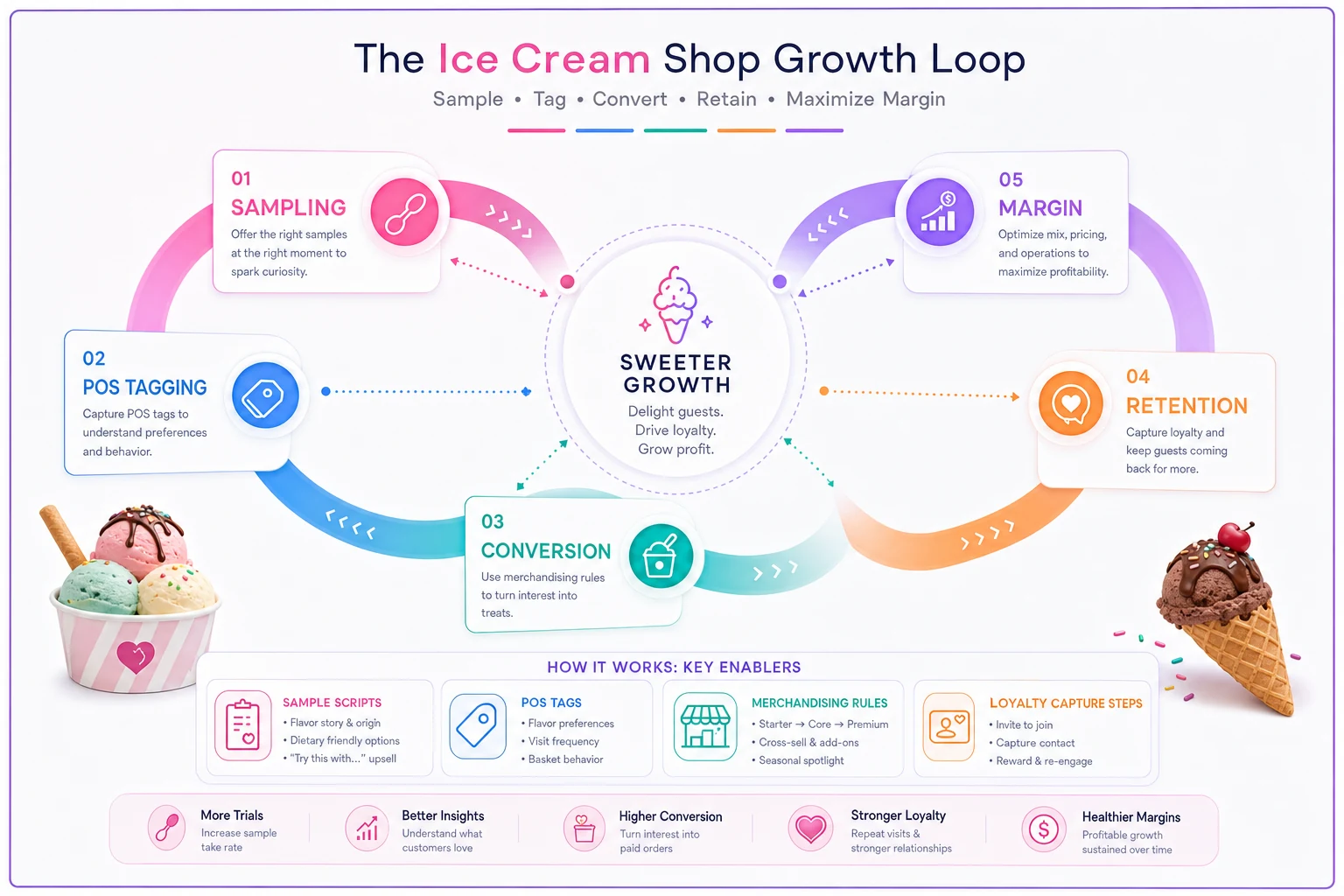
A simple visual of the flow helps teams see where each responsibility sits and what data needs to move at each handoff.
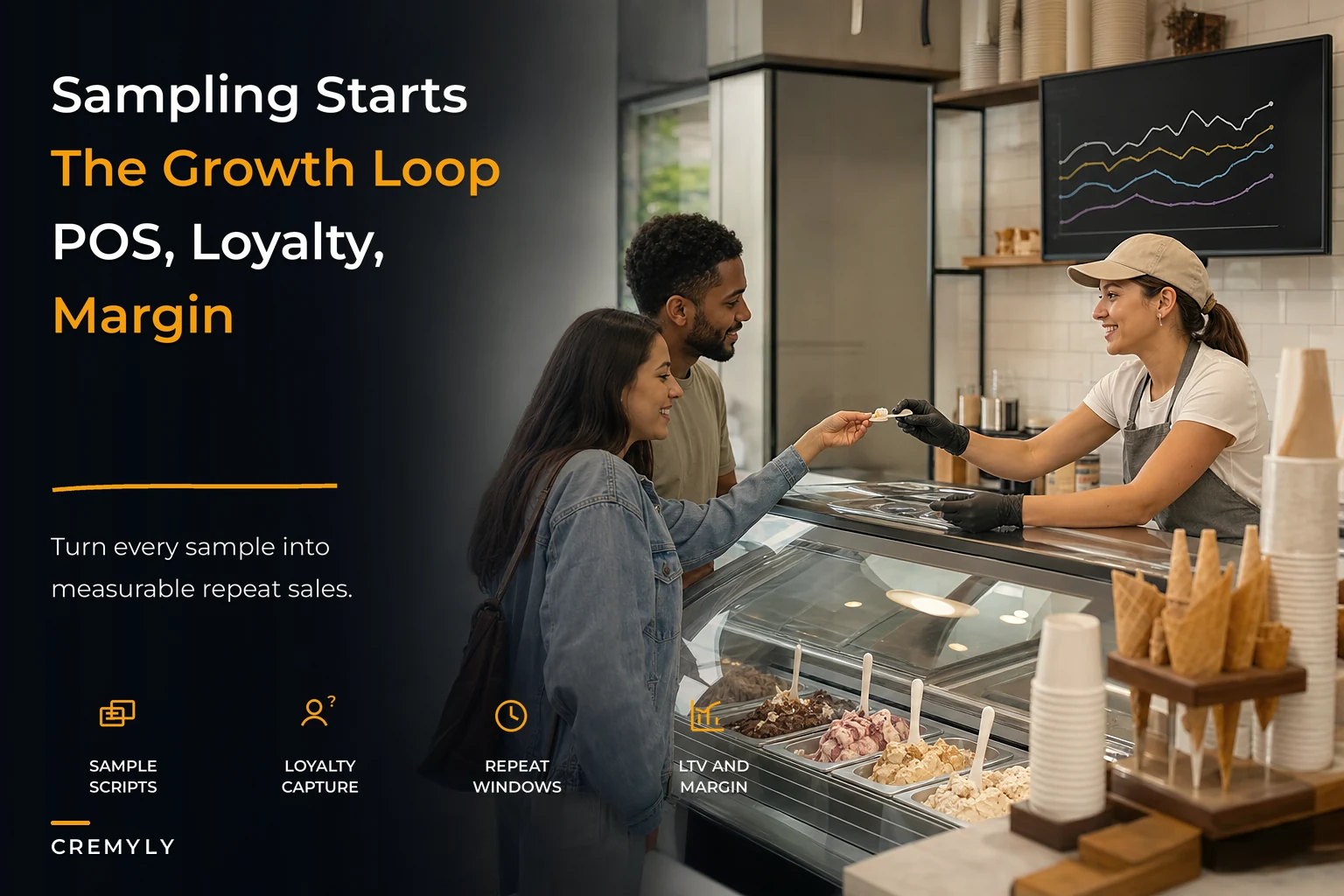
Sampling scripts (tie the spoon to the data):
-
Sample the high-margin, high-conversion flavors first — not the featured one, not the one nearest your hand.
-
One line after every sample
"Want that as a scoop or grab a pint for later?" The pint prompt is where average ticket climbs.
-
When someone loves a sample and buys, that's your moment for the loyalty capture — not before.
POS tags (the data that has to flow):
-
Tag whether a sale was sample-influenced (a single quick button).
-
Tag cup vs cone vs pint vs bulk so retention analysis can separate walk-in habit from take-home behavior.
-
Attach a loyalty identifier on capture so visits can be threaded together.
Merchandising rules (the return arrow, made physical):
-
The flavor you sample most gets the freezer position that's easiest to scoop and the case position that's easiest to see. Alignment between what you sample and what you stage matters.
-
Rotate sampled flavors monthly based on the margin refresh, not on gut feel.
-
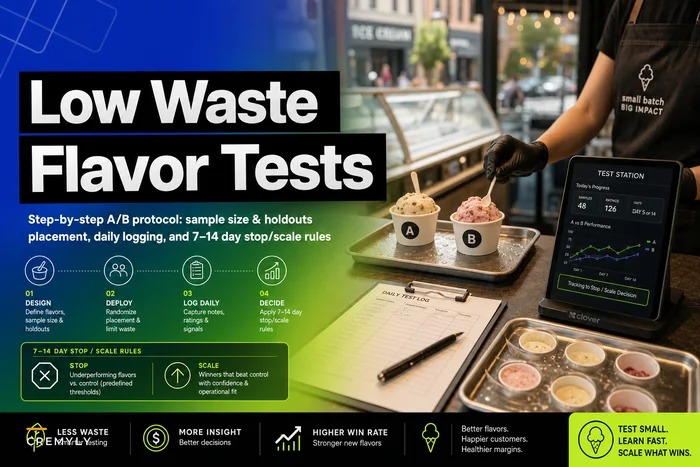
Any new flavor entering the sample rotation goes through a proper test window first — the A/B protocol with clear stop/scale rules for new offerings keeps you from sampling something you'll regret.
Retention rules:
-
First-time captured customers get a comeback nudge inside their first two weeks. That window is where a one-time sampler becomes a regular.
-
Loyalty rewards should push toward higher-value purchases — a pint reward beats a free single scoop for your margin. Not just free repeat scoops.
Make the loyalty capture part of the purchase moment—ask for the phone number when someone buys after a sample.
These rules are deliberately simple so they can be run without heavy tech investment yet still thread data through the loop.
A real scenario
A two-location shop in a mid-size town — roughly 300–350 tickets a day across both stores in peak season — had solid sampling and decent conversion, but a 60-day repeat-visit rate sitting somewhere around 18%. Profitable in summer, terrifying in shoulder season.
When they actually tagged sample-influenced sales, they found staff were sampling two low-margin fruit sorbets constantly because those tubs sat at the front of the well. Those flavors converted around 25%, well below their custard-base flavors sitting near 40%. So they were burning their most-sampled product on their weakest converters.
They did three things: reordered the freezer well so the high-margin, high-conversion flavors were the easy grab; switched the sample script to lead with those; and added a simple phone-number capture at the point of a happy purchase with a two-week comeback offer aimed at pints.
Over the following couple of months, 60-day repeat visits moved into the high-20s%, sample waste dropped noticeably, and their average take-home ticket ticked up because the pint prompt finally had a place in the flow. Nothing dramatic in any single number — but the loop started feeding itself instead of leaking. That's the whole game.
When this makes sense — and when it doesn't
Do this if: you've got repeat-customer potential (a neighborhood, regulars, a local base), you're stepping off the floor or adding locations, and your margins are healthy enough to fund sampling and a real loyalty offer.
Skip most of it if: you're a pure-tourist location where 90% of customers will never return no matter what you do. In that case, optimize hard for sampling → conversion → average ticket and don't spend energy on a retention loop that has nothing to loop back to. Know which business you actually are before you build for the wrong one.
Don't do this if your per-flavor costing is still guesswork. The margin arrow is what makes every other decision honest. Fix costing first, then close the loop.
Bringing it together
The reason sampling, conversion, and retention feel like separate problems is that most shops built them separately — different people, different tools, different weeks. But they're one system with one job: turn a spoon into a regular, and turn that regular's margin back into a better spoon for the next person.
Keeping that loop visible as you grow is mostly a data-flow problem. When each handoff carries the piece of information the next stage needs — which flavor converted, who the customer is, what a repeat visit is actually worth — the loop tightens on its own. This is exactly the kind of cross-stage coordination that connected operational software makes practical, because holding it all in your head stops working the day you have two locations and a Tuesday off. The software is just the plumbing. The loop is the thing worth building.
The reason sampling, conversion, and retention feel like separate problems is that most shops built them separately — different people, different tools, different weeks. But they're one system with one job: turn a spoon into a regular, and turn that regular's margin back into a better spoon for the next person.
Keeping that loop visible as you grow is mostly a data-flow problem. When each handoff carries the piece of information the next stage needs — which flavor converted, who the customer is, what a repeat visit is actually worth — the loop tightens on its own. This is exactly the kind of cross-stage coordination that connected operational software makes practical, because holding it all in your head stops working the day you have two locations and a Tuesday off. The software is just the plumbing. The loop is the thing worth building.
Ready to scoop up efficiency and grow your shop?
Join hundreds of ice cream shops using Cremyly to boost productivity, reduce waste, and delight customers with faster service.