


Sampling is one of those things every scoop bar does and almost nobody measures. You hand out little pink spoons, customers nod, they order (or don't), and the whole thing feels harmless. But if you actually add up the product going out on those spoons over a busy summer Saturday, it stops looking harmless pretty fast.
The core tension is simple: sampling drives conversion, but every sample is product you're not selling. A loose sampling operation can quietly burn through 4–7% of your daily product on tastes that don't convert. A tight one turns sampling into one of the highest-ROI things happening at your counter. The difference isn't whether you sample — it's whether you have a sampling SOP for your ice cream shop that treats it like a controlled process instead of a free-for-all.
This post is about the specific rules: how long a taste interaction should last, how many samples one customer actually gets, what happens to a scooped-but-refused sample, and how you hand off a hesitating customer between staff without restarting the whole sampling cycle.
The math nobody runs on their sample spoons
Let me put actual numbers on this, because "samples add up" is the kind of vague warning that gets ignored.
Say your average sample is a rounded quarter-ounce of product on a taster spoon. Your product costs roughly $0.10–$0.14 per ounce landed depending on your mix of house-made and purchased base. One sample is small — call it 3 to 4 cents of raw product. Nobody blinks.
Now run a busy day. A mid-volume shop doing 400–500 transactions on a peak Saturday might hand out 250–350 samples. Some customers take three or four. At the high end you're pushing 400+ tastes in a single day. That's roughly $15–$25 of product, most of it during your busiest ten weekends of the year. Across a season, undisciplined sampling at a single busy location lands somewhere in the $1,200–$2,000 range in raw product cost alone — before you count the labor time each sample interaction eats.
And here's the part that matters more than the dollar figure: most of that product goes to people who were already going to order. The regular who asks to "just try the new pistachio" before getting her usual two scoops of vanilla didn't need convincing. That sample was pure margin leakage dressed up as service.
Sampling only earns its keep when it converts an undecided customer or upgrades an order. Everything else is waste wearing a friendly face.
The three failure modes at the sample station
Sampling breaks down in three predictable ways. Knowing which one is happening in your shop tells you which rule to tighten.
Keep your ice cream shop running smoothly.
Cremyly helps you manage every order, stock level, and staff shift with precision and ease.
- Real-time inventory tracking
- Order management dashboard
- Staff scheduling & shift coordination
No credit card required
The runaway taster. One customer camps at the counter working through six flavors while a line forms behind them. Conversion on serial samplers is genuinely bad — people who need to try six flavors usually order one small scoop or nothing. Meanwhile you've tied up a staff member and slowed the whole line.
The default sampler. Staff offer samples reflexively to everyone, including customers who already know what they want. This is the sneakiest failure mode because it feels like good hospitality. It's actually just giving away product to buyers who were already sold.
The scoop-and-refuse. Someone asks to taste, gets a sample, doesn't like it, and now there's a partially scooped taster's worth of product plus whatever got contaminated on the spoon or tub surface. Without a discard rule, this either goes somewhere it shouldn't or gets tossed sloppily — and nobody tracks it either way.
Each of these needs a different fix. Lumping them together as "we sample too much" doesn't help anyone behind the counter make a better call in the moment.
Timed sampling scripts: the 20-second rule
The single most effective control is putting a soft time boundary on the sampling interaction — not with a stopwatch, but with a script that naturally moves the customer toward a decision.
The problem with open-ended sampling is that "Would you like to try anything?" invites browsing. A structured script reframes it as a decision aid. The goal is getting from "I'm not sure" to a scoop in the cup inside roughly 20–30 seconds.
A workable structure looks like this:
-
Narrow first, sample second. Instead of opening up the whole case, ask a narrowing question: "Are you leaning fruity or chocolatey today?" This cuts the candidate flavors from twelve to three before a single spoon comes out.
-
Offer one, mention a backup. "Want to try the blackberry? If that's not it, the strawberry basil is the other one people love right now." You've framed a maximum of two samples, not six.
-
Close on the sample. After the taste
"Want that as your scoop, or should we try the other one?" That line ends runaway sampling. You're asking them to decide — gently, every time.
Here's a quick workflow image of the sampling interaction.

The narrowing question is what most shops skip, and it's the highest-leverage step. It does most of the conversion work before any product leaves a tub. A customer who tells you "fruity" has basically pre-committed to a category; the sample just confirms the pick.
Single-serve rules: capping tastes per customer
You need an explicit ceiling, and staff need to know it's a real rule — not a suggestion they'll feel awkward enforcing.
A common, defensible standard: two samples per customer under normal flow, one sample per customer when there's a line of three or more. The line-length trigger matters because sampling generosity should scale down exactly when the opportunity cost of a slow interaction scales up.
-
"Those two are the standouts in that direction — want me to scoop the one you liked better?"
-
"Grab that one today and next time we'll get you onto the caramel line."
You're redirecting to a decision, not denying a taste. Staff who have the exact words ready will hold the line consistently. Staff who have to improvise will cave every time, because caving is easier than an awkward moment with a stranger.
One more rule worth setting: no samples of a flavor the customer has ordered before. Regulars who ask to "re-taste" their usual are just enjoying a free bite. A friendly "you already know that one's good" plus a smile handles it without making anyone feel bad.
Laminate the exact deflection scripts so staff can enforce the cap without improvising.
You're redirecting to a decision, not denying a taste. Staff who have the exact words ready will hold the line consistently.
Discard protocols: what happens to a refused sample
This is where sampling waste connects to food safety, and where a lot of shops get sloppy in ways that quietly hurt them.
Every taster spoon is single-use, obviously. The real discipline is about the scoop-and-refuse scenario and tub contamination. If a taster spoon touches the product surface — and under pressure it happens — that contact point needs to be scraped and discarded, not smoothed over.
-
Taster spoons are one-touch, one-toss. Never re-dipped, never set down on the case for reuse.
-
If a spoon contacts the tub surface, scrape and discard a thin layer at that spot before the next scoop.
-
Refused sample product is discarded, not returned to any container.
-
A "sample waste" spot on the shift log gets a tick mark for anything scooped and refused, so you can actually see the pattern over time.
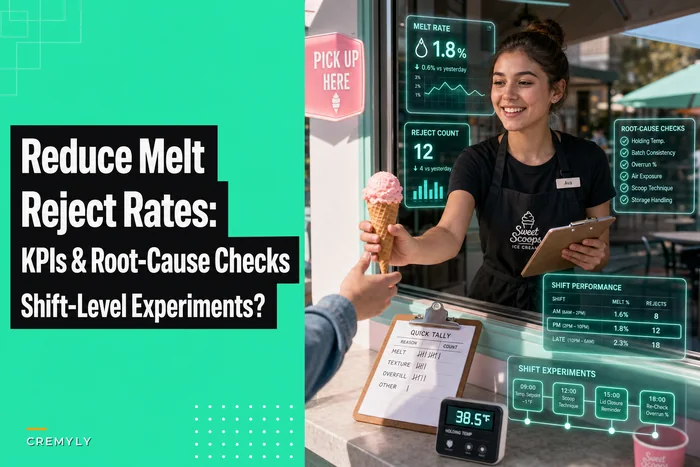
That last point is the one people resist because it feels like busywork, but tracking refused samples is how you catch a flavor that samples great and orders poorly. If the new lavender gets sampled forty times a weekend and converts eight, you're subsidizing a flavor that isn't earning its case space. It's the same discipline you'd apply when reducing melt-and-reject rates — you can't fix what you're not counting.
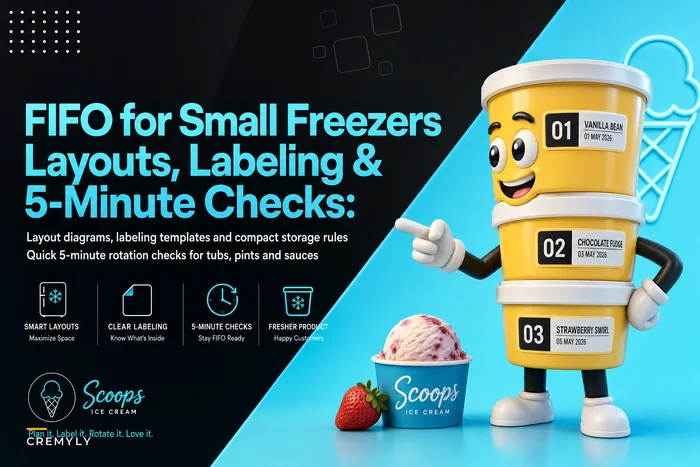
Careless sampling also ties into rotation and surface hygiene. If your tub tops are getting nicked and scraped inconsistently, it throws off surface freshness and makes your FIFO rotation checks harder to keep clean.
Staff handoff protocols: not restarting the sample cycle
Here's a subtle waste driver almost nobody has a rule for. A customer starts sampling with one scooper, the line shifts, a second scooper takes over — and re-offers samples the customer already had. Now the same undecided person is on their fourth or fifth taste across two staff members, and neither feels responsible for closing the interaction.
-
The scooper handing off relays the state, not just the customer
"She's tried blackberry and strawberry basil, leaning blackberry, deciding on size."
-
The receiving scooper closes — they don't re-open
"Blackberry it is — one scoop or two?"
A handoff transfers a decision in progress, not a fresh sampling session. Without this, hesitant customers get passed around and re-sampled, and your two-sample cap silently becomes a five-sample free pass because nobody's counting across the handoff.
This matters most on your busiest shifts, which is exactly when you've got multiple people rotating through the counter and the temptation to re-offer is highest.
Conversion vs. waste: where to set your dials
Not every shop should run the same sampling posture. Here's how the tradeoffs shake out.
| Sampling posture | Best for | Conversion effect | Waste risk | When it backfires |
|---|---|---|---|---|
| Generous, open (sample freely) | New shop building trust, low foot traffic | High for undecided first-timers | High | Peak weekends, established regulars |
| Timed + 2-sample cap | Most established scoop bars | Strong, targeted | Controlled | Rarely — the balanced default |
| Sample-on-request only | High-volume, long-line locations | Lower but efficient | Minimal | Slow days when you want to upsell |
| No sampling | Grab-and-go or delivery-heavy models | None | Zero | Any experience-driven shop |
Most independent scoop bars should live in the timed + capped row during peak periods and can loosen toward generous on slow weekday afternoons when a sample interaction has real upsell value and no line cost.
When tighter sampling rules make sense
-
You've got consistent lines on weekends and sampling is visibly slowing throughput.
-
Refused-sample and serial-sampler patterns are showing up as measurable product loss.
-
New flavors are getting sampled heavily but converting poorly.
When you should NOT tighten
-
You're a new shop still building a regular base — generosity buys loyalty and word of mouth that's worth the product cost.
-
Foot traffic is low enough that no line ever forms, so the opportunity cost of a slow sample is basically zero.
-
Your differentiation is a tasting-forward, small-batch experience where sampling is the product story.
Tightening sampling in a shop that's still building trust is a classic case of optimizing a cost while quietly killing the thing driving your growth.
A real scenario
A two-location scoop bar in a beach town was running fully open sampling — offer to everyone, no cap, no script. Their busiest location was doing around 450 weekend transactions with visible line backups every afternoon.
They made three changes: the narrowing-question script, a two-sample cap that dropped to one when the line hit three-plus, and a refused-sample tick on the shift log. No fancy tech — just laminated script cards at the station and a fifteen-minute crew briefing.
Over the next six weeks the peak shifts got noticeably faster. Line backups eased because interactions were closing instead of drifting. Sample product waste dropped by something in the range of a third to a half based on their rough log counts. Conversion on genuinely undecided customers actually went up slightly, because the narrowing question was doing more selling than the old scattershot "try anything?" approach. The refused-sample log also flagged one new flavor that was sampling heavily and converting poorly — they cut it two weeks earlier than they otherwise would have.
Nothing dramatic. Just a sampling process that stopped leaking.
Putting it together
Sampling isn't hospitality theater and it isn't pure cost — it's a controllable process sitting right at your highest-margin moment, the point of order. The shops that get it right aren't the ones that sample the most or the least. They're the ones who decided, on purpose, how long a taste should take, how many a person gets, what happens to a refused one, and how a hesitating customer moves between staff without starting over.
Write the scripts down. Cap the samples. Track the refusals. Brief the crew so the rules survive contact with a busy Saturday. Do that, and every pink spoon that leaves your case is either closing a sale or telling you something useful about a flavor — instead of just quietly draining your tubs.
Sampling isn't hospitality theater and it isn't pure cost — it's a controllable process sitting right at your highest-margin moment, the point of order. The shops that get it right aren't the ones that sample the most or the least. They're the ones who decided, on purpose, how long a taste should take, how many a person gets, what happens to a refused one, and how a hesitating customer moves between staff without starting over.
Write the scripts down. Cap the samples. Track the refusals. Brief the crew so the rules survive contact with a busy Saturday. Do that, and every pink spoon that leaves your case is either closing a sale or telling you something useful about a flavor — instead of just quietly draining your tubs.
Ready to scoop up efficiency and grow your shop?
Join hundreds of ice cream shops using Cremyly to boost productivity, reduce waste, and delight customers with faster service.