


The worst part of end-of-season isn't the slowdown. It's the tubs. Half-depleted flavors nobody's ordering, a walk-in freezer that's still 70% full when foot traffic has dropped to a third of July levels, and that nagging feeling you overbought sometime in August and now you're going to eat the difference.
Managing end of season inventory at an ice cream shop is really a timing problem wearing a discounting costume. Most owners think the challenge is "how deep do I discount," when the real question is "when do I start, and in what order do I clear things out." Discount too early and you torch margin during weeks you'd have sold at full price anyway. Discount too late and you're dumping product at a loss or writing it off entirely.
This post is about getting that timing right — building a closeout calendar, setting margin floors so you don't panic-discount into the red, running B2B sell-downs to move bulk fast, and making sure the stuff you do sell doesn't melt-and-reject in transit.
Why closeout timing goes wrong (it's almost always a calendar gap)
In real operations, the failure usually isn't emotional. It's structural. Nobody assigned a date to the decision. The season winds down, weekends stay okay-ish, and each week the owner tells themselves "one more good Saturday and I'll deal with the freezer." Then the temperature drops, and suddenly there's four weeks of inventory and two weeks of demand left.
A typical situation looks like this: a shop carries around 40–45 open tubs across two dipping cabinets and a backup freezer. In peak season they burn through roughly 6–8 tubs a week. By late September that drops to 3, maybe 4. If you're still ordering on your summer reorder points, you're stacking product against a demand curve that's falling off a cliff.
The pattern is predictable enough that you can plan against it. The mistake is treating the wind-down as something that "just happens" instead of a scheduled sequence with hard decision dates. Once a date is attached to each action, the panic disappears — you're no longer reacting, you're executing something you decided back in August when your head was clear.
The closeout timing calendar
Work backward from your actual last high-traffic day. For most seasonal shops that's a specific known point — a local festival, Labor Day, the last warm weekend, the start of the school schedule that guts your afternoon crowd.
Keep your ice cream shop running smoothly.
Cremyly helps you manage every order, stock level, and staff shift with precision and ease.
- Real-time inventory tracking
- Order management dashboard
- Staff scheduling & shift coordination
No credit card required
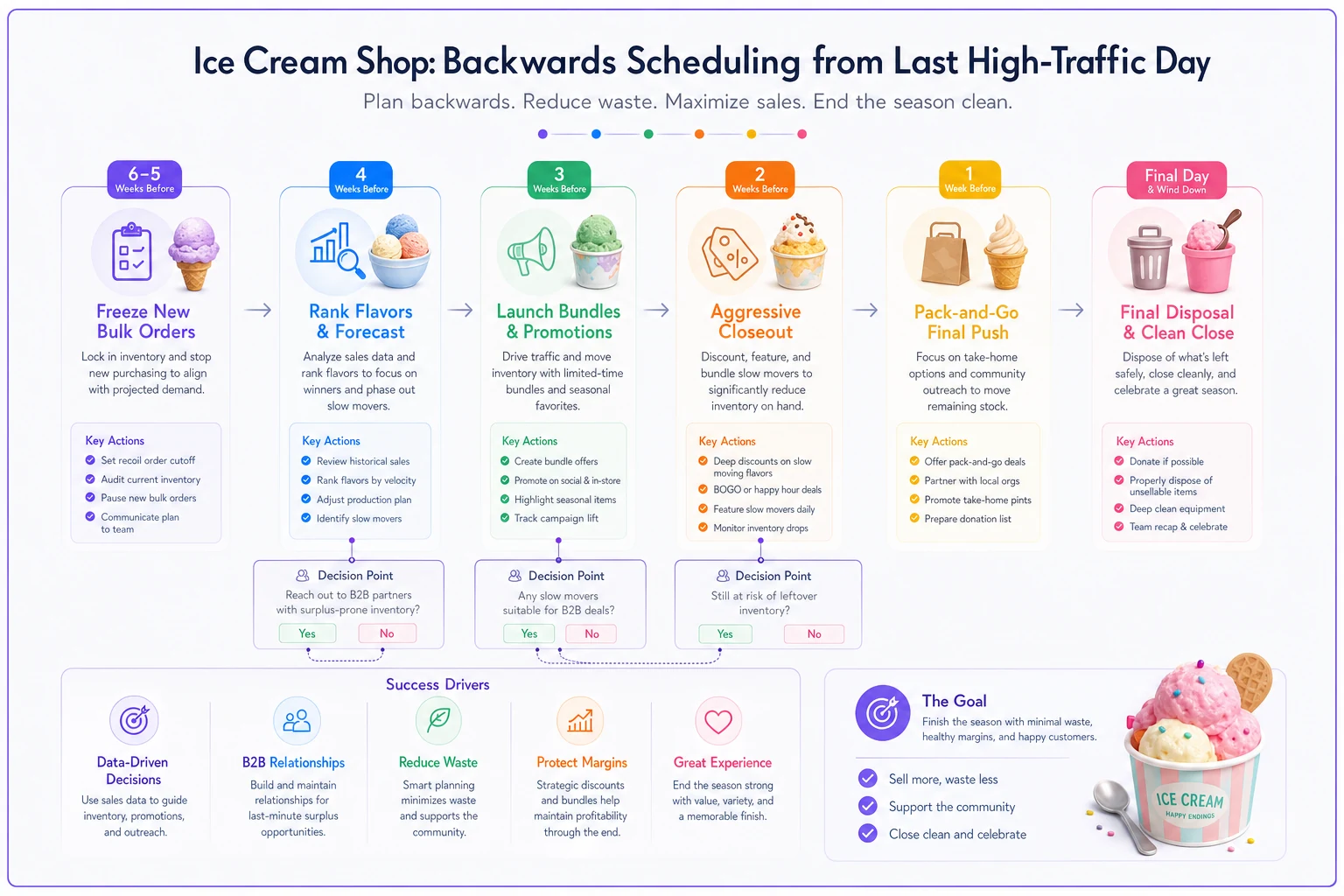
Here's a working calendar built around a shop that closes or shifts to reduced winter hours around mid-October. Adjust the anchor date to fit your own season.
| Weeks before wind-down | What you're doing | Discount posture |
|---|---|---|
| 6–5 weeks out | Freeze new bulk orders on slow flavors. Keep ordering only your top 5–6 sellers. | Full price |
| 4 weeks out | Rank every flavor by weeks-of-supply on hand. Flag anything with 3+ weeks of stock at current pace. | Full price, quiet menu nudges |
| 3 weeks out | Launch limited-time bundles to move mid-tier flavors. Start B2B outreach on true overstock. | Bundle pricing only |
| 2 weeks out | Aggressive in-store closeout on flagged flavors. First B2B sell-down calls close. | Margin-floor discounts |
| 1 week out | Pack-and-go pints, staff take-home allotments, final wholesale pickups. | Move-it pricing |
| Final days | Whatever's left goes to bundles, donation, or staff. | Clear the cabinet |
The key move is the "6–5 weeks out" line. Cutting off new bulk orders on slow flavors early is the single highest-leverage decision in the whole calendar, because you can't discount your way out of product you never should have brought in. Your reorder logic needs to switch modes before the slowdown is obvious — not after.
Here's a quick visual of the timing workflow.
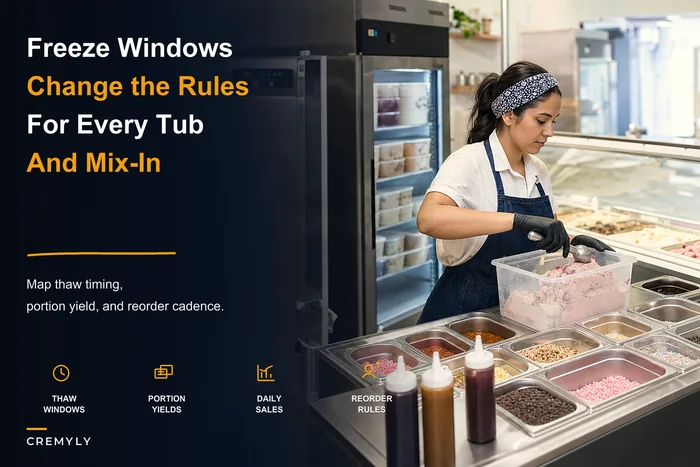
If you want a cleaner way to rank flavors by weeks-of-supply, the freeze/thaw and reorder logic in the perishable inventory system for frozen dessert shops gives you the portion-yield math to know exactly how many scoops you're actually sitting on per tub.
Margin guardrails: stop discounting into the red
This is where most closeouts quietly bleed money. Someone panics in week two, slaps 40% off everything, and clears the freezer — but half of what they discounted was already going to sell at full price. That's not moving dead inventory, that's donating margin to customers who'd have paid full.
The fix is a margin floor per flavor, decided before you start. You need to know, for each tub, the point below which you're better off donating or writing it off for the tax treatment than selling at a loss and eating labor on top.
A simple guardrail structure:
-
Green (sells itself) never discount. Top sellers hold full price to the final week.
-
Yellow (mid-pace) eligible for bundles only. You protect per-scoop margin by attaching a slow flavor to a fast one instead of cutting price directly.
-
Red (true overstock) discount down to your floor, which is usually your food cost plus a token contribution. Below that floor, it goes to B2B or donation.
Set your per-flavor margin floors during your August inventory review so you don't make panic decisions once the season slows.
A worked example. Say a tub costs you around $34 and yields roughly 45 scoops — so your food cost per scoop is somewhere near $0.75. At a $4.50 menu price your gross margin per scoop is close to $3.75. A "red" flavor with two weeks of excess stock might get discounted to $2.50 — still well above cost, still contributing something. What you don't do is drop it to $1.50 in a fit of "just get rid of it," because at that point donation gives you a cleaner write-off and you're not burning staff time scooping near-break-even product.
The guardrail isn't about being stingy. It's about not letting week-two anxiety make a decision that August-you would've called insane.
When deep discounting actually makes sense
Go below your normal floor only when the product literally won't survive to next season, storage cost exceeds recovery value, or you need the freezer space for something with better turn. Space is a real cost people forget — a cabinet full of dead flavors you're holding onto is a cabinet that can't hold your winter pint program.
When it's a bad idea
If you have any realistic winter or holiday sales channel — pints, wholesale, catering — don't fire-sale product you could hold. Freezer-stable flavors that hold quality can bridge into a slower but higher-margin season. Dumping them at 60% off in October to solve a "clutter" feeling is just losing money for tidiness.
Limited-time bundle tactics that protect margin
Bundles are the closeout tool that gets underused because owners default to straight percentage-off signage. The problem with a percentage discount is it trains customers to wait and cuts margin on everything. A bundle moves slow inventory while anchoring to a full-price item, so your blended margin stays healthier.
-
The pairing flip — one scoop of a top seller plus one scoop of a flagged flavor, priced slightly below two-scoop menu. The fast flavor sells it; the slow one rides along.
-
The pint push — buy-two-get-one on take-home pints, weighted toward overstock flavors. This moves volume fast and turns walk-in traffic into freezer-clearing purchases.
-
The sampler close — a four-mini-scoop "end of season sampler" built entirely from yellow and red flavors, priced as a fun experience rather than a discount. Customers feel they're getting variety; you're clearing three problem tubs at once.
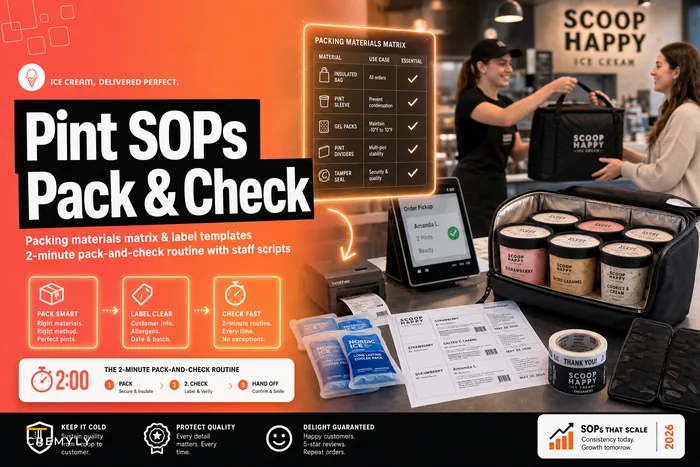
For pint-heavy bundles, your packing routine matters more than the discount. A pint that melts on the ten-minute drive home becomes a refund and a bad review. The pack-and-check steps in the take-home pint SOPs keep your closeout volume from turning into melt complaints right when you're trying to end the season clean.
The thing most people miss: bundles let you clear the exact flavors you choose. A blanket sale clears whatever customers already wanted — which is rarely your problem inventory. You control the sell-down when you build the offer around what's actually stuck.
B2B sell-down scripts for real overstock
When you've got genuine bulk — three or four full tubs of a flavor that isn't moving at retail in the time you have — retail isn't your channel. You need a wholesale buyer who can take volume at a price that beats donation. Local restaurants, coffee shops, small caterers, event venues, even a nearby brewery doing dessert flights.
The mistake is waiting until the final week, when your leverage is gone and you're basically begging. Start these calls at the three-weeks-out mark, when you can still offer a decent product with real shelf life left.
A workable script skeleton:
> "Hi — this is [name] from [shop]. We're wrapping our season and I've got roughly [X] tubs of [flavor] in great shape that I'd rather move to a local business than sit on. I can do [price] a tub, which is well under what you'd pay wholesale, and I can have it to you by [date]. Would that work for your dessert menu the next few weeks?"
What makes it land:
-
Lead with quantity and quality, not desperation. "In great shape" and a real pickup date signal this is a deal, not a dump.
-
Anchor to their wholesale cost, not your retail. They don't care about your menu price; they care that you beat their supplier.
-
Bundle flavors for a volume price if you've got multiple stuck tubs — "all six tubs for [total]" moves faster than negotiating each one separately.
-
Set a hard pickup window. Perishables plus vague timing equals a deal that dies in someone's inbox.
A realistic outcome: a shop sitting on five overstock tubs (roughly $170 in food cost) that would otherwise get written off sells them to a café and a caterer for around $30–35 a tub. That's $150–175 recovered on product that was headed for the trash. Not a windfall, but the difference between a break-even close and a small loss.
Packing and shipping notes for what leaves the shop
Whatever moves in bulk needs to survive the handoff. End-of-season shipping failures cost you twice — the product and the relationship with a new wholesale contact you just built.
A quick pre-handoff checklist for bulk and pint outflow:
-
Pre-chill transport containers; don't load warm coolers.
-
Dry ice or gel packs sized to travel time — under 30 minutes local pickup can run gel packs; anything longer needs dry ice.
-
Label every tub with flavor, pack date, and an allergen line so the receiving business can use it legally.
-
Confirm the buyer has freezer space ready before pickup — a wholesale tub sitting on a loading dock is a total loss.
-
Log what left and to whom, so your closeout numbers actually reconcile at the end.
Small operational note that saves headaches: track your closeout outflow the same way you track receiving. A lot of shops log incoming inventory carefully and then let closeout product vanish out the back door in bundles, comps, and staff take-home. When you can't account for where it went, you can't tell whether your closeout actually recovered value or just quietly leaked it.
A real scenario
A two-cabinet neighborhood scoop shop ended its season with about 38 open tubs and roughly two weeks of realistic demand left. The prior year they'd run a straight 30%-off-everything sale in the final ten days, cleared most of it, and later realized they'd discounted a stack of top sellers that would've moved at full price anyway — costing them somewhere in the low hundreds of margin for no reason.
The next year they ran the calendar version. They cut bulk reorders on slow flavors five weeks out, ranked everything by weeks-of-supply at four weeks, launched pairing bundles and a sampler at three weeks, and made B2B calls that landed five overstock tubs with two local businesses.
The result: they held full price on their green flavors right up to the final week, recovered roughly $150 on tubs that would've been trashed, and ended the season with a nearly empty freezer instead of a write-off list. The difference wasn't a magic discount — it was deciding the sequence in advance instead of reacting to a cold Saturday.
Where the calendar tends to fall apart
The plan is easy to write and easy to abandon. What breaks it is the middle of the season, when everyone's slammed and nobody's tracking weeks-of-supply per flavor. By the time you look up, you've missed the five-weeks-out reorder cutoff — the one decision that mattered most.
This is where having your inventory and reorder points inside a system that flags weeks-of-supply automatically actually earns its keep. When your platform can surface "this flavor has 4+ weeks of stock at current pace" without someone manually counting tubs, the closeout calendar runs itself instead of depending on someone remembering to check. The point isn't the software — it's that the flag shows up before the slowdown, while you still have full-price weeks to work with.
Wrapping up
Closeout isn't a discount event. It's a sequence with dates attached, margin floors decided in advance, and a couple of channels — bundles for retail, B2B for bulk — that let you choose exactly what leaves and at what price. Get the calendar right and the discounting takes care of itself. Skip it and you're back to staring at a full freezer in October, hoping for one more warm Saturday that isn't coming.
Set your anchor date now, mark the five-weeks-out reorder cutoff, and rank your flavors before the slowdown makes the decision for you.
Ready to scoop up efficiency and grow your shop?
Join hundreds of ice cream shops using Cremyly to boost productivity, reduce waste, and delight customers with faster service.