
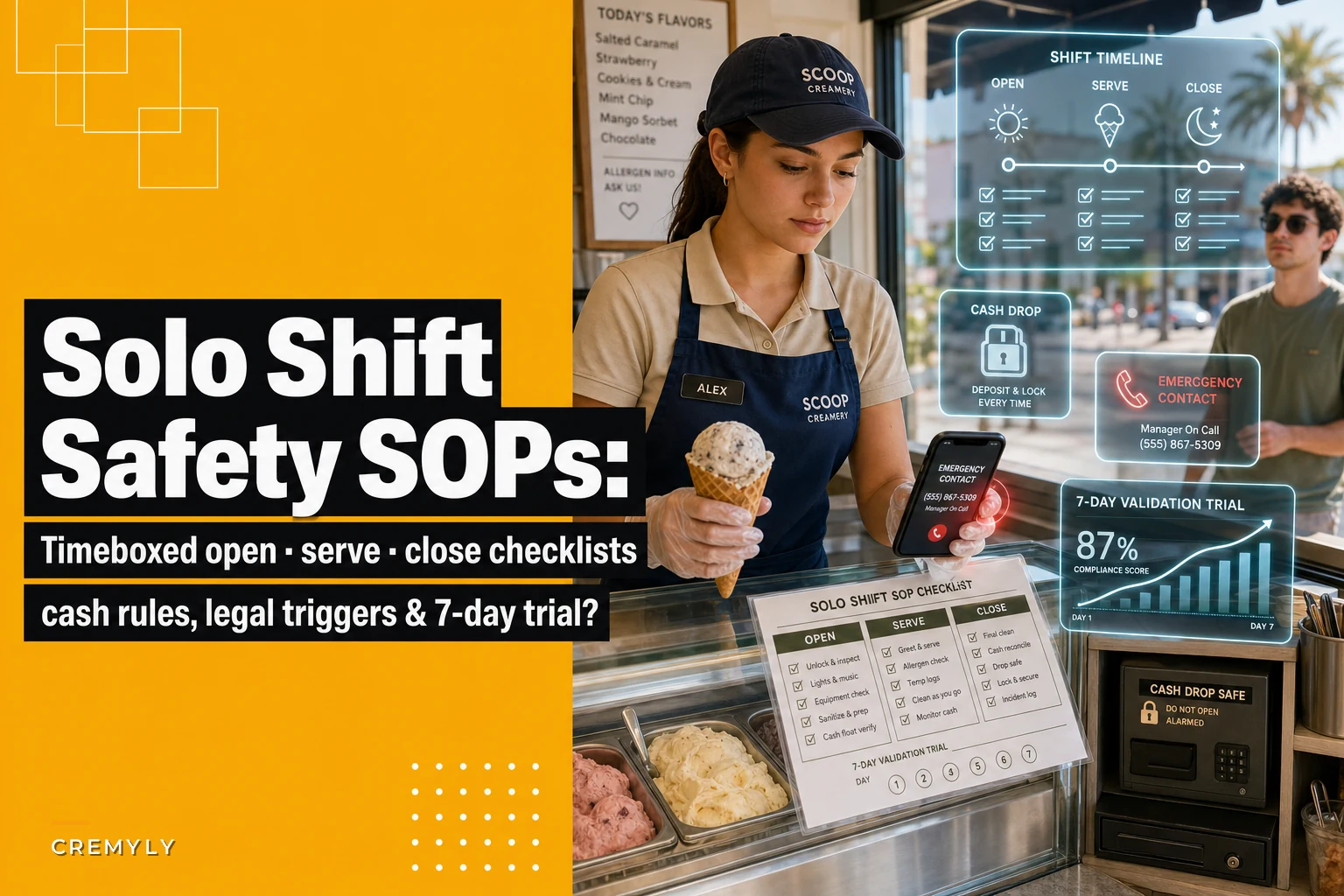

Solo shifts are usually not planned. Somebody calls out, the Tuesday closer quits with no notice, or your part-timer is stuck in traffic and you've got a line forming at 3pm. Most scoop shops end up running at least a few single-staff hours a week, and almost none of them have anything written down about what that person is actually allowed to do.
That gap is where things goes sideways. A solo scooper isn't just scooping — they're the cashier, the closer, the person deciding whether to refund an angry customer, the one figuring out if a slip-and-fall needs a report, and the only human in the building if the card reader dies with $600 in the drawer. Without a tight, timeboxed SOP, every one of those situations gets improvised, and improvised decisions during a solo shift are how you lose money, break compliance rules, or put someone at risk.
This is a walkthrough of how to build a one person shift SOP for an ice cream shop that holds up under pressure. Not a generic "clean the counters" checklist — the real stuff: timed open/close routines, cash and security rules built for one person, hard limits on customer service authority, and the emergency triggers that tell a solo worker exactly when to stop and escalate.
Why solo shifts quietly become the riskiest hours you run
The problem with single-staff hours is that they look calm. Low traffic, quiet Monday afternoon, one person behind the counter. Owners assume low risk because it feels slow. But risk during a solo shift isn't about volume — it's about coverage. When something happens, there's no second set of hands and no second judgment call.
A typical scenario: a solo closer at a shop doing maybe $400 on a slow weeknight. Everything's fine until closing, when they realize the back door was propped for the AC and they're alone counting the drawer in full view of the front window at 9:45pm. Nothing goes wrong most of the time. The times it does is what the SOP is for.
The other quiet failure is decision fatigue. A solo person running register, prep, and service at once will default to "whatever's fastest" when a judgment call comes up. Fastest is almost never safest or most compliant. The whole point of a solo SOP is to make the safe choice the pre-decided default — so nobody has to think their way through it mid-rush.
The timebox structure: why solo SOPs need clocks, not just checklists
A normal opening checklist assumes you have time and backup. A solo opening checklist has to assume neither. The thing that separates a working solo SOP from a laminated wish list is timeboxing — attaching a clock to each block so the single person knows what gets done, in what order, and what's allowed to slip when they fall behind.
Keep your ice cream shop running smoothly.
Cremyly helps you manage every order, stock level, and staff shift with precision and ease.
- Real-time inventory tracking
- Order management dashboard
- Staff scheduling & shift coordination
No credit card required
When one person is doing everything, something will always run late. If you don't pre-decide what slips, they'll make that call under pressure — and they'll usually drop a safety or compliance task because it's invisible to customers, while keeping the visible stuff like wiping the case. That's exactly backwards.
So you build the SOP with priority tiers baked into the timebox:
| Block | Time window | Non-negotiable (never skip) | Can slip if behind |
|---|---|---|---|
| Open | 30 min pre-door | Temp log check, handwash sink stocked, door/lock check, float count | Full case face-down, signage setup |
| Mid-shift / serve | rolling | Allergen protocol, cash drops over threshold, temp recheck | Deep restock, flavor card updates |
| Close | 30–40 min | Drawer count in back, door secured, freezer temps logged, lights/alarm | Full mop, prep for next day |
The temp log is a good example of a task that feels skippable to a rushed solo worker but isn't — it's both a food-safety and an insurance issue. If you want the full detail on what inspectors actually look for, the local compliance checklist for scoop shops breaks down exactly which logs and labeling need to survive a solo shift with nobody double-checking.
If a task consistently slips during the trial, move it to the 'can slip' column and test the change in the next run.
Visualize the timebox workflow to make the order and priorities obvious to a solo worker.
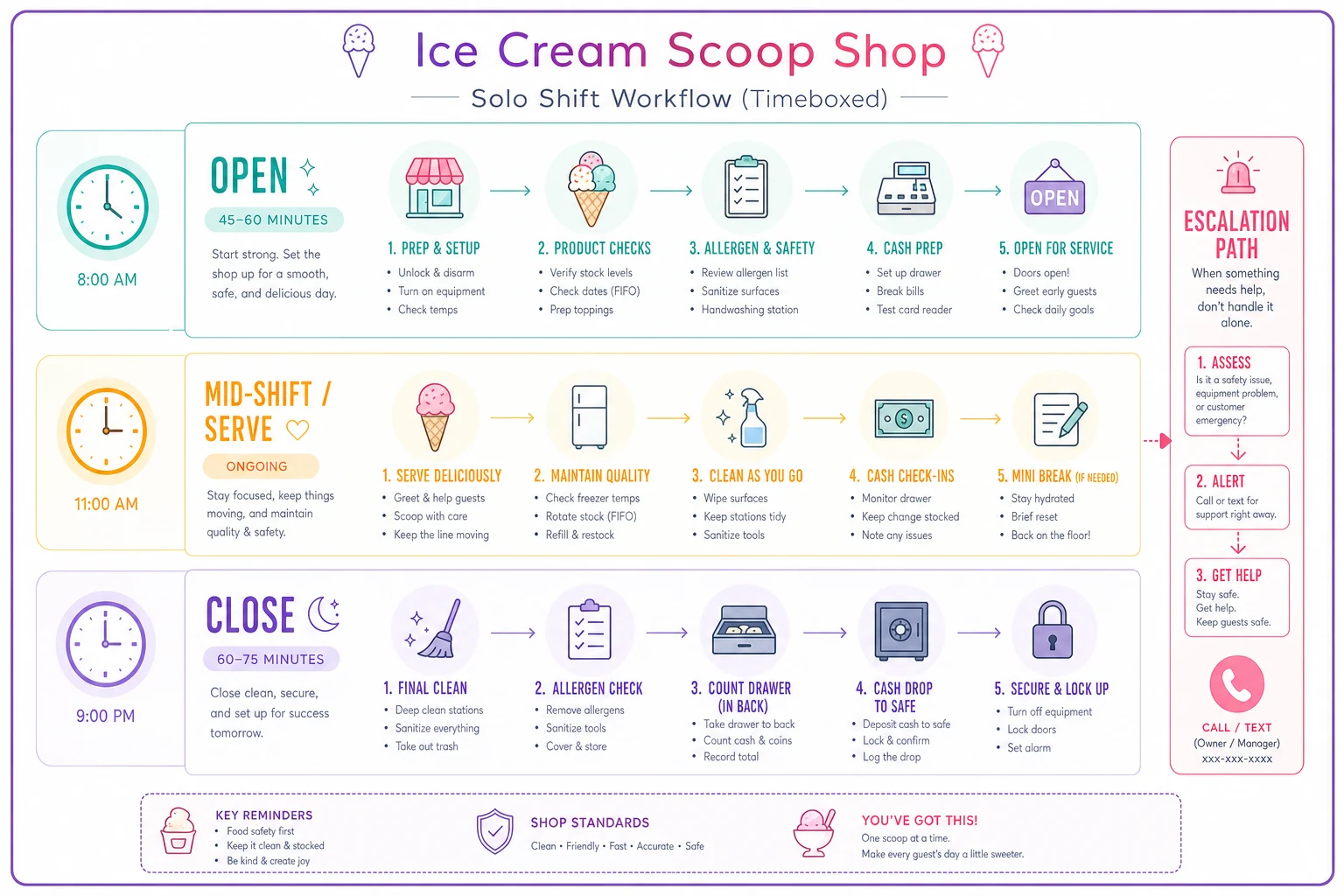
Use the visual when training so the order of tasks and emergency steps are clear at a glance.
Cash and security rules written for one person
Standard cash handling assumes two people — one counts, one witnesses; one runs register, one takes the drop to the back. A solo worker breaks all of those assumptions, so the rules have to change, not just get quietly ignored.
The core principle: a solo person should never be the most valuable, most visible target in the building. That shapes everything else.
Practical solo cash rules that actually work:
-
Drop early, drop often. Set a cash threshold — say $150–$200 in the drawer — and drop to the safe the moment it's crossed. A solo shift should never be carrying the full day in the till. This is the single highest-leverage rule.
-
Count in the back, never the front window. Drawer counts at open and close happen away from the glass, door locked if counting at close.
-
No count with customers in the building. If someone walks in mid-count, the count stops and the cash goes in the safe until they leave. Non-negotiable.
-
Closing count happens after the door is locked and the dead bolt is thrown, not while the "open" sign is still technically up.
-
One person does not chase a walkout or confront a theft. The rule is: let it go, log it, report it. A $12 loss is not worth a solo worker leaving the counter or getting into it with anyone.
Shops that get hit during solo hours almost always had a routine an outsider could watch and predict — same person, same close time, drawer counted in plain view, trash taken out the back alone at 9:50 every night. Varying the order of close tasks week to week costs nothing and quietly removes that predictability.
Where to draw hard customer-service limits
This is the section most owners skip, and it's the one that keeps a solo shift from spiraling. When one person is handling everything, "the customer is always right" becomes a liability — a single difficult customer can pull the only worker off the counter, out of the register's sight, and into a decision they're not authorized to make.
Pre-decide the limits so the solo worker never has to negotiate on the fly:
-
Refund ceiling. Set a dollar amount a solo person can approve without calling you — maybe $15–$20. Above that, the answer is "my manager handles that, here's the number / come back tomorrow." No exceptions, no pressure.
-
No comps beyond a set value. A free scoop to smooth over a wrong order is fine. A free round for a group of eight is a call to the owner.
-
Discount authority is off during solo shifts. Not the time for improvised deals.
-
The "walk away" rule. If a customer becomes aggressive, the script is simple and memorized: stay behind the counter, keep hands visible, don't argue, and if it escalates, the solo worker is authorized to lock up and call for help. Protecting the person beats protecting the sale, always.
The point isn't to be rigid with good customers. It's that a solo worker under pressure needs a wall to point at — "I'm not able to do that on my own, but here's what I can do." That framing takes the personal confrontation out of it. The limit becomes the policy's problem, not theirs.
Emergency triggers and escalation: the part that has to be instant
Everything above is routine. This section is the stuff that happens two or three times a year and determines whether a solo shift ends normally or ends with an injury, a loss, or a lawsuit. A solo worker should never have to decide whether something is an emergency. You pre-define the triggers, and crossing one triggers a fixed action — no judgment required.
Build a short, memorized trigger list. These are the "stop everything" events:
-
Medical — a customer or the worker is injured (slip, burn, allergic reaction). Trigger: call 911 first, then owner. Fill the incident log same shift, while details are still fresh.
-
Allergen exposure in progress — customer showing a reaction after eating. This is medical, not customer service. Same trigger as above.
-
Freezer / power failure — compressor alarm, outage, or temps climbing. Trigger: log the time, call owner, start the equipment-failure protocol. Don't let a solo worker eat the loss by "waiting to see."
-
Security — attempted theft, aggressive customer, someone refusing to leave at close. Trigger: do not engage, secure the register, lock up if needed, call for help.
-
Cash discrepancy over threshold — drawer off by more than a set amount, say $20. Trigger: stop, don't re-count repeatedly, photograph the drawer, log it, call owner. Over-counting a short drawer under stress usually makes the record worse, not better.
The escalation ladder itself has to be dead simple because a solo worker in a crisis has no bandwidth for a flowchart:
Trigger → Immediate action → Log → Call the one number.
One number. Not "try Sarah, then try the owner, then the backup." A solo worker should have a single escalation contact who is actually reachable during that shift, and that contact's job is to decide the next step. If your escalation contact changes by day, fine — but print it on the shift sheet so there's zero guessing.
A note on the incident log
Every trigger ends in a log entry, and this matters more than most people realize. A photographed, timestamped note written the same shift is worth ten times a reconstructed memory a week later — for insurance, for health department follow-up, and for spotting whether a pattern is developing. Keep the log format to three fields: what happened, when, what action was taken. Anything longer won't get filled out consistently.
The 7-day validation trial: proving the SOP actually works before you trust it
Most shops write the SOP, laminate it, and assume it works. Then the first real solo emergency reveals that step four was impossible because the safe is in a back room the solo worker can't see the counter from. A paper SOP is a hypothesis. You validate it with a short, measured trial.
Run the new solo SOP for seven days and track a small set of metrics so you can see where it breaks:
-
Open/close completion time — did the timeboxes hold, or did close consistently run 20 minutes over?
-
Non-negotiable task completion rate — were temp logs, drops, and door checks actually done every shift? This is the one that reveals whether your priority tiers are realistic.
-
Cash variance — drawer accuracy across solo shifts vs. staffed ones.
-
Escalation friction — any moment the solo worker should have escalated but hesitated, and why.
-
Service complaints — did the service limits cause friction, or did customers accept them fine?
A common thing this surfaces: a shop finds that solo closes are running 15–20 minutes long because the timebox assumed the mop happened during open hours, which it never actually does on a solo shift. They move the deep mop to a "slip if behind" task, add it to the next morning's open instead, and closes land back on time. Small fix, only visible because they measured it.
The 7-day window is deliberately short. Long enough to catch recurring friction, short enough that you'll actually finish it. At the end you adjust the SOP once, then run a two or three day spot-check to confirm the fix held.
A real scenario: the Wednesday-closer problem
A single-location scoop shop, two scoopers and an owner, doing roughly $2.5k–$3k on a typical summer day. Weeknight closes were almost always solo. No written SOP — just "close up and text me when you're out."
Over one season: two drawers short by $30–$60 with no idea why, one closer who left the walk-in door propped and lost a tub of base to a temp swing nobody logged, and a near-miss where a solo worker got into a shouting match with a customer over a refund because there was no stated limit and they didn't want to "lose the sale."
They built a one-page timeboxed solo SOP — drop threshold at $150, drawer counted in back after lock-up, $15 refund ceiling, a five-item trigger list, one escalation number printed on the shift sheet. Then ran the 7-day trial.
What it surfaced: closes ran long on nights the solo worker also had to prep for a catering pickup, so that prep got moved off solo shifts entirely. The drop threshold was too high for busy Fridays, so they dropped it to $120 on weekends. After those fixes, drawer variance on solo shifts went from a recurring headache to essentially flat, and the refund arguments stopped because the worker finally had a line to point to. Nothing dramatic — just fewer bad surprises, which is the whole point.
When a solo shift makes sense — and when it doesn't
Solo shifts are fine for predictable low-traffic windows: slow weekday afternoons, the first hour after open, maybe the last quiet hour before close in the off-season. The SOP exists to make those hours safe, not to pretend they're risk-free.
-
Close involves cash the solo worker can't drop fast enough. Big nights should not end solo, full stop.
-
The shop layout means you can't watch the counter and handle cash or prep safely at the same time. Blind spots plus solo equals risk you can't SOP your way around.
-
You're training someone new. A first-week scooper should never close alone — the first-30 manager onboarding curriculum is a useful model for how long real competence actually takes before someone should be trusted on their own.
-
The area or hour has a known security concern. No SOP replaces a second person when the risk is people, not process.
If you're scheduling solo hours because you can't afford coverage, that's a real constraint — but the answer is to shrink the solo window and tighten the SOP, not to pretend the exposure isn't there.
Pulling it together
A one person shift SOP for an ice cream shop isn't about control — it's about taking the weight of split-second decisions off someone who's already doing four jobs at once. Every pre-decided limit, every timebox, every trigger is one less thing they have to figure out alone while the line grows and the drawer fills up.
Write the timeboxes. Set the cash thresholds low. Draw the service limits in ink. Give them one escalation number. Then — and this is the step everyone skips — run the seven days, watch where it breaks, and fix the one thing that breaks the most. A solo SOP you've actually tested is worth more than a perfect one that's never left the binder.
Ready to scoop up efficiency and grow your shop?
Join hundreds of ice cream shops using Cremyly to boost productivity, reduce waste, and delight customers with faster service.