

Most scoop shops don't lose margin in one dramatic moment. They lose it in slow leaks nobody notices until the month-end numbers come in soft. A weekend BOGO that "felt busy." A staff schedule that ran two people too heavy on a slow Tuesday. A heatwave promo that doubled foot traffic but somehow made less money than a normal day. Each of those things feels fine in isolation. Stacked over a season, they're the difference between a shop that clears real profit and one that just stays open.
The problem isn't that owners make bad decisions. It's that most shops have no system connecting the decision to its margin consequences. Pricing lives in one head. Labor lives in another. Promos get run on gut feel. And the P&L only tells you what happened weeks after you could've done anything about it.
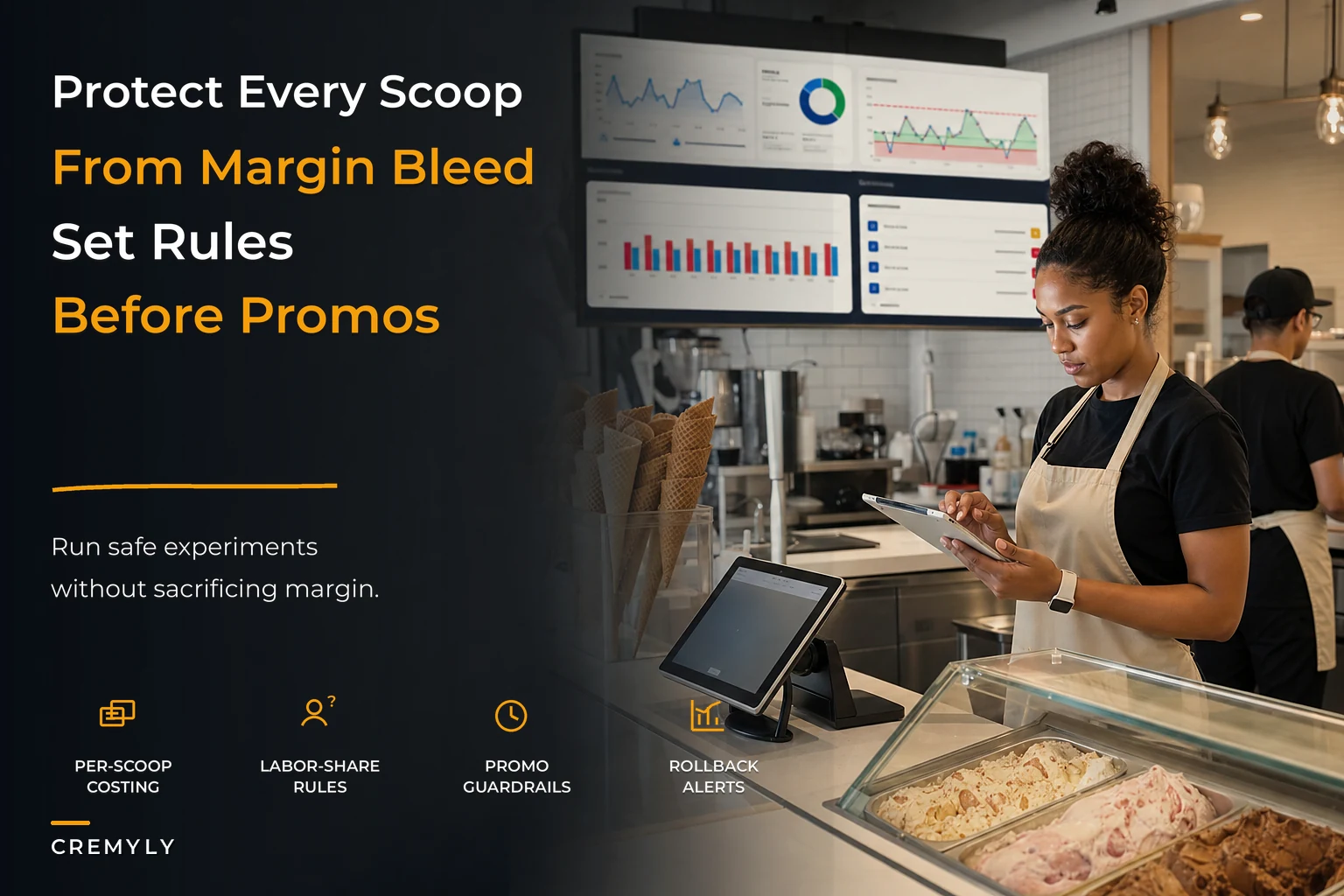
What actually works to protect margin in an ice cream shop is treating these as one connected structure — a decision architecture where per-scoop cost, labor rules, promo guardrails, and rollback triggers all talk to each other. Not more spreadsheets. A wired-together system where every experiment has brakes built in before it starts.
Here's how that system fits together, where it breaks, and what it looks like on a real shop floor.
Why margin leaks are a coordination problem, not a pricing problem
This pattern shows up constantly. An owner runs their scoop cost at around $0.85 against a $4.50 price, figures margin is healthy, and starts running promos freely. Adds a punch card. Bumps staff for busy weekends. Comps the occasional cone.
Each of those decisions gets made by a different person, on a different day, with no shared reference point. The scooper doesn't know that today's labor target is already blown. The shift lead doesn't know the promo is only profitable above a certain volume. The owner doesn't see any of it until the weekly numbers land.
That's the core issue. Margin isn't controlled by any single lever — it's controlled by how the levers coordinate. When per-scoop cost, labor share, and promo pricing are managed in separate silos, you end up with decisions that each look reasonable but combine into a loss.
A promo that pulls in a crowd is only good if labor scaled proportionally and your product cost per ticket didn't quietly climb because everyone ordered the expensive waffle-cone loaded sundae. When those pieces aren't linked, "we were slammed all day" and "we made less than usual" can happily coexist.
If you haven't locked down your true per-scoop cost yet, that's step zero — everything downstream depends on it. Our breakdown on calculating per-scoop cost and setting profitable menu prices covers how to get that number right, including the overhead pieces most owners forget to load in.
The four components of a margin defense system
A working system has four parts that feed into each other. Think of it less like a checklist and more like a circuit — cut any wire and the whole thing stops protecting you.
Keep your ice cream shop running smoothly.
Cremyly helps you manage every order, stock level, and staff shift with precision and ease.
- Real-time inventory tracking
- Order management dashboard
- Staff scheduling & shift coordination
No credit card required
1. Per-scoop costing as the anchor. This is your ground truth. Not just the ice cream — the cone or cup, the spoon, the napkin, the sample you gave to convert the sale, the melt-and-waste allowance. A single scoop that "costs $0.85" in dairy might actually run $1.15 fully loaded once you count everything that leaves the shop attached to it.
2. Labor-share rules. Instead of scheduling by feel, you set labor as a target percentage of sales — and you define what that percentage should be at different demand levels. A slow weekday might tolerate 30% labor. A predictable rush should run closer to 18–22% because volume covers the fixed staff cost. The rule isn't a fixed headcount; it's a ratio tied to expected sales.
3. Promo guardrails. Every promotion gets a break-even defined before it launches. Not "let's try 20% off." Instead: "This discount only works if we hit at least X tickets, and if average ticket doesn't drop below Y." The guardrail is the number that tells you whether the promo is earning its keep in real time.
4. Rollback triggers. The brakes. A pre-agreed condition that, if hit, ends the experiment automatically. "If labor share crosses 35% by 2pm, we cut a shift." "If margin per ticket drops below $2.60 for two hours, we pull the promo pricing." Without rollback triggers, a bad experiment runs until close instead of ending at hour two.
The value isn't in any one of these individually. It's that they all reference the same underlying numbers. Your promo break-even is calculated from your loaded per-scoop cost. Your rollback trigger fires based on your labor-share rule. One system, not four.
What breaks at scale
A single owner-operated shop can sort of run this in their head. You know your costs, you're standing behind the counter, you feel when labor's too heavy. The system exists — it's just informal.
-
Promo consistency. One location runs the summer promo tight, the other gives away scoops because the shift lead misunderstood the terms. Same promo, two totally different margin outcomes.
-
Labor reaction time. At one shop you can send someone home when it's dead. Across three shops, nobody's watching labor share in real time, so overstaffing runs all day at whichever location is slow.
-
Cost drift. Your per-scoop cost calculation was accurate in April. By July, dairy went up, portion sizes crept, and nobody re-ran the numbers. Your promo break-evens are now sitting on stale costs.
The pattern is always the same: the parts that used to coordinate through one person's attention stop coordinating once that attention is stretched thin. This is why building the labor logic into a repeatable structure matters — our guide on tying forecasted demand to shift templates and margin targets gets into how to make labor decisions systematic instead of reactive.
Two worked examples: heatwave promo vs. steady day
Abstract rules don't stick. Running the same decision architecture through two very different days makes it easier to see how this actually works.
The heatwave promo
Baseline setup:
-
Loaded per-scoop cost
~$1.10
-
Standard single-scoop price
$4.50 → margin ~$3.40
-
Promo
"Double scoop for $6" (normally $6.50, so a modest $0.50 discount but pushes larger tickets)
The double scoop costs ~$2.20 loaded and sells for $6.00 → margin ~$3.80 per ticket. So if customers trade up, the promo actually raises margin per ticket, not lowers it. That's the whole point of designing it right.
Labor-share rule: You forecast roughly 3x a normal Saturday afternoon. You staff five instead of three. Expected sales support keeping labor share around 20%.
Rollback trigger: If by 3pm sales are tracking below the forecast that justifies five staff — say labor share climbs past 30% — you send one scooper home. If average ticket drops below $5.50 (meaning people are ordering singles, not doubles), you know the promo isn't driving trade-up and you re-evaluate.
How the day plays out: Traffic hits hard, average ticket runs around $6.20, labor share sits near 19% through the rush. Every guardrail is green. You keep going. You end the day with more revenue and healthier margin per ticket than a normal Saturday. That's a safe experiment — you had brakes, you never needed them.
The steady, unremarkable Tuesday
Same shop, ordinary 74°F Tuesday. An owner without a system runs the exact same promo because "it worked Saturday." That's the trap.
-
~60 tickets, ~$0.50 discount each you didn't need to give = ~$30 in handed-back margin
-
One extra staff member for a 5-hour shift = roughly $70–$90 in unnecessary labor
Call it $100–$120 of avoidable margin loss on one quiet day. Do that twice a week for a season and you're looking at a four-figure leak that never shows up as a single obvious mistake.
The system's job here is to say no. The promo guardrail flags that break-even volume isn't there on a slow day. The labor-share rule caps you at two. The rollback trigger never even arms because the experiment shouldn't launch in the first place. A margin defense system protects you as much by killing bad experiments as by optimizing good ones.
The dashboard layer: turning rules into alerts
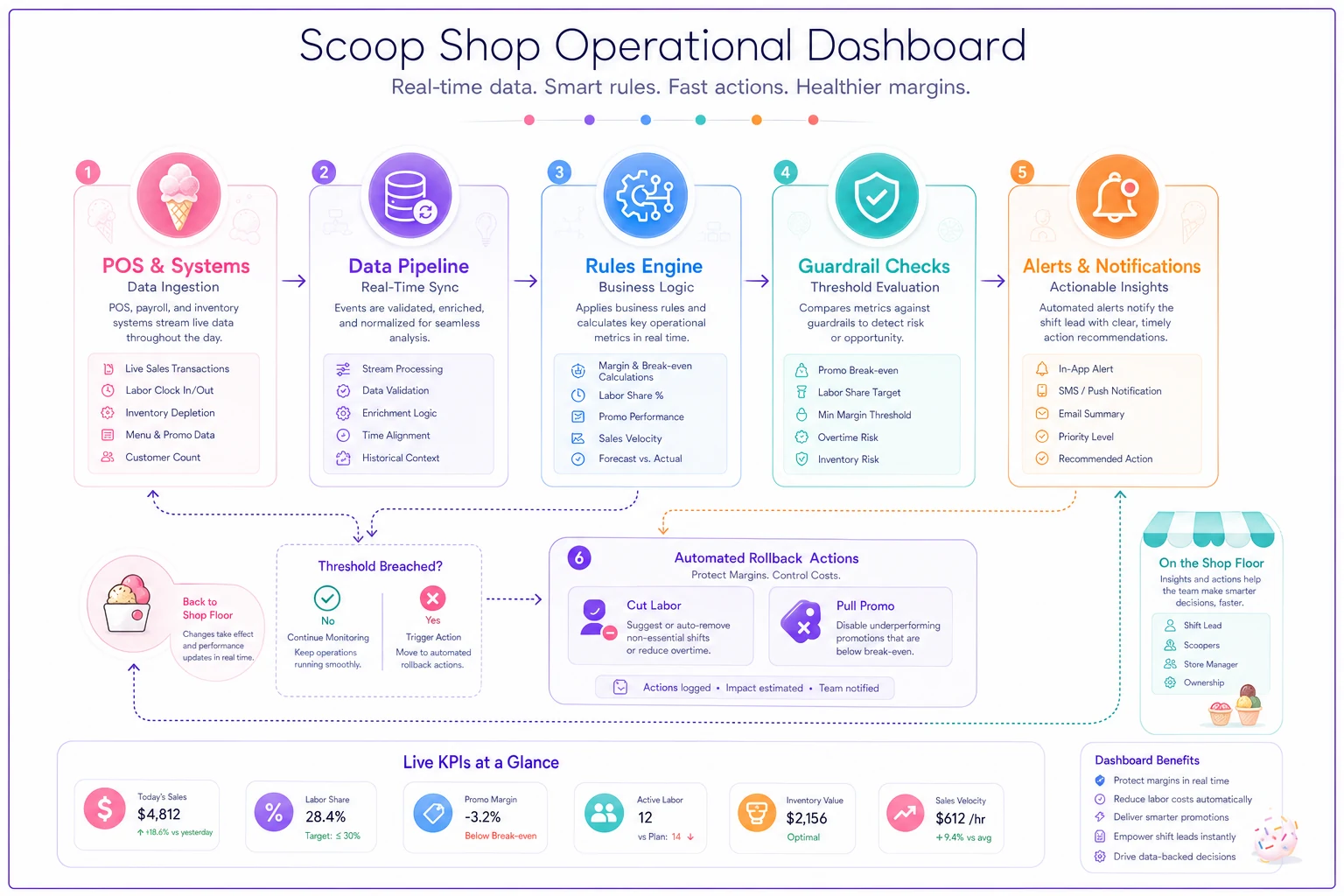
Rules that live in a binder don't fire in real time. The reason most shops can't actually run this system is that checking labor share at 2pm, cross-referencing average ticket against a promo break-even, and deciding whether to cut a shift — all while scooping — is genuinely too much to track manually.
A simple visual shows how your POS data flows to alerts and then to actions on the floor.
A practical alert set for a scoop shop looks like this:
| Alert | Trigger condition | Action it prompts |
|---|---|---|
| Labor share high | Labor % > target + 8 pts for 60 min | Consider cutting a shift |
| Promo underperforming | Avg ticket below break-even line for 90 min | Re-evaluate or pull promo |
| Margin-per-ticket dip | Loaded margin < floor for 2 hrs | Check portioning / discount misuse |
| Waste spike | Discards above daily allowance | Check freezer / over-scooping |
| Cost drift | Per-scoop cost moves >10% vs. baseline | Re-run promo break-evens |
Start with the two highest-risk alerts—labor share and promo underperforming—then expand as you learn which triggers matter most.
The value isn't the dashboard itself — it's that it closes the loop between deciding a rule and enforcing it in the moment. That's the gap where margin leaks live. Automated alerts don't make the decision for you; they make sure the decision-maker actually sees the trigger before the day is over instead of during the weekly review when it's already too late.
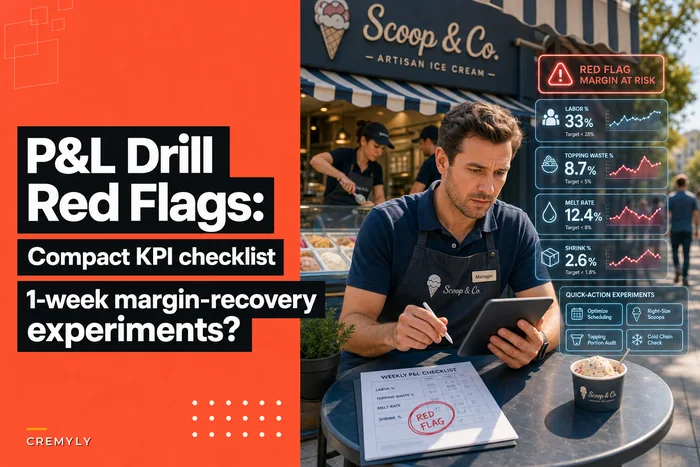
For the weekly rhythm that pairs with real-time alerts, the weekly P&L drill checklist covers the KPIs and red flags worth reviewing so nothing that slipped past the daily alerts goes unnoticed for long.
A simple process to install this at your shop
You don't build all four components at once. Here's a sane order:
-
Lock your loaded per-scoop cost. Include everything
product, packaging, samples, waste allowance. Re-run it quarterly and after any supplier price change.
-
Set labor-share targets by demand tier. Define what labor % is acceptable on a slow day, a normal day, and a peak day. Write the actual numbers down.
-
Give every promo a break-even before it launches. Minimum ticket count and minimum average ticket. If you can't calculate the break-even, you're not ready to run it.
-
Define rollback triggers for each experiment. Pre-agree the condition that ends it early, and who has the authority to pull the trigger mid-shift.
-
Wire the numbers to alerts. Connect your POS data to your thresholds so breaches surface in real time, not at month-end.
-
Review and recalibrate weekly. Which experiments earned their keep? Which triggers fired? Adjust the rules based on what actually happened.
Review and recalibrate weekly. Which experiments earned their keep? Which triggers fired? Adjust the rules based on what actually happened.
When this system is worth it — and when it's overkill
When it makes sense: You run regular promos, you have more than one employee making floor decisions, or your margins are tight enough that a bad weekend actually hurts. If you're running seasonal experiments, weather-driven pricing, or you've got a second location on the horizon — you need this before you scale, not after.
When it's overkill: If you're a tiny counter that runs one price, never promos, and the owner is always present, a full alert architecture is more machinery than you need. Your intuition is functioning as the system, and that's fine at that size. Just know the informal version stops working the moment you step away or add a location.
Who should not do this: Anyone whose per-scoop costing is still guesswork. There's no point building promo break-evens on top of a cost number you don't trust. Fix the foundation first, then layer the defenses.
The real point
Running experiments is how a scoop shop finds its edge — the right promo, the right flavor, the right price at the right temperature can genuinely move a season. The reason most owners are scared to experiment is that they've been burned by a promo that felt great and lost money, with no way to see it happening until it was over.
A margin defense system flips that. It doesn't stop you from experimenting — it lets you experiment aggressively because the brakes are already installed. You can try the heatwave promo knowing exactly when you'll pull it. You can staff up for a rush knowing the rule that tells you to send someone home. The confidence comes from the structure, not from luck.
The shops that hold margin through a full season aren't the ones with the best gut instincts. They're the ones who wired their costing, labor, promos, and rollback rules into a single connected system — and then trusted it to catch what a busy shift lead can't. Build that once, keep the numbers current, and you stop guessing whether you're protecting margin. You'll know, by 2pm, on the day it matters.
Ready to scoop up efficiency and grow your shop?
Join hundreds of ice cream shops using Cremyly to boost productivity, reduce waste, and delight customers with faster service.