


Most scoop shops don't have a flavor problem. They have a flavor retirement problem. New flavors get added with enthusiasm — someone tried a lavender honeycomb somewhere, the owner loved it, it goes on the board. But almost nobody has a rule for when a flavor comes off the board. So the menu just grows. Twenty-two flavors becomes twenty-eight. Half of them sell three scoops a day and sit in the dipping cabinet melting and re-hardening until the texture is shot and the batch gets tossed.
The waste isn't the base ingredients. It's the missing structure — the lifecycle — the thing that tells you when to introduce a flavor, how much to make while it's unproven, and the exact sales number that pulls it off the menu. That's what this covers: an end-to-end menu lifecycle where every flavor moves through defined stages on a calendar, with inventory caps and retirement triggers built in from day one.
This isn't about testing flavors in isolation. It's about the whole timeline — from the day a flavor gets a slot to the day it's pulled — and the sales thresholds that move it along automatically so nobody has to have an emotional argument about killing the pistachio.
Why menus bloat and never shrink
The core issue is asymmetry. Adding a flavor is a decision anyone can make and feel good about. Removing one feels like a small failure — like admitting the idea didn't work. So additions happen constantly and removals basically never do, until a freezer is physically full and something has to go.
There's also a data blindness problem. Most owners can name their top three sellers instantly. Almost none can tell you their bottom five without pulling reports, and even fewer track how long a flavor has been underperforming. A flavor that sold decently in July and fell off a cliff in September is still holding a cabinet position in November because nobody set a checkpoint to actually look at it.
The pattern that shows up over and over: a shop runs 24 dipping positions, and somewhere around 7–9 of them are zombie flavors. Not bad enough to complain about, not good enough to restock with any confidence. They generate maybe 4–6% of scoops combined but eat up a full third of your cabinet real estate, your prep labor, and your batch-to-batch waste. That's what no lifecycle costs you.
The four stages every flavor should move through
A working menu lifecycle has explicit stages, and each stage has different rules for how much you make and when you review it.
Keep your ice cream shop running smoothly.
Cremyly helps you manage every order, stock level, and staff shift with precision and ease.
- Real-time inventory tracking
- Order management dashboard
- Staff scheduling & shift coordination
No credit card required
| Stage | Duration | Inventory cap | Review trigger | What you're measuring |
|---|---|---|---|---|
| Test window | 2–3 weeks | 1 tub at a time, no backups | End of window | Scoops/day vs. threshold |
| Provisional | 4–6 weeks | Max 2 tubs, no bulk prep | Mid + end | Repeat pull-through, waste rate |
| Core | Ongoing | Normal reorder points | Quarterly | Rank vs. floor threshold |
| Retirement | 1–2 weeks | Sell-down only, zero reorder | On trigger hit | Clean exit, no leftover base |
The stages matter because they change your risk exposure. A test-window flavor should never have a backup tub in the walk-in — if it flops, you walk away with almost nothing wasted. A core flavor earns normal reorder treatment. The mistake most shops make is treating a brand-new flavor with the same inventory confidence as a proven one, so a failed test leaves you with two extra tubs and a bag of mix-ins you'll never use.
For the test-window mechanics themselves, pair this with a proper low-waste flavor testing protocol so your freeze/thaw windows and portion yields are dialed in before you're measuring anything.
Setting the retirement trigger (the part everyone skips)
This is the whole game. A retirement trigger is an explicit, pre-agreed sales number that automatically moves a flavor into the retirement stage — no debate, no "let's give it another week."
The trigger has to be relative, not absolute, because a slow week across the board shouldn't kill a flavor. The cleanest version that actually holds up:
A flavor enters retirement when it ranks in the bottom 15% of scoops for three consecutive review periods AND falls below a hard floor of scoops/day.
Both conditions matter. The rank check protects you from seasonal drops — if the whole menu slows in October, your bottom flavors are still measured relative to a lower total, so you don't panic-cut everything. The hard floor stops you from keeping a flavor just because something else is doing worse. You need both conditions firing together.
A worked example. Say your shop averages around 900 scoops a week across 24 flavors — roughly 37 per flavor per week. You set:
-
Hard floor under 12 scoops/week (about 1.7/day)
-
Rank floor bottom 15% (bottom 3–4 flavors)
-
Consecutive periods 3 weeks
A flavor that does 9 scoops one week might just have had a bad week. A flavor that does 8, 10, and 7 across three consecutive weeks and sits in the bottom four each time — that's a retirement trigger. It's not personal, it's the number.
The calendar that ties it all together
The reason this becomes an actual system rather than a good intention is the calendar. Every flavor slot needs dates attached, not just a status.
-
Slot assignment (Day 0) Flavor gets a cabinet position and a test-window start date. One tub prepped, no backup. Retirement trigger numbers set now, in writing, before you know if it works.
-
Test window (Days 1–18) POS tags every scoop. Daily count logged. No reorder allowed even if it's selling well — you're capped to one tub to keep waste exposure near zero.
-
First checkpoint (Day 18) Hit the threshold? Move to provisional. Missed it? Sell-down and free the slot.
-
Provisional (Days 19–60) Up to two tubs, still no bulk prep. Watch repeat pull-through — is it selling because it's new, or because people come back for it?
-
Promotion to core (Day 60) Normal reorder points and forecasting treatment from here.
-
Quarterly core review Every core flavor re-checked against the rank floor and hard floor. Trigger hit for three periods → retirement.
-
Retirement window (1–2 weeks) Zero reorder. Sell down existing stock, maybe discount the last tub, pull the slot clean.
Here's a quick visual of that calendar-driven flow.
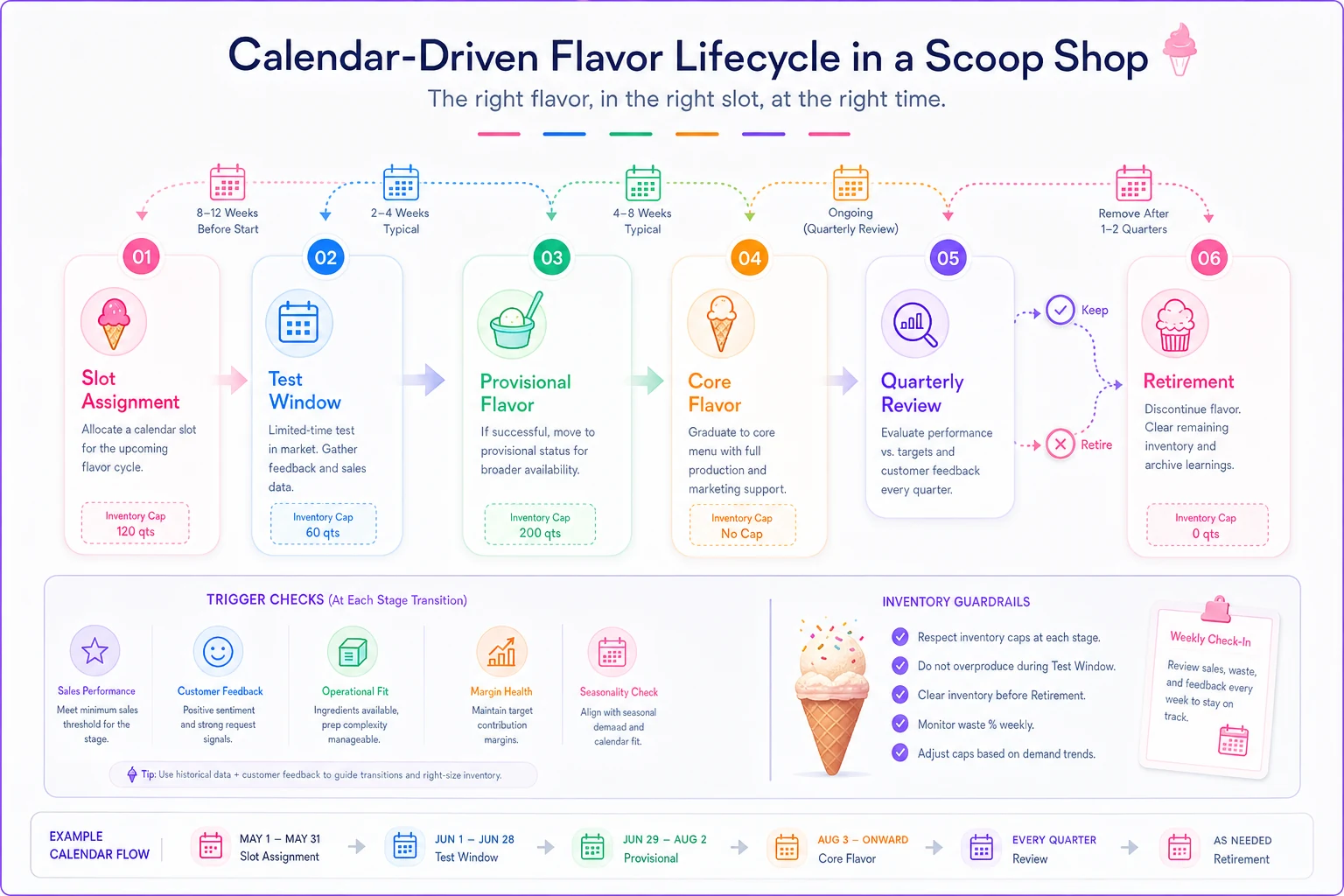
The critical detail is step 1: you set the retirement numbers before launch. Once a flavor is live and people have opinions about it, you'll find reasons to keep it. Setting the kill number on day zero removes the argument later.
Inventory caps by stage — the low-waste piece
The caps are what actually cut waste, because they limit how much unproven product can be sitting around at any given moment.
-
Test flavors 1 tub live, 0 backups in the walk-in. If it sells out mid-window, that's useful data — note it and move on.
-
Provisional flavors 2 tubs maximum across live and backup. No mix-in bulk orders beyond one batch's worth.
-
Core flavors reorder points set by actual velocity, tied to your demand forecast, not gut feel.
-
Retiring flavors sell-down only, no exceptions, even if a regular asks you to keep making it.
If a test flavor sells out mid-window, note it and resist restocking until the window ends.
The most common cap violation is the "let's stock up on mix-ins since we're already ordering" move. A test flavor needs cookie pieces, so someone orders the 5-lb bag instead of a small amount. Flavor flops, you've got 4.5 lbs of cookie pieces aging out. Caps have to cover the inputs, not just the finished tubs.
On the reorder side for core flavors, lean on your seasonal, weather-driven demand forecasting so velocity targets actually reflect the fact that August and February are completely different operating conditions.
A real scenario
A two-location shop running about 26 flavors per store kept adding seasonal specials but rarely retired anything. Their freezer was at capacity, batch waste was creeping up, and Sunday prep had ballooned because they were making small amounts of a lot of things — inefficient in every direction.
They put in a lifecycle: every flavor got a stage, test flavors got a hard one-tub cap, and retirement was triggered by bottom-15%-for-three-weeks combined with a floor of roughly 12 scoops/week. First pass, the system flagged 8 flavors across both locations. They pulled 6 of them over about three weeks.
The numbers weren't dramatic but they added up. Cabinet positions dropped from 26 to around 19 core plus 2–3 rotating test slots. Weekly batch waste fell by roughly a third — far fewer half-used tubs of slow movers going in the bin. Sunday prep got shorter because they were running larger batches of fewer flavors, which is just more efficient per scoop. And the rotating test slots actually gave regulars a reason to check the board.
The owner's comment stuck with me: the hardest part wasn't the math, it was letting a flavor die on a number instead of a feeling.
When this makes sense — and when it doesn't
This works well if you run 18+ flavors, add specials regularly, and deal with freezer space or batch waste issues. The zombie-flavor problem scales with menu size, so the larger the menu, the more a lifecycle pays off.
This is overkill if you run a tight 10–12 flavor menu with almost no rotation. At that scale, you probably already know every flavor's performance intuitively, and a formal trigger system adds structure you don't need.
Who should skip this entirely: a brand-new shop still finding its identity. In your first six months, you want to churn flavors and learn what your neighborhood actually buys. Lock in the lifecycle discipline once you have a stable core and a clear baseline volume — otherwise you'll retire flavors before the shop itself has had time to build a following.
Getting the tracking to run itself
The one thing that kills lifecycle systems is manual tracking. If someone has to remember to pull scoop counts every week, rank the flavors, and check trigger conditions by hand, it works for a month and then quietly dies.
Clean POS tagging paired with a system that watches thresholds for you changes that. If every scoop is tagged by flavor and stage, the review basically writes itself — you get flagged when a flavor hits three consecutive weeks below the floor instead of discovering it during an annual walk-in cleanout. Operational software with AI automation built in isn't doing anything you couldn't do with a spreadsheet and perfect discipline; it's just removing the "someone has to remember" failure point, which is exactly where these systems fall apart. The calendar dates, stage transitions, trigger flags — those are worth automating because they're the pieces humans consistently forget.
The bottom line
A menu lifecycle isn't about being ruthless with flavors. It's about deciding the rules before you're emotionally invested, so the freezer doesn't slowly fill up with things nobody quite wants to kill. Give every flavor a stage, cap the unproven ones hard, set a retirement number on launch day, and put the whole thing on a calendar. The flavors that earn their slot stay. The ones that don't leave quietly, on a number, before they cost you cabinet space and thrown-out tubs. That's the whole system — and it's a lot less painful than the annual "why do we have 28 flavors" conversation.
Ready to scoop up efficiency and grow your shop?
Join hundreds of ice cream shops using Cremyly to boost productivity, reduce waste, and delight customers with faster service.