


Most scoop shop owners run their menu on gut feel plus whatever the POS "top sellers" report tells them. That report lies to you, though. It tells you what sells a lot, not what pays your rent. A flavor can be your #2 seller by volume and still be dragging down your blended margin, eating freezer slots, and quietly costing you two extra hours of staff training per new hire.
The real problem isn't picking profitable flavors. It's that menu decisions touch four systems at once — margin, turn rate, training/labor cost, and physical freezer space — and almost nobody weighs all four together. You optimize one and break another. Drop a slow premium flavor to free up a freezer slot, and you accidentally remove the thing that justified your $6.50 scoop price to the neighborhood. Add three "fun" seasonal flavors, and suddenly your new scoopers can't hit portion weights because they're memorizing 22 SKUs instead of 14.
This is a framework for making those tradeoffs on purpose — with a decision grid, promotion guardrails so your discounts don't torch your margin, a quarterly rationalization rhythm, and a spatial calculator so freezer constraints stop being an afterthought. A menu profitability framework for an ice cream shop only works if it respects all four constraints at the same time, so that's how we'll build it.
Why single-variable menu decisions keep backfiring
Here's a pattern that shows up constantly in small shops. An owner looks at a spreadsheet, sees that Pistachio has the lowest unit sales, and cuts it. Feels responsible. Three weeks later they notice regulars who used to order two scoops now order one, or just walk. Pistachio wasn't a volume play — it was a signal flavor. Its presence told a certain customer "this place is serious," and that halo lifted the whole ticket.
The opposite mistake is just as common. A shop keeps every flavor that sells "fine" and ends up with 24 open tubs, half of them turning slowly, all of them occupying cold space, all of them needing to be rotated, weighed, labeled, and taught. Each additional flavor is not free. It carries a hidden cost across inventory, labor, and spoilage that never shows up on the flavor's own line in the P&L.
What breaks is coordination. Margin lives in finance's head. Turn rate lives in the inventory log. Training cost lives with your shift lead. Freezer space lives in physical reality nobody measures until a delivery won't fit. These four live in four different places, so no single person ever sees the full tradeoff. The menu becomes an accumulation of past decisions instead of a current one.
If you haven't already nailed down per-scoop costing, that's the prerequisite for everything here — the grid below assumes you know your true cost per serving, which is the whole point of pricing by portion and calculating per-scoop cost.
The four variables, and why each one lies on its own
Before the grid, you need to understand what each variable actually measures and how each one deceives you in isolation.
Keep your ice cream shop running smoothly.
Cremyly helps you manage every order, stock level, and staff shift with precision and ease.
- Real-time inventory tracking
- Order management dashboard
- Staff scheduling & shift coordination
No credit card required
Margin is your dollar contribution per scoop, not percentage. This matters more than people think. A $7 premium scoop at 62% margin throws off more cash per serving than a $4.50 classic at 70%. Percentage-chasers end up cutting high-dollar flavors that are actually funding the operation.
Turn is how fast a tub empties — days-to-empty, or servings sold per open tub per week. Turn is the hidden tax collector. Slow turn means more freeze-time, more risk of ice crystals and quality rejection, and more capital frozen (literally) in inventory. A flavor can have great margin and still lose money if it turns so slowly you're scraping freezer burn off the top third of every tub.
Training cost is the sneaky one. Every flavor a scooper has to know is something that can be portioned wrong, described wrong, or cross-contaminated. Complex textures — dense gelato-style bases, mix-ins, swirls — take longer to teach correctly. More flavors means longer Week-1 onboarding and higher portion variance from newer staff.
Space is brutally finite. Your dipping cabinet holds what it holds. Every slot you give a flavor is a slot you can't give to a faster, higher-contribution one.
The insight most owners miss: these four variables aren't independent. Slow turn makes quality worse, which increases rejects, which raises effective cost, which lowers real margin. More flavors raise training cost and consume space and usually lower average turn per SKU. They're a system. That's why you can't optimize them one at a time.
The cross-functional decision grid
The grid is a scoring tool that forces all four variables onto one page for every flavor. Score each flavor 1–5 on each dimension, then weight.
| Variable | What you're scoring | 5 = best | 1 = worst |
|---|---|---|---|
| Margin ($/scoop) | Dollar contribution per serving | High $ contribution | Thin $ contribution |
| Turn | Servings per open tub per week | Fast, empties cleanly | Slow, risks freezer burn |
| Training cost | Portion/serve complexity (inverted) | Simple, hard to mess up | Complex, high variance |
| Space efficiency | Contribution per freezer slot | High $ per slot | Low $ per slot |
Default weighting to start with for most shops: Margin 35%, Turn 30%, Space 25%, Training 10%. Training gets the lowest weight because it's a one-time-ish cost per flavor, while the other three recur daily. Premium shops should bump Margin to 40% and drop Turn to 25%. High-volume shops near a boardwalk or campus should flip it — Turn 35%, Margin 30% — because throughput is their whole model.
The scoring forces an honest conversation. A flavor scoring 5-5-5-2 (great on everything but complex to serve) stays — you just invest in training. A flavor scoring 4-2-3-2 is a candidate for the chopping block even if it "sells fine," because it's slow and space-hungry.
If your cabinet is near capacity, prioritize space efficiency when choosing weights.
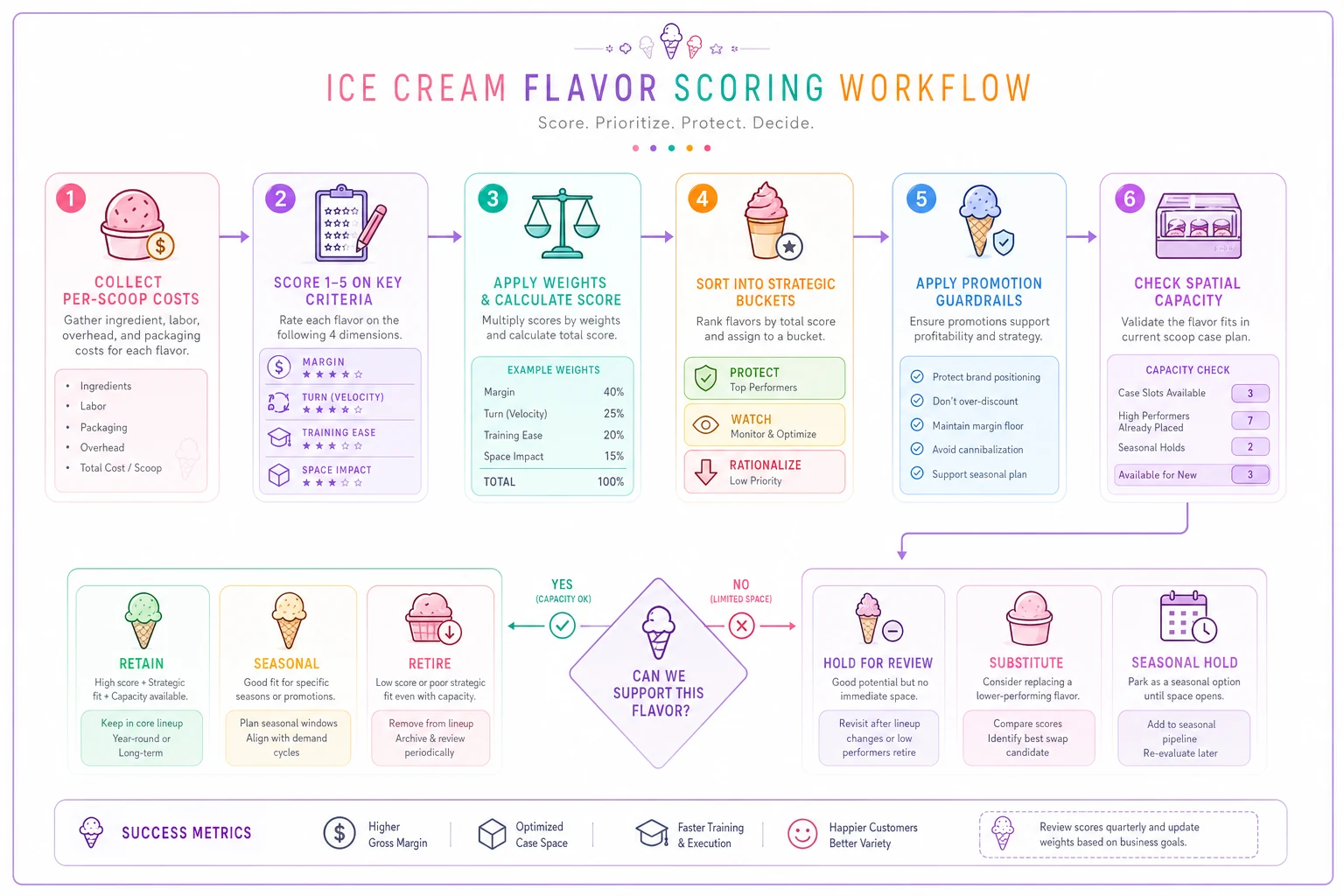
A quick visual of the scoring-to-action workflow.
Worked example: a high-turn shop
Say you're a 14-flavor campus-adjacent shop doing roughly 700–850 scoops on a good weekend day. Vanilla Bean scores: Margin 3 (classic, mid-dollar), Turn 5 (empties in under 2 days), Space 5 (one slot, huge contribution), Training 5 (dead simple). At the high-turn weighting, it's a clear keeper — it's the engine.
Now your Lavender Honeycomb: Margin 5 (people pay $7), Turn 2 (empties in 9–10 days), Space 2 (slow slot), Training 3 (swirl technique). At high-turn weighting it scores poorly. On a boardwalk it probably doesn't earn its slot. Cut it, or move it to a rotating seasonal position so it never permanently occupies a slot.
Worked example: a premium shop
Same two flavors, different shop — a small-batch neighborhood place doing maybe 180–240 scoops a day at higher prices. Reweight to Margin 40 / Turn 25 / Space 25 / Training 10. Now Lavender Honeycomb's margin-5 and brand-signal value carry it. Its slower turn is acceptable because your whole model is premium and lower volume. Meanwhile plain Vanilla might underperform here — it doesn't differentiate you, and its lower dollar contribution matters more in your blend.
Same two flavors. Opposite decisions. That's the entire point of scoring all four together instead of staring at a sales-rank list.
Promotion guardrails: stop discounts from eating your grid
This is where most shops undo all their careful menu math in a single weekend. You run a "buy one get one" or a punch-card freebie, volume spikes, everyone's thrilled — and your blended margin for the month quietly craters because the promotion ran on flavors you can't afford to discount.
-
Never promote a flavor scoring below 3 on margin. Discounting a thin-margin flavor to drive volume just loses money faster.
-
Promote slow-turn, high-margin flavors to clear them, not fast-turn flavors that would've sold anyway. A BOGO on Vanilla is pure margin donation. A BOGO on that slow-turning Lavender before it freezer-burns is smart waste prevention.
-
Cap total promotional scoops at a set percentage of weekly volume — somewhere around 12–18% is a sane ceiling for most shops. Above that, you're training customers to wait for deals.
-
Set a floor price, not a floor percentage. Define the minimum dollar contribution per promoted scoop and don't cross it, regardless of how the discount is framed.
-
Every promotion gets a defined end trigger — a date or a volume cap — written down before it launches. Open-ended promotions are how a "weekend special" becomes a permanent margin leak nobody remembers starting.
The guardrail that saves the most money is also the simplest: a promotion should move inventory you're worried about, or build traffic on a dead daypart. Never discount your heroes. If your busiest flavor is on promo, you just gave away money you had already earned.
Quarterly rationalization cadence
A menu drifts. Flavors that scored well in June score differently in October. The discipline that keeps the grid honest is running it on a fixed quarterly rhythm instead of reacting whenever someone has an opinion.
-
Pull the quarter's data — servings per flavor, waste/reject by flavor, actual cost per serving (including spoilage), and average days-to-empty per tub.
-
Re-score every flavor on the grid using current numbers, not last quarter's gut sense.
-
Sort into three buckets Protect (top third), Watch (middle), Rationalize (bottom third).
-
For the Watch bucket, pick one lever per flavor — reprice, change the promo rule, reduce par so it turns faster, or move it to seasonal rotation.
-
For the Rationalize bucket, retire or replace using explicit sales triggers, not attachment. The discipline of retiring on data rather than emotion is exactly what a proper menu lifecycle with low-waste test windows and sales-trigger retirement is built to handle.
-
Reserve 1–2 slots for tested new flavors so the menu refreshes without expanding total SKU count.
The non-obvious rule: total slot count stays fixed. Rationalization is a swap, not an add. The fastest way to wreck all four variables at once is letting the menu creep from 14 to 19 flavors because "customers kept asking." Every quarter you earn a new flavor by retiring one.
Doing this quarterly instead of annually matters because perishable turn data goes stale fast. A flavor that turned well in peak season but collapses in the shoulder months needs to be caught in a quarter, not after a year of slow bleed.
The spatial-capacity worksheet for freezer constraints
Space is the variable owners ignore until it physically bites them. A delivery arrives and there's nowhere to put it, so tubs get stacked wrong, FIFO breaks, and quality drops. A spatial calculator turns "it'll probably fit" into an actual number.
The core math is simple. Your usable capacity isn't your freezer's rated volume — it's your dipping cabinet slots plus your backup/holding freezer slots, minus a working buffer. You always need empty working space for incoming deliveries and rotation, so plan to use roughly 80–85% of raw capacity, not 100%.
-
Dipping cabinet slots available ___ (count physical openings)
-
Backup freezer tub capacity ___ tubs
-
Working buffer (keep empty) ~15–20% of total
-
Usable slots = (cabinet + backup) × 0.82 ___
-
Current active flavors ___
-
Slots per flavor needed (active tub + 1 backup for fast movers): fast = 2, slow = 1
-
Total slots demanded = Σ (slots per flavor) ___
-
Slack/deficit = Usable slots − slots demanded ___
If your slack goes negative, you are over-menued for your physical space, full stop. That's not a motivation problem, it's a geometry problem, and no amount of hustle fixes it.
Worked spatial example
A shop has a 12-slot dipping cabinet and a backup freezer that holds 10 tubs. Raw total = 22. Apply the 0.82 buffer → about 18 usable slots. They run 14 flavors. Their 4 fast movers each want 2 slots (active + backup) = 8 slots; the remaining 10 flavors want 1 each = 10 slots. Total demand = 18. Slack = 0.
Zero slack means every delivery is a Tetris problem and there's no room to test a new flavor without breaking FIFO. The grid already flagged two bottom-bucket flavors. Retire them, drop to 12 flavors, and now there's a 2-slot cushion — exactly the room needed to run a quarterly flavor test without blowing up rotation. The spatial worksheet and the decision grid talk to each other: space pressure tells you how many to cut, the grid tells you which ones.
When this framework makes sense — and when it doesn't
When it clearly makes sense: you're running 12+ flavors, you've got a backup freezer, and your blended margin feels soft even though sales look okay. That gap between "selling fine" and "not making money" is exactly what the four-variable view exposes.
When it's overkill: a tiny 6-flavor shop with one cabinet and no backup freezer. At that scale your space is so constrained the decisions mostly make themselves, and a full quarterly re-scoring is more process than the problem warrants. Run a lightweight version — just margin and turn — twice a year.
Who should not bolt this on yet: anyone who doesn't have clean per-serving cost numbers. If you don't know your true cost per scoop including spoilage, the margin column of the grid is fiction, and fiction weighted at 35% will steer you wrong. Fix costing first.
One common mistake is treating the weightings as fixed law. They're a starting point. A shop that shifts seasonally — tourist-heavy summer, local-only winter — should honestly run two weightings and re-score at the season change, because the same flavor genuinely has different value in July versus February.
A short real scenario
A neighborhood shop running 16 flavors, somewhere around $4k–$5k in weekly sales, kept feeling like good weeks didn't turn into good months. Their top-sellers report looked healthy. The problem was invisible because it lived across four systems nobody looked at together.
Scoring everything on the grid surfaced it quickly. Three flavors in the bottom bucket were turning in 11–13 days, occupying 4 freezer slots between them, and generating consistent freezer-burn rejects — a slow quality bleed that never got blamed on the flavors causing it. Meanwhile two thin-margin flavors were getting BOGO'd on weekends, donating contribution on servings that would've sold anyway.
They retired the three slow movers, swapped in one tested seasonal, pulled the two thin-margin flavors out of the promo rotation, and redirected promotions toward clearing slow-but-high-margin tubs before they burned. Nothing dramatic happened on the sales line — volume held roughly steady. Blended margin improved by a few points over the next quarter, reject-related waste dropped noticeably, and Week-1 training got shorter because new scoopers had fewer complex flavors to memorize. Same revenue, more money kept. That's the whole game.
Pulling it together
Menu profitability feels slippery in a scoop shop because the decision sits at the intersection of four systems that normally never meet — finance, inventory, labor, and physical space. Each one, looked at alone, gives you a confident but wrong answer. The grid forces them into the same room. The promotion guardrails keep your pricing discipline from leaking out the side door. The quarterly cadence keeps the whole thing from drifting. And the spatial worksheet makes sure your ambitions respect the actual cold cubic feet you own.
None of this requires fancy tooling to start. A spreadsheet and an honest quarterly afternoon will get you most of the way there. What it requires is the discipline to stop judging flavors one variable at a time. Your best seller might be underpaying you. Your slowest flavor might be your brand. You only find out when you score all four at once, on purpose, on a schedule.
Menu profitability feels slippery in a scoop shop because the decision sits at the intersection of four systems that normally never meet — finance, inventory, labor, and physical space. Each one, looked at alone, gives you a confident but wrong answer. The grid forces them into the same room. The promotion guardrails keep your pricing discipline from leaking out the side door. The quarterly cadence keeps the whole thing from drifting. And the spatial worksheet makes sure your ambitions respect the actual cold cubic feet you own.
None of this requires fancy tooling to start. A spreadsheet and an honest quarterly afternoon will get you most of the way there. What it requires is the discipline to stop judging flavors one variable at a time. Your best seller might be underpaying you. Your slowest flavor might be your brand. You only find out when you score all four at once, on purpose, on a schedule.
Ready to scoop up efficiency and grow your shop?
Join hundreds of ice cream shops using Cremyly to boost productivity, reduce waste, and delight customers with faster service.