

Most scoop shops treat their dairy base supplier like a marriage. One vendor, years of history, a handshake relationship with the sales rep who's been driving that truck since before you signed the lease. It works fine until the Tuesday it doesn't — the delivery is short two flats of base, the cream came in warm, or the whole route gets skipped because their truck broke down in July heat.
When that happens, you're negotiating from zero. Calling around desperate, paying whatever the backup quotes, accepting whatever quality shows up, because you have a line out the door and no base to churn tomorrow's batch.
This post is about fixing that specific gap. Not "manage your suppliers better" as a vague goal — building a simple supplier scorecard for your ice cream shop, running a real on-delivery audit, and keeping two or three backup vendors pre-vetted so you can onboard one in a day instead of a panic. Everything here is meant to be lightweight. If it takes more than a clipboard and one shared spreadsheet, it's too heavy for a shop your size.
The scorecard: five things worth measuring, and nothing else
The mistake people make with vendor scorecards is turning them into a corporate procurement exercise — 22 metrics, weighted averages, a quarterly review meeting. You don't have time for that and it doesn't change behavior anyway.
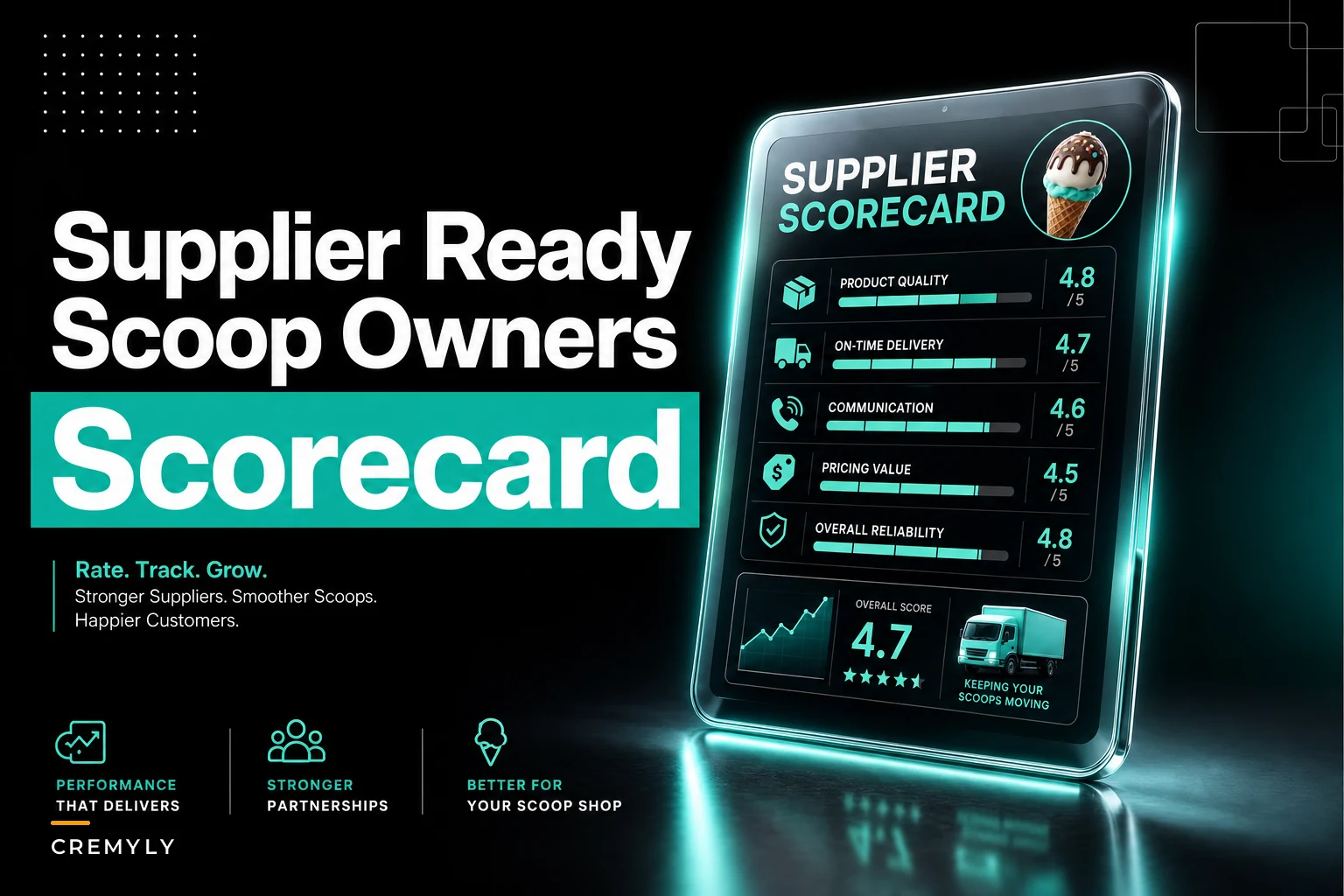
| Metric | What you're really measuring | What a "2" looks like |
|---|---|---|
| On-time delivery | Did it arrive in the promised window? | Two-hour window blown twice this month, no heads-up |
| Fill rate | Did you get the full order? | Short 1–2 items most weeks, "we'll credit you" |
| Cold-chain integrity | Temp on arrival, packaging, ice | Base logged at 45°F, box damp, no gel packs |
| Invoice accuracy | Did the bill match the quote? | Random price creep, wrong case counts |
| Responsiveness | Can you reach a human fast? | Calls go to voicemail, texts ignored for days |
Score below a 3 average two months running and that supplier moves onto your "at risk" list — which is your signal to warm up a backup before you're forced to.
Weight your attention on fill rate and responsiveness — those two failings cost scoop shops most.
One thing that's easy to overlook: fill rate and responsiveness are the two that hurt most in a scoop shop specifically. A late delivery you can sometimes absorb with buffer stock. But if you're short base on a heat-wave weekend and nobody's answering the phone, that's lost revenue you never recover. Weight your attention there. The reorder logic that keeps your buffer honest is worth locking down separately — the supplier cadence and reorder point framework for tubs pairs directly with this.
The on-delivery audit: 90 seconds at the back door
The scorecard is only as good as the data feeding it, and the data comes from the moment the delivery hits your back door. This is where shops get lazy. The driver's in a hurry, your closer is slammed, so someone signs the manifest without checking anything and the box goes straight into the walk-in. Then three days later you discover the base was warm on arrival and now you're eating the loss with nothing to show for it.
Keep your ice cream shop running smoothly.
Cremyly helps you manage every order, stock level, and staff shift with precision and ease.
- Real-time inventory tracking
- Order management dashboard
- Staff scheduling & shift coordination
No credit card required
-
Temp-probe the base and dairy first, before anything else moves. One reading, written on the manifest. If it's above your threshold (usually 40°F for liquid dairy base), flag it now — not after it's unpacked.
-
Count cases against the order, not against the invoice. Vendors sometimes short you and bill you for the full amount, betting you won't check. Count what you ordered vs. what's on the pallet.
-
Eyeball packaging and dates. Damp boxes, missing gel packs, tubs with dented lids, anything dated tighter than expected.
-
Note anything off in one line on the manifest. "2 flats base short, temp 44°F, driver notified 6:42pm." That one sentence is your leverage on the credit call later.
-
Snap a photo if anything's wrong. Warm base, damaged case, short pallet — photograph it before the driver leaves. This settles disputes fast.
The whole thing is a minute and a half. The insight most owners don't act on: the audit isn't really about catching this delivery — it's about training the supplier. Once a vendor's driver knows your shop actually probes and counts every time, the shorts and borderline-warm loads mysteriously stop. Suppliers push exactly as far as the least-attentive customer lets them.
Feed each audit into your scorecard the same day. If you're already tracking daily numbers, this folds into the same rhythm as your inventory and daily P&L alignment — the delivery exception is often the first place a margin leak starts.
Building the backup bench before you need it
The scorecard tells you when to activate a backup, but the backup has to already exist. Trying to source a new dairy base vendor mid-crisis is how you end up locked into bad pricing and inconsistent product.
-
You've had one real conversation and gotten a written quote
-
You've placed at least one small trial order and tested the product
-
You have their MOQ, lead time, and delivery days on file
-
You have a direct number for someone who can actually say yes
That's it. Maybe two hours of work per backup, spread over a slow week. The payoff is that when your primary fails, you're not shopping — you're activating.
A typical setup: a shop running roughly 40–50 gallons of base a week keeps their primary regional dairy plus one smaller local creamery and one broadline distributor on the bench. The creamery costs a bit more per gallon but delivers on 24-hour notice. The broadline is cheaper and slower but never runs out. Between the three, there's almost no scenario that leaves the shop dark.
Who should NOT bother with three backups
If you're in a dense metro with five dairy distributors competing for your business, you probably don't need a formal warm bench — you can source a replacement in an afternoon. This system earns its keep for shops where supply is genuinely thin: rural areas, specialty organic or A2 base, single-source local ingredients where one farm is your only realistic option. That's where being caught flat-footed actually shuts you down.
Negotiation scripts for onboarding a backup fast
The reason backups feel intimidating is the negotiation. Owners avoid the conversation because they don't know what to ask for. Here are the scripts — literally what to say — for the two situations that matter.
> "Hey, I run [shop] over on [street]. We're happy with our current base supplier, but I like having a backup lined up in case something goes sideways. Can you send me a quote on [product/volume], your MOQ, your lead time, and which days you deliver to my zip? I'd want to place a small trial order this month just to make sure the product works for us."
> "I need [X gallons of base] delivered by [date]. My regular supplier fell through and I've got a weekend I can't miss. You quoted me [$X] on [date] — can you hold that price for this order and confirm delivery? I'll place the order in the next twenty minutes if you can commit."
> "If this order goes smoothly, I'll rotate a standing order to you every few weeks so you stay current on our account."
A small standing order — even one bag every three weeks — keeps a backup genuinely warm and gives them a reason to prioritize you in a pinch. Cheap insurance.
The contingency flow: what happens when the primary fails
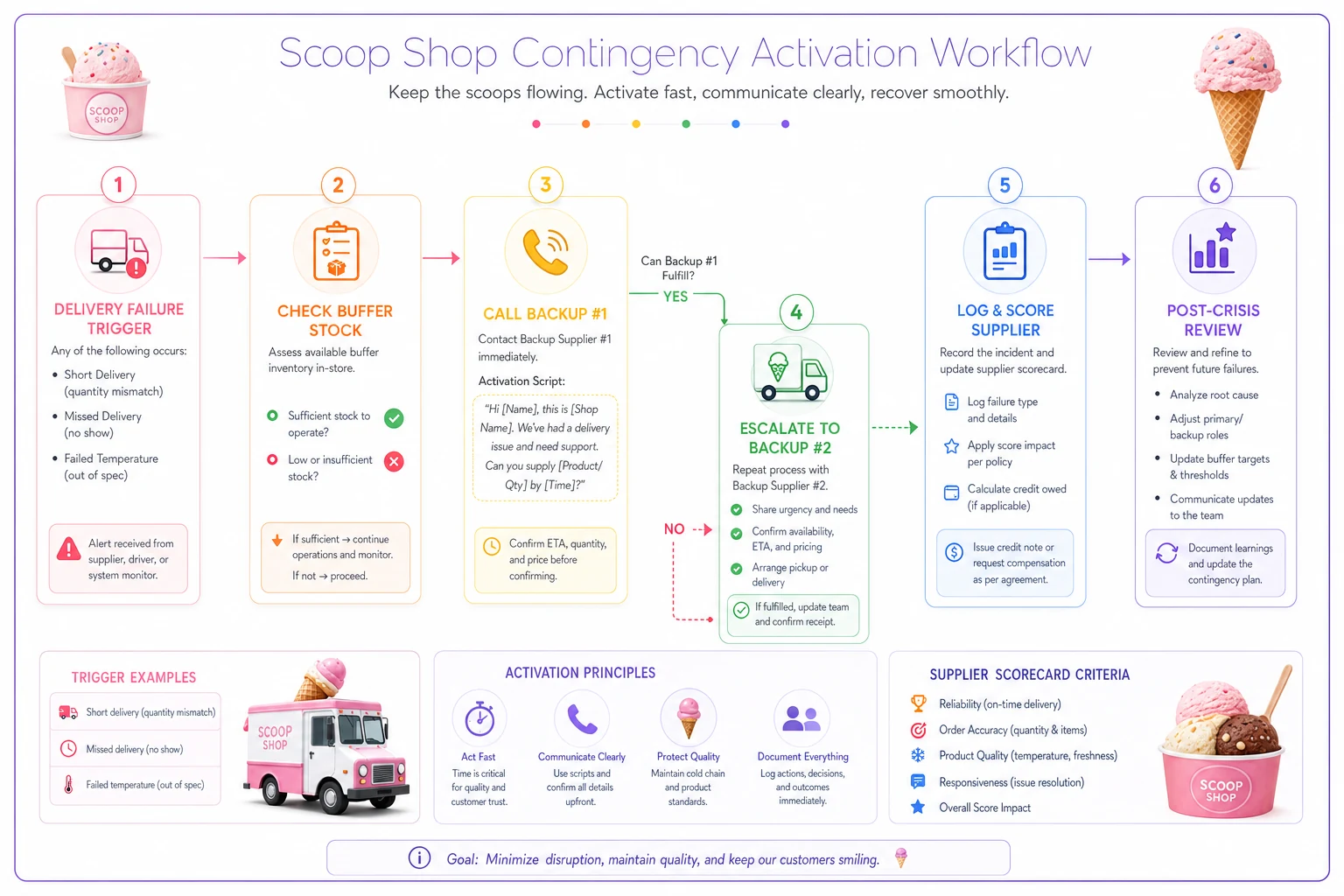
Scripts and scorecards are useless if nobody knows the sequence in the moment. Below is the flow, start to finish, so any manager can run it without calling you at home.
-
Delivery arrives short, is missed entirely, or fails the temp audit with no same-day correction coming
-
Check buffer stock — how many batches can you churn with what's on hand? This determines urgency
-
Pull up the backup sheet and call Backup #1 using the activation script, referencing the last quote
-
If Backup #1 can't hit the timeline, move to Backup #2 — speed beats saving a few dollars per gallon here
-
Log the failure on the primary's scorecard as a hard mark, and note the credit owed on the failed delivery
-
After the crisis settles, decide whether this was a one-off or a pattern — and adjust primary/backup roles accordingly
Most shops skip that last step. They survive the crisis, feel relieved, and go right back to the supplier who burned them — because switching feels like effort and the relationship feels safe.
Then it happens again in August, the worst possible month. The scorecard exists specifically to make that decision unemotional. Numbers on paper are harder to rationalize away than a friendly rep's apology.
Here's a simple flowchart that maps those activation steps.
The scorecard exists specifically to make that decision unemotional. Numbers on paper are harder to rationalize away than a friendly rep's apology.
Keeping the paperwork genuinely minimal
The failure mode of every system like this is that it gets too heavy and dies. The entire thing should live in one place — a single shared sheet with three tabs:
-
Scorecard — one row per supplier, five columns, updated monthly
-
Backup bench — contact, product, MOQ, lead time, delivery days, last quote and date
-
Delivery log — date, supplier, exceptions noted, tied back to the audit
That's the whole footprint. If you're already running your ordering, exceptions, and vendor notes inside an operational platform rather than scattered across texts and a paper binder, this folds into what you've got — the value is that the delivery audit, scorecard, and reorder trigger stop being three separate memories in three different people's heads and become one shared record any manager can act on. But you don't need software to start. A spreadsheet and the discipline to fill it in beats a fancy system nobody updates.
A short real scenario
A single-location shop in a smaller market — roughly 300–350 gallons a month at peak — was single-sourced on organic base from one regional dairy. That dairy missed a delivery on a Fourth of July weekend, truck breakdown, no warning. The shop lost most of two days of scooping because they couldn't source base fast enough. Somewhere in the $2,500–$3,500 range of walk-in revenue gone, plus a lot of turned-away regulars who don't fully come back.
The following off-season they built a bench: the primary dairy, one local creamery at about 8% higher cost but 24-hour delivery, and a broadline distributor as the cheap-but-slow floor. Total setup effort was maybe an afternoon of calls and two small trial orders. The scorecard lived on one spreadsheet tab. The next summer the primary shorted them again — this time on a Saturday. The manager ran the flow, called the creamery, referenced the standing quote, and had base delivered Sunday morning. No lost scooping days. The extra cost of the emergency order was under a hundred dollars. That's the entire ROI story: a hundred bucks of premium base versus a few thousand in lost weekend revenue.
Bottom line
You don't need a procurement department. You need five metrics, a 90-second back-door audit, two or three pre-vetted backups, and a written sequence so nobody's improvising during a heat-wave failure. The whole system is cheap to build in a slow week and pays for itself the first time your primary supplier lets you down — which, if you've run a shop through more than one summer, you already know is a when, not an if.
Start with the scorecard this month. Warm up one backup before peak season. That's the minimum viable version, and it's already more supply resilience than most shops on your block will ever have.
Ready to scoop up efficiency and grow your shop?
Join hundreds of ice cream shops using Cremyly to boost productivity, reduce waste, and delight customers with faster service.