

Most scooper training is basically shadowing. New hire follows a senior scooper for two shifts, gets told "you'll get the hang of it," then gets thrown on the line during a Saturday rush. Nobody measures whether they actually learned to scoop consistently. Nobody checks if their portions match what the pricing math assumes.
That gap is where money quietly leaks. A scooper serving 4.2 oz when your menu is built on 3.6 oz isn't making a small mistake — they're giving away roughly 16% of every scoop. Multiply that across a full shift and you're bleeding margin without a single customer complaint.
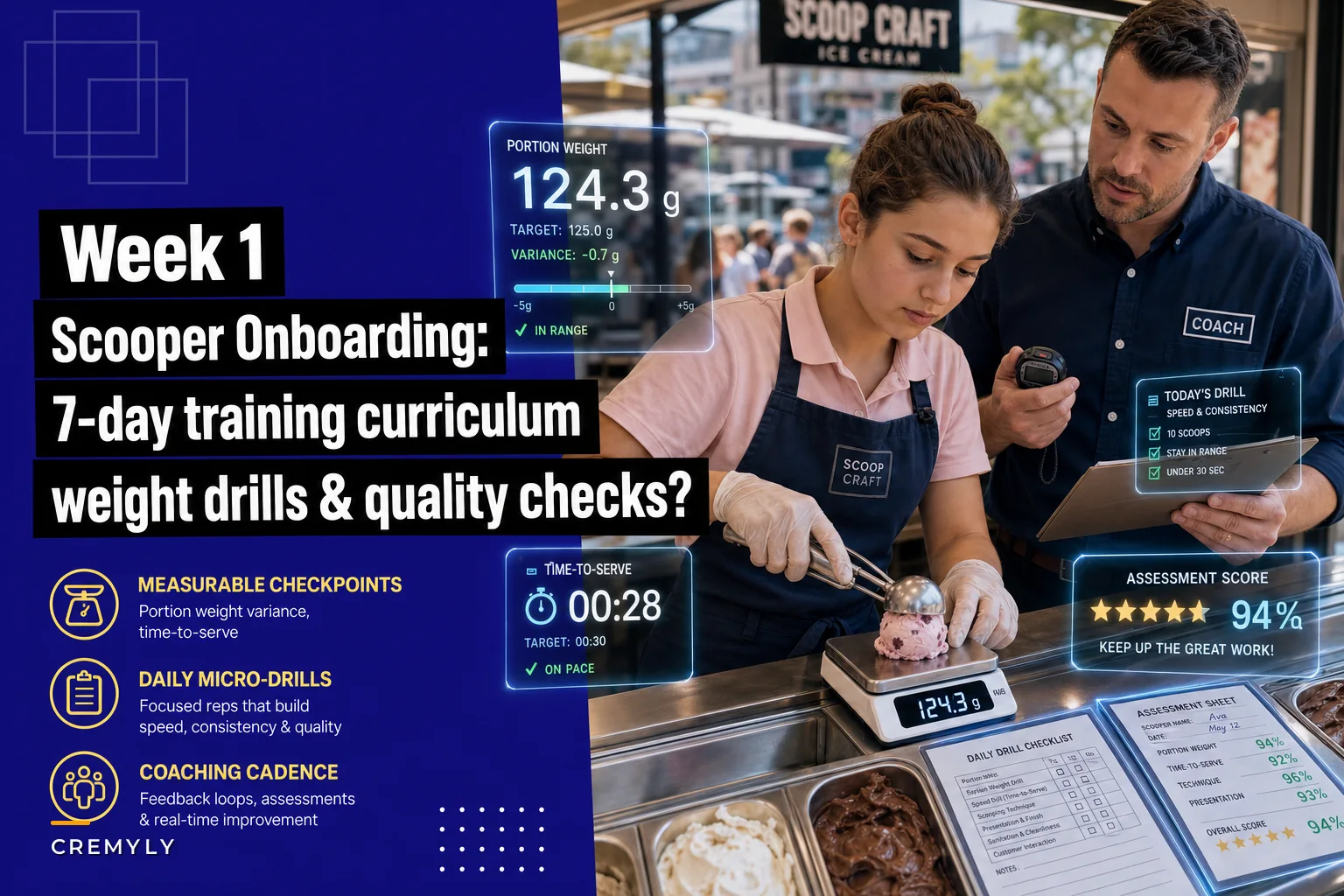
This is a tight, measurable Week-1 curriculum built around two numbers you can actually track: portion weight variance and time-to-serve. Everything else — cone technique, sample etiquette, register flow — matters, but those two metrics tell you whether a scooper is safe to put alone on the line by Day 7.
Why "watch and learn" produces inconsistent scoopers
The problem with shadow-only onboarding is that scooping is a muscle-memory skill disguised as an easy one. It looks simple. Anyone can drag a scoop across a tub. But hitting a target weight repeatedly — through a soft tub, a rock-hard tub, a nearly empty tub — takes calibrated feel that only develops through repetition with actual feedback.
-
New scoopers overfill early because they're afraid of looking stingy to customers.
-
They overfill more when a line forms, because rushing kills portion control.
-
Nobody catches it because there's no scale on the line and no baseline to compare against.
By the time you notice your cost-per-scoop climbing, that scooper has already formed a habit. And habits set in week one are the hardest to unwind. The whole point of a measured curriculum is to build the right muscle memory before the wrong one locks in.
There's also a consistency problem that hits the customer side. When one scooper serves 3.5 oz and another serves 4.3 oz for the same "single scoop," customers notice. You get the "the guy yesterday gave me more" comment, and your team starts second-guessing portions mid-shift. Consistency isn't just a margin issue — it's a trust issue.
The two metrics that actually matter in week one
Before the day-by-day plan, get clear on your targets. You can't run drills without a number to hit.
Keep your ice cream shop running smoothly.
Cremyly helps you manage every order, stock level, and staff shift with precision and ease.
- Real-time inventory tracking
- Order management dashboard
- Staff scheduling & shift coordination
No credit card required
Portion weight variance. Start with your target scoop weight from your costing (if you haven't nailed this down, that's step zero). Say your single scoop target is 3.6 oz. Variance is how far each scoop drifts from that. A trainee serving 3.4–3.8 oz is tight. One serving 3.1–4.5 oz is a problem, even if the average looks fine — because averages hide the giveaways.
Time-to-serve. From "order confirmed" to "product handed over." You're not chasing speed on Day 1 — you're tracking whether speed destroys accuracy. The goal is a scooper who stays within weight tolerance even when the clock is running.
Here's a reference table for what "on track" looks like across the week:
| Day | Weight variance target (single scoop, 3.6 oz base) | Time-to-serve target | Focus |
|---|---|---|---|
| 1 | ±0.6 oz | Not measured | Feel & grip |
| 2 | ±0.5 oz | Not measured | Repetition |
| 3 | ±0.4 oz | Under 90 sec | Consistency |
| 4 | ±0.4 oz | Under 75 sec | Multi-scoop orders |
| 5 | ±0.3 oz | Under 60 sec | Speed under weight control |
| 6 | ±0.3 oz | Under 50 sec | Simulated rush |
| 7 | ±0.3 oz | Under 45 sec | Solo assessment |
These numbers aren't gospel — adjust for your scoop size and your product's hardness. But the shape matters: tighten variance first, add speed second. A shop that pushes speed before accuracy trains overfillers.
The 7-day curriculum
Each day is built around a short drill, a checkpoint, and a coaching moment. The whole daily block is 20–30 minutes of structured practice plus normal supervised floor time. You don't need to shut the shop down for this.
Day 1 — Grip, feel, and the baseline weigh-in
Start with the scale. Have the trainee do 10 scoops into cups, weighing each without looking at the number until after they scoop. Record all 10. This is their raw baseline, and it's almost always all over the place — spreads from 2.9 to 4.8 oz aren't uncommon.
Then teach the actual mechanic: the pull, the turn, the release. Focus on tub temperature awareness — a tub straight from the deep freeze scoops completely differently than one that's been in the dip cabinet an hour. Most trainees don't realize this until someone points it out explicitly.
Coaching moment: Show them their 10-scoop spread. Don't shame it. The point is to make the target concrete — "this is where you are, and by Friday you'll be inside a half-ounce."
Day 2 — Repetition to narrow the spread
Pure volume day. 30–40 practice scoops, weighing every one, calling out the weight before checking the scale so they build the guess-then-verify habit. That prediction loop develops calibrated feel faster than anything else.
Watch for the overfill drift as they tire. Trainees get sloppy around scoop 25. That's normal and worth naming out loud when it happens.
Checkpoint: Are 7 of 10 scoops within ±0.5 oz? If not, that's fine on Day 2 — flag it for extra reps tomorrow.
Day 3 — Add the clock, gently
Now you introduce time-to-serve, but framed as "don't let the timer wreck your weight." Run mock orders: single cone, single cup, kid's scoop. Call the order, start a timer, they serve and weigh.
This is where you'll see the classic trade-off — speed up 15 seconds, variance blows out to ±0.7. Coach them to find the pace where both numbers hold. It's usually slower than they expect.
Day 4 — Multi-scoop orders and the stacking problem
Doubles and triples introduce a new failure mode: the second scoop is almost always heavier than the first because they've built momentum and lost some of the early caution. Weigh each scoop of a double separately so they can actually see it.
Also drill flavor transitions — wiping the scoop, using the water well, not dragging chocolate into the vanilla tub. Cross-contamination is a quality issue that connects directly to product waste and rejects. If you want to go deeper on how execution errors on the line feed into waste, the breakdown on reducing melt-and-reject rates covers the root-cause side.
Day 5 — Speed under weight control
Push time-to-serve toward your real-shift target while holding variance at ±0.3. This is the hardest day. Some trainees plateau here — that's fine. Better to spend an extra day than to graduate an overfiller.
Run 20 timed mock orders back to back. Track both numbers. The goal isn't a perfect run — it's whether accuracy holds when they're moving fast.
Day 6 — Simulated rush
Get a second person to play impatient customer. Stack five orders, throw in a substitution and a "which one's less sweet?" question mid-scoop. This tests whether they can hold portion discipline while distracted, which is the real job on a summer Saturday.
You're watching for the panic overfill — the moment stress pushes them to dump an extra half-ounce just to move the line. If it shows up here in practice, you can coach it out before it costs you on the floor.
Day 7 — Solo assessment
They run a real block solo while you observe and log. Pull 8–10 random weight checks across the shift and a handful of time-to-serve readings. Compare against the Day 7 targets. Pass, or extend two more days.
A simple visual to map the daily flow.
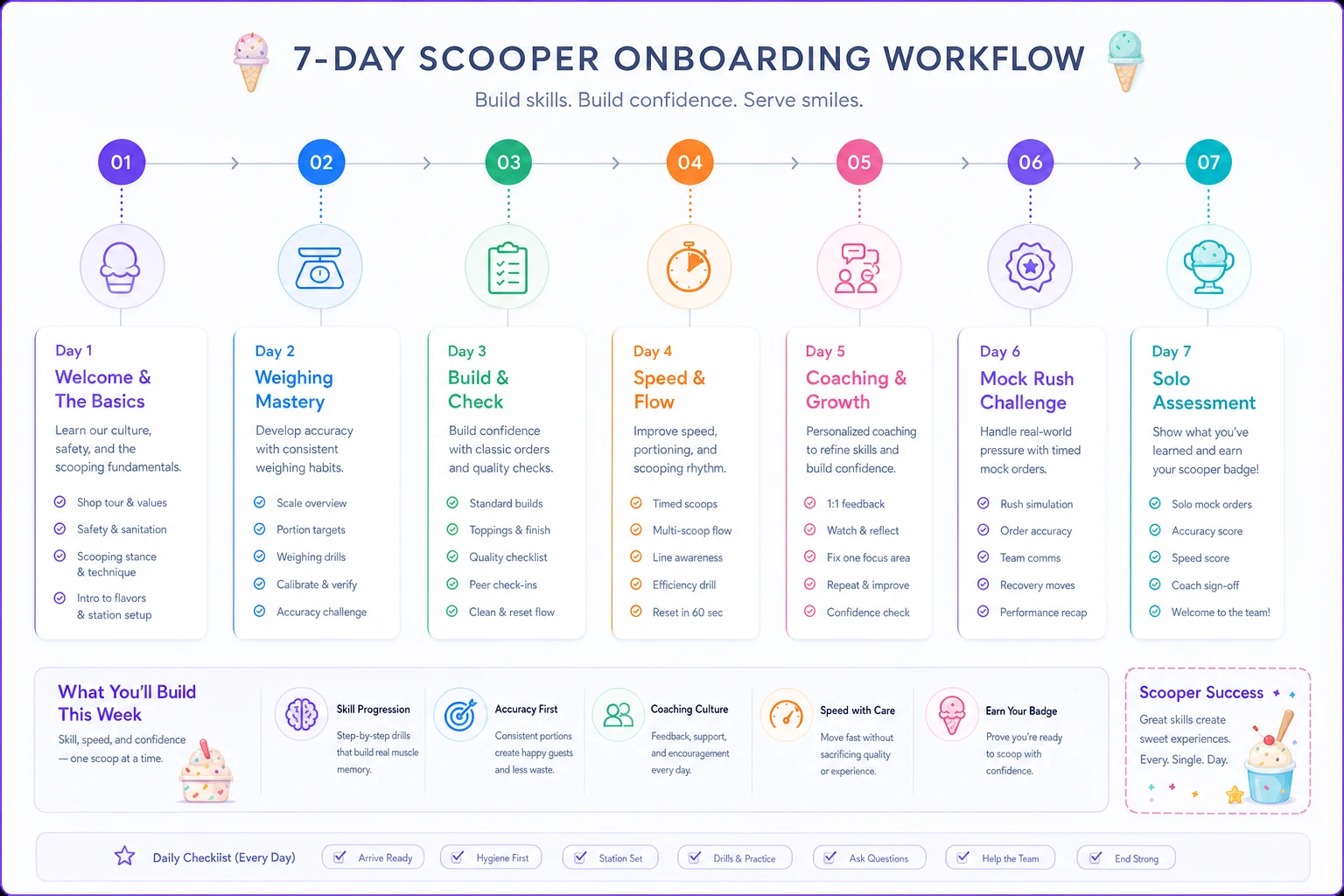
Keep the block short and focused so it fits into a shift without disrupting service.
A sample assessment sheet you can copy
Keep it simple. A clipboard or a tablet note works fine. Here's the structure:
-
Trainee name / Date / Trainer
-
Scoop weights (record 10)
-
Average weight ___ oz
-
Number within tolerance ___ / 10
-
Time-to-serve samples (record 5) ___ sec
-
Flavor-transition technique pass / needs work
-
Notes on behavior under pressure ___
-
Coaching focus for tomorrow ___
The "coaching focus for tomorrow" line is the most important field on the sheet, and the one people skip. Each day should hand off one specific thing to work on. Without it, the assessment becomes a scorecard instead of a development tool.
The coaching cadence that ties it together
Metrics without a feedback rhythm just become paperwork. The cadence that actually works is short and daily:
-
Pre-shift (2 min) State today's one focus and the target number.
-
Mid-drill (ongoing) Correct in the moment — feel, grip, tub temperature — but keep it light.
-
Post-drill (5 min) Review the sheet together. Show the numbers. Pick tomorrow's focus.
That's it. The mistake managers make is either over-coaching (correcting every single scoop until the trainee freezes up) or under-coaching (weighing scoops and never discussing the results). One clear focus per day, reinforced with real numbers, is the sweet spot.
Have trainees record their own weights so they start self-correcting by Day 3.
One pattern worth naming: trainees improve noticeably faster when they record their own weights. Handing them the scale and the sheet makes them own the target. When the trainer holds the clipboard, the trainee waits to be told how they did. When the trainee holds it, they start self-correcting by Day 3 without being prompted.
A real scenario
A two-cabinet neighborhood shop — roughly 180–220 transactions on a good summer day — kept seeing cost-per-scoop creep up in July despite stable supplier pricing. No obvious waste, freezers fine, no theft signals. Turned out to be onboarding: three seasonal hires from spring had never been weight-calibrated. Their average single scoop was landing around 4.1–4.3 oz against a 3.6 oz target.
They rolled out a version of this 7-day curriculum for the next batch of hires and re-calibrated the existing three. Over about six weeks, average single-scoop weight settled near 3.7 oz with a tighter spread. The owner figured the reduction in giveaway was worth somewhere in the low-to-mid hundreds per month during peak — not life-changing, but real money that had been walking out the door one heavy scoop at a time.
The bigger win was consistency. The "he gave me more yesterday" comments basically stopped, and shift leads stopped having to eyeball-correct portions mid-rush.
When this level of structure makes sense — and when it doesn't
Do this when: you run multiple scoopers per shift, hire seasonal staff, or your portion cost is a meaningful chunk of your margin. If you've ever been surprised by cost-per-scoop drift, structured weight training pays for itself.
Skip the heavy version when: you're a one-person operation scooping everything yourself, or you're small enough to personally train each hire over several weeks anyway. In that case, just steal the Day 1 baseline weigh-in and the assessment sheet — you don't need the full cadence.
Who should not run this loosely: any multi-location shop. Inconsistent portioning across sites is a silent margin killer, and it compounds. If portion discipline isn't standardized, the same drift shows up in your inventory and daily P&L numbers. That connection between line-level execution and margin is exactly what the margin-leak operations playbook gets into — onboarding is upstream of half the leaks that show up there.
Making the checkpoints stick after week one
Week-1 training only holds if you spot-check afterward. A calibrated scooper drifts over a season — tubs change, fatigue sets in, habits soften. A quick monthly re-weigh (10 scoops, compare to target) catches drift before it becomes a cost problem again.
Logging those spot-checks somewhere central, rather than on a clipboard that gets tossed, is what turns a one-time training into an ongoing standard. A shared operations system beats scattered paper notes here because you can actually see whether a specific scooper's weights are creeping across weeks, not just whether they passed day seven.
The core idea is simple but easy to ignore: scooping is measurable, and if you don't measure it in week one, you'll pay for it silently all season. Give new hires a target, a scale, and seven days of honest feedback, and you graduate scoopers who protect your margin instead of quietly eroding it.
Ready to scoop up efficiency and grow your shop?
Join hundreds of ice cream shops using Cremyly to boost productivity, reduce waste, and delight customers with faster service.