

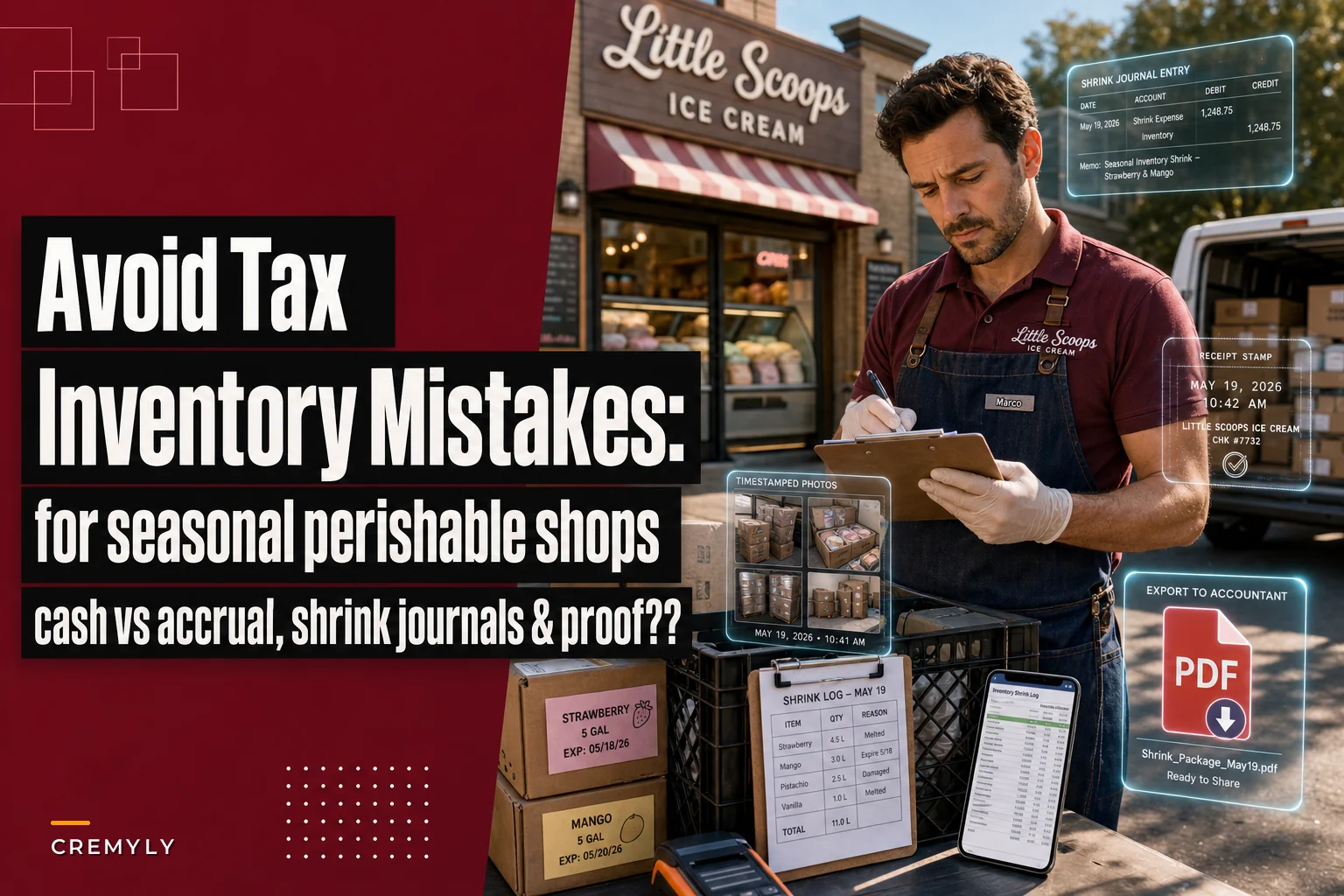

Most scoop shop owners don't lose money on inventory accounting because they're bad at math. They lose it because nobody told them that how they count and record melted, expired, or discarded product has tax consequences — and that a sloppy shrink entry in March can turn into a rejected insurance claim in July or an uncomfortable conversation with an auditor the following April.
This isn't a lecture on debits and credits. It's the set of decision rules, sample entries, and evidence habits that keep your books clean enough that your accountant stops emailing questions and your insurer stops asking for "supporting documentation" you don't have.
Scope is intentionally tight: inventory accounting for perishable retailers, specifically the shrink and method-choice problems that bite seasonal ice cream shops.
Start with the one decision that shapes everything: cash vs accrual
Before any journal entry matters, you have to know which method you're actually on — and a surprising number of owners don't, or they think they're on one when their books say otherwise.
If you're a small single-location shop well under the gross receipts threshold, the IRS lets you use the cash method, which is simpler and ties taxable income to when money actually moves. That feels great for a seasonal business where cash swings hard between January and July. But cash-basis accounting hides something important for perishable retailers: it doesn't force you to value inventory on hand, which means shrink can quietly disappear into "cost of goods" without ever being measured.
Accrual forces discipline. You carry inventory as an asset, and when a tub spoils or melts you have to move that value out deliberately. For a business where product loss is a daily reality, that visibility is worth quite a bit.
Here's a rough decision table for how most owners should think about it:
| Situation | Lean cash | Lean accrual |
|---|---|---|
| Single location, under ~$29M gross receipts (well under, obviously) | ✅ Simpler filing | |
| You want tight shrink visibility month to month | ✅ Forces inventory valuation | |
| Heavy catering/wholesale with invoiced receivables | ✅ Matches revenue to the period earned | |
| You barely track inventory counts now | ✅ Lower bookkeeping burden | |
| You're planning to scale to multiple sites or seek financing | ✅ Lenders expect accrual | |
| Cashflow timing is your biggest planning headache | ✅ Taxable income follows cash |
When cash actually makes sense
If you're a true single-shop operation — mostly walk-in sales, no meaningful wholesale, and your inventory on hand at year-end is small relative to annual spend — cash is fine, and simpler is better. You'll still want to measure shrink for operational reasons, you just won't be running formal inventory journal entries.
When cash is a bad idea
The moment you start doing meaningful catering, selling pints to local grocers, or carrying significant freezer inventory across a slow season, cash starts lying to you. Your January books look profitable because you're not buying much, while the real story — product you bought in October still sitting frozen — is invisible. Pair that with your seasonal cashflow planning and the accrual picture becomes a lot more honest.
Who should NOT switch methods casually
If you've been on cash for years and your accountant is happy, don't flip to accrual mid-year on a whim. Method changes often require filing a Form 3115 and can trigger a one-time adjustment. Make this decision with your accountant, ideally before the fiscal year starts.
Shrink is where perishable books go wrong
Shrink — the gap between what you bought and what you actually sold — is the defining accounting problem for frozen dessert shops. Melt, freezer burn, over-portioning, sampling waste, expired mix, the occasional freezer failure. All of it eats inventory that never became revenue.
Keep your ice cream shop running smoothly.
Cremyly helps you manage every order, stock level, and staff shift with precision and ease.
- Real-time inventory tracking
- Order management dashboard
- Staff scheduling & shift coordination
No credit card required
The mistake isn't having shrink. Every shop has it. The mistake is burying it.
In real operations, shrink usually disappears one of two ways. Either it's never recorded at all (cash-basis shops just see a fat COGS number and move on), or it gets dumped into a generic "waste" line with no categories, so nobody can tell whether the loss came from melt, theft, or bad portioning. When all shrink looks the same, you can't fix any of it — and neither can your accountant when they're trying to justify a deduction.
A typical example looks like this
Say you run a mid-size summer shop. Over a peak month you buy roughly $18k of mix and toppings. At month end, your counts show about $1,400 of product unaccounted for after sales. That's your shrink. If it's one blob, it's just a number. Broken out, it might look like:
-
~$600 over-portioning (a training or scale problem)
-
~$400 melt and discard from a warm afternoon in the back
-
~$250 expired toppings nobody rotated
-
~$150 sampling overage
Each of those has a different fix and a different story for your books. The over-portioning is a labor issue. The melt may tie to equipment — which is exactly the kind of thing that matters when you're building a freezer-failure resilience plan and need documented loss history.
Sample journal entries for shrink (accrual shops)
If you're on accrual and carrying inventory as an asset, here's how to actually record the common perishable events. These are intentionally simple so you can hand them to a bookkeeper and say "do it this way every time."
1. Routine spoilage / normal shrink
Debit Cost of Goods Sold – Shrink (Spoilage) $1,400 Credit Inventory $1,400
Keeping a separate COGS sub-account for shrink is the single most useful habit here.
Keeping a separate COGS sub-account for shrink is the single most useful habit here. It lets you and your accountant see normal loss distinct from purchases, period over period.
2. Abnormal loss from a freezer failure or similar event
Debit Inventory Loss – Equipment Failure $3,250 Credit Inventory $3,250
If you later receive an insurance payout: Debit Cash $2,800 Credit Inventory Loss – Equipment Failure $2,800
The remaining $450 stays as a real, documented loss. That separation is what makes the deduction defensible and the claim auditable.
3. Write-down for product still on hand but degraded
Debit Cost of Goods Sold – Inventory Write-down $380 Credit Inventory Reserve / Allowance $380
If you're on cash basis
You won't run these entries because you expensed the product when you paid for it. But you should still keep an internal shrink log with the same categories. It won't appear on your tax return as a separate line, but it's your operational early-warning system and your evidence trail if you ever file a claim. The accounting method changes the bookkeeping — it doesn't change your need to measure.
The minimal evidence checklist
This is the part owners skip and later regret. When an insurer or auditor asks "prove it," the shops that come out fine are the ones with boring, consistent records — not the ones scrambling to reconstruct events months after the fact.
You don't need a mountain of paperwork. You need the right small set, captured close to when things actually happen.
-
Dated inventory counts — at minimum monthly, ideally at period close. A count with no date is nearly worthless to an insurer.
-
Purchase invoices matched to those counts, so the buy-vs-have math is traceable.
-
A shrink log by category (spoilage, melt, over-portion, expired, event loss) with dates and rough dollar values.
-
Temperature logs for the relevant period — these corroborate melt and equipment-failure claims and overlap with what you already keep for your local compliance and temp-log requirements.
-
Photos of any large or event-based loss (a freezer full of melted product, the disposal). Timestamped if your phone does that automatically.
-
Disposal records — what got tossed, when, roughly how much.
-
For equipment events the service or repair invoice and a timeline of when the unit failed and when product was moved or lost.
Seven things. A shop that keeps these consistently almost never has a claim denied for "insufficient documentation."
A simple weekly routine that produces all of it
-
End of each week manager does a quick count of major inventory categories and logs it with a date.
-
Daily whoever discards product notes it in the shrink log under a category — 15 seconds, not a form.
-
At month close reconcile purchases against counts, calculate total shrink, and classify it.
-
Immediately after any event (freezer failure, big spoilage)
photo, note, and a one-line entry in the shrink log before anyone forgets the details.
-
Quarterly hand the shrink log and counts to your accountant alongside the P&L so entries are recorded while the context is still fresh.
Here's a simple workflow to produce that evidence.

The owners who struggle are almost always the ones trying to reconstruct a year of shrink in April. The data's gone, the context is gone, and the deduction becomes a guess.
Real scenario: a two-freezer summer shop
A seasonal shop doing roughly $240k–$260k in summer revenue was on cash basis and recording all product loss as undifferentiated COGS. Their accountant flagged that COGS was running high but couldn't say why. When a chest freezer failed in late July they filed an insurance claim with essentially no supporting records beyond a repair invoice. The claim came back partially denied — the insurer couldn't verify the lost inventory value, so they paid out a fraction of the roughly $3k loss.
The fix wasn't complicated. They kept cash basis (right for their size), but added a dated weekly count and a five-category shrink log. By the following season, shrink was finally visible: over-portioning was quietly costing a few hundred dollars a month, a scale and quick retraining trimmed it considerably, and total shrink dropped by a meaningful amount. When a smaller equipment issue hit the next year, the claim went through cleanly because they had dated counts, temp logs, and photos.
The money they recovered wasn't just the insurance payout. It was the shrink they finally saw.
Where software quietly helps — without taking over
None of this requires fancy tools. A spreadsheet and consistent discipline will get you there. But the reason shrink logging falls apart in real shops is friction: it's one more thing to remember on a busy Saturday, and manual reconciliation at month-end is tedious enough that people skip it.
This is the narrow place where an operational platform earns its keep. When your POS, inventory counts, and purchase records live in one system, the buy-vs-sold-vs-on-hand math that defines shrink gets calculated for you instead of reconstructed by hand. Category tagging on waste becomes a tap instead of a form. And when it's time to hand evidence to an accountant or insurer, the dated records are already there — counts, logs, and loss events captured as they happened rather than rebuilt from memory.
The point isn't automation for its own sake. Consistent evidence is the whole game in perishable inventory accounting, and consistency is exactly what gets lost when the process depends on someone remembering to write things down during a rush.
The takeaway
Get the method decision right with your accountant, record shrink in categories instead of one blob, use clean separate entries for routine loss versus event loss, and keep the small set of dated evidence that insurers and auditors actually ask for. None of it is complicated. It's just the kind of unglamorous discipline that quietly separates the shops that recover their losses from the ones that eat them.
Ready to scoop up efficiency and grow your shop?
Join hundreds of ice cream shops using Cremyly to boost productivity, reduce waste, and delight customers with faster service.