



Most scoop shops don't fail in July. They fail in February.
That gap between your peak revenue and your slowest month is where the real risk lives, and it's almost never a revenue problem. Shops that clear six figures in the summer still get caught flat-footed in the off-season because the money moved through their hands without ever being seen ahead of time. The owner felt rich in August, paid down some debt, bought a new soft-serve machine, and then hit November with a bank balance that couldn't cover payroll plus the equipment lease plus the surprise compressor repair.
This article is about building a control system that keeps you ahead of that — a rolling 13-week cash forecast, seasonality buckets that reflect how your specific shop actually earns, hard rules for your emergency reserve, and a numeric framework for deciding whether to repair or replace equipment. Not theory. The actual mechanics.
Why seasonal cashflow breaks even for profitable shops
The trap with a seasonal cashflow ice cream shop business is that profitability and liquidity look like the same thing until they don't. A shop can be profitable on paper for the full year and still run out of cash in a single quarter. Your P&L smooths everything out over twelve months. Your bank account doesn't. It lives week to week, and the weeks are wildly unequal.
The pattern that keeps showing up: peak season generates a flood of cash, and that flood feels like normal. Owners recalibrate their spending to the July version of the business without realizing that July is subsidizing five or six months where the shop barely breaks even — or loses money outright.
The other issue is timing mismatch. Your biggest fixed costs — rent, insurance, equipment leases, loan payments — are flat across the year. Your revenue isn't. So you have a curve of income sitting on top of a straight line of obligations, and the two only sync up during a narrow window. Everything outside that window is a slow drain.
A monthly forecast won't catch this. Monthly is too coarse. A single big supplier invoice or a payroll run landing on the wrong week can put you negative even when the month "works out" on average. That's why the 13-week horizon matters — it's short enough to be accurate and long enough to see the cliff coming while you can still do something about it.
The rolling 13-week cash forecast
Thirteen weeks is one quarter. It works better than a monthly budget because it forces you to think in the same unit your bank account thinks in: individual weeks, each with real inflows and outflows.
Keep your ice cream shop running smoothly.
Cremyly helps you manage every order, stock level, and staff shift with precision and ease.
- Real-time inventory tracking
- Order management dashboard
- Staff scheduling & shift coordination
No credit card required
The word rolling is the important part. Every week you drop the week that just ended and add a new week 13 out. You're never looking at a stale plan. The forecast walks forward with you, so at any moment you can see roughly where cash lands three months from now.
Here's the structure. For each of the 13 weeks you track:
-
Starting cash — your actual bank balance at the start of the week.
-
Expected inflows — projected sales (net of card processing lag), catering deposits, gift card float, any wholesale receivables.
-
Expected outflows — payroll, rent, supplier payments, utilities, loan/lease payments, tax set-asides, owner draw.
-
Net movement — inflows minus outflows.
-
Ending cash — starting cash plus net movement, which becomes next week's starting cash.
What separates a useful forecast from a useless one is honesty about timing, not just amounts. A $2,800 dairy invoice you know is coming has to sit in the week it actually clears, not smeared across the month. Same with payroll — if you run biweekly, some months have three pay periods, and that third one is where shops get ambushed.
A quick example of how a single week can look during shoulder season:
-
Starting cash
$9,400
-
Projected net sales (after processing)
$6,200
-
Payroll
$4,100
-
Supplier payments
$2,900
-
Rent (this is the week it hits)
$3,600
-
Utilities
$700
-
Net movement
–$5,100
-
Ending cash
$4,300
One week. Rent landed the same week as the big supplier payment, and you dropped from $9,400 to $4,300. If your reserve floor is $5,000, you just broke it — and you'd have known two months earlier if the forecast was running.
Building seasonality buckets that match your shop
Generic seasonal advice assumes everyone follows the same summer-peak, winter-trough curve. Real shops vary a lot depending on location, product mix, and whether you've got wholesale or catering revenue smoothing things out.
The move here is to sort your weeks into buckets based on how they actually behave, not the calendar. Four buckets capture almost everything:
| Bucket | Typical share of a shop's weeks | What it means for cash |
|---|---|---|
| Peak | ~10–14 weeks | Cash surplus; this funds the rest of the year |
| Shoulder-up | ~6–8 weeks | Ramping; sales rising but costs already climbing |
| Shoulder-down | ~6–8 weeks | Declining; the dangerous slide into low season |
| Trough | ~14–18 weeks | Break-even or loss; survival months |
The point of bucketing isn't to label weeks for fun — it's to assign different rules to each bucket. During peak, you're not spending freely; you're deliberately routing surplus into reserves and pre-funding the trough. During shoulder-down, you're tightening labor and inventory before the drop fully hits, because reacting after sales fall is always a few weeks too late.
The mistake most owners make is treating shoulder-down like peak because the numbers still look decent. But shoulder-down is when you need to already be cutting. Your labor model, your ordering, your discretionary spend — all of it should shift the moment you cross from peak into the decline, not when the trough arrives. If your demand read is loose, tightening your forecasting on the sales side pairs directly with this; margin discipline during the slide is a big part of what a broader operations playbook to align inventory, scheduling and daily P&L is built to protect.
One more thing about buckets: your fixed costs don't respect them. That's exactly why you pre-fund. The whole game is using the peak bucket's surplus to carry the trough bucket's deficit, which only works if you've quantified both ahead of time.
Emergency reserve rules that actually hold
"Keep some savings" is not a rule. It's a wish. A reserve only works when it has a defined floor, a defined target, and clear conditions for touching it — otherwise it just becomes operating cash you spend without noticing.
A structure that holds up for seasonal shops:
-
Reserve floor the amount you never drop below without treating it as an emergency. A reasonable floor for a single-shop operation is enough to cover roughly 3–4 weeks of total fixed costs plus one payroll run. For many small shops that lands somewhere in the $8k–$15k range depending on rent and headcount.
-
Reserve target the fully-funded level, usually enough to cover the projected trough deficit plus the floor. If you know your slow season will run you about $12k negative across the winter, your target is roughly that deficit plus your floor.
-
Funding rule during peak weeks, a fixed percentage of net sales gets swept into reserve before any owner draw increase or discretionary purchase. Treat it like a bill you owe your future self.
-
Withdrawal rule you only draw from reserve to cover a forecasted trough shortfall or a genuine emergency — equipment failure, an insurance gap. Not for a new sign. Not for a "great deal" on a second machine in October.
The behavioral trap is real. When August cash is fat, an equipment upgrade or expansion idea feels affordable, and the reserve gets quietly raided or simply never funded. Then a compressor dies in January and there's nothing behind it. Writing the rules down and checking them against your rolling forecast every week is what keeps the reserve from being fiction.
A practical detail: keep the reserve in a separate account. Not a mental bucket in the same checking account — an actual separate account. The friction of transferring money back out is a feature, not a bug.
The capex-vs-repair decision, with real thresholds
This is where a lot of owners either overspend on gear they don't need or nurse a dying machine so long it takes down a whole batch of inventory during peak. Both are expensive. The fix is a numeric threshold you decide before the compressor starts making noise, when you can think clearly.
The core question: is this repair worth it, or is it throwing money into equipment that's going to keep failing?
Repair if all of these are true:
-
The repair cost is less than roughly 50% of the replacement cost.
-
The unit has more than about 2–3 years of expected life left post-repair.
-
This is the first or second significant repair on the unit.
-
The failure didn't cause inventory loss (or the risk of repeat inventory loss is low).
Replace if any of these are true:
-
Repair cost exceeds 50% of replacement cost.
-
The unit has failed two or more times in the past 12 months.
-
Energy inefficiency is measurably costing you (older units run hot and hungry).
-
A failure would put peak-season inventory at serious risk.
Here's the math on a common case. Say a display freezer's compressor goes. Replacement unit runs about $4,200 installed. The repair quote comes in at $1,600.
-
Repair as % of replacement
1,600 / 4,200 ≈ 38% → under the 50% line, points to repair.
-
But this is the third repair in 14 months → the repeat-failure rule says replace.
-
Those two signals conflict, and this is exactly where owners freeze. The tiebreaker is inventory risk and timing. If this unit holds your peak-season product and it's May, the repeat-failure pattern wins — you replace now, before the season, because a fourth failure in July costs you far more than $4,200 in melted inventory and lost sales days. If it's a backup unit in the trough, you repair the $1,600 and plan the replacement into next peak's capex budget.
The number too many owners ignore is the cost of the failure itself, not just the repair quote. A freezer full of product represents real dollars, and a mid-July outage during your highest-volume week is a revenue event, not just a maintenance call. When you fold that into the math, replacing marginal equipment before peak almost always pencils out. Building that logic into a proper systems approach to preventive maintenance and emergency response means the repair-vs-replace decision isn't the first time you're thinking about a given unit's history.
On the replacement side, don't forget running costs. An older freezer can quietly cost hundreds a year more in electricity than a newer unit, which shifts the payback math toward replacing sooner. There's real money in tuning what you keep, too — seasonal setpoints and night-cycle rules that cut freezer energy costs can actually change whether an aging unit is worth holding onto at all.
When this control system is overkill (and when it's essential)
Not every shop needs all four pieces running at full detail.
This full system makes sense when:
-
You have a pronounced season with a real trough (most outdoor-market and cold-climate shops).
-
You carry fixed obligations like a lease, equipment financing, or a loan.
-
You've been surprised by a cash crunch at least once — that's usually the sign your gut-feel forecasting has hit its limit.
You can run a lighter version when:
-
You're in a warm climate with relatively flat year-round demand.
-
Your fixed costs are low and your rent is small.
-
You have strong non-seasonal revenue (steady wholesale, a food-service contract) smoothing the curve.
Who should not skip the reserve rules regardless: any shop that's financed equipment or signed a multi-year lease. Fixed obligations plus seasonal revenue is the exact combination that punishes shops without a funded reserve. If that's you, the reserve isn't optional even if you simplify everything else.
Real scenario: a two-machine shoulder-season save
A single-location shop in a four-season market — roughly $290k in annual revenue, heavy summer skew — had never run a forward cash view. They used the checking balance as their dashboard, which worked fine until it didn't.
The problem showed up when they started a rolling 13-week forecast in early September. It flagged that week 9 (mid-November) landed at about –$1,900 ending cash, driven by a lease payment and a quarterly insurance premium hitting the same week payroll ran three times that month. No single number was alarming. The timing pileup was the killer, and it was completely invisible on a monthly budget.
Because they saw it eight weeks out, the fixes were boring instead of frantic. They shifted a supplier payment by a week, moved the insurance premium to a monthly plan, and trimmed a shoulder-down shift the sales data didn't justify. Combined, that turned the –$1,900 week into roughly +$2,600.
The bigger change was behavioral. By the following peak, they were sweeping about 8% of net summer sales into a separate reserve account under a fixed funding rule. When a prep freezer started short-cycling the next spring — third issue in a year — the repair-vs-replace math (repeat failure plus peak inventory risk) said replace, and the reserve covered the ~$4,000 unit without touching a credit line. Same event that would've been a crisis the year before was just a line item.
Making the system actually run every week
A forecast you build once and abandon is worthless. The value is entirely in the weekly discipline of updating it. Pulling sales figures, matching them against upcoming payroll and supplier due dates, and rolling the whole thing forward by hand is exactly the kind of chore that gets skipped the moment things get busy — which is precisely when you need it most.
This is where having your operational data connected pays off. When your POS sales, labor scheduling, and supplier orders already live in one workflow platform instead of scattered across a register, a spreadsheet, and your inbox, the rolling forecast can largely populate itself — projected inflows pulled from sales trends and known catering deposits, outflows pulled from your scheduled labor and supplier reorder cadence. AI-assisted forecasting can flag a timing pileup like that mid-November week automatically, weeks before you'd catch it eyeballing the bank balance. The goal isn't to remove your judgment; it's to make sure the numbers are in front of you before the decision gets urgent.
Update your spreadsheet every Monday morning with real balances and real due dates to keep the rolling forecast accurate.
That said, don't wait for perfect tooling. A well-built spreadsheet, updated every Monday morning with real balances and real due dates, will already put you ahead of most shops in your market. The tooling just removes the friction that makes people quit.
A simple workflow shows how POS, scheduling, and supplier orders feed the rolling forecast.
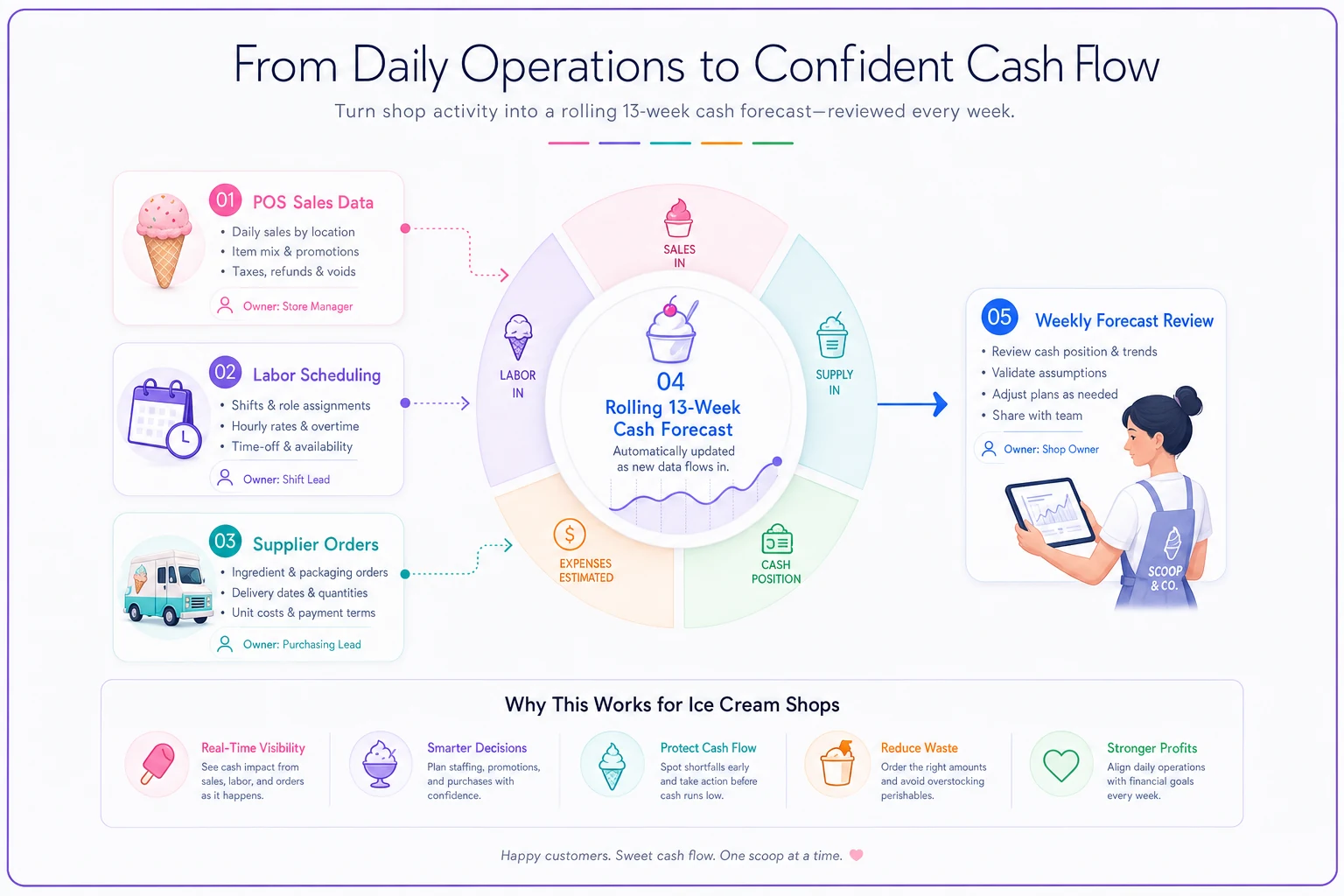
The visual helps teams see who owns each feed and where automation can reduce weekly work.
Bringing it together
Seasonal cash management isn't about predicting the future perfectly — it's about giving yourself enough runway to react while reacting is still cheap. The four pieces work as one system: the 13-week forecast shows you the timing, the seasonality buckets tell you which rules apply right now, the reserve gives you something to fall back on when the trough or a broken compressor arrives, and the capex thresholds keep you from either overspending in the fat months or nursing dying equipment into a peak-season disaster.
Run those together and February stops being the month you dread. It becomes just another bucket — one you funded back in July, on purpose, because you could see it coming.
Run those together and February stops being the month you dread. It becomes just another bucket — one you funded back in July, on purpose, because you could see it coming.
Ready to scoop up efficiency and grow your shop?
Join hundreds of ice cream shops using Cremyly to boost productivity, reduce waste, and delight customers with faster service.