

A dead compressor at 6am is not a hardware problem. It's a chain reaction. You've got maybe a few hours before soft-serve mix turns into a liability, staff arriving to a shop they can't open, a supplier who has no idea you need an emergency delivery, and an insurance policy with fine print nobody's read since the day it was signed.
Most scoop shops handle this badly, and it's not because owners are careless. It's because the response lives entirely in one person's head — usually the owner's — and that person is asleep, on vacation, or panicking along with everyone else. When the plan is "call me and I'll figure it out," the plan doesn't scale past one location and one calm day.
This is a systems piece. Not "what to do when the freezer breaks," but how prevention, detection, mitigation, and recovery connect into one workflow — and where each of those links quietly snaps as you grow. If you want the deeper mechanical maintenance side, that's covered separately in freezer-fleet operations. Here we're focused on the response machine that kicks in after something has already gone wrong.
The four stages, and why shops only build one of them
A real freezer failure response plan for an ice cream shop has four moving parts:
-
Prevention — reducing the odds a failure happens at all
-
Detection — knowing fast when it does
-
Mitigation — limiting damage in the first critical hours
-
Recovery — getting reimbursed, restocked, and reopened
What comes up again and again across small operations is that shops invest heavily in prevention — maintenance contracts, temperature logs — and then have almost nothing for the other three. They maintain the equipment beautifully and then lose $4,000 of product because nobody knew the walk-in had drifted to 18°F overnight, and nobody knew whether that loss was even claimable.
Prevention alone gives you a false sense of safety. The failures that hurt aren't the ones you saw coming. They're the ones that happened at 2am on a Saturday of a holiday weekend, when detection was slow and mitigation was improvised.
Start with a risk register, not a checklist
A checklist tells you what to do. A risk register tells you what could go wrong, how badly, and who owns it. It's the backbone everything else hangs off of, and most shops have never built one because it sounds corporate. It isn't. It's a single spreadsheet.
Keep your ice cream shop running smoothly.
Cremyly helps you manage every order, stock level, and staff shift with precision and ease.
- Real-time inventory tracking
- Order management dashboard
- Staff scheduling & shift coordination
No credit card required
Here's a stripped-down version of what a scoop shop register actually looks like:
| Risk | Likelihood | Impact if it hits | Early warning sign | Owner | First move |
|---|---|---|---|---|---|
| Compressor failure (chest freezer) | Medium | ~$800–1,500 in stock | Motor runs constantly, frost building | Shift lead | Transfer stock, log temp, call tech |
| Walk-in drift overnight | Medium | $2,000–4,000 | Morning temp reads high | Opener | Photograph gauge, isolate stock |
| Power outage >2 hrs | Low-Med | Full inventory at risk | Utility alert / storm | Owner | Activate generator or transfer plan |
| Delivery truck no-show | Medium | Weekend stockout | No confirmation by cutoff | Manager | Trigger backup supplier |
| Refrigerant leak | Low | Slow spoilage, hard to spot | Temp creep over days | Tech / lead | Shutdown + service call |
The value isn't the table itself — it's the "early warning sign" and "owner" columns. Those two turn a vague fear into an assignable task. A common version of how this goes wrong: a shop knows compressors fail, but nobody wrote down that a compressor running nonstop is the warning. Staff notice the noise, shrug, and the freezer dies three days later fully loaded.
Rank your risks by likelihood times impact. You'll usually find two or three that dominate, and those are the only ones worth building detailed SOPs around. Don't write a fifteen-page manual for a scenario that happens once a decade.
Detection is where minutes turn into thousands of dollars
The gap between "freezer failed" and "someone noticed" is the single most expensive variable in this whole system. Everything downstream — how much product you save, whether you can claim it, whether you reopen on time — depends on how fast you knew.
The detection layers worth having:
-
Physical thermometers on every unit, read and logged at open and close (baseline, non-negotiable)
-
Min/max recording thermometers so the morning opener can see if temp spiked overnight even if it recovered
-
Wireless temperature sensors that push alerts to phones — probably the single highest-ROI upgrade for any shop running real inventory overnight
-
A defined "who gets the alert and who's the backup" chain, because an alert nobody acts on is worse than no alert at all
Route alerts to a primary and a backup and test the notification chain monthly so it isn't just one silent phone.
That last point is the one shops miss. They install sensors, route everything to the owner's phone, and then the owner turns notifications off because false alarms during defrost cycles were annoying. Now the system is technically running and functionally dead. Detection is only as good as the human response chain attached to it, which is why the register assigns owners and backups to begin with.
Emergency SOPs: write them for the person having the worst day
The mistake in most emergency SOPs is that they're written by the calm, experienced owner for a reader who is also calm and experienced. In reality they get read by a 19-year-old part-timer who's alone, stressed, and watching product melt. Write for that person.
Good emergency SOPs are short, sequenced, and front-load the decisions that can't wait. Here's the structure of a freezer-down SOP that actually gets followed under pressure:
-
Confirm and timestamp. Photograph the temperature gauge or sensor reading. Note the exact time. This is both an operational and an insurance step — you'll need that timestamp later.
-
Isolate the load. Don't open the failing unit repeatedly. Every door-open dumps cold air. Decide in one move where product is going.
-
Transfer by value, not by proximity. Move the highest-cost, most-perishable stock first — mix, premium pints, anything near a freeze/thaw threshold. The freeze/thaw windows in your perishable inventory system tell you what survives a partial thaw and what has to be tossed.
-
Notify up the chain. One call or message to the shift lead or owner. Not a group discussion — one person now owns the decision.
-
Call the tech. Have the number and account details in the SOP, not in someone's contacts.
-
Log everything as you go. Times, temps, actions. This is the recovery paper trail forming in real time.
Notice the order. Documentation and isolation come before the repair call, because the repair might take hours and product decisions can't wait that long. Sequencing is the whole game with emergency SOPs — the right steps in the wrong order still lose you the inventory.
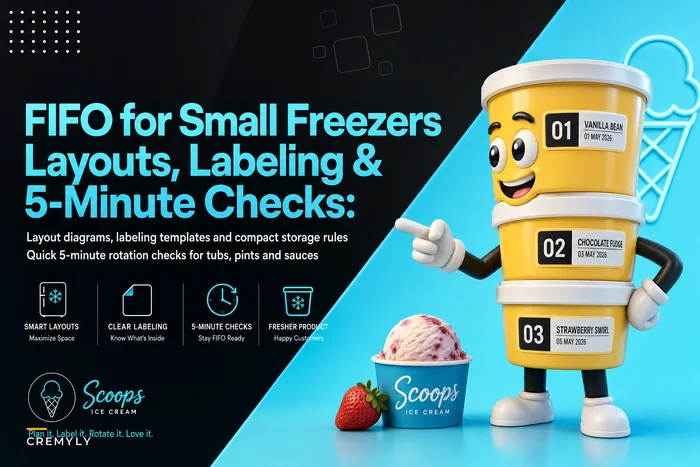
One thing worth flagging: shops that store frozen stock with clear rotation and labeling handle transfers dramatically faster, because staff can see at a glance what's high-value and how old it is. If your freezer is a chaotic pile, the person doing an emergency transfer is making value judgments blind. Clean FIFO layouts and labeling quietly double as an emergency-response asset.
The notification templates nobody prepares until it's too late
Here's a gap that shows up constantly: the shop handles the physical emergency well, saves most of the product, gets the tech out — and then loses days and money on the communication side because they're writing supplier and insurer messages from scratch while stressed.
Pre-written templates fix this. You want three sitting in a shared folder, ready to fill in the blanks.
Supplier emergency reorder template should include: your account number, the failure timestamp, exactly what you need and quantities, the delivery window you're requesting, and a fallback contact. The difference between "we need a rush order, help" and a structured request with account details is often a full day of turnaround time.
Insurer notification template should include: policy number, date and time of failure, cause if known, estimated loss value, and confirmation that you're documenting for a claim. Sending this fast matters — many policies have notification windows, and a late notice is one of the most common reasons claims get reduced or denied.
Staff and internal template covering two situations that need scripts: "we're closed today, here's the plan" and "we're open but limited, here's what to tell customers." Staff improvising customer explanations during a crisis is how you get inconsistent stories and refund chaos.
The reason to write these in advance is simple: your judgment is worst exactly when you need these messages most. Templates move the thinking to a calm day.
Claim-threshold rules: know your break-even before you're deciding it emotionally
This is the part almost no shop formalizes, and it's where money quietly leaks. When product spoils, you face a decision: file an insurance claim or absorb the loss? File too small and you burn goodwill, pay a deductible for nothing, and sometimes trigger a premium increase for a claim that netted you little. Fail to file a large one and you eat a loss you were paying premiums to cover.
Set the rule before the emergency. A workable claim-threshold framework looks like this:
-
Below your deductible never file. Absorb it. (Obvious, but shops forget their own deductible number under stress.)
-
Deductible to roughly 2x deductible case-by-case. Weigh the claim against likely premium impact. Often not worth it.
-
Above roughly 2x deductible file, and file fast. This is what the policy is for.
A concrete threshold beats a gut call every time. The pattern worth avoiding: filing a $600 claim on a $500 deductible — netting $100 and eating a premium bump — then six months later not filing a $2,800 loss because you were tired of dealing with insurance. Exactly backwards. Written rules prevent that kind of emotional whiplash.
Your register should already have rough impact estimates per risk. Cross-reference those against your deductible now, so the claim decision is basically pre-made by the time it matters.
What breaks at scale — one shop vs. three
Everything above works fine for a single owner-operated shop where the owner is reachable and knows every unit personally. It falls apart in predictable ways as you add locations.
At one location, tribal knowledge is enough. The owner knows the walk-in "runs a little warm on the left side" and mentally adjusts. At three locations, that knowledge doesn't transfer. The Tuesday-night lead at store two has no idea what "normal" looks like for that specific compressor, so drift goes unnoticed until it's a failure.
The scaling failures follow a pattern:
-
Detection fragments. Each location logs temps differently, or not at all, and there's no central view of which units are trending toward trouble.
-
Ownership blurs. With one shop, "the owner handles it" is a plan. With three, an emergency at store three hits a lead who assumes someone else was alerted. Nobody was.
-
Response quality diverges. The flagship location responds crisply because the owner spends most time there. The other stores improvise, because the SOPs never really got taught — just posted.
-
Recovery gets sloppy. Claims get filed inconsistently, some late, some not at all, because no single person owns the paper trail across sites.
This is the point where operational software earns its place — not because software is trendy, but because coordination across locations is genuinely a data problem. When temperature logs, sensor alerts, SOP checklists, and incident timestamps live in one system instead of three notebooks and a group chat, the owner can actually see store three's walk-in trending warm before it fails. AI-assisted monitoring can flag patterns like a compressor running nonstop from sensor data before a human would catch it, and route the alert to whoever's actually on shift rather than a phone that's on silent. The point isn't automation for its own sake — it's that the parts of this playbook that depend on someone remembering are exactly the parts that break at scale, and those are worth handing to a system.
A real scenario
A two-location scoop shop in a beach town, roughly $400k combined annual revenue, had a walk-in compressor fail on a Friday night in July at the busier location. It wasn't caught until the 7am Saturday opener read the gauge — around 21°F, up from a target of 0°F, for an unknown number of hours.
They lost the bulk of the walk-in stock: somewhere around $3,200 in product, on their busiest weekend. Worse, they had no timestamped documentation of when it failed, the opener had already started throwing product away before photographing anything, and nobody notified the insurer until Monday. The claim came back reduced — the insurer questioned the loss amount without dated evidence and flagged the late notice.
After that, the owner built exactly the system described here: wireless sensors on both walk-ins alerting two phones with a defined backup, a one-page freezer-down SOP laminated at each location, pre-written supplier and insurer templates, and a written claim threshold. The following summer a similar drift happened at the other location — but the sensor caught it roughly 90 minutes in, the on-shift lead transferred high-value stock, and the tech arrived before most product crossed its thaw threshold. Loss was under $500, absorbed without a claim. Same failure. Completely different outcome, and the difference was entirely in the response system, not the equipment.
When building all of this is overkill
Not every shop needs the full apparatus. If you're running one small location, one chest freezer, and a modest walk-in — and you're genuinely reachable and ten minutes away — a laminated SOP, a min/max thermometer, and pre-written templates might be enough. Wireless sensors and multi-site software would be solving a coordination problem you don't have yet.
The full system starts making sense when you can no longer personally be the detection layer. That's usually a second location, or a first location where you're often off-site, or any setup with older equipment and real overnight inventory risk. Below that threshold, build the register, write the SOPs, and don't over-engineer.
The one piece nobody should skip regardless of size: the risk register and the claim-threshold rule. Both cost nothing but an afternoon, and they're the difference between a calm response and a $3,000 lesson.
Pulling it together
Resilience isn't a device you install or a document you print. It's the connection between four stages that most shops build in isolation — you prevent what you can, detect fast what you can't prevent, mitigate damage in the first critical hours, and recover both the inventory and the money afterward.
Break any one link and the whole chain underperforms. Great maintenance with slow detection still loses the stock. Fast detection with no claim discipline still loses the reimbursement.
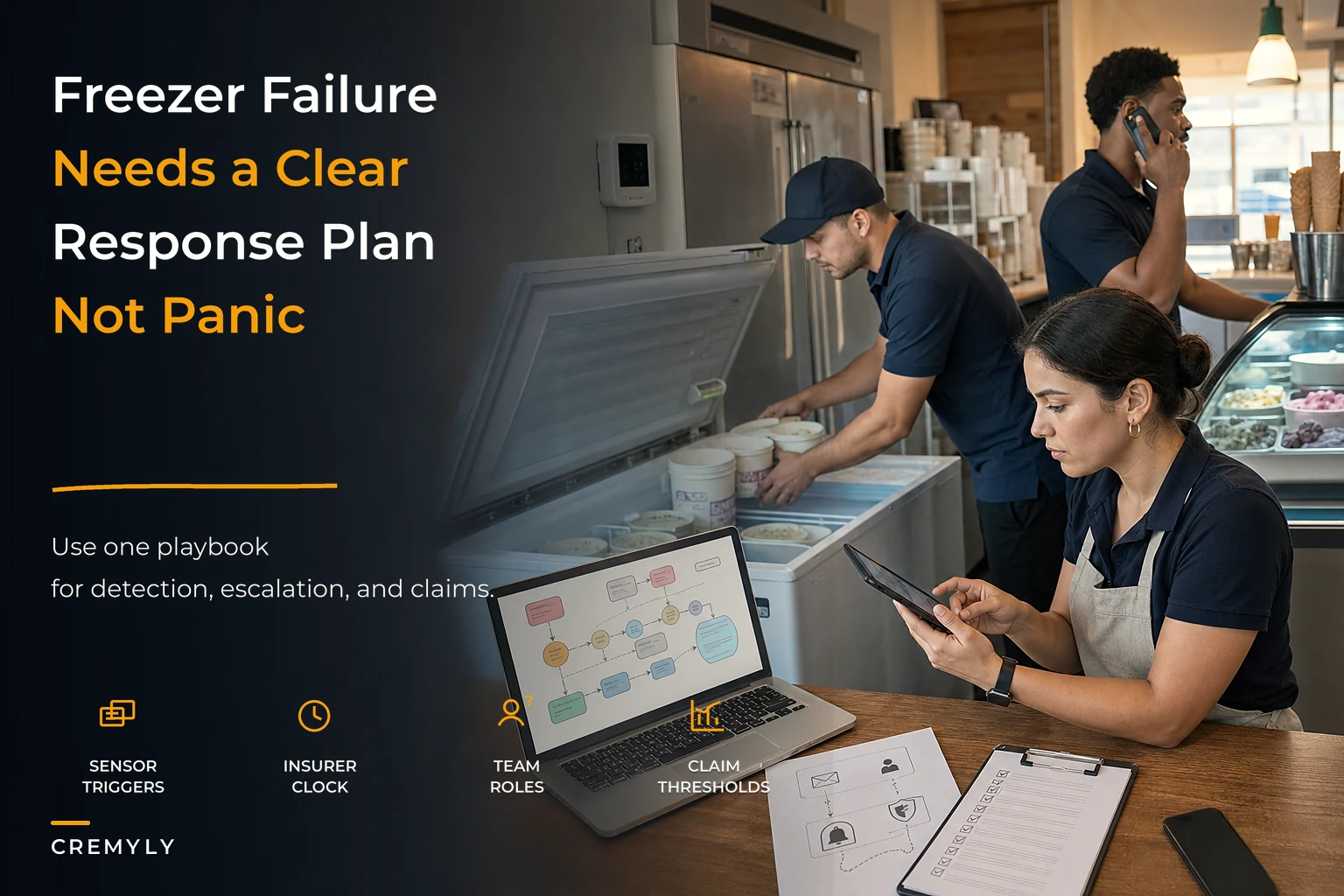
Here's a quick visual of how the four stages connect and where roles, sensors, SOPs, and insurer triggers fit.
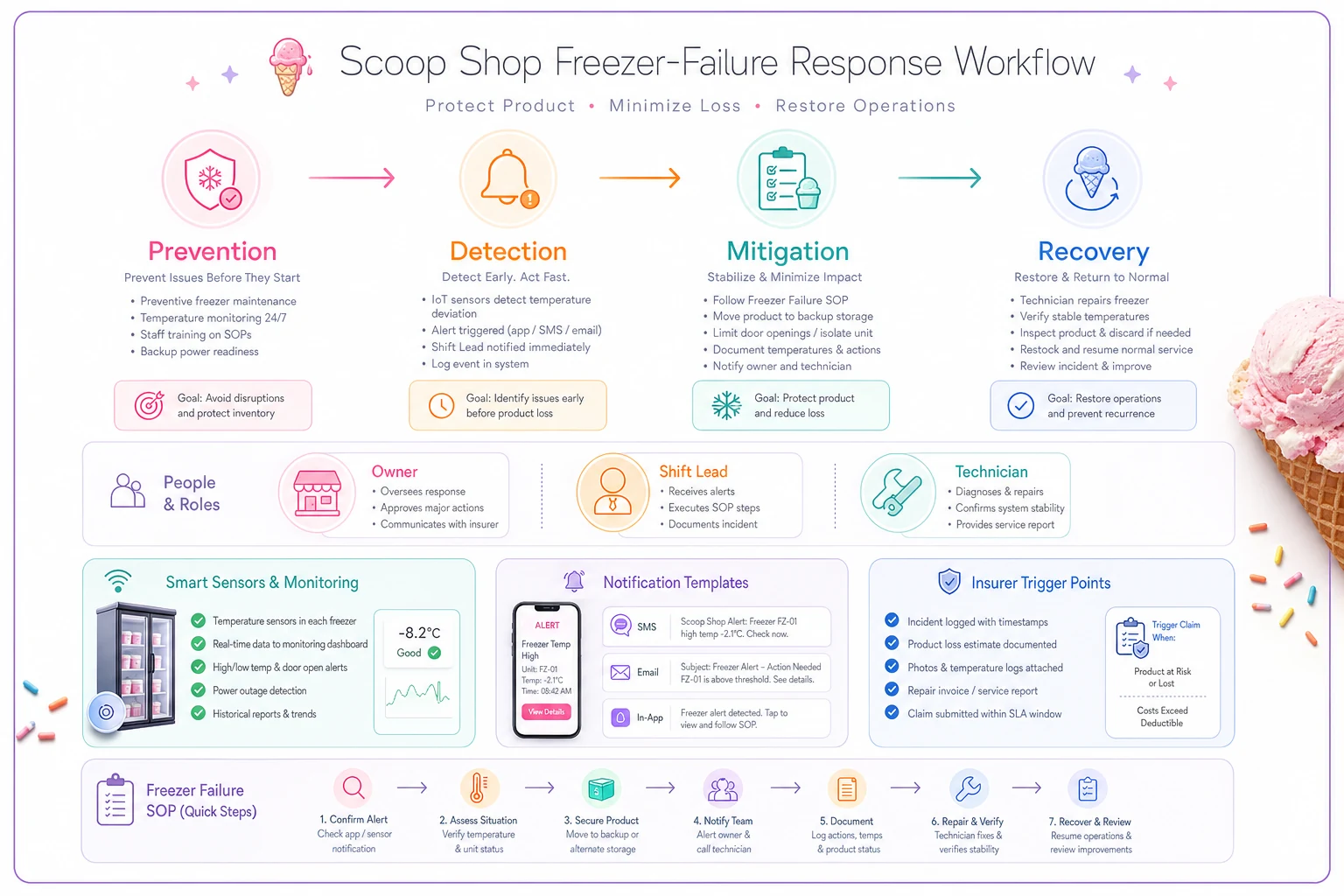
This diagram highlights where to focus first: named owners, reliable detection that works when the shop is dark, and short SOPs that get followed under pressure.
Build the register first, because it forces you to name your real risks and assign owners. Layer detection that works when the shop is dark. Write SOPs for your most anxious employee, not your calmest. Keep notification templates ready and claim thresholds decided in advance. Then, as you add locations and can't be everywhere at once, move the remembering-and-coordinating parts into a system instead of hoping tribal knowledge scales. It won't — but a well-built response machine will.
Ready to scoop up efficiency and grow your shop?
Join hundreds of ice cream shops using Cremyly to boost productivity, reduce waste, and delight customers with faster service.