


Most scoop shops don't have an accounting problem. They have a channel mixing problem that shows up looking like an accounting problem.
The pattern: your register says the shop did roughly $14k last week. Your delivery apps paid out a few days late with fees already skimmed off the top. A catering invoice went out but hasn't been paid. A grocery account bought twelve tubs at wholesale. By the time all of this hits your books, four revenue streams have been crushed into one "sales" number, fees are buried somewhere, and nobody can tell you which channel actually made money.
So you look at a P&L that says you're fine, while your best-looking channel is quietly the one bleeding you.
This is what almost nobody sets up correctly from day one: channel accounting for perishable retail isn't about being neat. It's about comparability. If you can't line up walk-in margin against delivery margin against catering margin on the same basis, every pricing and staffing decision you make is a guess with confidence attached.
Below is how the whole system should be wired, where it breaks, and the actual journal entries and reconciliation cadence that keep it honest.
Why channels refuse to stay comparable
The reason this is hard isn't the math. It's that each channel reports money to you in a different shape, at a different time, with different costs already removed.
Walk-in is the clean one. Customer pays, you get the gross, your card processor takes a cut a day or two later. Simple.
-
Third-party delivery reports a menu price that's often inflated above your in-store price, then deducts a commission (often 15–30%), a service fee, sometimes a marketing fee, and pays you net on a delay.
-
Catering and bulk often invoice at a negotiated rate, get paid on net-15 or net-30 terms, and carry labor and packaging costs that never touch your counter.
-
Wholesale/grocery accounts sell at a totally different price point with near-zero service labor but real delivery and sometimes slotting costs.
If you book all of these as "sales" and all your ingredient costs as one lump "COGS," you've thrown away the only information that matters. A dollar of delivery revenue and a dollar of walk-in revenue are not the same dollar. One of them has already lost 25 cents before it reaches you.
What you tend to see across small food operations is that the moment a second or third channel gets real volume — usually delivery apps crossing 15–20% of sales — the owner's gut instinct about margin stops matching reality. The gut was calibrated on walk-in. The books never got re-calibrated.
The core rule: gross revenue in, fees as explicit expense
The single most important accounting decision you'll make here: always record the full gross sale, then record third-party fees as a separate expense line. Never record the net payout as your revenue.
Keep your ice cream shop running smoothly.
Cremyly helps you manage every order, stock level, and staff shift with precision and ease.
- Real-time inventory tracking
- Order management dashboard
- Staff scheduling & shift coordination
No credit card required
This feels like extra work. It is extra work. It's also the only way to see what delivery apps actually cost you.
Say a customer orders $20 of ice cream through a delivery app. The app's menu shows $24 (they marked it up). They take a 25% commission on the $24, so they keep $6 and deposit $18 to you.
The lazy way: book $18 as revenue. Done.
-
Revenue (delivery)
$24
-
Third-party commission expense
$6
-
Net cash received
$18
At the end of the quarter you can look at one line and see you paid, say, roughly $3,800 in delivery commissions. That's a number you can act on. The $18-only approach hides it forever.
Same logic applies to processor fees on walk-in, platform fees on gift card resellers, and marketplace fees on any online store. Gross in. Fee out. Net is the cash result, never the reporting number.
Chart of accounts: build channel into the structure, not into memos
The failure point here is subtle. Owners try to track channels using memo fields or transaction descriptions, then wonder why no report ever splits cleanly.
Channel has to live in your account structure or your class/tag/location field — somewhere a report can actually group on. Most small-business accounting tools support either sub-accounts or "classes/tags." Pick one and commit.
Revenue
-
4000 Revenue – Walk-in
-
4010 Revenue – Delivery (3rd party)
-
4020 Revenue – Catering/Events
-
4030 Revenue – Wholesale/B2B
-
4040 Revenue – Gift card redemption
Cost of Goods Sold
-
5000 COGS – Base product (allocated)
-
5010 COGS – Packaging (channel-specific)
Channel Costs (below COGS, above overhead)
-
5100 Delivery commissions & fees
-
5110 Card processing fees
-
5120 Catering labor (direct)
-
5130 Wholesale delivery/freight
The reason to split channel costs into their own band — below COGS but above rent and general overhead — is that it gives you a channel contribution margin. Revenue minus product COGS minus the costs that only exist because that channel exists. That's the number that tells you whether a channel is pulling its weight.
If you've already got tax and inventory structure questions floating around, it's worth reading our breakdown on avoiding tax and inventory mistakes for seasonal perishable retailers before you lock in your chart of accounts — some of these decisions interact with how you value end-of-season inventory.
COGS allocation when one batch feeds every channel
This is where perishable retail gets genuinely tricky and where most templates you'll find online fall apart. You make a batch of ice cream once. That same batch gets scooped at the counter, packed into pints for the app, and portioned into tubs for a catering gig. One cost pool, four destinations.
You can't realistically cost every scoop individually. What you can do is allocate the base product cost by channel using portion yields, then layer channel-specific packaging on top.
-
Establish your base cost per standard portion (per scoop, or per ounce). If a 3-gallon tub costs you about $38 and yields roughly 64 four-ounce scoops, your base cost is around $0.59 per scoop. Keep it simple and consistent.
-
Pull units sold by channel from your POS and order records.
-
Multiply units × base cost per unit = base COGS by channel. That's your 5000 allocation.
-
Add packaging COGS by channel separately. Walk-in cup and spoon might be $0.12. A delivery pint with lid, sleeve, and insulated bag might run closer to $0.95. Catering tubs and serving supplies more still.
The insight most owners miss: packaging is often where channel margin quietly dies. The base product cost is nearly identical across channels, but a delivery order can carry 6–8x the packaging cost of a walk-in scoop. If packaging is buried in one lump "supplies" expense, you'll never see that the app order with the free-delivery promo actually lost money on packaging alone.
A quick comparison of how the same $5 scoop performs across channels:
| Line | Walk-in | Delivery app | Catering (per portion) |
|---|---|---|---|
| Gross price | $5.00 | $6.00 (marked up) | $4.00 (negotiated) |
| Base product COGS | $0.59 | $0.59 | $0.59 |
| Packaging COGS | $0.12 | $0.95 | $0.40 |
| Channel fees | ~$0.15 (card) | ~$1.50 (25% comm.) | ~$0.00 |
| Direct labor (catering) | — | — | ~$0.55 |
| Contribution | ~$4.14 | ~$2.96 | ~$2.46 |
The channel that looks best by gross price (delivery at $6) is middle of the pack on contribution. Walk-in at $5 throws off the most margin per portion. Without channel-level allocation, you'd never see that — and you'd probably over-invest in the wrong one.
Sample journal entries
1. Walk-in daily sales (summary), card + cash
Dr Cash 1,180.00 Dr Card processing fees (5110) 36.00 Cr Revenue – Walk-in (4000) 1,216.00
(Gross sales $1,216; processor took ~3%; net cash deposited $1,180.)
2. Delivery app weekly payout
Dr Cash 2,250.00 Dr Delivery commissions (5100) 900.00 Cr Revenue – Delivery (4010) 3,150.00
(App reported $3,150 gross, kept $900 in commissions/fees, deposited $2,250. The gross hits revenue, not the payout.)
3. Catering invoice issued (accrual, net-15)
Dr Accounts Receivable 640.00 Cr Revenue – Catering (4020) 640.00
4. Catering direct costs for that event
Dr COGS – Base product (5000) 95.00 Dr Packaging (5010) 64.00 Dr Catering labor – direct (5120) 88.00 Cr Inventory / Wages payable 247.00
5. Catering payment received
Dr Cash 640.00 Cr Accounts Receivable 640.00
6. Gift card redemption (not a new sale — liability drawdown)
Dr Gift card liability 45.00 Cr Revenue – Gift card redemption (4040) 45.00
This one trips people up constantly. Selling a gift card is a liability, not revenue. Revenue only happens on redemption. Booking the sale as revenue inflates your top line and understates a liability you legally owe.
The catering flow above matters more than it looks, because events pull product and labor away from your counter. If you're running meaningful event volume, the operational side of protecting walk-in service is covered in our piece on managing catering and bulk orders without disrupting walk-in service — the accounting here is just the ledger version of those same reserve decisions.
The reconciliation cadence that keeps the P&L trustworthy
Accounting rules only hold if someone checks them on a rhythm. The breakdown in most shops isn't that they lack rules — it's that reconciliation happens monthly (or never), by which point you can't remember which deposit was which, and the delivery app statement is a wall of line items nobody will ever decode.
For perishable retail with multiple channels, monthly is too slow. The right cadence is weekly reconciliation, with a tight daily touch on cash.
The weekly loop runs like this:
-
Pull POS sales by channel for the week — walk-in, in-app online orders, catering tickets, wholesale.
-
Pull each payout statement
card processor, every delivery app, any marketplace.
-
Match gross-to-net per channel. Does POS gross minus reported fees equal the deposit? Flag anything off by more than a few dollars.
-
Confirm fee rates match what your contract says. Apps change fees and "promotional" deductions quietly.
-
Verify COGS allocation ran against the week's unit counts.
-
Check AR for catering and wholesale invoices aging past terms.
-
Lock the week. No backdating after lock except with a documented adjusting entry.
The daily touch is lighter — just reconcile the drawer and confirm the card batch settled. That's it.
A quick checklist you can tape by the office computer:
-
[ ] POS gross by channel pulled
-
[ ] Every payout statement downloaded
-
[ ] Gross-to-net matched per channel, variances flagged
-
[ ] Fee percentages match contract
-
[ ] Gift card liability moved only on redemption
-
[ ] Packaging booked to the right channel
-
[ ] Catering/wholesale AR aging reviewed
-
[ ] Week locked
If you want the P&L side of this to be fast and repeatable, our one-page weekly P&L drill template pairs directly with this reconciliation loop — reconcile first, then run the P&L against clean numbers.
Here's a simple visual of the weekly reconciliation workflow.
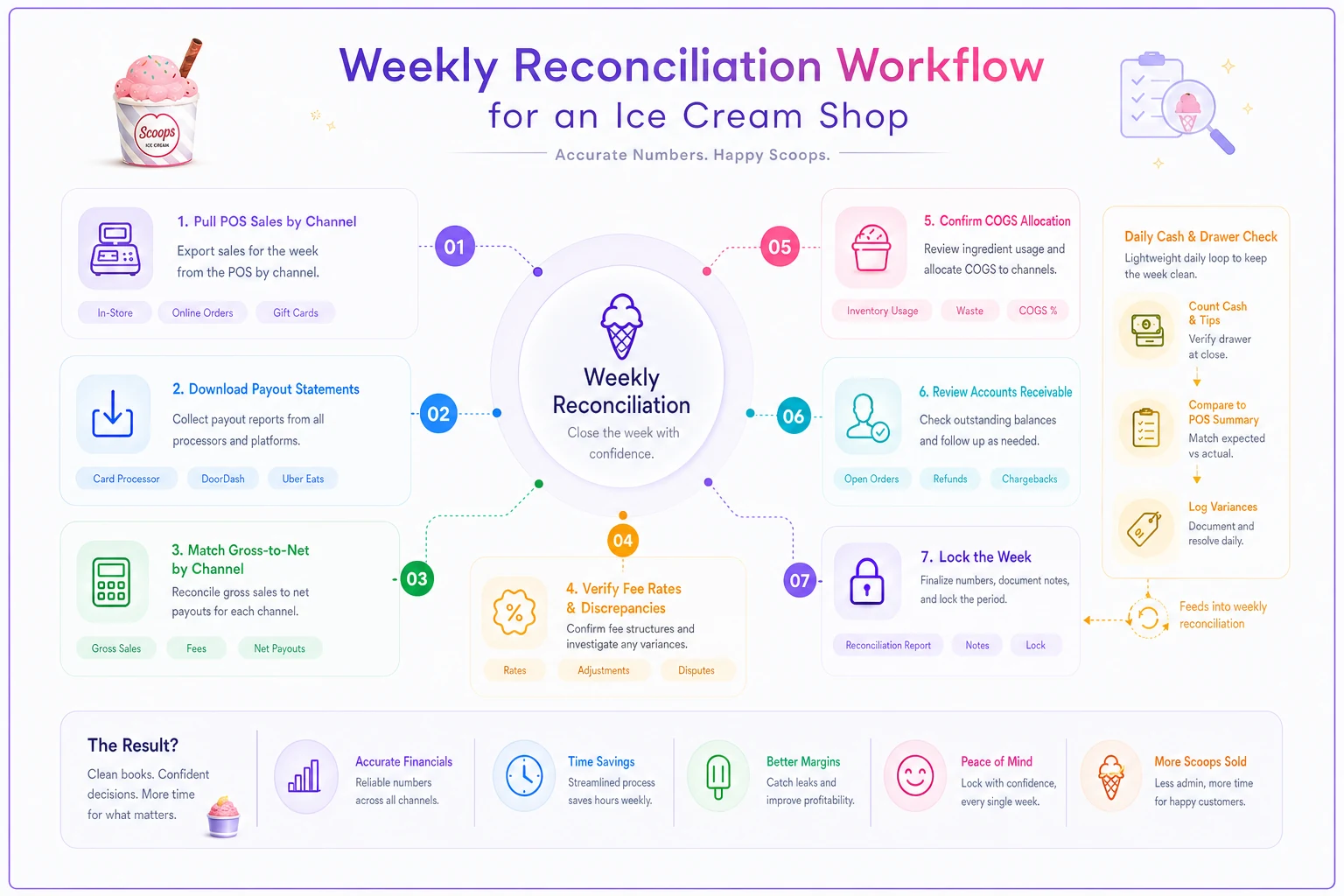
Use a compact checklist next to the computer so the loop can be completed in 20–30 minutes each week when volumes are modest.
A simple reconciliation template
You can run this in a spreadsheet. One tab per week, one row per channel.
| Channel | POS gross | Reported fees | Expected net | Actual deposit | Variance | Notes |
|---|---|---|---|---|---|---|
| Walk-in | 6,420 | 193 | 6,227 | 6,227 | 0 | matched |
| Delivery A | 3,150 | 900 | 2,250 | 2,250 | 0 | matched |
| Delivery B | 1,480 | 460 | 1,020 | 988 | (32) | mktg fee — check |
| Catering | 640 | 0 | 640 | 0 | (640) | AR net-15, not due |
| Wholesale | 912 | 45 | 867 | 867 | 0 | freight incl. |
The variance column is the whole point. A clean week is all zeros except for AR you expect. The $32 on Delivery B is exactly the kind of quiet "marketing fee" deduction that, across a year, becomes real money you never agreed to. Catching it weekly means you can question it while the statement is still fresh.
A real scenario
A single-location shop was running walk-in plus two delivery apps plus occasional catering. On paper, blended food cost looked fine — sitting around 28%, which for scoop is reasonable. The owner assumed delivery was free growth.
When they finally split the books by channel, the picture shifted. Walk-in was throwing off strong contribution. Delivery, after commissions averaging around 24% and heavier packaging, was contributing only about half what walk-in did per dollar. On the lower-ticket app orders with free-delivery promos, some items were basically breakeven or slightly negative after packaging.
Nothing exotic happened next. They pulled four low-margin items off the delivery menus, raised delivery menu prices modestly (which, because of the app's own markup, didn't scare off orders), and started booking fees to their own line so they could watch them. Within a couple of months the delivery channel's contribution improved meaningfully — not a dramatic turnaround, just the difference between a channel that drained margin and one that paid for itself. The real win was that they finally knew which channel to grow.
When this level of rigor is worth it — and when it isn't
When it makes sense: the moment you have more than one real channel and any of them carries different fees or packaging. If delivery, catering, or wholesale combined are more than roughly 10–15% of sales, you need channel-level books. Full stop.
When it's overkill: a pure walk-in shop with a single card processor doesn't need five revenue accounts. One revenue line and a processing-fee line is plenty. Don't build a chart of accounts for channels you don't have.
Who should not do this: if you're pre-launch or your delivery volume is a handful of orders a month, skip the elaborate allocation. Book gross, book the fee, move on. The complexity only earns its keep when the volume is real enough that a wrong channel decision costs you more than the bookkeeping time.
The mistake in both directions is the same: treating all channels as one when they're genuinely different, or building elaborate channel accounting for channels that are still a rounding error.
Bringing it together
Channel accounting for perishable retail comes down to three disciplines that reinforce each other. Record gross revenue and break out every third-party fee so costs stay visible. Allocate your single product cost pool across channels by portion yield, then layer channel-specific packaging on top so you can see where margin actually lives. And reconcile weekly — gross-to-net, channel by channel — so the numbers you make decisions on are the real ones, not a late, blended guess.
Do those three things and your weekly P&L stops being a vague scoreboard and becomes something you can actually steer by. You'll know which channel to feed, which items to pull off the apps, and which "growth" is really just margin leaking out the back door in packaging and commissions you never booked.
The shops that struggle aren't usually the ones with thin margins. They're the ones who can't see where the margin went. Channel-level books are how you get your eyes back.
Ready to scoop up efficiency and grow your shop?
Join hundreds of ice cream shops using Cremyly to boost productivity, reduce waste, and delight customers with faster service.