

Most single-shop owners don't think they have a governance problem. They think they have a "my staff keeps making weird calls when I'm not there" problem, or a "nobody wrote down why we changed the sample size" problem, or a "the closing shift compped four sundaes and I have no idea why" problem.
Those are all the same problem. It's the absence of a decision structure. When there's no clear line about who can decide what — and what has to wait for you — every small judgment call becomes either a bottleneck (staff freezes and texts you) or a leak (staff guesses and you find out later). Neither is good, and both compound the busier you get.
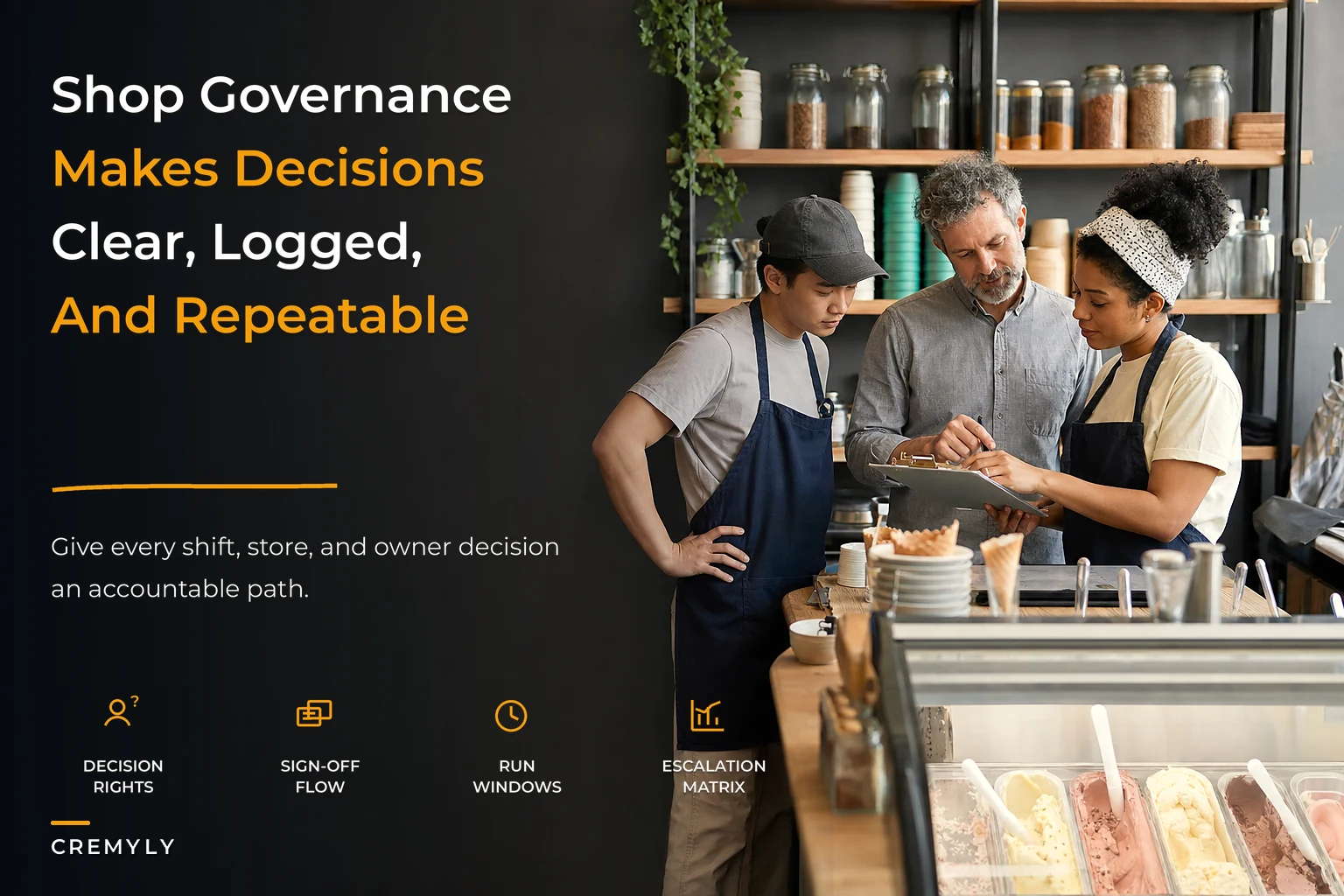
This is where a real shop governance system for an ice cream shop earns its keep. Not a binder of rules nobody reads. A tiered map of authority, a few data contracts so numbers mean the same thing to everyone, and a sign-off flow for the changes that actually matter. Built the way it works in a small shop, not the way it looks in a corporate org chart.
Why decision authority breaks in a single shop first
Governance tends to be worse in a one-location shop than in a small chain. In a chain, the owner is forced to delegate because they physically can't be everywhere, so authority gets written down. In a single shop, the owner is usually on the floor, so everything routes back to them by default. That works fine until it doesn't.
What breaks it is time. You take a two-week vacation. You're stuck on a supplier call during a Saturday rush. You hire a second shift manager and suddenly two people are making conflicting calls about the same thing. The moment your presence stops being the governance system, you discover you never actually had one.
A typical example: a shift manager decides mid-rush to stop offering samples because the line is long. Reasonable call in the moment. But nobody told the owner, sample conversion drops that weekend, and Monday's numbers look off with no explanation. There was no rule that said stopping samples is a shift-level decision that gets logged versus an owner-level decision that needs approval. So it just happened, invisibly.
The core insight here isn't about control. It's about making decisions visible and repeatable so you can tell the difference between a good call and a lucky one.
The three-tier map: shift, store, owner
The cleanest structure for a small scoop shop is three tiers. Each tier owns a defined set of decisions, has a spending or impact ceiling, and knows when to hand something up.
Keep your ice cream shop running smoothly.
Cremyly helps you manage every order, stock level, and staff shift with precision and ease.
- Real-time inventory tracking
- Order management dashboard
- Staff scheduling & shift coordination
No credit card required
| Tier | Owns these decisions | Impact ceiling | Must escalate when… |
|---|---|---|---|
| Shift (scoopers, shift lead) | Portion corrections, single-customer comps, sample cadence during rush, temporary station changes, calling in an on-call staffer | ~$25 per incident, resolvable within the shift | A comp exceeds the ceiling, equipment shows a temp fault, a customer threatens escalation, or two shifts disagree |
| Store (manager) | Weekly schedule, local promo execution, reorder within set points, small menu tweaks, discipline write-ups, approving shift comps above ceiling | Anything within approved budget and existing SOPs | A change alters margins, breaks an SOP, commits spend beyond budget, or affects a supplier contract |
| Owner | Pricing, new flavors/menu changes, supplier contracts, capital spend, hiring/firing managers, anything that changes the P&L structure | No ceiling | External events (legal, health inspector, media, insurance) — these skip straight up |
The ceiling column isn't meant to be rigid. It gives a scooper permission to act on the small stuff without texting you, and permission to stop on the big stuff without feeling like they're being difficult. Most staff anxiety on a shift comes from not knowing which of those two they're allowed to do.
One thing worth naming: the dangerous decisions are almost never the big ones. Nobody accidentally signs a supplier contract. What leaks money is the accumulation of small shift-level calls — comps, over-portioning "to be nice," discarding product early — that no single person feels responsible for. The shift tier needs the tightest logging, not the loosest.
Data contracts: making numbers mean one thing
Here's a quiet killer in small shops: two people look at the same number and mean different things. "Waste" to a scooper means the pint that hit the floor. "Waste" to you means melt, over-portioning, comps, spoilage, and the floor pint combined. When your manager reports "waste was low this week," you have no idea what they actually counted.
A data contract fixes this. It's a short, boring definition of what a metric is, who enters it, when, and where. Nothing fancy — but writing it down forces agreement. If you've already built out something like a unified KPI architecture, data contracts are the layer that keeps those KPIs from silently drifting over time.
A data contract only needs six lines:
-
Metric name e.g., Shift Waste
-
Definition exactly what's included and excluded (discarded product in oz, including melt and floor loss; excludes comps, which are tracked separately)
-
Owner who is responsible for the number being correct (closing shift lead)
-
Source where it comes from (waste log + POS comp report)
-
Cadence when it's captured (end of every shift)
-
Tolerance what counts as normal vs. a flag (over 3% of product moved = flag to store tier)
Define them cold, when nothing's on fire.
Write one of these for every number that shows up in a decision. Waste. Comps. Sample count. Labor as a percent of sales. Cash variance. It takes an afternoon. The payoff is that when your manager says "comps were high Tuesday," everyone already agrees on what "comps" and "high" mean, and the conversation is about why instead of what are we even measuring.
The mistake most people make here is defining metrics after a dispute. By then everyone's defensive and the definition feels like an accusation. Define them cold, when nothing's on fire.
The experiment sign-off flow
Scoop shops run experiments constantly, even when they don't call them that. New flavor. New portion size. Changed sample script. Shorter Sunday hours. The problem isn't running experiments — it's running them without any record, so you can't tell what worked or roll it back cleanly.
A sign-off flow keeps experiments accountable without making them bureaucratic. Five steps is plenty for a single shop:
-
Proposal (one paragraph). What we're changing, why, and what we expect to happen. Written by whoever's proposing it — a manager, or even a scooper with an idea.
-
Tier check. Does this change something the proposer's tier can't own? A new sample script is store-tier. A price change is owner-tier. This routes the sign-off.
-
Metric commitment. Which existing data-contract metric will tell us if this worked, and what's the threshold to keep it? "Sample conversion up 2 points over two weekends" is a commitment. "See if people like it" is not.
-
Run window + stop rule. Fixed end date, plus a condition that kills it early (e.g., waste jumps above tolerance).
-
Review + sign-off. At the window's end, the owning tier signs it to keep, kill, or extend — and that decision gets logged.
A quick visual of the sign-off flow:
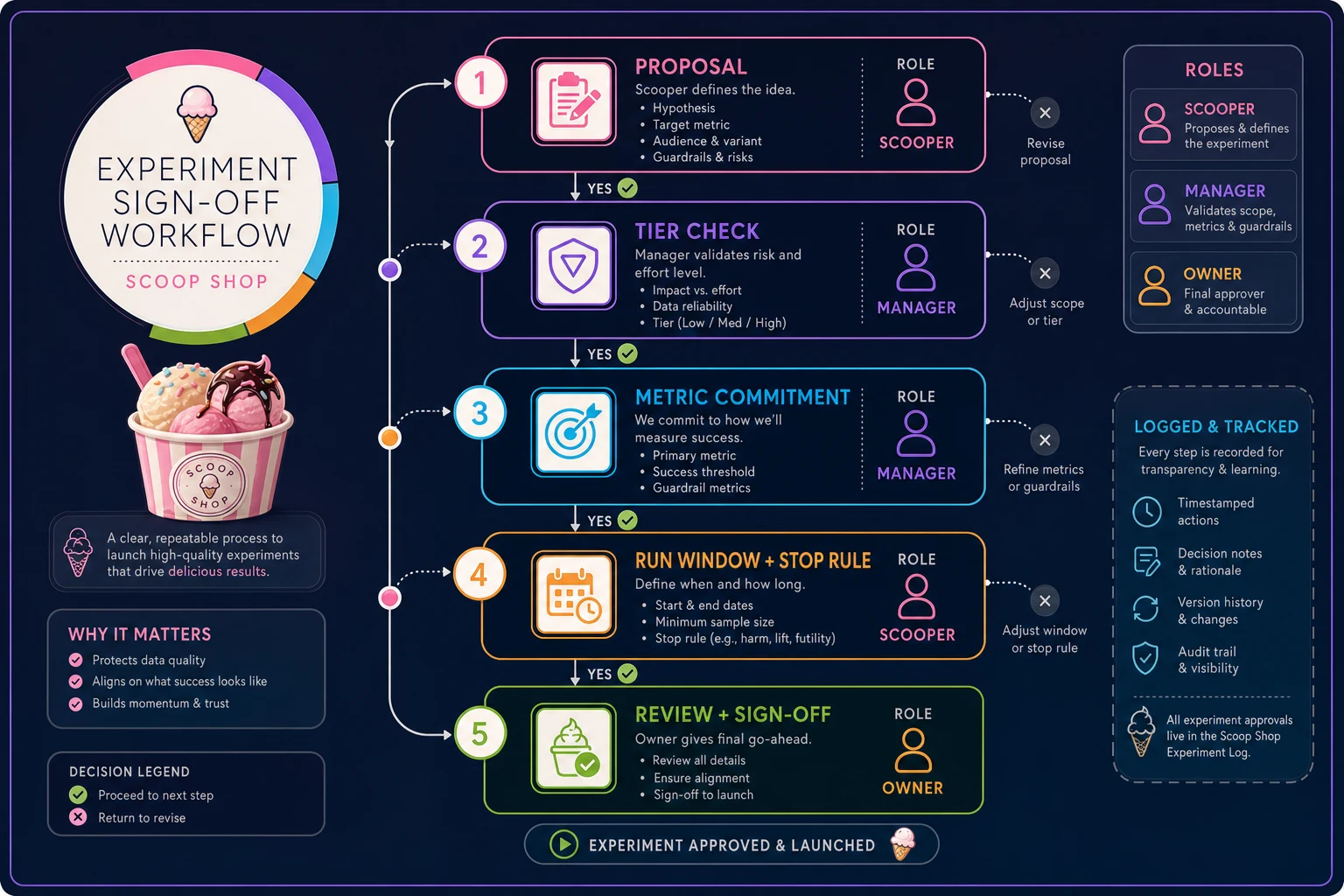
The sign-off signature matters more than it sounds. It creates a moment where someone consciously decides "we're keeping this," instead of experiments quietly becoming permanent through inertia. Most bad menu bloat and weird operational habits are just old experiments nobody ever formally ended.
Most bad menu bloat and weird operational habits are just old experiments nobody ever formally ended.
Worked sign-off example
-
Proposal "Rush lines are backing up at the sample station. Pre-portioning 20 sample cups of the two featured flavors before the Saturday 1–4pm peak should speed throughput."
-
Tier check Sample cadence and station setup are store-tier during a defined window. Manager can own it. ✅
-
Metric commitment Sample-to-cone conversion (per data contract) plus sample waste in oz. Keep if conversion holds within 1 point and average line wait drops noticeably.
-
Run window + stop rule Two Saturdays. Kill early if sample waste exceeds tolerance (pre-portioned cups melting unused).
-
Review After two weekends, conversion held around 14%, wait times dropped, but pre-portioned waste ran about 8% higher than the on-request model. Manager signs it to keep, modified — pre-portion 12 cups instead of 20 and top up as needed.
That last line is the whole point. Without the flow, this becomes "we tried trays, seemed fine, kept doing it" and the 8% waste bleeds forever. With it, you got a documented decision and a correction in one pass. This connects directly to how you align inventory, scheduling and daily P&L — governance is what keeps those alignments from silently coming undone.
The escalation matrix
Escalation is the part everyone skips, and it's the part that saves you at 8pm on a Saturday. The question an escalation matrix answers is simple: when something goes off-script, who gets contacted, how fast, and what's the fallback if they don't answer?
Here's a working matrix tuned for a single scoop shop:
| Situation | First responder | Escalate to | Timeframe | Fallback if unreachable |
|---|---|---|---|---|
| Comp request above shift ceiling | Shift lead | Store manager | Before customer leaves | Approve up to 1.5x ceiling, log with reason |
| Freezer temp alarm / fault | Shift lead | Store manager → owner | Immediate | Follow freezer-fault SOP, move product |
| Cash drawer variance > tolerance | Shift lead | Store manager | End of shift | Lock drawer, document, no recount alone |
| Angry customer, refund disputed | Shift lead | Store manager | During incident | Full refund + note, never argue publicly |
| Health inspector arrives | Any staff | Owner directly | Immediate | Cooperate, log everything, call owner |
| Two shift leads disagree on a call | Either lead | Store manager | Same shift | Defer to written SOP, escalate after |
| No-show + understaffed rush | Shift lead | Store manager | Within 15 min | Call on-call list, cut non-essential tasks |
Two things make an escalation matrix actually work. First, every row has a fallback, because the person you're escalating to won't always pick up. A matrix that dead-ends when the manager's phone is off isn't a matrix, it's a wish. Second, it lives where the shift can see it — laminated by the POS, not buried in a shared drive nobody opens mid-rush.
Something worth noting: shops that build escalation matrices usually discover their real problem was never the emergencies. It was the ambiguity around ordinary events — a normal comp, a normal disagreement — that had no defined path. The dramatic rows (inspector, freezer failure) are the ones people already handle okay because the stakes are obvious. It's the mundane rows that were quietly costing money.
When this level of structure actually makes sense
You don't need all of this on day one with two employees and yourself always on the floor. The trigger points are pretty specific:
-
You've hired a manager or second shift lead. The moment two people can make decisions in your absence, you need tiers.
-
You're planning time away. A week off exposes every undocumented decision instantly.
-
You caught a leak you couldn't explain. Unexplained comps, waste, or cash variance means decisions are happening invisibly.
-
You're thinking about a second location. Governance you can't articulate can't be replicated.
If you're a true solo operator working every shift and not scaling, a full three-tier map is overkill. Write the data contracts anyway — they're useful at any size — but skip the elaborate escalation matrix until you have people to escalate to.
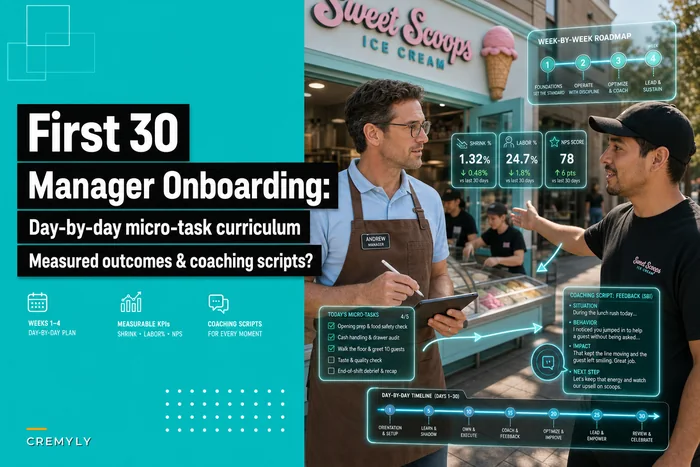
One thing to be careful about: owners who use governance as a substitute for training. Structure doesn't replace judgment; it channels it. If your escalation matrix exists so you never have to teach a scooper how to think, you've built a cage, not a system. The best-run shops pair tiers with real coaching — the kind of hands-on development covered in a proper manager onboarding curriculum — so people grow into their tier instead of just obeying it.
A real scenario
A single-location shop running somewhere between $18k and $22k in monthly summer revenue had a recurring mystery: waste and comps together were hovering around 6–7% of product, but the owner couldn't pin down where. Everything looked fine when he was on the floor.
He built the basics — a shift-tier comp ceiling of $20 with mandatory logging, a two-line data contract separating waste from comps, and a laminated escalation card by the register. No software at first, just paper.
Within the first month, the logs told the story. A specific closing shift was comping heavily to clear product before close "so it doesn't go to waste," which meant product showed up as comps and still counted as loss when portions went unused anyway. It wasn't theft. It was a well-meaning habit nobody had authority to question. Combined waste-plus-comps dropped to around 4% once that closing routine got an actual rule and a stop point. The dollar impact was modest — a few hundred a month — but the real win was that the number was finally explainable.
Once the paper version proved out, moving the logs into a shared operations tool made the pattern-spotting near-instant instead of a month later. That's the natural progression: the system earns its structure on paper first, then software just makes it faster to see.
Bringing it together
A governance system isn't about turning your scoop shop into a corporation. It's about making sure that when you're not standing at the counter, the shop still makes decisions the way you would — and when it doesn't, you find out fast enough to fix it.
The three tiers tell people what they can own. The data contracts make sure everyone's working from the same numbers. The sign-off flow keeps experiments honest and reversible. The escalation matrix removes the panic from the moments that count. None of it is complicated. It's mostly just deciding these things before you need them, instead of reconstructing them from a confusing set of Monday-morning totals.
Start with the tier map and one data contract. Add the rest as your shop earns the complexity. The goal isn't a thicker binder — it's a shop that runs the same whether you're behind the counter or on a beach three time zones away.
Ready to scoop up efficiency and grow your shop?
Join hundreds of ice cream shops using Cremyly to boost productivity, reduce waste, and delight customers with faster service.