

The freezer doesn't know which channel a customer came through. Neither does the dipping cabinet, the two scoopers behind the counter, or the pint of brown butter pecan that three different people just claimed in the same ten minutes. That's the whole problem in one sentence. Every channel pulls from the same physical inventory and the same pair of hands, but each one arrives through a different door, at a different pace, with different expectations about speed.
When a scoop shop is just walk-in, operations are simple — one queue, one rule: serve the next person. The margin bleed starts the moment you add a second and third way for product to leave the building. A DoorDash order fires mid-rush. A catering pickup is scheduled for 2pm but the kitchen forgot to pull the quart tubs. Someone orders six pints online for same-day pickup and nobody reserved them, so by the time they arrive you're out of two flavors and improvising refunds.
None of these are dramatic failures. They're small, quiet leaks — a comped order here, a 15-minute counter jam there, a flavor sold twice. Added up across a season they're the difference between a shop that nets what it should and one that wonders where the money went. This is an orchestration problem, not a staffing problem, and the fix is a single framework that tells every channel how to behave around shared resources.
Why channels collide (and why it gets worse as you grow)
The collision point is almost always the same: shared inventory and shared labor, consumed by channels that don't see each other.
Walk-in traffic is unpredictable but forgiving — people expect to wait a little on a hot Saturday. Delivery is impatient and invisible; the courier is already on the way before your counter even knows the ticket exists. Catering is the opposite — scheduled days ahead, high-volume, and completely unforgiving if you under-prep. Pickup pints sit somewhere in between, promising availability you haven't actually guaranteed.
Each channel optimizes for itself. Delivery platforms want you to accept every order. Catering clients want their full quote honored. Walk-in customers want the flavor on the menu board to actually be there. And your counter staff, with no visibility into what's committed elsewhere, just serves whoever is physically in front of them. That last part is the killer — physical presence beats digital commitment every time unless you build a rule that says otherwise.
What breaks at scale is predictability. At one channel you can hold the whole operation in your head. At three or four channels during peak season, the number of possible conflicts grows faster than anyone can track manually. A typical example: a shop running walk-in, Uber Eats, and weekend catering hits a Saturday where a 40-scoop catering pull, a lunchtime delivery spike, and a street festival all land in the same afternoon. No single order was unreasonable. The combination was never reserved against, and the shop spent the day telling people they'd just run out.
The orchestration map: who gets what, when, and from where
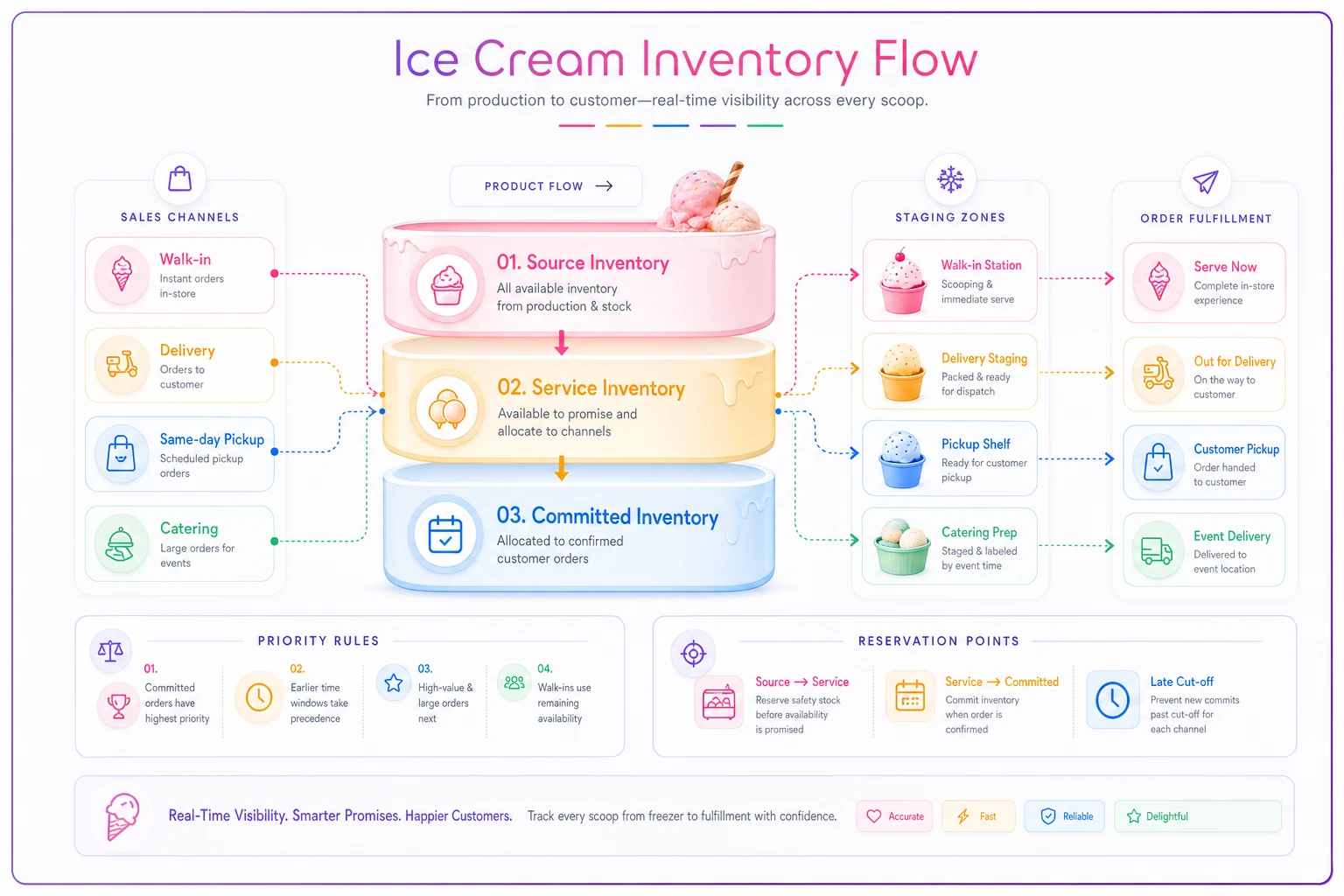
Layer 1 — Source inventory. The backup freezer. Your true stock. Nothing is promised here; it's just what exists.
Keep your ice cream shop running smoothly.
Cremyly helps you manage every order, stock level, and staff shift with precision and ease.
- Real-time inventory tracking
- Order management dashboard
- Staff scheduling & shift coordination
No credit card required
Layer 2 — Service inventory. The dipping cabinet and the front-of-house tubs. What's physically available to serve right now. This is the contested zone.
Layer 3 — Committed inventory. Product reserved against a specific future order — the catering pull, the scheduled pickup, the pints packed and waiting. This should be physically separated whenever possible.
Here's a simple visual of how the layers and channels interact.
| Channel | Draws from | Reservation timing | Priority when scarce |
|---|---|---|---|
| Walk-in | Service inventory only | None (real-time) | Default, unless flavor is flagged |
| Delivery (3rd-party) | Service inventory | At order acceptance | Below walk-in during rush windows |
| Same-day pickup pints | Committed inventory | At order placement | Protected once confirmed |
| Catering / bulk | Committed inventory (pulled from source) | At quote confirmation | Highest — prepped off the floor |
The single most important line in that table: catering and confirmed pickups never compete with the dipping cabinet. They get pulled from source inventory into a staging zone before service starts, so they're invisible to the counter rush. The moment a catering order shares a tub with walk-in traffic, you've lost control of it.
Reservation rules: making a digital promise physical
A reservation is worthless if it only lives in software and not on the shelf. The gap between "the system says we have it" and "the tub is actually full" is where most same-day pickup disasters happen.
-
1. Reserve at commitment, not at fulfillment. When a same-day pickup order comes in for 3 pints of cookie dough, that quantity comes out of available inventory immediately — not when the customer walks in. Otherwise you'll sell the same three pints to the counter in the meantime.
-
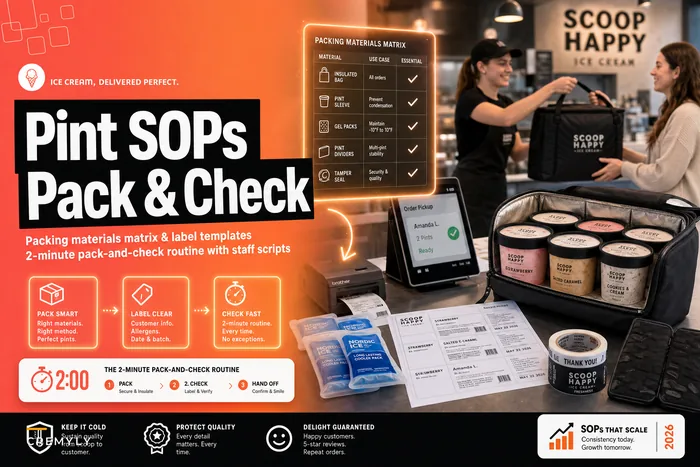
2. Physically stage anything confirmed more than an hour out. If someone's picking up at 5pm, pack and label those pints during a slow window and move them out of the active freezer. A reserved pint still sitting in the service cabinet is a pint that will get scooped. The take-home pint packing routine matters here specifically because the pack-and-check step is what converts a soft reservation into a hard one.
-
3. Set a hard cutoff for delivery acceptance per flavor. When service inventory of a flavor drops below a threshold — say two scoops' worth of buffer — delivery availability for that flavor turns off. Walk-in gets the last of it. This single rule prevents the most common delivery failure: accepting an order for a flavor that's gone by the time you make it.
A reserved pint still sitting in the service cabinet is a pint that will get scooped.
The mistake shops make is treating reservations as a courtesy ("we'll try to have it ready") instead of a lock. A reservation that can be overridden by whoever's standing at the counter isn't a reservation — it's a hope.
Inventory reservation recipes
Catering reserve recipe. Confirmed catering quantity plus a 10% buffer, pulled from source into staging the morning of. For a 40-scoop event: pull roughly 44 scoops equivalent — about three 3-gallon tubs depending on your portions — stage separately, and log it as committed so your available count drops. The buffer covers portioning variance and the inevitable "can we add a flavor" call an hour before pickup.
Same-day pickup pint reserve. Order quantity reserved at placement, with a flavor-level check that blocks the order if it would drop walk-in buffer below your floor. If someone wants 6 pints of a flavor and you only have 8 scoops' worth left, the system should decline rather than cannibalize the counter.
Delivery dynamic reserve. No pre-reservation here, but a live floor. Each flavor carries a minimum service-inventory threshold; drop below it and that flavor goes unavailable on delivery platforms. This is hard to execute manually during a rush — which is exactly why it's the first thing worth automating. A platform that watches service counts and toggles flavor availability across delivery channels removes the one judgment call your staff genuinely can't make while slammed.
Counter choreography: the dance that keeps channels from stepping on each other
Inventory rules decide what's available. Choreography decides who does what, when, so the physical work of multiple channels doesn't jam up the single counter.
The core pattern is separation by motion, not just by task. A scooper serving a walk-in line and also assembling a delivery bag between customers creates a stop-start rhythm that slows both. Even in a two-person shop, you want roles that can flex but default to lanes:
-
Primary server owns the walk-in queue and doesn't leave it during a rush. Their only job is forward motion through the line.
-
Fulfillment flex handles delivery assembly, pickup handoffs, and catering staging. During slow periods they float to the counter; during a rush they protect the back channels so those don't interrupt the line.
The choreography that breaks is the "everybody does everything" default. It feels efficient and flexible, but at volume it means every delivery order stops the walk-in line, and every walk-in surge delays delivery. A typical mid-rush failure: a courier arrives, the only scooper stops serving to find and bag the order, the walk-in line stalls for ninety seconds, and three people quietly decide the wait isn't worth it. That abandoned line doesn't show up on your P&L but it's very real.
Staging zones are the physical backbone of choreography. You need:
-
A pickup shelf — labeled, chilled, out of the service path, where confirmed orders wait.
-
A delivery assembly spot — near but not blocking the counter, with bags, dry ice or gel packs, and spoons pre-staged.
-
A catering stage — ideally in back, holding committed inventory completely off the service floor.
When these zones overlap with the serving area, every channel competes for the same six square feet and the counter becomes the bottleneck for the entire operation.
Channel coexistence rules
These are the tie-breakers — the "when two channels want the same thing, here's who wins" decisions made in advance so nobody improvises during a rush:
-
Walk-in wins the last scoop of any flavor during posted peak windows. They're physically present and they see the empty tub; a stockout in front of a real customer costs more than a delivery substitution.
-
Confirmed catering and confirmed pickups are untouchable. Once committed and staged, they don't get raided to cover a walk-in shortage. If you're pulling from a catering reserve to serve the counter, your reservation system has already failed.
-
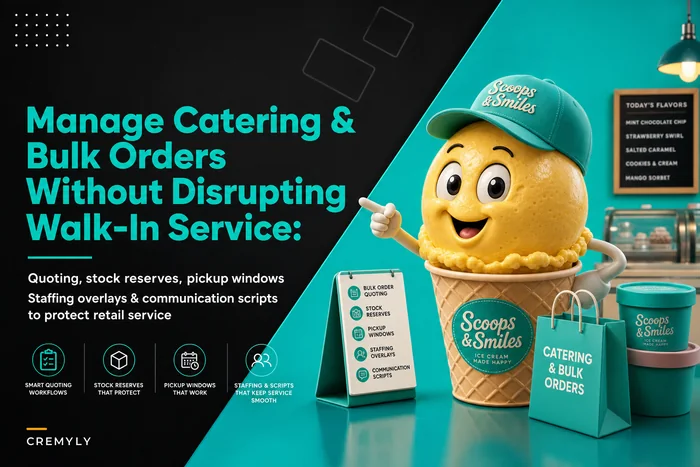
Delivery is the shock absorber. It's the channel you throttle first. Turning off a flavor or pausing delivery for twenty minutes during a surge is a controlled move, not an emergency. The deeper planning side of this is covered in the piece on handling catering and bulk orders without disrupting walk-in service — the coexistence rules here are the real-time extension of that.
-
Nobody accepts an order the kitchen can't honor. If catering staging isn't done, the morning catering order isn't "confirmed" yet — it's at risk, and the schedule should reflect that.
The underlying principle: decide the tie-breakers when you're calm, not when you're buried. A rush is the worst possible moment to be inventing policy.
A real scenario
A single-location shop doing roughly $9k–$11k in a good summer week added same-day pickup pints and third-party delivery on top of established weekend catering. Within a month they were comping or refunding somewhere around $250–$400 a week — double-sold flavors, pickups that weren't ready, delivery orders with missing items. Counter throughput on busy Saturdays visibly dropped because one scooper kept peeling off to bag delivery orders.
They didn't add staff. They rebuilt the flow: catering pulled to a back staging shelf every morning, confirmed pickups packed during the 2–4pm lull and moved off the service cabinet, delivery availability tied to a per-flavor floor, and a clear primary-server/fulfillment-flex split on weekends. Within about three weeks the refunds dropped to a trickle — maybe $40–$60 a week, mostly genuine quality issues rather than coordination misses. The Saturday line moved noticeably faster because the counter stopped getting hijacked by couriers.
Nothing exotic happened. They just stopped letting four channels fight over one freezer and one counter.
Same-day reconciliation checklist
Orchestration during the day is only half of it. At close, you confirm the channels actually balanced — catching leaks the same day, before they compound into a mystery variance you can't trace a week later:
-
[ ] Walk-in POS totals reconcile against cash + card settlement
-
[ ] Every delivery order marked fulfilled matches a prepared ticket (no phantom accepts)
-
[ ] All confirmed pickups were collected; any no-shows logged and inventory returned to available
-
[ ] Catering pull quantity matches what was actually portioned and sent (buffer variance noted)
-
[ ] Comps and refunds tagged by reason and channel, not lumped together
-
[ ] Reserved-but-unsold inventory moved back into the service count for tomorrow
-
[ ] Flavor stockouts logged with the time they hit (feeds next week's reorder and reservation floors)
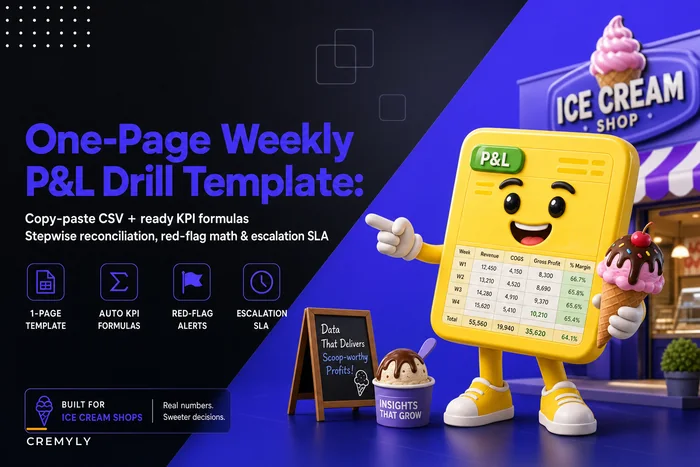
The reason-and-channel tagging matters most. "We comped $300 this week" is noise. "We comped $300, and $220 of it was delivery items we accepted but couldn't fulfill" is a fixable problem pointing straight at your delivery reservation floor. For tying this into your weekly numbers, the one-page weekly P&L drill template gives you a place to roll these channel-tagged variances up into margin impact.
When this full framework makes sense — and when it's overkill
When it's worth building: You're running three or more channels, catering is more than an occasional one-off, and you've already caught yourself double-selling or comping coordination mistakes. If peak-season Saturdays feel like controlled chaos, you've outgrown holding it in your head.
When it's overkill: A pure walk-in shop, or walk-in plus very occasional pre-ordered catering, doesn't need staging zones and reservation floors. Adding process to a simple operation creates overhead without a payoff. Don't build orchestration for channels you don't actually run.
Who should not bolt on delivery yet: If your counter already backs up on a normal Saturday with walk-in alone, adding delivery will make both channels worse. Fix counter throughput and staffing first. A new channel multiplies your existing bottleneck — it doesn't route around it.
Where software quietly earns its place
Most of this framework is policy and physical layout — things no app installs for you. But two pieces genuinely resist manual execution at volume: keeping a live, shared inventory count that every channel reads from, and automatically toggling flavor availability across delivery platforms when service stock drops. Those are moves a busy two-person counter can't make by hand mid-rush, and they're where an operational platform that ties your POS, pickup orders, and delivery channels to one inventory truth does real work — not by running the shop, but by holding the shared count so your staff can trust it and keep serving.
Everything else is discipline: reserve at commitment, stage anything confirmed, keep channels in their lanes, and reconcile the same day. The software is just what makes the shared count honest when four channels are all reaching for the same tub.
Bringing it together
The shops that run multiple channels without bleeding margin aren't the ones with the most staff or the fanciest tech. They're the ones that decided, in advance, how pickup, delivery, catering, and walk-in traffic share a single freezer and a single counter — and then made those decisions physical with staging zones, reservation locks, and clear counter lanes.
Margin bleed from omnichannel operations isn't caused by any one bad order. It's caused by the absence of a rule for what happens when channels collide. Build the rule set once, make reservations real on the shelf and not just in software, and reconcile daily so leaks surface while they're still small. The freezer still won't know which channel the customer came through — but your operation will.
Ready to scoop up efficiency and grow your shop?
Join hundreds of ice cream shops using Cremyly to boost productivity, reduce waste, and delight customers with faster service.