

Most resilience advice for small shops assumes one thing breaks at a time. A freezer goes down. A supplier is late. There's a heatwave. You find the relevant SOP, you execute, you move on.
Real failures don't line up like that. They stack. The heatwave that fries your compressor is the same heatwave slowing your supplier's refrigerated trucks and doubling your walk-in traffic. Now you're making three decisions at once, usually on a Saturday, usually with your best scooper calling in sick.
The problem isn't that owners lack SOPs. It's that they have no framework telling them how much to spend on the fix given what's actually in the bank. A $1,200 emergency equipment rental is a no-brainer if you're sitting on eight weeks of reserves. It's a genuinely dangerous call in late September when cash is thin and the season's winding down.
A real shop resilience playbook for ice cream operations needs one thing most don't have: a way to connect the money you have to the moves you're allowed to make, so you're not improvising financial decisions in the middle of an incident.
Why single-decision thinking fails when incidents stack
The three failure vectors scoop shops hit most often: temperature events (heat, power), supply interruptions (late deliveries, quality rejects), and labor gaps (no-shows, illness). Each has a clean playbook. The trouble starts when the response to one quietly makes another worse.
Say your freezer throws a fault mid-shift. Standard move is to consolidate product into your working units and maybe rent backup capacity. Fine. But if a supplier delay means those units are already packed with three days of extra tubs you took early to avoid a stockout, you have nowhere to consolidate. The freezer SOP assumed spare capacity that the supplier SOP already consumed.
That's the core issue. Individual playbooks are written in isolation, each assuming the rest of the business is healthy. When two or three fire simultaneously, they compete for the same three resources: freezer space, cash, and labor hours. Nobody arbitrates that competition in the moment, so owners default to whichever problem is loudest.
What tends to happen across a lot of these incidents is that the loudest problem is rarely the most expensive one. The dramatic freezer alarm gets all the attention while the quiet supplier delay — the one that'll leave you with empty display wells all weekend — gets ignored until it's too late to fix.
The resource you're actually rationing is cash
During a multi-vector incident, almost every good decision costs money, and almost every bad decision is a refusal to spend it.
Keep your ice cream shop running smoothly.
Cremyly helps you manage every order, stock level, and staff shift with precision and ease.
- Real-time inventory tracking
- Order management dashboard
- Staff scheduling & shift coordination
No credit card required
Rent emergency freezer capacity? Money. Activate a backup supplier at a worse price? Money. Call in an off-schedule staffer at overtime? Money. Pull the specialty flavors and simplify the menu so one person can run the line? That saves labor but costs revenue.
So the real question during any incident is: how aggressively am I allowed to spend right now? That depends entirely on your cash position, which swings dramatically across the season. A shop with roughly $18k in reserves in July behaves completely differently than the same shop with $6k in October.
If you haven't mapped how your cash moves through the year, the tiers below won't mean much. A solid seasonal cashflow playbook gives you the baseline — knowing that your "normal" reserve in peak season might be three times your shoulder-season number changes which tier you're actually sitting in on any given day.
Building the cash-tier decision matrix
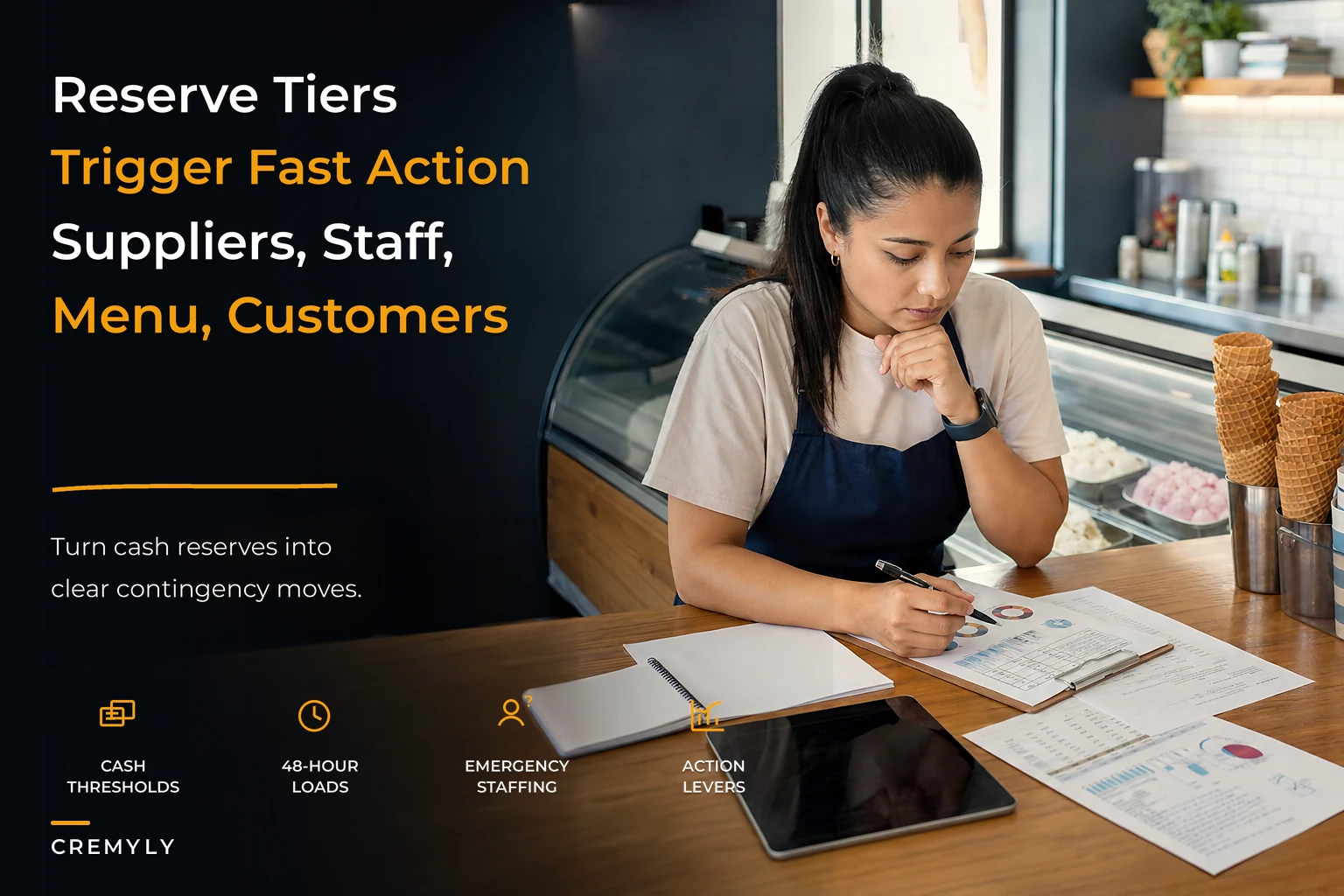
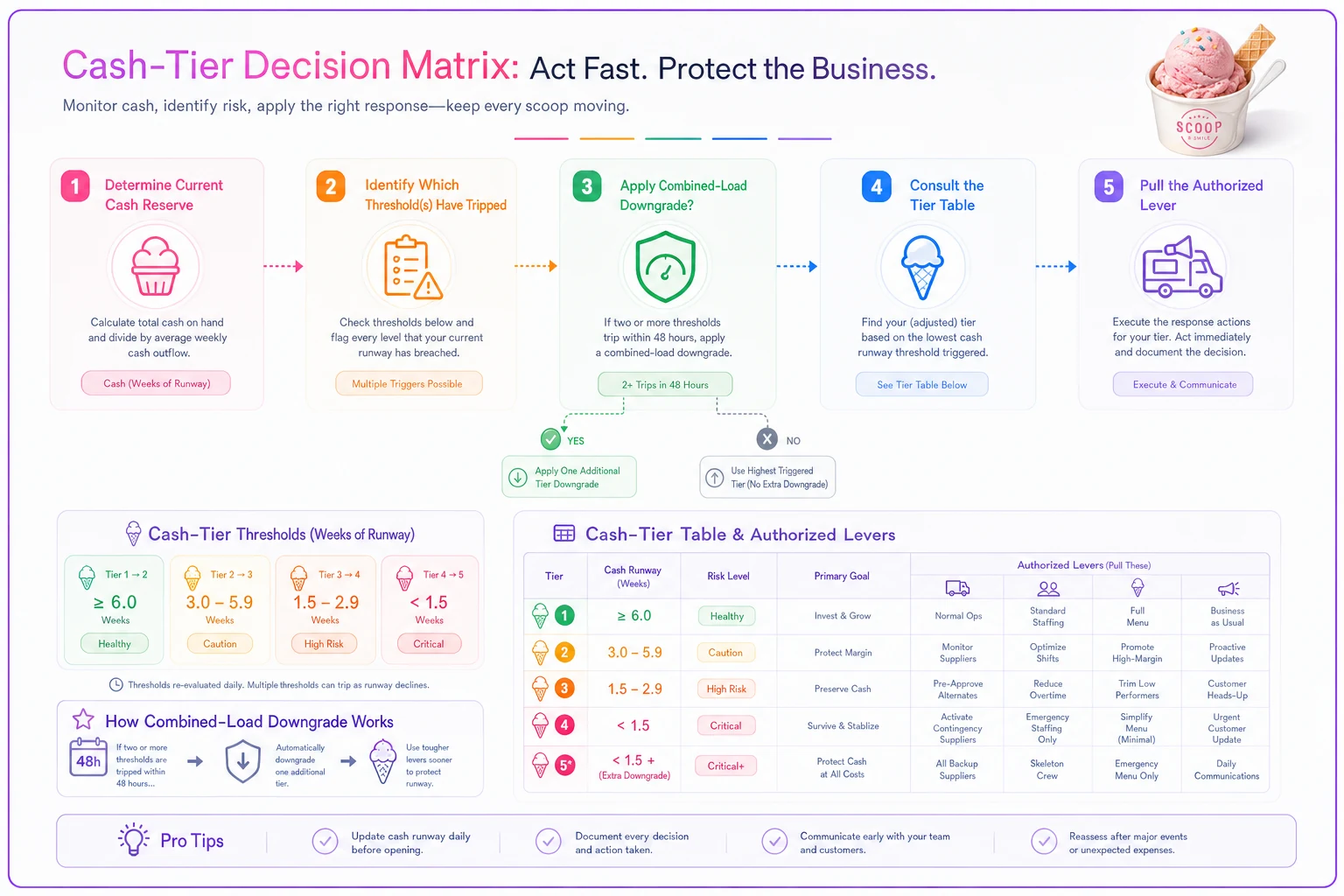
The matrix has two axes. Down the side: your current cash reserve, expressed in weeks of operating expenses covered. Across the top: the four response levers you can pull. The cells tell you what you're authorized to do at each tier without stopping to agonize.
First, define your tiers against your weekly operating cost. For a shop running roughly $9k–$11k a month in total expenses, weekly operating cost sits around $2,200–$2,600. The examples below use $2,400.
| Reserve tier | Weeks covered | Cash range (at ~$2,400/wk) | Spending posture |
|---|---|---|---|
| Tier 1 — Flush | 6+ weeks | $14,400+ | Spend freely to protect sales and product |
| Tier 2 — Comfortable | 3–6 weeks | $7,200–$14,400 | Spend to protect product; weigh revenue plays |
| Tier 3 — Tight | 1.5–3 weeks | $3,600–$7,200 | Protect product only; defer revenue spends |
| Tier 4 — Critical | under 1.5 weeks | below $3,600 | Preserve cash; accept lost sales over new spend |
Now the four levers, and how each tier handles them.
This visual shows the workflow from determining your cash-weeks to selecting the authorized lever during an incident.
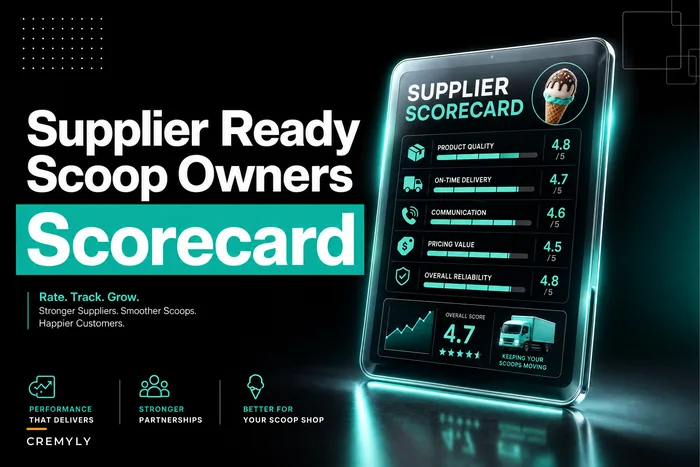
Contingency supplier activation. Your backup supplier almost always costs more per unit, or comes with minimum order quantities that force you to overbuy. At Tier 1, you activate instantly to avoid empty wells. At Tier 3, you activate only for your top five sellers and let the long-tail flavors go dark. At Tier 4, you don't activate at all — you ride it out on existing stock and simplify the menu around what you have. Having your backup already onboarded matters enormously here; trying to negotiate a cold-start supplier relationship during an incident is a disaster. If you haven't built that bench yet, a supplier scorecard and fast-backup onboarding process is the prerequisite that makes this lever usable at all.
Emergency staffing. Calling someone in at premium pay. Tier 1 and 2: do it to keep full service running. Tier 3: only if you'd otherwise have to close, and only for peak hours. Tier 4: you run short-staffed and reduce the menu instead.
Menu simplification. This is your free lever — no cash cost, saves labor and freezer load. The deeper your cash trouble, the harder you lean on it. At Tier 4, simplification isn't optional; it's your primary tool.
Customer communication. Also nearly free, and chronically underused. The right message here isn't tier-dependent in cost — it's about matching the tone to how much you're actually cutting.
Activation thresholds: what actually trips each lever
Tiers tell you how much you're allowed to spend. Thresholds tell you when a lever fires. Keep these numeric and boring so a shift manager can act without calling you.
-
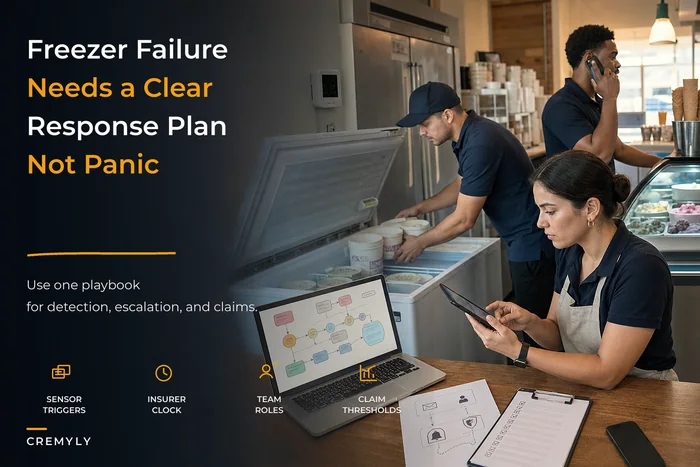
Freezer temperature threshold. Working units holding above –12°C (10°F) for more than 20 minutes trips the consolidation and backup-capacity decision. The cash tier then decides whether you rent (Tier 1–2) or consolidate and discard overflow (Tier 3–4).
-
Supplier delay threshold. A delivery confirmed as 24+ hours late trips the contingency supplier evaluation. You check projected stockout against the delay: if any top-five flavor runs out before the new ETA, the lever fires — subject to tier.
-
Staffing threshold. Any shift dropping below your minimum safe count — typically two people during peak, one during slow hours — trips the emergency staffing or menu-simplification decision.
-
Combined-load threshold. This is the one most shops miss
when two or more thresholds trip within the same 48 hours, you drop one full tier in your posture automatically. Stacked incidents burn cash faster than the sum of their parts, so you treat yourself as poorer than you are. A Tier 2 shop hit by freezer and supplier problems behaves like Tier 3.
That last rule is the whole point of thinking in a matrix instead of separate SOPs. It's the arbitration layer that single-vector playbooks simply don't have.
Worked example: the triple-vector Saturday
Mid-July, peak season, sitting in Tier 1 — Flush at around $16k in reserves.
Friday night, a heatwave pushes ambient temps past 100°F. Saturday 11am, one of your three display freezers throws a compressor fault and starts climbing — hits –9°C within 25 minutes. Temperature threshold tripped. Same morning, your dairy supplier emails that Saturday's delivery is pushed to Monday — a 48-hour slip. Supplier threshold tripped. And your opening scooper texts that she's out sick, dropping your peak shift from three to two. Staffing threshold tripped.
Three thresholds, same 48-hour window. Combined-load rule fires: you drop from Tier 1 to Tier 2 posture. You're still allowed to spend to protect product, but you're more careful about pure revenue plays.
Here's how the levers resolve:
-
Freezer Consolidate the faulting unit's product into your two healthy freezers. But the heatwave means those units are working harder and have less thermal headroom. You rent a backup chest freezer — a local party-rental place has one for about $85 for the weekend. At Tier 2, protecting product, this is easy. The faulting unit held roughly $900 of product. An $85 rental to save $900 isn't a decision, it's reflex.
-
Supplier The Monday delay means you'll run out of your two bestsellers (vanilla, cookies-and-cream) by Sunday afternoon based on peak-season draw of around 11–13 tubs per day combined. Your backup supplier can deliver Sunday morning but with a 6-tub MOQ per flavor at roughly 15% higher cost. At Tier 2 you activate — but only for those two flavors, not the full order. Extra cost: around $40–$55 over normal pricing. Worth it against a full weekend of empty bestseller wells.
-
Staffing Down to two people on a heatwave Saturday with lines out the door. You could call in your backup at overtime — roughly $110 for the shift. But you're in Tier 2 posture now, and you have a cheaper lever: menu simplification. Pull four hand-dipped specialty flavors and your two most labor-intensive sundaes, cutting the line menu from about 18 items to 11. Two people can now run the counter at speed without the extra hire. You saved the $110 by spending nothing.
-
Communication Simple sign, quick social update. Script below.
Net incident cost: roughly $125–$140 in direct spend ($85 freezer rental plus ~$50 supplier premium), zero in emergency labor, doors open, bestsellers stocked through the busiest weekend of the month. The combined-load downgrade is what stopped the reflexive $110 staff spend when a free lever got the job done.
Now run the same incident in late September. Tier 3 — Tight, around $5k reserves. Combined-load rule drops you to Tier 4 posture. Different shop entirely:
Freezer: consolidate, but skip the rental. Discard whatever overflow you can't fit — maybe $150 of product written off — rather than spend cash on capacity you'll barely use in slow season.
Supplier: do not activate the backup. Let the bestsellers run dry Sunday and lean on whatever's in stock.
Staffing: no emergency call-in. Run two people, simplify the menu hard — down to maybe 8 items.
Communication: a more apologetic, expectation-setting message, because you're visibly cutting more.
Same three failures. Completely different response — correctly — because the cash tier changed what you could afford to do.
Customer-communication scripts by severity
This is the lever owners neglect because it feels soft. It isn't. A well-timed honest note converts a frustrated customer into a sympathetic one, and it costs essentially nothing regardless of your cash tier.
Light touch (menu trimmed, bestsellers available):
> "Heads up — we've streamlined today's menu to keep lines moving fast in this heat. All your favorites are here, just a shorter list than usual. Thanks for your patience!"
Moderate (some flavors out, service slower):
> "We're running a lighter menu today due to a delivery delay and the heatwave. A few flavors are temporarily out, but we're fully scooping everything that's listed. Scoop's still cold, we promise."
Heavy (significant outages, hours cut):
> "Transparency time: a supply delay plus equipment trouble means we're on a reduced menu today and may close early if we sell through. We'd rather serve you a great scoop of what we have than stretch thin. Back to full strength by [day]. Thanks for sticking with us."
The pattern: name the cause briefly, state what's still available, give a recovery date when you can. Never over-apologize for a trimmed menu on a 100-degree day — customers understand heat.
Where owners get the matrix wrong
A few failure patterns come up once shops actually try to run something like this.
-
They set tiers once and never update them. Reserve tiers expressed in weeks-covered are stable, but your dollar thresholds shift as costs rise. Re-check the cash ranges each season.
-
They skip the combined-load downgrade. It feels pessimistic to treat yourself as poorer during a multi-incident. It isn't — stacked incidents genuinely burn cash faster, and the downgrade stops you overspending early and getting caught flat when things drag on longer than expected.
-
They don't pre-authorize shift managers. If every lever requires an owner phone call, the matrix is useless during the exact moments it's meant for. Write the tier and threshold rules on a laminated card by the office. Your manager should be able to pull the freezer-rental trigger at Tier 1–2 without you.
-
They treat menu simplification as a last resort. It's your cheapest, fastest lever. In most stacked incidents it should fire first, before you spend a dollar on staff or capacity.
It's your cheapest, fastest lever. In most stacked incidents it should fire first, before you spend a dollar on staff or capacity.
How this connects to the rest of your operation
The decision matrix isn't a standalone document — it's the arbitration layer that sits on top of your existing playbooks. Your freezer-fault SOP still tells you how to consolidate and when to call the technician; the matrix just decides whether you're also renting backup capacity. If your freezer response layer isn't solid underneath, the matrix has nothing to arbitrate. The groundwork in a proper freezer resilience playbook with risk registers and insurer triggers is what the temperature-threshold cells actually point to.
Same with supply and cashflow. The matrix assumes you have a backup supplier ready and that you know your weekly operating cost cold. Those come from work you do in calm weather, not during an incident. Shops that handle stacked failures well aren't improvising — they built the component playbooks months earlier and spent the incident simply reading cells off a grid.
That's the shift that makes a shop resilience playbook for ice cream operations actually hold up under pressure: you stop treating each crisis as a fresh problem requiring judgment, and start treating it as a lookup. Cash tier, threshold tripped, combined-load check, pull the authorized lever. The judgment happened when you built the matrix. The incident is just execution.
A short real scenario
A single-location shop in a beach town, roughly $320k annual revenue, kept getting hammered by summer power-and-heat events — three in a bad July. Before the matrix, every incident was an owner-on-the-phone scramble, and they'd defaulted to the expensive move every time: emergency staff plus freezer rental plus full backup supplier orders, because panic says spend. Over that July, those reflexive responses ran close to $1,400 in avoidable premium spend, much of it in overtime they didn't actually need.
They built a four-tier card the following off-season and wrote the combined-load rule into it. The next summer hit them with a comparable run of incidents. Direct incident spend dropped to around $500–$600 across the season — mostly because menu simplification fired first and killed most of the reflexive overtime, and because the combined-load downgrade stopped them from activating a full backup supplier order on days where stocking two bestsellers would've covered it. Service stayed open through every event.
The difference wasn't better SOPs. It was having a rule that said, in advance, how much you're allowed to spend given what's in the bank.
Most shops already know what to do in a crisis. What they lack is a cold, pre-decided answer to how much to spend — and that answer has to be tied to today's cash, not to last month's confidence.
Ready to scoop up efficiency and grow your shop?
Join hundreds of ice cream shops using Cremyly to boost productivity, reduce waste, and delight customers with faster service.