


The hard truth about a second location is that most of what makes your first shop good doesn't live in a manual. It lives in your head, in your closer's instincts, in the fact that you personally notice when the pistachio is running low or when the line's getting long enough to open the second register. None of that transfers automatically. When owners open shop number two and just "hire good people and hope," they usually end up running two mediocre shops instead of one great one.
Scaling an ice cream shop to multiple locations is really a question of what you can replicate cleanly versus what breaks the second you're not physically there. Some things copy easily — recipes, packaging, freezer specs. Other things — judgment, pacing, the small daily corrections — don't copy at all unless you build a system for them first.
This is a map for that. Four layers you need to replicate (people, product, supply, data), a lightweight governance model so your shops don't quietly drift into becoming totally different businesses, and a 90-day checklist for actually opening the next door.
Why the second location breaks the first one
Nobody warns you about this part. The first thing that usually suffers when you open location two isn't location two — it's location one.
The pattern goes like this. Your best assistant manager, the one who could run the original shop in their sleep, gets pulled to launch the new site. Now the original is being run by someone with three months less experience, and you're spending most of your time at the new place because it needs you more. Sales at the original dip somewhere around 6–10% over the first couple months. Waste creeps up because the FIFO discipline you enforced by walking the freezer every morning isn't happening anymore.
What shows up across a lot of small food businesses is that the founder is basically invisible infrastructure. You're the demand forecaster, the escalation path, the culture, the quality control, and the person who fixes the POS when it freezes. A single shop hides all of that because you absorb it in person. The second location forces every one of those hidden jobs to become either a defined role or a written process. If it doesn't, the work doesn't disappear — it just gets done badly, or not at all.
So before getting into layers and checklists, the real prerequisite: can the original shop run for two full weeks at target numbers without you setting foot in it? If not, you're not ready to replicate. You'd just be replicating your own absence.
The four-layer replication map
Think of a shop as four stacked systems. Each one replicates differently, and each one fails differently at scale.
Keep your ice cream shop running smoothly.
Cremyly helps you manage every order, stock level, and staff shift with precision and ease.
- Real-time inventory tracking
- Order management dashboard
- Staff scheduling & shift coordination
No credit card required
| Layer | What it actually is | How hard to replicate | Where it breaks at scale |
|---|---|---|---|
| People | Hiring, training, shift leadership, culture | Hardest | New site has no bench, no local leader |
| Product | Recipes, portioning, presentation, menu | Easiest to document, hard to keep consistent | Flavor and scoop size drift between shops |
| Supply | Ordering, par levels, vendors, cold chain | Medium | Two shops competing for the same delivery windows and MOQs |
| Data | POS setup, tagging, reporting, daily numbers | Medium, but usually ignored | You can't compare shops because they log everything differently |
The order matters. Most owners obsess over product — it's the fun part — and completely ignore data, then wonder why they can't tell which location is actually profitable. Let's go layer by layer.
Layer 1: People — the layer that decides everything
You cannot open location two without a location-one bench. This is the non-negotiable.
About six months before a new site opens, you should be over-hiring at your existing shop on purpose. Not wildly — just enough overlap per shift so you're always developing a shift lead who's slightly ahead of where they strictly need to be. The goal is that when you open the new door, you can move a proven person into it and backfill behind them with someone you've already been developing.
A common mistake: promoting someone to run the new shop who's never actually run your shop unsupervised. Being a great scooper is not the same skill as closing out a register that's $40 short, managing an angry catering customer, and rewriting the schedule when two people call out on a 90-degree Saturday.
-
Onboarding checklist and training sequence (documented, not verbal)
-
Shift-lead decision rights — what they can comp, discount, send home, or reorder without asking
-
The daily open/close routine
-
Your standards for pace and cleanliness
What does not replicate and needs a real leader on-site: judgment calls, culture, and reading the room during a rush.
Layer 2: Product — consistent enough that customers don't notice which shop they're in
Product feels like the easy layer because you can write recipes down. The problem isn't the recipe — it's drift. Shop two's staff scoops slightly heavier. Shop one's freezer runs a touch warmer so the texture's different. Three months in, regulars start saying "the other location is better" and you have no clear answer why.
-
Portion standardization with actual tools and checks. Same scoops, same weights, same cups. Spot-weigh scoops during a shift and log it. This ties directly into cost — if you haven't nailed your per-scoop economics yet, get that locked before you replicate, because you're about to multiply whatever margin mistake you're making across however many shops you open.
-
A single source of truth for recipes and specs. Not a binder in the back office that gets coffee spilled on it. One master spec that both shops pull from, so when you tweak a recipe it updates everywhere rather than one shop running the old version for six weeks.
The thing most people miss: consistency is worth more than peak quality once you have multiple locations. A slightly-less-amazing flavor that tastes identical at both shops builds more trust than a spectacular flavor that's hit-or-miss. Chains live and die on "it's the same every time."
Layer 3: Supply — where two shops start fighting each other
One shop, one order, one delivery. Simple. Two shops, and suddenly there are questions you never had to answer:
-
Do both shops order independently, or through a central buyer?
-
Who hits the MOQ, and who eats the shipping cost when a shop's order is too small?
-
If shop one runs short on a Friday, can it pull from shop two — and who logs that transfer?
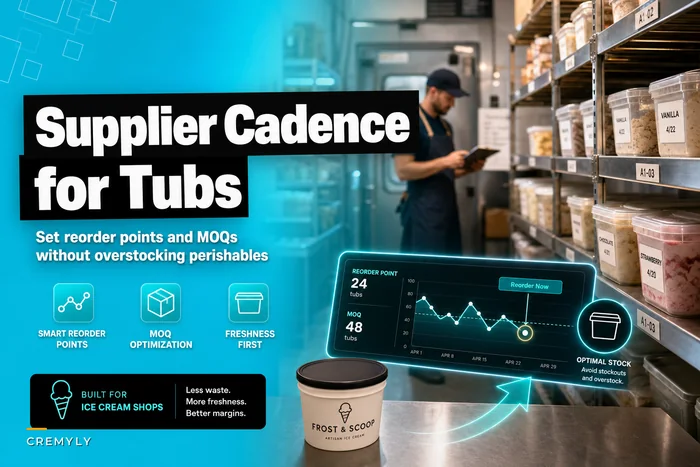
The instinct is to let each shop order for itself because it feels simpler. That works for a while and then quietly costs you money. Two shops each ordering just under a supplier's minimum order quantity means you're either overpaying or overstocking perishables at both. The fix is shared reorder logic even if the shops are technically ordering separately — consistent par levels, consistent reorder points, and some awareness of each other's stock position. Getting your supplier cadence and reorder points dialed in at a single shop first is what makes this manageable across two.
A real coordination trap: delivery windows. Your best vendor delivers Tuesday and Thursday mornings. Both shops want the early slot. Now somebody's receiving product mid-rush, or you're paying for a second delivery run. Work this out with your suppliers before opening, not after the new shop's freezer is sitting empty on a Saturday.
Layer 4: Data — the layer that tells you the truth
This is the one everyone skips, and it's the one that determines whether you can actually manage a chain or are just guessing at two shops separately.
-
POS categories and modifier structure (identical, down to the button layout if possible)
-
Waste and comp logging
-
The daily numbers each shop reports, and when
-
Your weekly P&L format
The whole point of a second location is that it becomes a control group for the first. Shop one tries a new upsell, shop two doesn't, and clean shared data tells you in two weeks whether it worked. That comparison only exists if the data layer was built to be identical from day one. Your demand-forecasting framework also gets sharper with two data sets — weather and seasonality patterns show up more clearly when you've got two locations confirming or contradicting each other.
Run a quick POS-and-waste audit for the first two weeks after opening to catch tagging drift before it skews your comparisons.
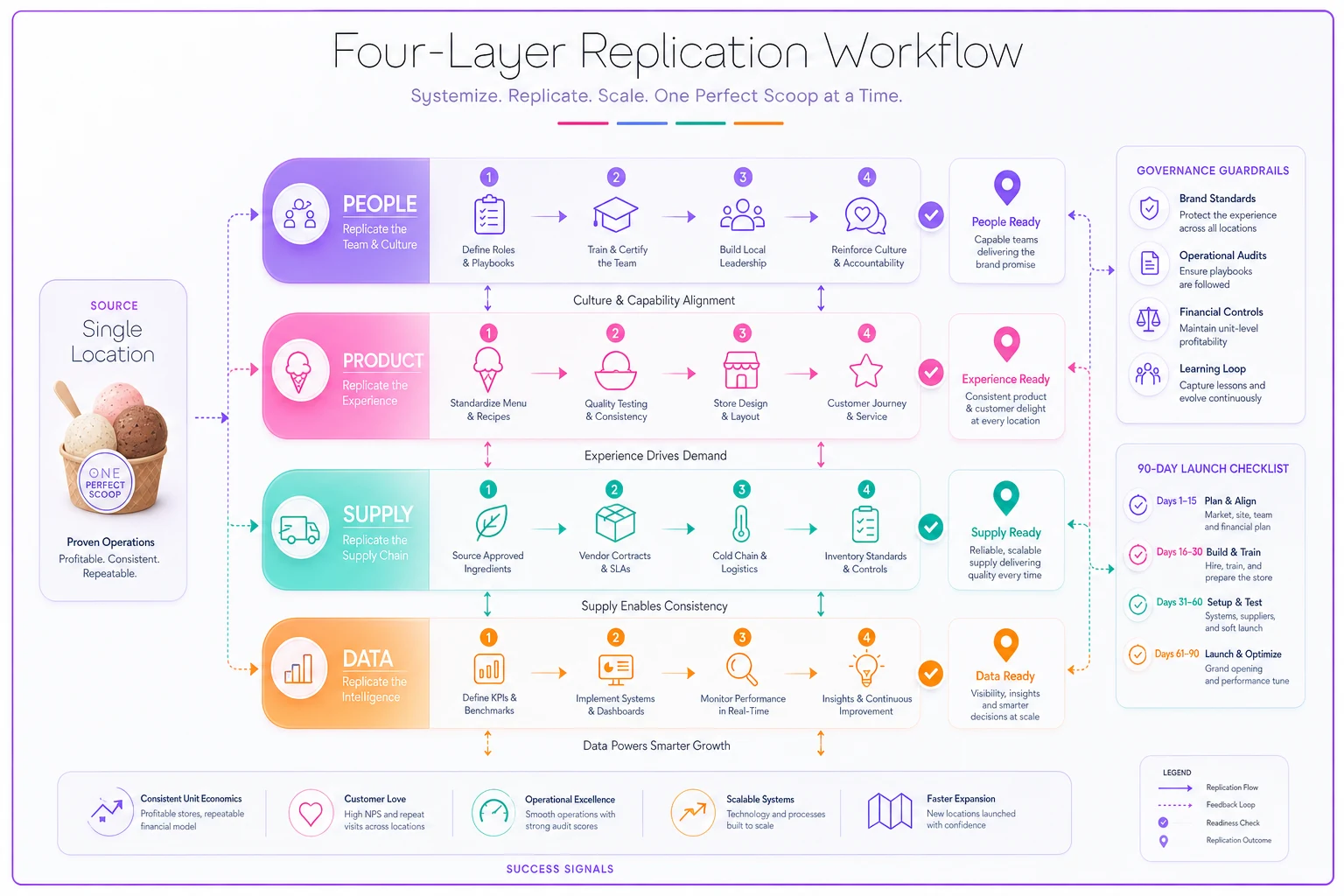
A quick visual like this helps you see where to add controls and checks as you operationalize each layer.
Governance: the minimal shared-service model
Most small chains go wrong in one of two directions. Either they centralize nothing — two shops that share a logo and not much else, drifting apart every month — or they build a bloated head office with a bookkeeper and an "operations director" when they have exactly two locations doing a combined $900k a year. Both are mistakes.
For two to four locations, you want a minimal shared service: a small set of things handled centrally, and everything else pushed to the shop level.
Centralize these (they benefit from being identical everywhere):
-
Recipes and product specs
-
Purchasing standards and vendor relationships
-
Brand, pricing, and menu
-
Data standards, reporting formats, and the weekly P&L review
-
Hiring standards and the training program
Keep these local (they need someone on the ground):
-
Daily scheduling and shift management
-
Local staffing decisions
-
Day-to-day inventory counts and reorders within set pars
-
Customer service and in-the-moment calls
-
Local marketing and community presence
The governing principle: centralize the standard, decentralize the execution. Head office — which at two shops is probably still just you plus a spreadsheet — decides what good looks like. The shop figures out how to hit it today.
A clean way to draw the line is a decision-rights list. Write down explicitly what a shop lead can decide alone, what needs a heads-up, and what needs approval. Example: a lead can comp up to $25 and send someone home early on a slow night without asking. A lead needs approval to change a vendor, adjust a price, or hire someone new. Ambiguity here creates either bottlenecks — everything routes through you — or chaos, where everyone freelances.
This is also where a shared operations platform earns its keep, not as a transformation, just as the plumbing. When both shops log sales, waste, and daily numbers into the same system with the same structure, the weekly comparison happens almost automatically instead of you rebuilding two spreadsheets by hand every Sunday night. The value isn't the software being clever — it's that you stop being the manual integration layer between two locations. The same idea shows up in aligning inventory, scheduling, and daily P&L at a single shop — it just matters more when there are two sets of numbers that need to line up.
The 90-day new-site checklist
Ninety days out is the realistic window to open a second scoop shop without scrambling. Here's the sequence, roughly by phase.
Days 90–60: Foundation
-
Confirm the original shop can run without you for two straight weeks at target numbers. If it can't, pause.
-
Identify and confirm your on-site leader for the new shop — someone already proven at shop one.
-
Start backfilling behind that leader at the original shop.
-
Finalize the lease, permits, and buildout timeline. Build your local compliance and permit checklist into the calendar early — inspections are the most common reason openings slip.
-
Lock recipes and product specs into a single shared master.
Days 60–30: Systems
-
Set up the new POS to exactly mirror the original — same categories, modifiers, tagging.
-
Negotiate delivery windows and MOQs with vendors for both shops at the same time.
-
Set par levels and reorder points for the new site (start conservative; you'll adjust).
-
Order equipment and confirm freezer and cold-chain specs match your standard.
-
Begin hiring for the new shop; schedule training at the original location so new hires learn from a working shop, not an empty one.
Days 30–0: Load and launch
-
Run new-shop staff through real shifts at location one.
-
Do a full soft-open and dry run — full menu, full workflow, no public.
-
Stock initial inventory based on conservative forecasts, not optimism.
-
Confirm the daily reporting flow works from day one, both shops reporting into the same format.
-
Set your first 30-day review date before you open, so it actually happens.
The template you want behind this: a one-page opening tracker with each item, an owner, a due date, and a red/yellow/green status. Boring — and it's the single thing that keeps an opening from turning into a fire drill.
A real scenario
A family-run shop doing roughly $520k a year at one location decided to open a second across town. First attempt, no real system — they moved their best lead to the new site, hired fast, and both shops ran on separate spreadsheets.
First-quarter results: the original shop's sales slid about 8% because the bench wasn't there to cover the gap. The new shop over-ordered perishables for two months straight and threw out a painful amount of product before par levels settled. Worst part — because the two shops tagged sales differently, the owners spent weeks unable to tell whether the new location was actually underperforming or just recording things in a different format.
They reset around the four layers. Standardized POS tagging so both shops reported identically. Built shared reorder logic instead of two independent ordering habits. And critically, they stopped pushing forward until the original shop had run two full weeks without the owner on-site.
By the following season the second location was landing within a few points of the original's margins, and the original had recovered its dip. Not a miracle — just the difference between replicating a system versus replicating a person.
When this makes sense — and when it doesn't
Do it when: your original shop is genuinely profitable (not break-even), it runs without you for weeks at a time, you've got a proven leader ready to move, and your numbers are clean enough to compare across shops. A second location amplifies whatever your first shop already is. If shop one is a well-run system, you're amplifying strength.
Don't do it when: shop one only works because you're there, your margins are thin or unclear, or you're expanding to escape a problem at the first location rather than because it's actually thriving. Opening a second location to fix a struggling first one is one of the faster ways to lose both.
Who should probably wait: anyone who can't answer, off the top of their head, what their per-scoop cost and weekly waste percentage are. If you don't know your numbers cold at one shop, two shops will just double the fog.
Bringing it together
Scaling to multiple locations isn't about doing your first shop again somewhere else. It's about pulling the systems out of your head and your habits and making them stand on their own — people you've actually developed, product that stays consistent across every counter, supply that two shops coordinate instead of quietly fighting over, and data clean enough that each location makes the other one smarter.
Get those four layers replicable, keep the shared service minimal but real, and the second location stops being a gamble on whether lightning strikes twice. It becomes the first proof that you built something that works whether or not you're standing behind the counter — which was always the point.
Ready to scoop up efficiency and grow your shop?
Join hundreds of ice cream shops using Cremyly to boost productivity, reduce waste, and delight customers with faster service.