


The hardest thing about running a scoop shop isn't cream costs or freezer bills. It's that your labor demand swings by 300–400% depending on the weather, and most shops try to manage that swing with the same hiring approach they'd use for a shop with steady year-round traffic.
That mismatch is where the pain lives. A shop doing $1,800 on a random Tuesday in April might do $6,500 on a Saturday in July. You can't staff for both with a fixed roster, and you can't just throw warm bodies at the counter in summer and hope quality holds. What you end up with, for most shops, is a summer where half the staff are undertrained and overwhelmed, and an off-season where you're overpaying to keep people you can't fully use.
So this isn't a "how to hire seasonal workers" post. It's about building a people system — one that flexes with demand, keeps quality intact when you triple your headcount, and doesn't collapse the moment your best summer lead quits in August. Four parts hold it together: role clarity, a float pool, tip and incentive rules, and a retention plan for the first 90 days.
Why Seasonal Staffing Breaks (And It's Not Because You Hired Badly)
Most owners assume their staffing problems come from bad hires. Sometimes that's true. But when you look at what actually breaks across scoop shops during a season, the failures are structural, not personal.
Here's the pattern. In May you're running lean — maybe four people who each do a bit of everything. Everyone knows the freezer layout, everyone can close, everyone reads the regulars. Then June hits and you double the team. Now you've got a roster where three people are veterans and five are two weeks in. The veterans get buried covering for the new folks. Line speed drops. Portion consistency slips because nobody had time to train weights properly. And your labor cost as a percentage of sales somehow goes up even though you're busier than ever.
The core issue is that most shops scale headcount without scaling structure. When you had four people, you didn't need role definitions — everyone just knew what to do. At twelve people, the absence of defined roles becomes an invisible tax on every shift. Nobody's technically responsible for restocking cups, so the line runs dry. Nobody owns sample-station discards, so waste creeps. The veterans absorb all of it until they burn out.
The second failure point is timing. Seasonal shops tend to hire in a panic — the first heat wave hits, the line's out the door, and you're onboarding people mid-rush. That's the worst possible moment to teach anyone anything. What breaks isn't the hire; it's that you never built a system that lets someone become useful in their first three shifts instead of their third week.
Part One: Role Definitions and a Competency Ladder
The first fix is boring but it fixes half of everything: define what each role actually does, and build a ladder people can climb.
Keep your ice cream shop running smoothly.
Cremyly helps you manage every order, stock level, and staff shift with precision and ease.
- Real-time inventory tracking
- Order management dashboard
- Staff scheduling & shift coordination
No credit card required
At a small shop you don't need a corporate org chart. You need four or five clear roles that map to real tasks. Here's a version that works for most single-location scoop shops:
| Role | Core Responsibility | Typical Pay Band | Who Fills It |
|---|---|---|---|
| Trainee Scooper | Scooping, cups/cones, basic cleaning | Base rate | First 2 weeks |
| Certified Scooper | Solo counter, portion accuracy, sampling | Base + $0.75–$1.50 | Passed weight + speed checks |
| Line Lead | Runs counter flow, coaches trainees, manages queue | Base + $2–$3 | 1+ full season, reliable |
| Shift Manager | Opens/closes, cash, staffing calls, escalations | Salary or premium hourly | Proven leads |
| Float | Cross-trained, covers gaps anywhere | Base + float premium | Flexible, fast learners |
The point of the ladder isn't the titles. It's that a new hire can see exactly what "getting better" looks like and what it's worth in dollars. When someone knows that passing their weight checks bumps them a dollar an hour and unlocks solo shifts, they train themselves. You stop being the only person pushing.
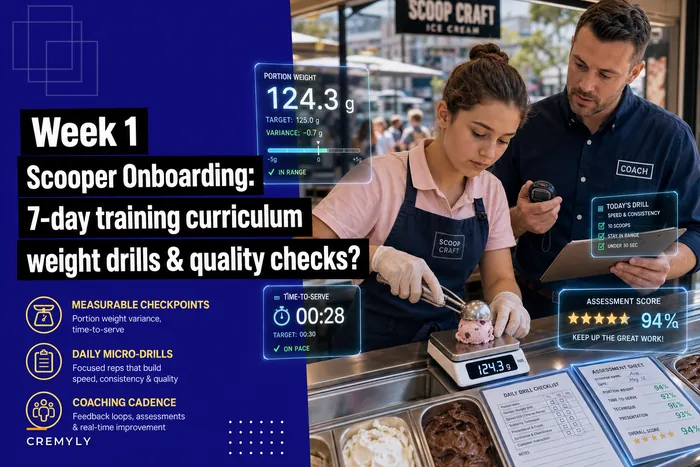
The competency part matters as much as the role part. A "Certified Scooper" should mean something specific — hitting portion weight within tolerance on ten straight pulls, running the register without help, delivering the sample script cleanly. If you've already built out your Week-1 scooper onboarding curriculum with weight drills, your certification checkpoints should tie directly to it. The onboarding teaches the skill; the ladder rewards it. Those two things should never live in separate documents.
One mistake worth flagging: don't make the ladder too tall. At a shop with eight summer staff, five rungs is plenty. I've seen owners build eight-tier progression systems that nobody understands and nobody climbs. The ladder works when it's simple enough that a 17-year-old can explain it to a new coworker in thirty seconds.
Part Two: Float-Pool Design and Two-Minute Micro-Training
The float pool is the piece most shops skip, and it's the piece that saves your season.
A float is someone cross-trained to plug into any station — counter, prep, sample bar, register — depending on where the shift is bleeding. The value isn't that they're better than a specialist. It's that they absorb the unpredictability that specialists can't. Someone calls out. The line spikes at 8 PM after a Little League game. A prep task falls behind. Floats are how you cover the chaos without over-staffing every position "just in case."
The operational reality: you can't fully cross-train people during a busy summer using long training sessions. Nobody has 45 minutes. So the training has to be broken into pieces small enough to run during a lull — the two-minute micro-module.
-
Pick one task — restocking the cone dispenser, resetting the sample station, running a refund on the POS.
-
Write it as 3–5 steps max. If it needs more, split it into two modules.
-
Demo once, watch once. Show the trainee, then have them do it while you watch.
-
Mark it off. A simple checklist per person tracks which modules they've cleared.
-
Stack them over weeks. Ten micro-modules over a month turns a counter person into a functional float.
The reason this beats a big training day is retention. When someone learns one task and does it live within the same shift, it sticks. When they sit through a two-hour orientation covering everything, they retain maybe a fifth of it. Micro-modules trade completeness for actual learning, and in a scoop shop, learning-that-sticks wins.
Shops that do this well keep a laminated card or a shared note per station listing its micro-modules. New hire hits a slow ten minutes? A lead grabs the next uncleared module and knocks it out. Training becomes a background process instead of something you have to schedule and dread.
Keep a laminated micro-module card at each station so training happens in spare minutes.
When a float pool is a bad idea
Not every shop needs one. If you're running a tiny operation with three total staff and predictable traffic, cross-training everyone informally is fine — a formal float pool adds structure you don't need. Floats also don't make sense if your pay compression is severe. If a float earns barely more than a trainee, nobody will take on the extra load and you'll just breed resentment. Build the float premium into the numbers before you build the pool.
Part Three: Tip-Pool and Incentive Governance
This is where good staffing systems quietly fall apart. You can nail roles and training and still torch morale with a tip structure nobody trusts.
The tension is simple. Your line leads and certified scoopers carry the shift. But tips at a counter shop get generated by the whole team — the person prepping, the person cleaning, the person scooping. If you pool everything evenly, your best people feel undervalued. If you pay purely by hours, the closer scrubbing machines at 11 PM feels cheated because the tips dried up after 9. There's no perfect answer, but there are governance rules that keep it fair enough that people stay.
A few principles that hold up across shops:
-
Write the rule down before the season starts. The single biggest tip-pool failure is changing the formula mid-summer. The moment people suspect the rules shift based on who's owed a favor, trust is gone and so are your best staff.
-
Weight by role, not by personality. A defensible model gives leads a slightly higher share — say, 1.2x a scooper's share — because the responsibility is real. Tie the weight to the role on the ladder, not to who you like.
-
Separate tips from incentives. Tips reward showing up and serving. Incentives reward hitting targets — low waste on a shift, upsell counts, a clean close. Mixing them makes both feel arbitrary.
-
Keep incentive metrics visible and few. One or two per shift, max. "Sample-to-cone conversion" or "melt-and-reject under X" work because staff can influence them directly. Don't incentivize things they can't control, like total sales on a rainy day.
A worked example. Say a Saturday shift generates $340 in tips across six people working uneven hours. A pure even split gives everyone around $57 regardless of contribution. A role-weighted model — two leads at 1.2 shares, four scoopers at 1.0 shares, prorated by hours — might land the leads around $68 each and scoopers around $52. That gap is small in dollars but big in signal. It tells your leads the shop notices what they carry, and it costs nothing extra because it's the customers' money being distributed more fairly.
The governance mistake that comes up constantly: owners who never explain the formula. They hand out tips and hope. When someone finally asks how it's calculated, the owner fumbles, and now that person assumes they're being shorted. Publish the math. A tip formula everyone understands, even if imperfect, beats a "generous" one that feels like a black box.
Part Four: The 90-Day Retention Playbook
You'll lose people. That's seasonal work. The goal isn't zero turnover — it's keeping the right people long enough to get a return on what you spent training them, and building a bench you can call back next May.
The math on this is worth sitting with. If it takes roughly two weeks of shifts to get a scooper certified and they quit at week five, you barely broke even on that investment. Get them to week twelve and they've paid back their training several times over — and they're now a candidate to come back next season as a lead, skipping the whole ramp. Retention isn't a soft metric. It's the cheapest labor-cost reduction available to a scoop shop.
A simple 90-day structure with metrics you can actually track:
-
Day 1–14 (Ramp) Track certification progress. Metric: percent of hires certified by day 14. Below 70%? Your onboarding or your hiring is off.
-
Day 15–45 (Settle) Track shift reliability — no-shows and late arrivals. Metric: attendance rate per hire. This is your earliest churn warning; people who start flaking at week three usually quit by week six.
-
Day 46–90 (Commit) Track advancement and hours. Metric: how many hires have cleared enough micro-modules to float or moved up a rung. People who see progress stay.
The checklist for actually running it:
-
[ ] One 5-minute check-in per hire in week two (not a formal review — just "how's it going, what's confusing")
-
[ ] Certification status reviewed weekly, not left until it's a problem
-
[ ] Attendance flagged the first time it slips, not the third
-
[ ] A clear "next rung" conversation by day 45 for anyone reliable
-
[ ] An end-of-season note logged for every keeper — who you'd rehire, and for what role
That last one gets skipped constantly and it kills you the following spring. If you don't write down who your good people were and why, you start next season from scratch. A shop that logs its keepers can call back six or eight trained staff and skip weeks of ramp. A shop that doesn't reopens with an empty bench every year.
A real scenario
A two-location shop I'll keep anonymous ran into the classic version of this. Summer headcount jumped from about six to eighteen across both stores. Labor cost hit roughly 34% of sales at peak — high for scoop shops — and quality complaints on portion sizes climbed. Turnover was brutal; they figured they retrained the same counter positions three or four times over a single summer.
They didn't fix it with a new hiring push. They fixed it with structure. Defined five roles, tied certification to existing weight drills, built about a dozen micro-modules per station, and published a role-weighted tip formula on day one. They also started the week-two check-ins and logged keepers at season end.
The next summer wasn't perfect, but labor settled closer to 28–29% of sales at peak, portion complaints dropped noticeably, and — the part that mattered most — they called back nine trained staff in the spring instead of hiring cold. The ramp that used to eat their whole June basically disappeared. Nothing about the work got easier. The system around the work got sturdier.
How the Four Parts Actually Connect
It's tempting to treat these as four separate projects. They're not. They're one loop.
Roles define what "good" looks like. The competency ladder turns "good" into something people can climb toward and get paid for. Micro-modules are how people climb it without you running formal training during a rush. The float pool is what that cross-training produces — flexible coverage that absorbs chaos. Tips and incentives make climbing worth it. The 90-day playbook makes sure the people you invested in stick around long enough to become the bench you rehire next year.
Break one link and the others weaken. Ladder with no incentives? Nobody climbs. Float pool with no micro-modules? You can't build floats fast enough. Great training with no retention plan? You lose everyone at week five and start over. The system only pays off when all four run together.
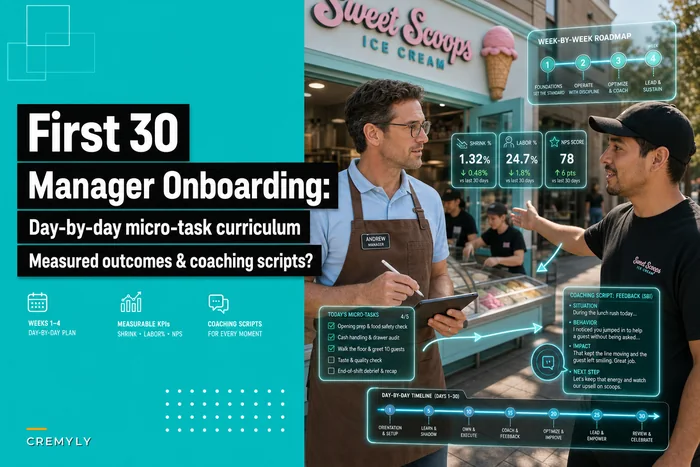
For owners thinking beyond one location, this architecture is also what makes replication possible — it's genuinely hard to scale a single scoop shop into a small chain without a people system that copies cleanly across sites. And on the management side, none of this holds together without leads who know how to run it, which is why your manager onboarding process has to teach the system, not just the shift.
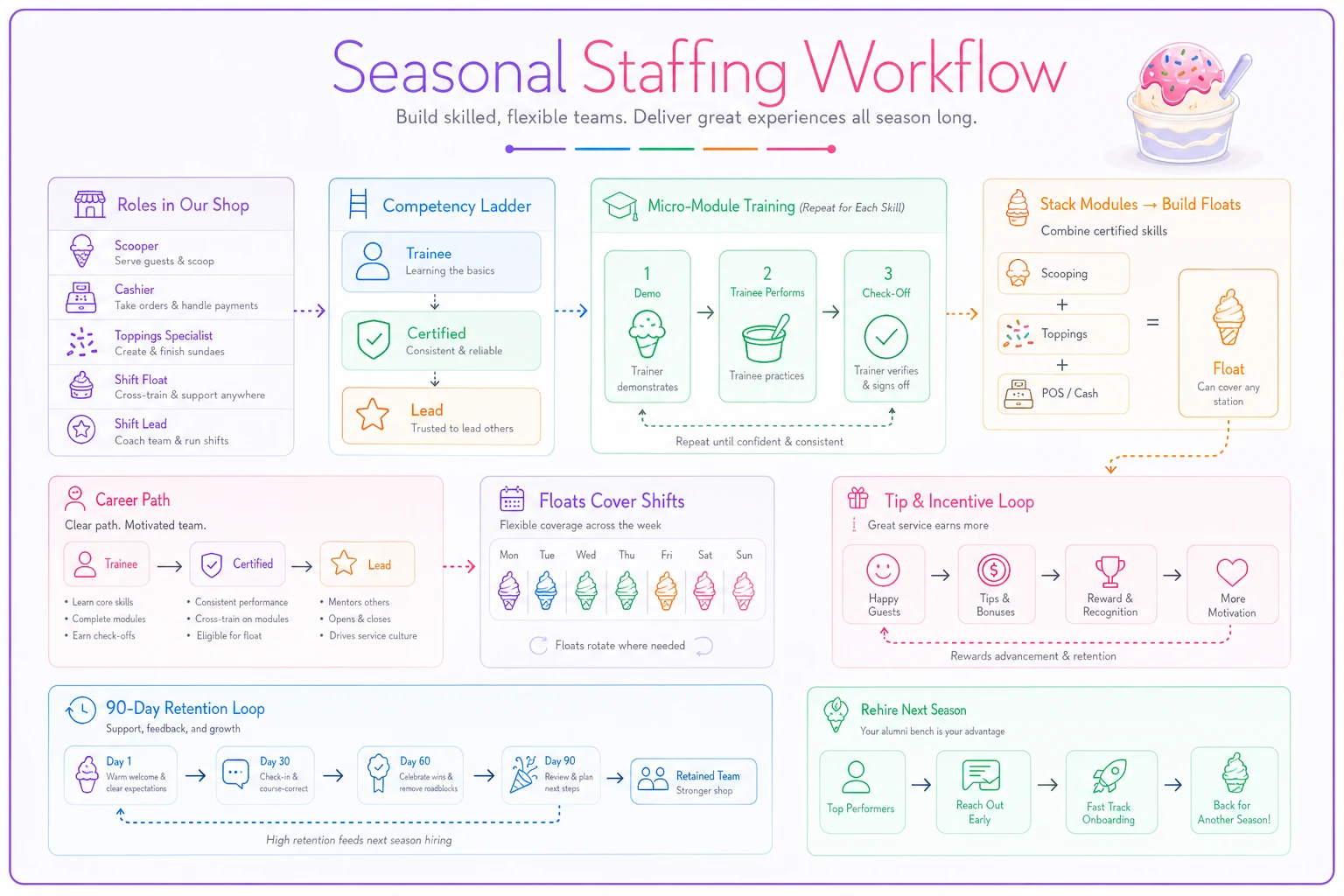
This flow highlights how each element feeds the next to form a resilient seasonal staffing system.
The Takeaway
Seasonal staffing at a scoop shop isn't a hiring problem you solve every spring. It's a system you build once and refine every year. The shops that struggle treat each summer as a fresh emergency — panic-hire, overload the veterans, watch quality slip, lose people, repeat. The shops that don't struggle have quietly built the four pieces: clear roles, fast cross-training, fair tips, and a retention plan that turns this year's hires into next year's bench.
Start with roles and the ladder, since everything else hangs off them. Add micro-modules the first slow week you get. Publish your tip math before the season, not during. And log your keepers before you close for the year. None of it is complicated. It's just structure — and structure is exactly what disappears when the line gets long and you never built it in advance.
Ready to scoop up efficiency and grow your shop?
Join hundreds of ice cream shops using Cremyly to boost productivity, reduce waste, and delight customers with faster service.