


Most single-location scoop shops treat partnerships the way they treat the weather: react when it shows up, scramble when it doesn't. A nearby brewery asks for a collab batch in July. The elementary school PTA emails three days before a fundraiser. A gym owner wants to "do something together" with no real plan behind it. Each of these is a real opportunity, and most of them get handled badly — not because owners don't care, but because there's no repeatable structure sitting underneath the yes.
The shops that actually make money off local partnerships aren't more charming or better connected. They've just decided in advance which types of partnerships they'll run, when those partnerships land on the calendar, and what each one has to clear financially before it gets a green light. That's the whole game. Below is a plug-and-play cadence built around four partnership channels that single-location shops can realistically sustain, plus the margin, staffing, and contract checks that keep each one from quietly eating your season.
Why ad‑hoc partnerships leak money
A partnership isn't free marketing. It's a mini-operation with its own COGS, its own labor load, and its own failure points. When you say yes to a fundraiser night without checking the calendar, you've just committed your two best scoopers to a 40% busier Tuesday at a discounted margin — and you probably didn't staff for it.
The pattern repeats constantly: the partnership sounds like upside, so nobody runs the numbers until the P&L comes in soft at month-end. A typical example — a shop does a "give-back night" with a local school, agreeing to donate 15% of sales. Turnout is great, revenue spikes maybe 30% for the night, and the owner feels good. Then you back out the donation, the overtime for the extra scooper, and the fact that most of the crowd ordered your highest-COGS sundaes, and the night actually netted less profit than a normal quiet Tuesday. The event wasn't a mistake. Running it without guardrails was.
What breaks isn't one bad event. It's the absence of a system that tells you, before you commit, whether a given partnership type is a margin builder, a break-even brand play, or a loss you're choosing on purpose. Those are three legitimate categories. The problem is treating a loss-on-purpose event as if it were a margin builder, then wondering why the summer felt busy but the bank account didn't.
The four channels worth building a year around
Not every partnership deserves a slot. The ones that repeat well for a single location share three traits: they're local, they're low-coordination once the template exists, and they pull in a customer you can win back later. These four cover most of what a scoop shop can realistically sustain across a year without burning out the owner.
Keep your ice cream shop running smoothly.
Cremyly helps you manage every order, stock level, and staff shift with precision and ease.
- Real-time inventory tracking
- Order management dashboard
- Staff scheduling & shift coordination
No credit card required
1. Food & beverage neighbors (breweries, coffee roasters, restaurants). Cross-promotions, collab flavors, "dessert course" supply deals. These tend to carry the best margin because you're often selling wholesale pints or a branded flavor rather than discounting your own counter.
2. Schools, sports leagues & youth groups. Fundraiser nights, team party packages, end-of-season celebrations. High volume, high goodwill, thinner margin. These are relationship investments that pay back over multiple seasons if you capture contact info.
3. Local employers & offices. Catering drops, cart service for company events, standing "treat Friday" orders. This is the quietest channel and often the most profitable per labor hour because it's scheduled, batched, and paid promptly.
4. Community events & markets (festivals, farmers markets, block parties). Brand exposure and new-customer acquisition. Margin varies wildly depending on booth fees and staffing. Treat these as acquisition spend, not profit centers, and measure them that way.
The mistake owners make is chasing all four in the same month because opportunities don't arrive evenly — they clump in May and June. The calendar below spreads them out so your labor and your freezer capacity don't collide.
A simple year cadence you can copy
Here's a quarter-by-quarter rhythm that keeps one channel "active" at a time while the others sit in prep or dormant. The point isn't to run everything constantly. It's to always have one partnership engine warm without overlapping the labor-heavy ones.
| Quarter | Primary channel | Secondary / prep | Why this timing works |
|---|---|---|---|
| Q1 (Jan–Mar) | Local employers & offices | Line up F&B collabs for spring | Slow walk-in season; office orders are weatherproof and keep cashflow steady |
| Q2 (Apr–Jun) | F&B neighbors (collab flavors, wholesale pints) | Confirm summer event calendar | Patios reopen; breweries and restaurants want dessert tie-ins before peak |
| Q3 (Jul–Sep) | Community events & markets | Schedule fall fundraisers | Peak foot traffic; acquisition events have the biggest audience |
| Q4 (Oct–Dec) | Schools, sports & youth groups | Renew office catering for holidays | Season winding down; goodwill events backfill soft weeks |
This cadence intentionally keeps the two most labor-hungry channels — community events and school fundraisers — out of the same quarter. Running a packed farmers market booth in July and three fundraiser nights the same month is how owners end up covering shifts themselves and quietly resenting the whole program.
If your cashflow is uneven across the year — and for most scoop shops it is — this cadence should be read alongside your seasonal cashflow planning, because partnership timing is really a cashflow lever as much as a marketing one.
Margin guardrails: the number each channel has to clear
Before any partnership goes on the calendar, it clears a floor. The floors are different by channel on purpose, because they serve different jobs.
-
F&B / wholesale deals Must hold at least your normal blended contribution margin after wholesale discount. If you can't net what a counter scoop nets per unit, it's not a deal, it's a favor. Target floor: 55–60% contribution.
-
Office catering Priced to clear a minimum ticket (set yours — many shops land around $150–$200) and hit 60%+ contribution because there's almost no discounting and labor is batched.
-
School / youth fundraisers Accept a lower floor on purpose — maybe 25–35% contribution — but only if you capture something durable (emails, a repeat date, a team package). No capture, no event.
-
Community events Judge on customer acquisition cost, not margin. If the booth fee plus labor divided by new customers acquired runs under what you'd pay elsewhere to acquire one customer, it's worth it even at break-even.
The guardrail that saves the most pain is the simplest one: decide the category before you decide the event. A fundraiser judged by F&B margin rules looks like a disaster. A wholesale deal judged by "it's good exposure" logic quietly loses you money for a year. Match the yardstick to the channel.
Staffing overlays: the part everyone underbuilds
Every partnership adds labor somewhere, and it almost never adds it where the walk-in counter already has slack. A fundraiser night loads your front counter. A catering drop loads your prep hours the morning before. A market booth pulls a person out of the shop entirely for six to eight hours.
-
Scope the labor delta. Estimate the added hours
prep, service, pack-out, teardown. A market booth isn't "one person for the day," it's one person plus the pack-and-load the night before plus the unload after close.
-
Decide the source. Is this overtime, a scheduled extra shift, or you? If the answer is routinely "me, the owner," the partnership program isn't profitable — it's subsidized by your unpaid hours.
-
Protect the counter. Never pull your strongest closer to an off-site event on a peak weekend. The in-shop experience is still your core P&L; a market booth that costs you a bad Saturday at the counter is a net loss you won't see on the booth's own ledger.
-
Set a trigger for extra help. If projected partnership volume pushes a shift past your normal per-labor-hour sales target, you add a person. No heroics.
If you're repeatedly covering partnership shifts yourself, log that time as a cost — it's the clearest sign the program isn't actually profitable.
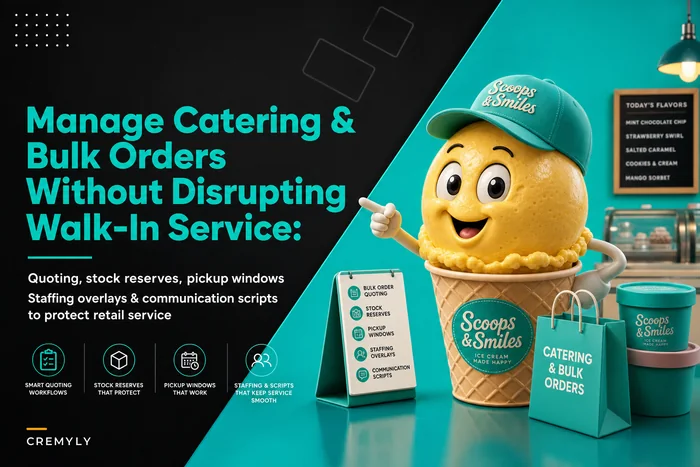
Catering and bulk orders deserve special attention here because they collide with walk-in service in ways markets don't. If offices and large team orders become a real channel for you, the mechanics of protecting walk-in service while fulfilling bulk orders — stock reserves, staffing overlays, quoting — are the difference between a profitable catering line and a chaotic counter.
The contractual and packaging checks that prevent the ugly surprises
Partnerships go wrong in boring, predictable ways: unclear quantities, who-pays-when confusion, and product that melts before it's served. A few lightweight checks kill most of it.
Before you confirm any partnership, run this list:
-
Quantity floor and ceiling. Minimum order that makes it worth prepping; maximum you can produce without starving the counter. Put both in writing, even for a friendly neighbor.
-
Payment terms. Deposit for anything custom or large. "Pay after the event" with a volunteer PTA treasurer is how you end up chasing $400 in November.
-
Cancellation window. If they cancel inside 48 hours, who eats the prepped product? Define it. Perishable inventory doesn't wait.
-
Who owns the flavor. For collab batches, write down whether it's exclusive, time-limited, and whether they can reorder. Awkward if you don't.
-
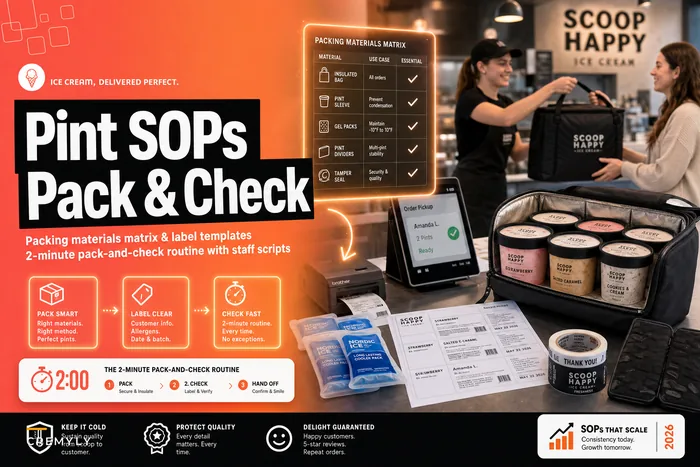
Packaging and transport spec. Match packaging to how the product travels and how long before it's eaten. Wholesale pints and off-site event packs have real cold-chain requirements, and your take-home pint packing SOPs already cover the materials and 2-minute check that keep product from arriving soft.
-
Labeling and allergen info. Any product leaving your shop needs correct labeling. A wholesale pint sitting in a brewery cooler is your liability if the allergen panel is wrong.
None of this needs a lawyer. A shared one-page terms sheet per partnership type, filled in each time, covers 90% of it. Shops that skip this don't skip it because they're careless — they skip it because the partnership felt casual. Casual is exactly when the money and the melt problems hide.
A real scenario: the brewery collab that almost didn't pencil out
A single-location shop near a mid-size brewery agreed to produce a spent-grain collab flavor, sold as pints in the brewery's cooler and as a feature scoop at the counter. The deal: 20% wholesale discount on pints, no minimum order, flavor exclusive to them.
On paper it felt like free marketing. In practice the first two weeks were ugly. The brewery ordered in dribbles — 12 pints here, 8 there — so the shop was running a specialty batch almost weekly for tiny quantities, blowing up prep labor. Contribution on those pints landed somewhere around 40% after the discount and the inefficient small batches, well under the shop's counter margin.
They fixed it with two changes, both from the checklist above. They set a minimum order of 48 pints per batch run, which let them produce efficiently and pushed contribution back up toward the high 50s. And they put the collab on a defined two-week feature window at the counter instead of running it open-ended, which created urgency and moved the higher-margin counter scoops. Over the back half of the season, the collab shifted from a roughly break-even vanity project to a channel netting a few hundred dollars a month — plus genuine new foot traffic from brewery customers who'd never visited.
Nothing about the idea changed. The guardrails changed. That's almost always where the difference lives.
When this cadence makes sense — and when it doesn't
This works well if: you have at least one reliable keyholder besides yourself, your counter operation is already stable, and you can capture customer contact info from events. Partnerships amplify whatever system you already have. A solid shop gets a real revenue channel. A shaky one gets more chaos.
Be cautious if: you're still fighting basic staffing coverage or your margins at the counter are already thin. Adding four partnership channels on top of an unstable base doesn't fix the base — it strains it further. Stabilize the core first, then layer partnerships in one channel at a time.
Who should probably skip most of this: a brand-new shop in its first season. You don't yet know your real labor costs, your peak-hour rhythms, or your true per-scoop margin. Run the counter for a season, learn your numbers, then build the partnership calendar on top of data instead of guesses.
Making the calendar actually run
The reason partnership programs fade isn't lack of ideas — it's that the follow-through lives in the owner's head and the owner is busy. The fix is making each channel a template, not a decision you re-make every time. One terms sheet per channel. One margin floor per channel. One staffing-overlay rule per channel. Once those exist, saying yes to a partnership becomes filling in a form, not reinventing the event.
A quick visual of the workflow helps cement who does what and when.
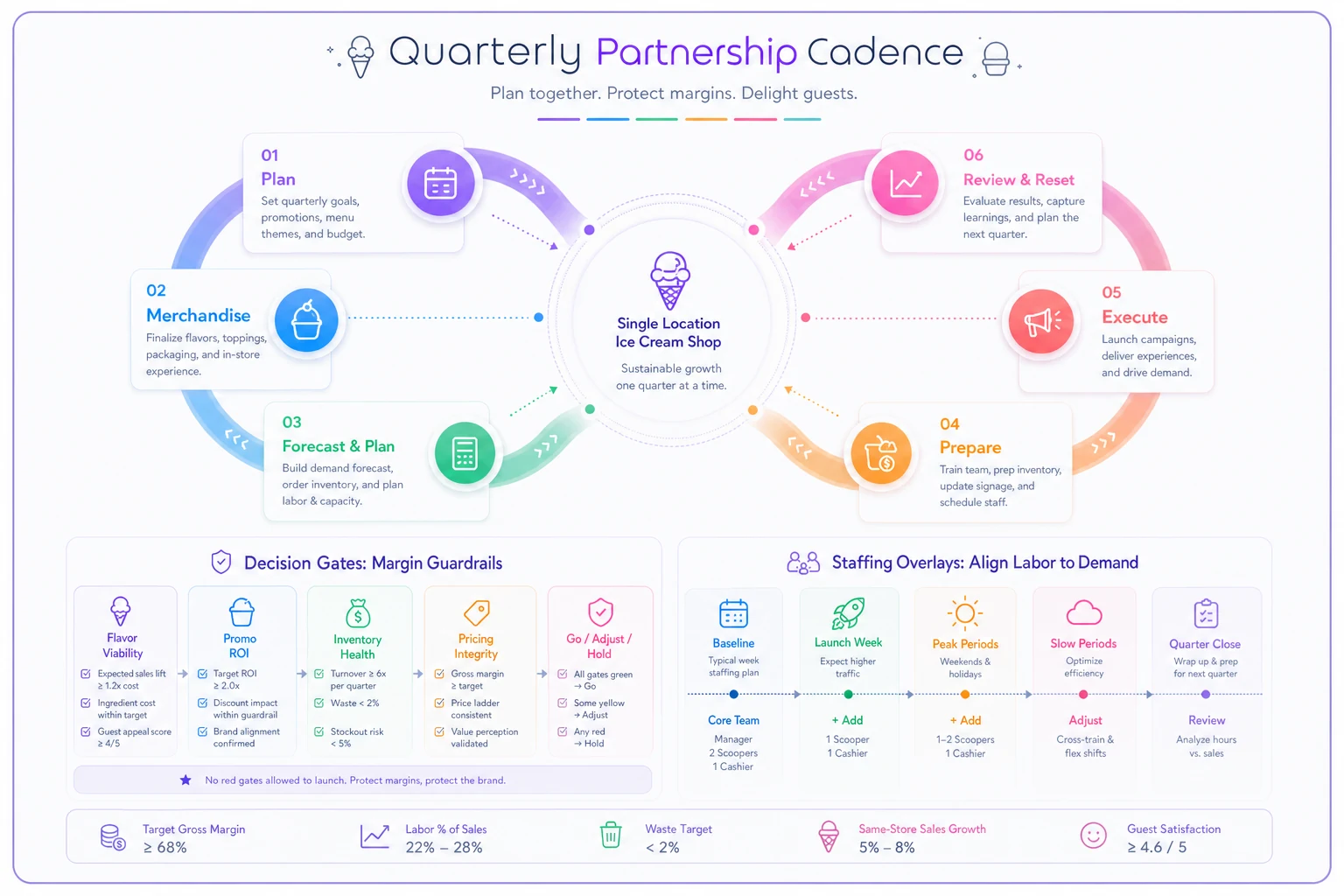
Keeping your partnership calendar, staffing overlays, and margin checks in the same operational system — rather than scattered across a wall calendar, a text thread, and your memory — quietly pays off too. When the fundraiser date, the extra-shift trigger, and the contribution floor all live together, the night before an event stops being a scramble. You see the collision coming in April, not the Tuesday it lands.
Build the four channels once. Set the floors once. Spread them across the quarters so they don't fight each other for your best people. Then let the calendar do the remembering, so the only decision left each time is whether a specific opportunity clears a bar you already set — calmly, in advance, before the yes becomes a problem.
Ready to scoop up efficiency and grow your shop?
Join hundreds of ice cream shops using Cremyly to boost productivity, reduce waste, and delight customers with faster service.